
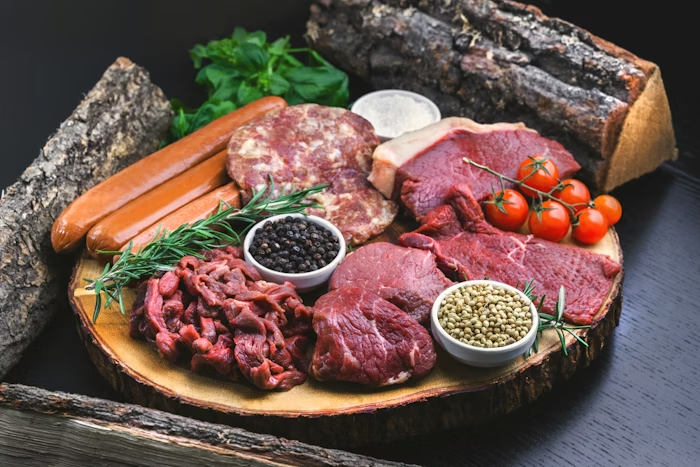
Most ranchers who try to sell meat online hit the same wall. They sign up for Shopify or WooCommerce, set up a product called “1 lb Ground Beef,” and realize two problems immediately: every package weighs slightly different, and there’s no way to charge for actual weight at fulfillment. So they either over-charge and lose trust, or under-charge and lose margin.
That’s before they get to subscription boxes, whole-animal pre-orders, halal certification, or B2B restaurant accounts. Generic platforms weren’t built for any of it. This guide covers what a real meat eCommerce setup needs to look like — and the decisions you’ll face at each step.
Why generic eCommerce fails meat producers
The core problem is that meat isn’t a fixed product. A ribeye steak at your butcher runs somewhere between 12 and 16 ounces. A ground beef package might be 0.9 lbs or 1.15 lbs off the grinder. A whole brisket could be 10 lbs or 16 lbs. Standard eCommerce assumes a SKU has one price. That assumption collapses immediately with variable-weight perishables.
There’s also the cold-chain issue. You can’t offer same-day shipping windows or block out weekends like any product — meat needs to ship Monday through Wednesday to avoid sitting in a carrier facility over the weekend. Shopify doesn’t know that. You have to build it.
Then there’s compliance. Depending on your state and whether you use a USDA-inspected processor, you’ll have different rules on what you can ship, to whom, and what has to appear on labels. Most platforms treat compliance as your problem, not theirs.
Sell-by-weight checkout: how it actually works
If you’ve ever wondered how a butcher shop could possibly run eCommerce without this, the answer is usually: they can’t, so they don’t. The ones that do have figured out workarounds — fixed-weight packs only, or pre-packaged boxes with locked contents. Both work, but they sacrifice flexibility and often margin.
A proper sell-by-weight checkout works like this:
Subscription boxes and whole-animal pre-orders
Subscription revenue is the most predictable income a meat producer can build. Customers who commit to a monthly box stick around — average LTV is roughly 3 to 4 times higher than one-time buyers. But the subscription model for meat has complications that a standard recurring billing setup won’t handle.
Monthly and quarterly box subscriptions
The simplest version: a curated box ships monthly or quarterly, auto-billed, with an option to pause or swap a delivery. The complexity is in the “curated” part. Some operations do farmer’s-choice (whatever’s in season or freshest that week), others let customers build their own box. Both require inventory logic that knows what’s available at pack time, not at order time.
Whole and half animal pre-orders
This is where most platforms completely give up. A half-beef pre-order typically involves a deposit at the time of order (say $200), customer-selected cut preferences submitted through a cut-sheet form, and a final balance charge when the animal is processed — sometimes 4 to 6 months later. The cut-sheet then needs to go to your processor in a format they can actually work with.
“We were managing whole-animal deposits in a spreadsheet and sending cut sheets by email. We lost two orders because the cut preferences got garbled. Now it all goes through automatically.
“Operations Manager, Pacific Northwest Beef Ranch
Halal and kosher certification online
For halal and kosher meat producers, certification isn’t just a badge — it’s the purchase decision. A Muslim buyer in a city without easy access to a halal butcher isn’t going to buy from an online store that just says “halal” in the product description. They want to see the certifying body, the slaughter date, and ideally a document they can pull up.
What a halal-compliant meat storefront needs:
- Certification documents attached per batch or lot, not just to the overall store
- Halal badge displayed prominently on product listings with a link to the certificate
- Multi-language support — Arabic, Urdu, Malay, French (for North African buyers) — on the storefront and in order confirmation emails
- Batch traceability so buyers can verify which slaughter date their order came from
- Appropriate payment options (some buyers prefer to avoid interest-based payment plans)
B2B wholesale and restaurant accounts
If you’re supplying restaurants, grocers, or institutional buyers, you’re running a fundamentally different sales channel from your DTC operation. Pricing is different, order frequency is different, and payment terms are different. You shouldn’t be managing this through the same storefront your retail customers use.
A functional B2B wholesale setup includes:
- Separate login for wholesale accounts with custom price lists per buyer
- Standing orders — the restaurant places a recurring order, you fulfill it on schedule, they get auto-invoiced
- Net-30 and net-60 payment terms with aging reports and auto-reminders
- Order guides — the buyer sees only the products they’re approved to purchase, at their negotiated prices
- Route planning integration so wholesale drops are on the same delivery schedule as retail fulfillment
| Feature | Perishly | Shopify | GrazeCart | Barn2Door |
|---|---|---|---|---|
| Sell-by-weight checkout | ✓ Native | ✗ Custom dev | ✓ Native | ~ Limited |
| Whole animal pre-orders + cut sheets | ✓ Native | ✗ | ~ Basic | ✗ |
USDA compliance and state rules
Compliance for meat eCommerce is genuinely complex, and the rules depend on how your meat is processed, where you’re selling, and what you’re selling. The basics:
- Interstate sales require USDA inspection. If your meat crosses state lines, it needs to be processed at a USDA-inspected facility. No exceptions.
- Intrastate rules vary by state. Many states have exemptions for direct farm-to-consumer sales under specific annual revenue thresholds. Check your state agriculture department before assuming you’re covered.
- Label requirements are non-negotiable. Safe handling instructions, inspection marks, ingredient statements (if applicable), and net weight all have specific format requirements.
- Custom-exempt slaughter limits your market. If you’re using a custom-exempt processor (common for whole-animal sales), that meat cannot be sold — only processed for the animal owner’s personal use. This is a common mistake that creates real legal exposure.
Your eCommerce platform shouldn’t make compliance harder than it already is. Systems built for perishable food can flag products that don’t meet labeling requirements, track which batch came from which inspection lot, and auto-generate required documentation.
Built for meat producers
Your online store, live in 14 days
Sell-by-weight checkout, halal certification, subscription boxes, B2B wholesale — set up and launched by our team under a flat monthly retainer. No per-subscriber fees. No surprise overages.
Getting your store live in 14 days
The 14-day timeline sounds aggressive, but it’s achievable when the platform is built for perishable food from the ground up — not adapted from a general-purpose framework.
Here’s what the setup process looks like for a typical meat producer:
- Days 1–3: Product catalog setup, pricing model configuration (fixed weight, variable weight, subscription tiers), and branding
- Days 4–6: Cold-chain shipping rules, delivery zones, blackout dates, and cut-off times for each shipping method
- Days 7–10: Payment processing setup, pre-authorization configuration, tax rules, and compliance documentation upload
- Days 11–13: B2B account setup, wholesale price lists, and standing order configuration (if applicable)
- Day 14: Test orders, soft launch to existing customer list, go live
The migration question comes up a lot. If you’re moving from an existing platform — or from a spreadsheet and a PayPal button — the data import is usually the longest part. Customer history, subscription details, and order records take more time than the storefront itself. Plan for that.
