
General retail ecommerce platforms promise one click setup, but farms hit operational ceilings within months. Here’s why platform architecture, not price, determines success.
The Problem Nobody Talks About Until It’s Too Late
A regenerative produce farm in the Pacific Northwest launched their direct to consumer store on Shopify in Q2 2025. By Q4, they were managing orders across three separate systems, the website, a spreadsheet for seasonal inventory and a delivery app that didn’t sync with either. They weren’t alone. Across implementations our research team has audited in farm direct supply chains, a consistent pattern emerges farms that launch with general retail platforms hit operational ceilings within 6 to 18 months. Not because the platform is bad, but because it was architected for CPG retail, not perishable DTC operations.
The Numbers That Matter
- 6 –18 months Typical timeline before farm operators hit operational ceilings with general retail platforms
- $30 billion Projected size of the global agricultural ecommerce market by 2025
- 40 – 60% higher Operational overhead cost for farms managing workaround systems vs. integrated farm specific platforms
- 3+ apps required Average number of add ons farms stack onto Shopify/WooCommerce to approximate core farm workflows
Key takeaways:
- Platform architecture matters more than brand or price when selling perishables directly to consumers
- Farm operations require built in variable weight pricing, not app stack workarounds
- Seasonal inventory and fulfillment coordination need automation, not spreadsheet reconciliation
The Mismatch Between Retail and Farm Operations
Here’s what distinguishes a farm from a traditional retail operation, most farms don’t sell items. They sell by variable weight, seasonal availability, and complex fulfillment logistics.
The architecture of a general ecommerce platform reflects decades of optimization around retail fixed SKUs, consistent inventory levels, predictable demand patterns, and standardized shipping methods. A Shopify store works brilliantly if you’re selling printed T-shirts or books. Every unit is identical. Every shirt in size medium weighs the same. Every book has the same shipping requirement. Scale those assumptions to perishable agriculture, and the entire framework breaks.
Farms operate on different assumptions entirely. Inventory varies by weather, season, and harvest timing. A field of strawberries exists or doesn’t exist. Processing capacity changes with labor availability. Customer demand concentrates around seasonal availability. These aren’t minor operational differences. They’re fundamental constraints that shape every decision a platform must make about how to store data, calculate pricing, manage fulfillment, and coordinate across sales channels.
A conventional online retailer thinks in fixed units, a T-shirt is a T-shirt, a book is a book. You list it, set a price, and the platform handles quantity. But a farm selling ribeye steaks, heirloom tomatoes, or raw milk doesn’t work that way.
Products vary. A cut of beef weighs a different amount each time. Tomato varieties disappear with the frost. A CSA box needs to combine what’s actually in the cooler, not what you hoped to harvest. Add processing deadlines, multiple delivery zones, and regulatory compliance for perishables, and you’re no longer in a retail playbook at all.
This seems like a small distinction until you’re trying to price a cut of beef to the quarter pound or reserve stock for a subscription when supply runs thin. That’s the moment most operators discover that general platforms assume consistent inventory, predictable orders, and standardized products. Farms assume none of those things. Most farms don’t sell items they sell by variable weight, seasonal availability, and complex fulfillment logistics.
Five Platform Failures That Derail Farm Direct Sales
Variable weight pricing, seasonal inventory, processing schedules, cold chain logistics, and multi location coordination. Each one seems manageable in isolation. Together, they expose a fundamental architecture mismatch between general retail and farm operations.
1. Variable Weight Pricing Built in or Bust
Most farm products aren’t uniform. Shopify doesn’t support variable weights natively. Farmers resort to paid apps that let you enter manual weights after packing, but the setup confuses buyers and doesn’t work for all product types. A farm selling meat, cheese, or produce by the pound needs the ability to:
- Charge by exact weight at fulfillment
- Show estimated charges at checkout that update after packing
- Include variable weight items in bundles without errors
- Enter manual weights directly for precise pricing
When these features are missing, farms end up manually adjusting invoices after orders ship, updating customers with revised totals, or building workarounds that leak into spreadsheets. According to research on farm ecommerce platform capabilities, a farm selling meat through an industry specific platform can calculate exact charges at fulfillment, update inventory immediately, and include variable weight items in bundles without the extra apps Shopify requires.
The contrast with general platforms is stark. Shopify, WooCommerce, and similar tools were engineered for retail businesses with fixed SKUs and standardized shipping. They lack the architectural foundation for agriculture’s core operational reality products that vary, seasons that shift, and fulfillment logistics that span multiple zones and delivery methods.
2. Seasonal and Batch Inventory, Automation vs Spreadsheets
Farms deal with seasonal products, batch based items, and unpredictable harvests. A strawberry farm’s homepage looks one way in June and completely different in December. Generic ecommerce platforms assume consistent inventory. The result, overselling, missed pre orders, or manual inventory shuffling that spans email, phone calls, and multiple systems.
Shopify’s inventory tools don’t account for harvest cycles or batch based production. Farms need platforms that can:
- Track detailed inventory with historical sales data
- Set out of stock thresholds to prioritize stock for subscriptions
- Automatically update availability based on harvest schedules
- Coordinate inventory across multiple pickup locations
Without these features, farms spend hours each week reconciling what’s actually available against what’s listed online. One produce operation managing 40+ SKUs across four locations and two sales channels reported spending 12 hours weekly on inventory reconciliation alone. That’s a full time employee cost buried in platform friction.
Seasonal inventory management isn’t optional for farm operations it’s the core operational challenge that distinguishes agriculture from retail. A platform that doesn’t accommodate harvest driven availability cycles forces farms into workarounds that scale poorly and introduce error at every step.
3. Processing Schedule Coordination, Deadlines and Delivery Windows
Farms have tight processing windows. Orders for Friday pickup must close by Wednesday morning to fit the production schedule. Orders for Monday delivery must be packed Sunday evening. When systems don’t coordinate automatically, farms resort to manual cutoffs, phone calls to customers who miss deadlines, and missed revenue.
Shopify provides basic scheduling capabilities, but automated deadlines, coordinated pickups, and multi location fulfillment usually require extra apps. A farm focused system should:
- Automatically close orders based on production schedules
- Manage multiple pickup and delivery windows in one calendar
- Track orders from web, POS, phone, and mobile in one system
- Record customer notes and preferences for future ordering
The lack of this coordination means farmers spend their mornings fielding calls from customers who thought they could order Tuesday when the deadline was actually Monday. It means pickup slots overflow while others sit empty. It means delivery routes get planned poorly because online orders aren’t synced with farm stand sales.
For farms managing multiple locations A single farm managing three delivery zones with different cutoff times, two on-site pickup locations, and regional wholesale orders needs unified fulfillment orchestration, not scattered apps. Each of these five failures isn’t a nice to have, it’s the difference between operational efficiency and chaos.
4. Perishable Fulfillment Logistics, Temperature, Timing, and Compliance
Selling perishables isn’t just logistics. It’s a compliance issue. USDA regulations for raw milk, PACA requirements for produce, and cold chain documentation for meat all have specific requirements. Generic platforms don’t know any of this exists.
Farms need systems that:
- Manage cold chain documentation and tracking
- Coordinate time sensitive delivery windows meat must arrive within 48 hours
- Support multiple shipping methods local delivery, regional shipping, national perishable carriers
- Track temperature compliance and generate regulatory records
When these features are missing, farms either skip documentation, rely on emails and PDFs, or build fragile spreadsheet systems that break when scale increases. Understanding cold chain logistics and compliance requirements Unlike conventional retail supply chains where temperature management is handled by third party logistics providers, farm direct operations often manage the entire cold chain journey themselves from processing through delivery.
5. Multi Location and Channel Sync, One Source of Truth or Many Systems
A farm selling online, at farmers markets, from the farm gate, and through wholesale channels needs a unified inventory system. Without it, you oversell one channel while understocking another. The farm selling 50 pounds of tomatoes online on Tuesday then discovering they only have 30 pounds left after Wednesday’s farmers market isn’t running a coordinated business. They’re running three separate businesses that don’t know about each other.
Shopify doesn’t coordinate online inventory with POS sales or phone orders. Farms need:
- Real time inventory sync across all sales channels
- One dashboard showing available stock across locations
- Order management that combines web, POS, phone, and delivery orders
- Automated inventory adjustments when orders complete
The alternative, manual spreadsheets, hours spent checking inventory levels, and the anxiety that you’ve oversold something you can’t fulfill.
Why App Stacks Become a False Economy
Here’s the math that breaks down. A farm starts with Shopify at $39/month for the basic plan. They add an app for variable weight products for $20/month. Another for seasonal inventory management $25/month. A subscription app $30/month. A delivery coordinator $35/month. They hire a developer to build a custom integration with their POS system ($3,000 to $5,000). Suddenly, the cheap platform costs $70 to $150 per month plus significant development overhead. And that’s just the money. The real cost is complexity and overhead.
Farms that start with Shopify often find themselves relying on multiple apps and workarounds to cover missing features. Over time, those gaps add complexity instead of reducing it. For operations already balancing planting schedules, harvest timelines, and customer expectations, that extra friction makes the platform harder to manage, not easier.
Data doesn’t sync between apps. Inventory updates in one system but not another. Customer information lives in three places. Order statuses are unclear because fulfillment happens across multiple platforms. The farm owner spends more time managing systems than managing the farm.
Research into farm management software The farm management software market is growing rapidly, with precision agriculture technologies delivering an approximate 22.3% increase in ROI across peer reviewed studies. That growth is driven by farms discovering that platform architecture matters more than price.
App stack total cost of ownership over 3 years:
- Platform fees, $1,404
- Average app bundle, $2,700
- Custom integrations, $4,000
- Labor for reconciliation (estimated), $8,000 to $12,000
- Total, $15,104 to $20,104
Compare that to a farm specific platform at $75 to $125/month with built in features, and the economics shift within 18 months.
The Platform Migration Trigger, When It’s Time to Move
Most farms don’t wake up and decide to migrate platforms. They hit a breaking point, usually around 6 to 18 months of growth. That’s when they recognize the real cost of workarounds and commit to moving.
The breaking point isn’t arbitrary. It typically coincides with reaching one of three thresholds: $200,000 in annual DTC sales, 500+ weekly orders across all channels, or operations spanning 3 or more sales channels web, POS, phone, farmers markets. At that scale, the friction of general platforms compounds faster than any single operator can manage manually.
Step 1:
Audit Your Current Pain Points
Map exactly which operations require workarounds. Are you manually entering weights after fulfillment? Maintaining a spreadsheet for seasonal inventory? Managing delivery routes in a separate system? Reconciling inventory between your POS and website daily? Each manual process is a migration trigger, and the triggers accumulate.
Create a simple audit list every step in your fulfillment workflow that involves switching between systems, copying data, or manual entry. Time each step for one week. Multiply by 52. That number is your annual operational overhead cost buried in platform friction.
Step 2:
Calculate the True Cost
Add up platform fees, app bundle costs, and labor for manual reconciliation. Don’t guess at the labor component. Track it precisely: if you’re spending 6 hours weekly on inventory reconciliation, that’s roughly $8,000 annually in labor cost at $25 per hour. If it’s 10 hours weekly common for multi location operations, that’s $13,000 annually. That number belongs in your decision framework.
Understanding farm fulfillment and logistics challenges helps frame the complete cost picture, since fulfillment complexity is often where general platforms fail most visibly. A farm managing local delivery across three zones and nationwide shipping through a third party carrier spends disproportionate time coordinating fulfillment across systems. Research into farm direct supply chains shows that platform architecture
Step 3:
Evaluate Platform Commitment
General platforms improve retail features, not farm specific ones. Check the platform’s public roadmap does it mention agricultural features? Multi location inventory? Seasonal workflows? Variable weight pricing? If not, your platform won’t adapt as you grow. That’s not a failure of the platform. It’s evidence that the platform wasn’t engineered for your industry.
Step 4:
Run a Parallel Pilot
If migration is justified, run a pilot with a farm specific platform before full cutover. Import a subset of products. Run orders through both systems for 2 to 4 weeks. Measure the difference in time, accuracy, and operational friction. Track these metrics: average time to process and fulfill an order, number of manual interventions required, inventory reconciliation time, customer communication overhead for issues.
Step 5:
Plan for Data Migration
This deserves its own step because most farms underestimate complexity here. Customer data, order history, product information, and pricing all need to move cleanly or you lose the context that matters for repeat customers and seasonal adjustments. Budget 4 to 8 weeks for migration and expect to hire support if your Shopify system is more than 2 years old with significant customization. The decision isn’t Shopify vs. farm platform, it’s spreadsheet and app reconciliation vs. unified operations. The math usually breaks in favor of migration within 18 months.
Evaluating Farm Specific Platforms, What to Look For:
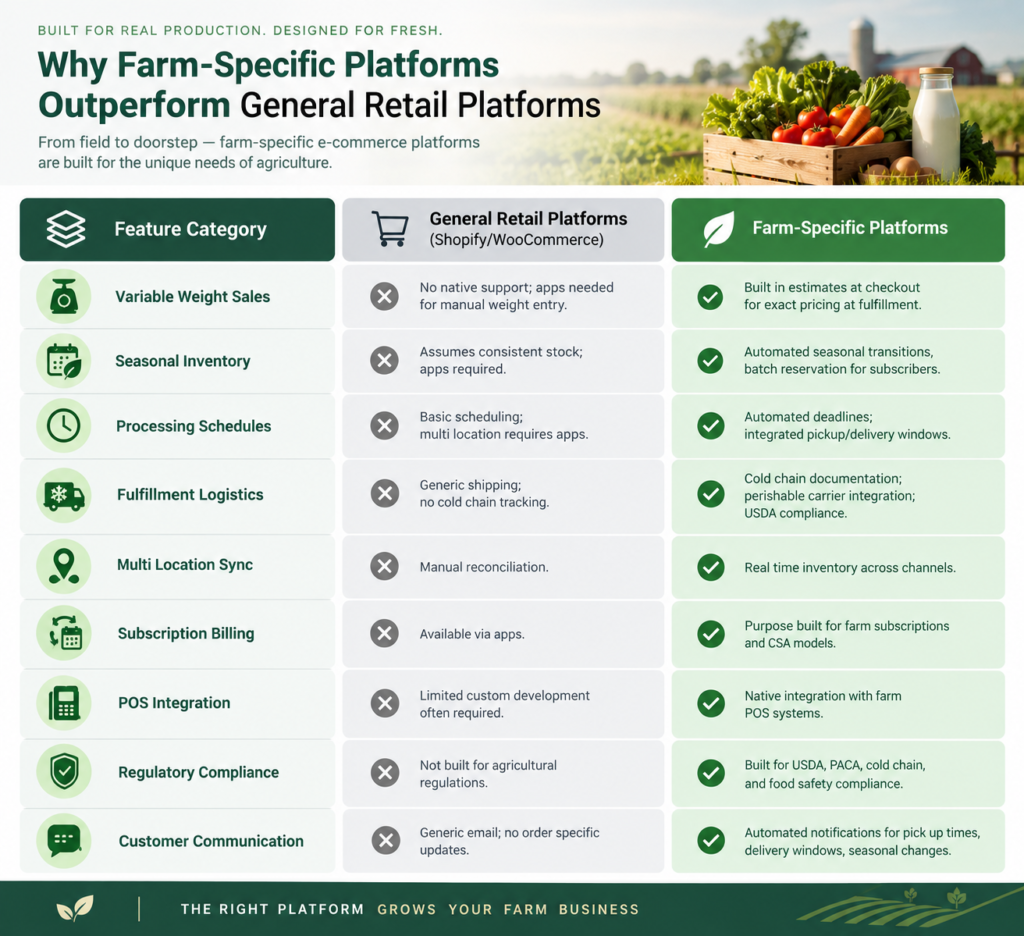
Farm specific platforms aren’t all created equally. Here’s what to evaluate when comparing options.
| Feature Category | General Retail Platforms (Shopify/WooCommerce) | Farm Specific Platforms |
|---|---|---|
| Variable Weight Sales | No native support; apps needed manual weight entry | Built in estimates at checkout exact pricing at fulfillment |
| Seasonal Inventory | Assumes consistent stock, apps required | Automated seasonal transitions, batch reservation for subscribers |
| Processing Schedules | Basic scheduling, multi location requires apps | Automated deadlines integrated pickup/delivery windows |
| Fulfillment Logistics | Generic shipping, no cold chain tracking | Cold-chain documentation, perishable carrier integration, USDA compliance |
| Multi Location Sync | Manual reconciliation | Real time inventory across channels |
| Subscription Billing | Available via apps | Purpose built for farm subscriptions and CSA models |
| POS Integration | Limited custom dev often required | Native integration with farm POS systems |
| Regulatory Compliance | Not built for agricultural regulations | Built for USDA, PACA, cold chain, and food safety compliance |
| Customer Communication | Generic email no order specific updates | Automated notifications for pick up times, delivery windows, seasonal changes |
Don’t ask a vendor Can we make this work? Ask instead: Will this platform adapt as we scale to 5 locations, 10 delivery zones, and 500 weekly orders? What happens when I add a second product line or move into wholesale alongside DTC? The answer to those questions determines whether you’re choosing a farm business platform or a temporarily adequate workaround.
The vendors worth evaluating should provide case studies showing farms similar to yours in size, sales channel mix, and product type. If they can’t name three comparable customers, that’s a signal they’re not actually built for your use case.
Farms operating subscription and CSA models face especially acute platform challenges A CSA operation managing 200+ weekly boxes across seasonal availability windows needs platform level support for what subscribers receive in each box, how supply constraints are communicated, and how customers adjust subscriptions around seasonal transitions.
FAQS
Can we just add more apps to Shopify to make it work for our farm?
Apps reduce friction, but they don’t solve the core architecture problem. You’ll still manually reconcile data across systems, which compounds over time. The real question, at what point is app maintenance more expensive than switching?
How do we know when we’ve outgrown Shopify?
If you’re handling more than three of these regularly, manual weight entry, spreadsheet inventory tracking, delivery schedule coordination, or multi location fulfillment. One is normal startup friction. There is a signal you need unified platform architecture.
Do farm specific platforms integrate with our existing POS or accounting software?
Most do, but verify upfront. Integration gaps are one of the biggest hidden costs in platform migrations. Ask for a technical specification sheet and references from farms using your accounting system.
What happens to our existing Shopify data if we migrate?
Data is exportable, usually via CSV or API, but customer history and order metadata may require manual mapping. Plan 4 to 8 weeks for a clean migration and expect to lose some historical reporting capability during the transition.
Is the cost of switching worth it for small operations?
If you’re doing $200,000 or more in annual DTC sales and managing multiple fulfillment streams, yes. Below that threshold, the app stack workaround may be cheaper upfront, but labor costs often flip the equation by year two.
What Drives Platform Success for Farm Direct Sales
The real market signal isn’t that farms should choose better platforms upfront. It’s that the wholesale migration away from general platforms is itself proof that platform architecture matters more than price or brand recognition. A farm’s decision to move from Shopify to a farm specific platform at $100 per month higher than Shopify’s base rate reveals something important the cost of misalignment is higher than the cost of switching.
Farms that sell perishables directly to consumers need platforms engineered for that specific challenge. Variable weight pricing, seasonal inventory contingency, hyper local fulfillment logistics, and regulatory compliance around perishables require platform level features, not app stack workarounds.
The result of platform misalignment: operators spend 2 to 3 years and 40 to 60 percent more operational overhead reconciling systems, managing manual weight entries, and coordinating multi location fulfillment. Only after hitting that friction ceiling do they discover that farm specific platforms were designed specifically to eliminate these gaps. That’s worth sitting with. The technology wasn’t built to be better at retail. It was built because retail technology doesn’t work for farms.
Conclusion
If you’re evaluating ecommerce platforms for farm-direct sales, start here list every manual process your operation currently handles. Weight entry, inventory reconciliation, delivery coordination, POS sync failures. Each one represents operational debt accumulated by a platform designed for someone else’s business.
Then run the numbers. Not just platform fees, but the complete cost of ownership. Finally, ask whether your current platform’s roadmap includes features for agricultural operations. If the answer is no, you have your signal. The shift toward farm specific platforms isn’t a trend. It’s a recognition that certain business models require platforms built specifically for those models. Farm direct sales is one of them.
