
In a market where every brand claims proven performance, strategic media pitching separates differentiated brands from the commodity crowd. Here’s the decision framework operators use to know when PR is worth the investment and how to pitch the outlets that actually move the needle.
The Problem:
Your Story Never Reaches the Right People
Most agricultural brands have a story worth telling. But most PR efforts stop the story before it lands anywhere that matters. You spend months building a narrative around your supply chain transparency, your novel production method, or your market shifting innovation. Then you send a pitch to Meat+Poultry and wait. Three weeks go by,or worse you get a polite rejection two weeks after their editorial calendar has already closed.
This is the core tension agricultural operators navigate, media coverage can genuinely move the needle on brand differentiation and operator trust. But only if you know when to pitch, where to pitch, and what story will actually resonate with journalists who receive hundreds of pitches every month.
The gap isn’t in the story itself. It’s in understanding how trade media, consumer outlets, and industry association channels work and how your narrative needs to shift depending on which you’re targeting.
Key takeaways:
- Trade media pitches need 6-8 week lead time, miss the calendar close, miss the cycle
- Commodity story (price/volume) = media dead end, differentiation story (sustainability/traceability/innovation) = media ready
- Measure success through operator engagement metrics, not just press mentions
The Commodity Branding Crisis
Every agricultural brand sounds the same. Not because the brands are the same, but because the language they use to describe themselves has converged into a handful of default phrases: trusted partner, proven performance, innovative solutions, industry leading,best in class.
Listen to trade press coverage in your segment long enough, and you’ll hear these terms repeated like industry liturgy. Seed companies use them. Equipment suppliers use them. Processors use them. Dairy producers use them. When every competitor wraps their narrative in identical language, the words lose meaning. Operators stop noticing which brand attached which claim.
This convergence doesn’t happen by accident. It’s the result of products achieving performance parity. When products achieve performance parity, information becomes universally accessible, and new competitors enter agricultural markets, brand distinction becomes increasingly valuable. But while differentiation matters more than ever, most agricultural brands continue communicating in undifferentiated ways. Brands that understand operator level decision frameworks can break through this noise by positioning themselves against the convergence, not within it.
The economic consequence is predictable: when brands converge, markets default to price based competition. The more your narrative looks like everyone else’s, the more an operator’s decision reduces cost per unit, delivery speed, and contract terms.
But here’s the insight worth sitting with: most agricultural brands aren’t commodities. They have real differentiation in supply chain transparency, production methods, sustainability practices, or operational innovation. The problem isn’t that the differentiation doesn’t exist. It’s buried under generic positioning.
This is where PR comes in. Trade media outlets like Meat+Poultry, Food Dive, Progressive Grocer, and AgFunder News exist precisely to surface operator level decision intelligence that commodity conversations ignore. These outlets reach procurement teams, operations managers, and supply chain directors who are actively evaluating trade-offs. They’re looking for the story behind the numbers. The barrier isn’t getting noticed. It’s knowing how to pitch a story that the trade media actually greenlight.
Three Outlet Types:
Where Your Story Goes
Agricultural media isn’t monolithic. Each outlet type has different audience expectations, different lead times, and different definitions of newsworthy. Pitching the same story to all three is like using a single marketing message across direct to consumer, food service, and retail channels. It doesn’t work.
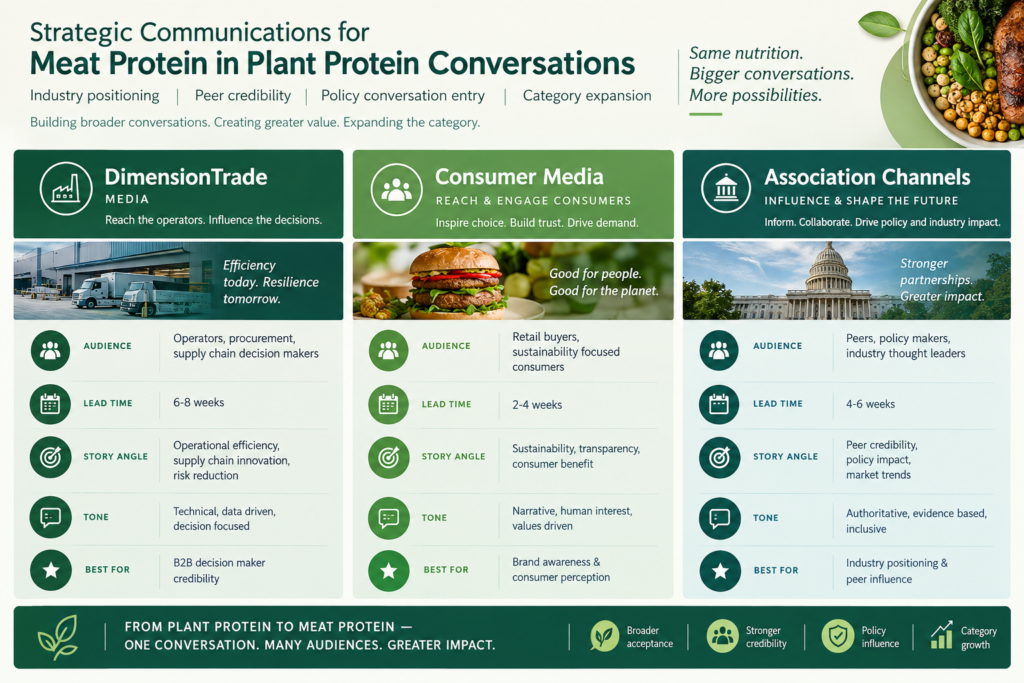
Trade Media:
Reaching Operators and Decision Makers
Examples:
Meat+Poultry, Food Dive, Progressive Grocer, The Packer, AgFunder News, Dairy Foods, Supermarket News
Audience:
Operators, procurement professionals, supply chain directors, plant managers, category buyers, the people making B2B purchasing and supplier decisions. Circulation and editorial structure for trade media reaching meat and poultry processors
What They Want:
Operational level decision intelligence. Not what is a cold chain that’s TOFU awareness. They want to know, how do I reduce risk? Improve efficiency? Navigate compliance? What’s changing in my segment that I need to plan for?
Editorial Tone:
Technical, data driven, evidence based. Assumes reader sophistication. No hand holding.
Lead Time:
6-8 weeks before publication. This is non-negotiable. Most trade outlets lock their editorial calendars 6-8 weeks in advance. If you pitch two weeks before their calendar closes, your story is too late. Trade press editors want to know that you understand the issues on the minds of their audience, and that your story conveys information sharing with readers, not selling them on your product.
Best For:
B2B credibility, operator awareness, and downstream business development. One example: A dairy processor’s traceability system story told to Meat+Poultry reaches 19,707 print readers plus 21,129 digital subscribers monthly operators who make supplier decisions.
Consumer Media:
Building Brand Awareness and Retail Positioning
Examples:
NPR Food & Agriculture, NYT Food section, Serious Eats, Wired (food tech), local food columns
Audience:
Retail shoppers, food enthusiasts, sustainability focused consumers, operators interested in direct to consumer positioning
What They Want:
Human stories, values alignment, transparency, and consumer relevance. They’re less interested in operational minutiae and more interested in why should I care about this brand or product?
Editorial Tone:
Narrative driven, accessible, values forward. Explains concepts without jargon.
Lead Time:
2-4 weeks. Consumer media operates on faster cycles than trade press. They’re responsive to trending topics and real time news angles.
Best For:
Direct to consumer brand awareness, retail positioning, consumer perception building, and values aligned market segments regenerative agriculture, food safety innovation.
Association Channels and Industry Bodies
Examples:
AgFunder News, USDA AMS publications, industry association newsletters NCBA, National Chicken Council, Dairy Management , peer networks
Audience:
Peers, policy makers, industry thought leaders, members seeking credibility signals
What They Want:
Evidence based research, peer credibility, policy insights, market analysis. Stories that elevate the whole industry category, not just one brand.
Editorial Tone:
Authoritative, evidence based, inclusive. Bridges operator concerns and industry wide challenges.
Lead Time:
4-6 weeks. Slower than consumer media, faster than deep dive trade features.
Best For:
Industry positioning, peer credibility, policy conversation entry, and category expansion positioning meat protein in plant protein conversations, for example.
When to Pitch:
The Decision Matrix
The wrong outlet + good story = silence. The right outlet + wrong story = silence. The right outlet + right story + wrong timing = silence.
Before you pitch anywhere, walk through this three step decision matrix. It takes 15 minutes and clarifies whether PR investment makes sense right now.
Step 1:
Define Your Story
Is your story about operational differentiation, supply chain innovation, sustainability, traceability, compliance efficiency, risk reduction, process automation? Or is it about volume and commodity positioning? We produce 10 million pounds annually,we’re a low cost supplier, we have capacity?
If it’s the latter, stop. Trade media doesn’t greenlight commodity stories. Consumer media might, but only if the narrative centers on consumer value or authentic sustainability practice, not just market presence.
Test your story: Can an operator explain, in plain language, why they should care? If the answer is we’re good at what we do, that’s not a story yet. If the answer is our supply chain traceability system reduces retailer fulfillment errors by 23%, which cuts their compliance risk, that’s a story. Understanding your position within agricultural market dynamics helps clarify whether your differentiation angle is operator relevant or just competitive chest beating.
Step 2:
Identify Your Target Audience
Who needs to believe this story? Operators and procurement teams making supplier decisions? Retail buyers evaluating product positioning? Consumers and sustainability advocates? Peers and industry leaders?
Different audiences = different outlets. Pick one primary audience for your first PR cycle. (You can segment later. For now, focus.)
- Operators and procurement:
Trade media - Retail buyers:
Trade media hybrid (food trade publications that straddle B2B and retail) - Sustainability-focused consumers:
Consumer media + association channels - Industry peers:
Association channels
Step 3:
Map Editorial Calendars
Before you write a single pitch, call or email three target outlets in your chosen channel. Ask: When does your [upcoming quarter] editorial calendar close? Do you accept contributed pieces or expert commentary? Document the dates. Seriously document them. These are your deadlines.
Editorial calendars are created by publications to map out their content for future issues, and most outlets post their media kits in an easy to find area of their website typically in the advertising section. Most outlets close calendars 6–8 weeks before publication. If you’re pitching a quarterly feature, you need to hit their calendar close now, not in three weeks.
Story Readiness:
Testing Your Narrative Before You Pitch
You have a story. You’ve picked outlets. You’ve got their calendar close dates. Before you write a single pitch email, test whether your story holds up.
Run your narrative past an internal stakeholder who’s not in marketing an operations person, a sales leader, or a supply chain director. Ask them to explain, in one minute, why an operator would care about your story.
If they stumble, the journalist will too. Ensuring your claims align with regulatory requirements and compliance standards strengthens story credibility significantly, especially for trade media where operators are already evaluating risk.
Red flag language to strip before pitching:
- Innovative without specific innovation in what?
- Industry leading without comparison leading compared to what?
- Best in class without evidence best according to whom?
- Vague benefits helps farmers, supports sustainability without operator relevance
- Undefined timelines or quantification
Replace red flag language with specifics:
We’re innovative in sustainability practices.
Our regenerative sourcing program expanded from 12 to 47 farms in 2024, increasing supply chain carbon sequestration by 18% while maintaining input costs within 2% of conventional sourcing. Every claim needs a number, a third party validation, or an operator quote. Journalists verify claims during interviews anyway. Get ahead of it.
Crafting the Pitch Journalists Actually Open
Your story is ready. The outlet’s editorial calendar is documented. Now comes the pitch. Most agricultural brand pitches fail not because the story is weak, but because the pitch is generic. Hi Editor, we have a story about our company lands in a folder with 200 other generic pitches.
Make your pitch specific, operator focused, and timed. When pitching to editors, demonstrate that you understand the issues on the minds of their audience, and tailor your pitch to convey information sharing, not selling.
Subject Line (Your One Chance):
Include the specific angle, why this outlet, and why now: Feature Idea: How mid market meat processors reduced cold chain failures by 18% editorial fit for Meat+Poultry’s Q3 operations coverage
Operator Pain, Not Your Company:
Open with the operator problem, not your solution. Plant managers at mid market processors are losing $200K annually to cold chain compliance failures and retailer chargebacks. Your Q3 operations focus covers exactly this challenge.
Differentiation Story:
Explain what makes this story interesting to this outlet’s audience. We developed a real time traceability system that reduces these failures by 18% while cutting operator labor on verification by 6 hours per week. This is an operator level efficiency story, not a product promotion.
Why This Outlet, Why Now:
Connect the story to the outlet’s editorial calendar. This aligns with Meat+Poultry’s June operations coverage cycle. Our technical team and affected operators are available for interviews. We can also provide third party audit results if needed.
Tone throughout:
You’re offering a story idea to help the journalist do their job, not pitching a product. Trade press editors notice the difference immediately.
Timing, Editorial Calendars, and the 6-8 Week Window
This is the part that kills more agricultural pitches than weak story angles. Meat+Poultry publishes 12 issues per year. Each issue’s editorial calendar closes 6 – 8 weeks before publication. If you miss that close date by two weeks, you’re pitching for the next cycle three months away.
Most agricultural brands discover this too late. They pitch great stories to missed calendars, get rejected, and assume the outlet isn’t interested. The reality: the outlet would be interesting but not in Q2. They might be interested in Q4, but you won’t know unless you’ve documented their close dates.
How to Find Editorial Calendars:
Most outlets post their editorial calendars online in easy to find areas of their website, typically in the advertising section, or you can email the Editor and request a copy. Meat+Poultry’s is visible on their media guide. Progressive Grocer publishes it. Food Dive announces cycle themes. If you can’t find it, ask directly.
When to Pitch:
- Trade media: 6–8 weeks before your target publication month
- Consumer media: 2–4 weeks before but build relationships with journalists first
- Association channels: 4–6 weeks before their publication cycle
Respect the calendar. It’s not a guideline. It’s the difference between your pitch landed in the active planning meeting and your pitch arrived three weeks too late.
Measuring PR Success for Agricultural Brands
You got the story placed in Meat+Poultry. Celebrate for a day, then measure what actually happened. Most agricultural brands measure PR success by counting press mentions. We got three articles. Great. But did those articles move your business?
Meaningful metrics for agricultural brands:
- Operator inquiry lift:
Did inbound B2B inquiries spike 30 days post publication? Track mentions of the article in early sales conversations.
- Procurement conversation activation:
Did the story reach procurement teams who then contacted you? Ask prospects where they heard about you.
- Trade show traffic:
Did you see lift in conversations at industry events post coverage?
- Media reach among target audience:
Not total reach impressions across all readers, but reach among operators and procurement professionals.
- Downstream business activity:
Did the story contribute to a partnership, distribution agreement, or account win?
Vanity metrics that don’t matter:
- Number of press clips without engagement data
- Total impressions mixing operator and non-operator audiences
- Social media shares unless they’re from industry accounts
- Equivalent advertising value calculations misleading and outdated
In a post campaign review, ask: Would I have pursued that supplier conversation anyway, or did this article trigger it? If the article triggered new business development, it worked. If it just provided background context for conversations you’d have pursued anyway, it’s supporting evidence but not ROI on its own.
Leveraging Perishly’s Supply Chain and B2B Strategy Work in Your PR Story
Operators increasingly care about end to end visibility and B2B operational capability. If your brand has invested in supply chain transparency, traceability systems, inventory synchronization, or demand forecasting integration that’s a media ready story angle. Trade media covers these operational innovations regularly because operators are actively evaluating them. Anchoring your PR narrative to documented supply chain improvement is far more credible than generic differentiation claims. Understanding agricultural B2B marketing strategy helps position your story as operator decision intelligence rather than vendor promotion.
FAQS
How do I know if my farm’s story is actually newsworthy, or if I’m just hoping a journalist will care?
Newsworthy stories answer an operator problem: How do I reduce risk? Improve efficiency? Navigate compliance? If your story answers an operator question, it’s newsworthy. If it’s just we do what we do really well, it’s not. Test it: Read a recent article in Meat+Poultry or Food Dive. Does your story have that operator decision angle? If not, refine it before pitching.
What’s the difference between pitching to trade media vs. consumer media, and which one should I start with?
Trade media Meat+Poultry, Food Dive, Progressive Grocer reaches operators and procurement the people making B2B decisions about your products. They want technical depth and ROI. Consumer media reaches shoppers and sustainability enthusiasts they want authenticity and values alignment. Start with trade media if you’re selling B2B. Start with consumer media if you’re building direct consumer brand awareness or retail positioning.
I have a great story, but I’m not sure if our claims will hold up to a journalist’s questions. What should I do?
Don’t pitch yet. Run your story through internal stakeholders, especially operations or sales. Can they verify the claim? Can they speak to it? Third party validation (certifications, audit results, operator testimonials) strengthens claims dramatically. Journalists will verify your claims during interviews anyway and get ahead of it.
I found Meat+Poultry’s editorial calendar and their next cycle closes in two weeks. Is it too late to pitch?
Probably. Trade media typically locks calendars 6 – 8 weeks in advance. Two weeks out, they’re already assigning stories. But call the editorial office anyway. Explain your story quickly. If they’re interested, they might pull a story or create space for Q4 planning. Worst case, you miss this cycle, but you’ve made a contact for future pitches. Build this into your planning aim to pitch 8 weeks out, not 2.
We got featured in Meat+Poultry. How do we know if it actually worked for our business?
Measure operator level impact, not just we got press coverage. Track: Did operator inbound inquiries spike post publication? Did a specific account reference the article in conversations? Did we get partnership or supplier interest as a result? Compare inquiry volume 30 days before and after publication. If there’s lift and operators mention the article, it worked. If the press mentions alone with no downstream activity that’s supporting evidence, not ROI.
Conclusion
Agricultural brands aren’t commodities. But generic PR feels like it. The brands that break through aren’t the ones with better stories, they’re the ones who know when their story is ready, where it belongs, and how to deliver it so journalists greenlight it. The commodity branding crisis is real. But it’s not unsolvable. Specificity, operator level differentiation, strategic outlet selection, and respect for editorial calendars separate noise from signal. Your story is ready. Know when to pitch it.
