
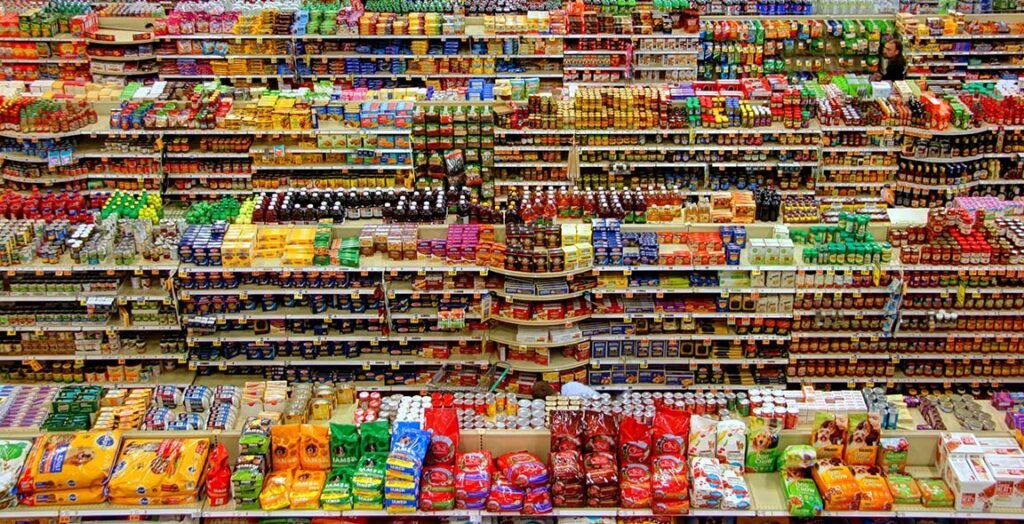
The last three years rewrote the rules of food and beverage retail. Consumers trained on price transparency by e-commerce are now sorting themselves into two distinct camps hunting aggressively for value, or paying premiums for products that signal safety, ethics, or innovation. The casualty is unmistakable, and it’s not what the industry expected. The mainstream middle the safe bet for decades is collapsing.
- 4 percentage points Super premium dollar share growth in 2025 alone Circana retail analysis
- 3x faster Private label growth rate compared to national brands PLMA 2025
- 1% volume decline Mainstream brand performance while premium brands grew 3% Circana 2024 data
- 0.5% revenue growth Legacy CPG companies ($1B+) versus 2.1% industry average BCG
Key takeaways:
- Mainstream volume loss is structural, not cyclical, driven by permanent shifts in consumer confidence and channel behavior.
- Success now demands clarity; you are either a cost leader, an authentic premium, or an innovator in a growing niche.
- The cost of repositioning varies by vertical and margin profile, but the cost of inaction is significantly higher.
Section 1:
The Data What Happened to the Mainstream Middle?
Three years ago, the F&B industry looked monolithic. A handful of legacy players controlled distribution. Margin was predictable. Volume growth was assumed. Then everything fractured. Circana’s latest retail analysis tells the story. Between November 2023 and November 2024, global retail food and beverage dollar sales grew 2.6 percent. Sounds fine. But dig into the mix, and the divergence becomes unavoidable.
Premium brand volumes climbed 3 percent. Mainstream brand volumes fell 1 percent. Private label volumes surged 3 percent, while national brands, the traditional growth engine, posted their first multi year volume decline.What’s hidden in those aggregate numbers is a reshuffling of consumer allegiance.
The Hidden Math In a 2% growth environment, a 1% volume decline for your brand means you’re losing share at a 2.1x rate relative to category growth. That gap widens every quarter without intervention. Circana’s forecast for 2026 projects price mix gains between 2 percent and 4 percent, but unit volumes flat or slightly negative. Translation the industry will chase profitability through pricing, not volume. For brands already losing volume, that math is brutal. You can’t raise prices on a shrinking customer base and expect loyalty.
The regional and vertical variation is worth noting. Super premium penetration is highest in meat and specialty proteins, where quality signals matter most to affluent consumers. Dairy shows a bifurcation between organic/grass fed premiums and store brand commodity milk. Bakery and plant based are still consolidating, with smaller insurgent brands capturing share from mid tier players.
The real acceleration happens in channels. E-commerce transactions now drive 35 percent of F&B dollar-sales growth despite holding only 10 percent of total market share. In that space, private label and direct to consumer premium brands have structural advantages that traditional retail bound players don’t.
Section 2:
Why Now Structural Forces Behind the Divergence
This isn’t a cyclical dip. It’s structural. Four forces are driving it simultaneously.
Post Inflation Consumer Confidence Bifurcation
Consumers are paying 30 percent more for groceries compared to 2019, despite inflation softening. That’s not a bump. That’s a permanent baseline shift that rewrote household budgeting. The response wasn’t uniform. Lower and middle income households absorbed the hit by trading down to private label and value channels. Affluent consumers seeing price driven promotions as evidence of quality decline traded up to premium brands signaling authenticity, ingredient integrity, or ethical sourcing.
No middle ground. No premium ish for the price category that holds. Mainstream brands tried to capture both ends with mid range pricing and moderate quality signals. They captured neither.
E-Commerce Transparency and Private Label Expansion
Amazon, Thrive Market, and specialty grocery platforms created an economic moat around private labels. Before e-commerce, private label was a Costco/Walmart play convenience plus savings. Today, it’s a lifestyle category. Thrive Market’s organic private label competes directly with brand name premiums on ingredient credibility. Amazon Fresh’s house brands use ingredient sourcing that matches or exceeds regional brands.
For consumers, the friction vanished. You’re no longer choosing between a store brand and a real brand. You’re choosing between functionally equivalent products with radically different pricing. Private labels won that choice by default.
Cold Chain and Supply Chain Premiumization
Here’s the operational hidden cost: nobody talks about modern supply chain infrastructure being expensive. ERP systems, lot level traceability, cold chain compliance, food safety certification. These costs exist for all brands. But margins exist differently.
A premium brand charging 25 percent more can absorb ERP costs and still hit gross margins above 40 percent. A mainstream brand holding price competitive positioning carries the same infrastructure cost but distributes it across tighter margins. That math breaks in a low volume environment. Mainstream brands face margin compression not just from consumer demand, but from operational fixed costs that don’t scale down.
Channel Proliferation and the Death of Shelf Browsing
Consumers no longer discover food brands by wandering a supermarket aisle. They discover through TikTok, YouTube, Reddit, targeted ads, and marketplace recommendations. Brands without a social commerce strategy are losing to brands that are.
That shift matters because the economics of DTC and social commerce favor insurgent premium brands and ultra cheap private labels. Mid tier brands built for shelf visibility and in store promotions are structurally disadvantaged in a recommendation driven discovery environment.
Section 3:
The Consumer Split Who’s Trading Up? Who’s Trading Down?
The bifurcation isn’t random. It follows income cohorts and confidence. Lower and middle income households are price conscious and skeptical of value messaging. A private label product that performs identically to a national brand, at a 30 percent discount, isn’t a compromise anymore it’s math. These consumers buy weekly, not monthly. Cumulative savings matter. A 30 percent price cut on yogurt, olive oil, and proteins adds up to hundreds per month.
Simultaneously, these households are trading sideways within the category. They’re not abandoning food categories. They’re swapping brands within categories, looking for the best value signal. Affluent consumers are trading up. They’re not buying more volume, they’re paying more per unit for products that solve specific problems or signal alignment with values. Grass fed beef signals regenerative agriculture. Organic signals reduced pesticide load. Non GMO signals regulatory safety. Super premium brands spend on communicating these signals. Mainstream brands stuck with quality as a generic claim. The middle is empty.
The Trading Sideways Blind Spot Many mainstream brands misinterpret competitor losses as market exit. In reality, those consumers are still shopping in that category; they’ve just swapped brands. A 2 percent volume loss for you might mean a 5 percent private label gain and a 3 percent premium brand gain in the same category, with the overall category flat. You didn’t lose the customer to another category. You lost them to a different positioning within the category. tariff driven food price inflation is reshaping consumer behavior
What makes this dynamic sticky is loyalty erosion. Consumers who switch to private label for price don’t remain price sensitive buyers if a premium brand proves worth the premium. But they don’t return to the mainstream unless mainstream demonstrates a specific reason to come back and trust our brand isn’t one anymore.
Section 4:
Vertical Snapshots Meat, Dairy, Specialty Proteins & Plant Based
The divergence shows up differently by vertical, and the implications are distinct.
Meat
Grass fed, regenerative, and animal welfare certifications have given premium meat brands a credibility moat. A grass fed ribeye at 25 percent premium commands customer loyalty that a conventional ribeye, even at equivalent quality, cannot match. The consumer is buying a story, not just a steak.
Simultaneously, private label ground beef and commodity cuts have captured significant share in value channels. Costco’s Kirkland and Walmart’s Great Value now compete directly with regional brands on quality signals at price points mainstream regional players cannot match.
Mid tier meat brands of good quality, conventional sourcing, no certification story are squeezed. Big Food is actively divesting these brands from portfolios, consolidating around premium or cost-leader strategies.
Dairy
Organic and A2 protein milk have created a premium segment worth defending. Those brands command 20–35 percent premiums and hold volume. Conventional milk is collapsing to commodity pricing and private label capture. Regional mainstream dairy brands with no specific positioning are losing on both ends.
Cheese and yogurt show more segmentation. Ultra premium artisan cheese competes against European imports at premium prices. Mid market cheese lost share to both private label commodity and imported premiums. Yogurt got disrupted by functional health claims (probiotics, protein, gut health), turning it into a pseudo supplement category where premium positioning became mandatory.
Specialty Proteins & Plant Based
Plant based meat insurgents captured the premium position initially by owning the innovation narrative. But saturation is real. Most households that want plant based already have a go to brand. The next phase is private label and regional variants capturing the growth market share, and conventional premium proteins regenerative beef, pasture raised poultry, wild caught fish holding the affluent loyalty segment.
Mid market specialty brands without specific differentiation, not quite premium, not quite value are consolidating or being acquired by bigger players trying to acquire growth through portfolio breadth.
Section 5:
The Strategic Fork Three Paths Forward
Every mid market F&B brand now faces one decision: pick a strategic position and build the operations to defend it. The three viable paths are distinct in cost, timeline, and margin recovery.
Path 1:
Cost Leadership and Value Channel Specialization
Become a supplier to private label, warehouse clubs Costco, Sam’s Club, and dollar store formats. This requires:
- Procurement ruthlessness offshore sourcing, simplification of SKU complexity, commodity grade ingredients
- Supply chain optimization high volume runs, limited variety, inventory velocity focus
- Resignation on brand equity you’re building someone else’s brand, not your own
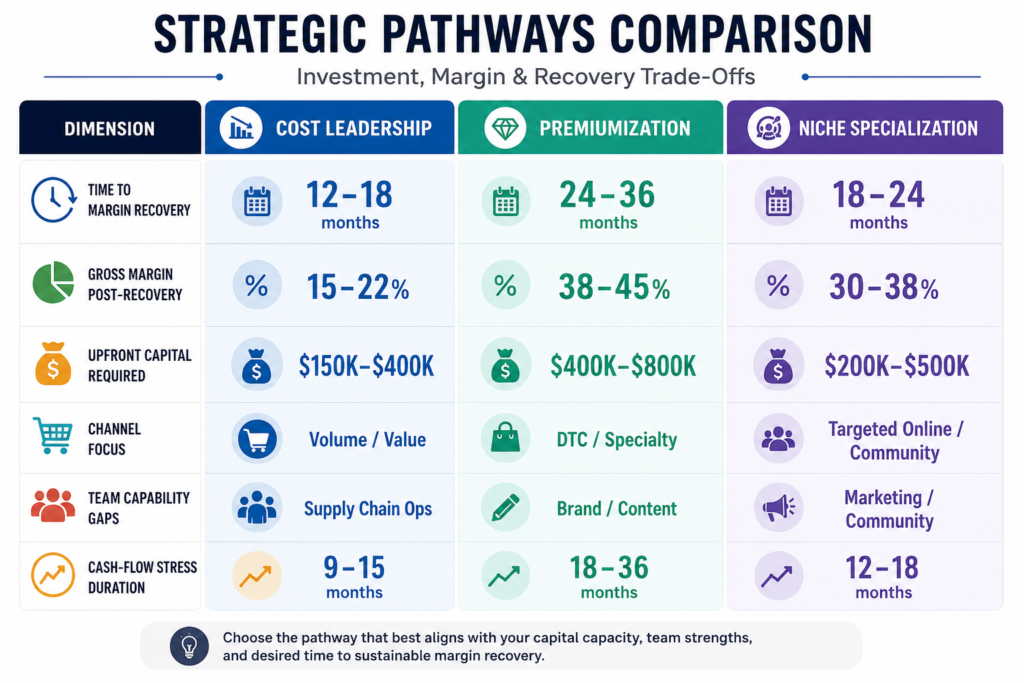
Margin recovery is 12–18 months because you’re optimizing around volume and velocity, not price. Unit margins compress often to 15–20 percent gross, but volume scales to compensate. This path works for brands with strong operations and weak brand equity already.
It also means accepting that you’re not winning with affluent consumers. You’re winning with budget conscious bulk buyers.
Path 2:
Authentic Premiumization
Invest in ingredient authenticity, sourcing transparency, certification organic, regenerative, non GMO, Fair Trade, and brand storytelling. This requires:
- Procurement transformation certified suppliers, traceability, potentially higher ingredient cost
- DTC and specialty retail channel building lower volume per channel but higher margins
- Content and brand investment your story is product, not just marketing
- Operational integration cold chain, lot level tracking, recalls management
Consumers smell dishonesty media tariff margin protection Margin recovery is 24 – 36 months because you’re rebuilding brand perception from scratch while investing in infrastructure. But gross margins can recover to 35 – 45 percent if you own the narrative and distribution is controlled. This path requires belief in a specific story. If you can’t authentically own regenerative farming, grass fed sourcing, or ethical labor practices, don’t fake it.
Path 3:
Niche Specialization
Become the best in the category at one specific thing. This might be a format ready to drink, shelf stable, a functional claim high protein, low FODMAP, a dietary positioning keto, paleo, or a demographic niche Gen Z, health conscious families.
Margin recovery is 18 – 24 months because you’re not starting from zero you’re optimizing existing strength into a defensible niche. But the addressable market is smaller. You’re not trying to win 30 percent market share. You’re trying to own 5 percent of a growing niche.
Section 6:
Operational Realities What Repositioning Actually Costs
Here’s what nobody discloses until you’re deep in the commitment: repositioning is capital intensive and works backward on cash flow.
Cost Ranges by Path and Brand Size
For a $20–50M brand:
Path 1 Cost Leadership requires 3 – 6 months of supply chain audits and ramp, plus 6 – 9 months of volume scaling before margin recovery. Cost: $150K – $400K. Cash impact is negative for 9 – 15 months as you fund inventory scaling before revenue acceleration.
Path 2 Premiumization requires ingredient source development 3 – 6 months, certification if applicable 6 – 12 months, brand repositioning and content creation ongoing, DTC platform build or specialty retail relationship development 6 –12 months. Cost: $400K – $800K. Cash impact: negative for 18 – 36 months. You’re paying for certification, sourcing audits, content, and digital marketing infrastructure before volume recovers.
Path 3 Niche requires market research and product refinement 2 – 3 months, targeted marketing and community building ongoing, potentially a product reformulation if your niche positioning doesn’t align with current recipe 3 – 6 months. Cost: $200K – $500K. Cash impact: negative for 12–18 months as you rebuild customer acquisition around a narrower audience.
Working Capital and Inventory Implications
Each path has hidden working capital costs. Path 1 requires extended payment terms with value channel retailers (60 – 90 days net), which means funding inventory for 2 – 3 months before cash returns. Path 2 requires slower inventory turns as you build a customer base specialty retail moves slower than mainstream. Path 3 requires customer acquisition investment in advance of loyalty, which is pure cash burn until cohort retention proves viable.
Section 7:
Decision Framework Where Does Your Brand Stand?
These five numbered steps define where you are and what move comes first.
1. Audit Your Current Position
Map your SKU mix by margin profile and volume velocity. Which SKUs are delivering 60 percent of your volume? Which are margin accretive? Which are cash burn slow movers?
Next, map distribution. What percent of revenue comes from mainstream retail? Private label partnerships? DTC? Value channels? If 80 percent of revenue comes from mainstream retail partnerships and 2 percent comes from DTC, you have zero optionality. You’re completely exposed to the mainstream decline.
Quantify your cash runway. A premiumization play requires 24 – 36 months of cash burn before margin recovery. If you have 18 months of cash on hand, premiumization is not your path. Cost leadership or niche might be, but not premiumization.
2. Test Market Viability
Pick one high affinity channel and run a six month pilot. If you’re considering premiumization, run it in specialty retail or a regional online marketplace Thrive, Amazon Fresh, a regional natural foods platform.
Track three metrics ruthlessly: trial rate what percent of customers in that channel buy at least once, repeat rate what percent come back within 6 months, and gross margin on that channel. Repeat rate is the signal that matters. Trial is cheap. Repeat is a signal.
If repeat rate is below 25 percent, your positioning isn’t credible or your product isn’t holding up. Pivot or exit.
3. Identify Capability Gaps
Make a list procurement can you source certified ingredients at scale? supply chain technology ERP, traceability, cold chain, brand and content do you have DTC copywriting capability? e-commerce operations order fulfillment, returns, logistics.
For each gap, decide to build, buy, or partner. Build is only viable if you have 12+ months. Buy means hiring or acquiring a team. Partner means finding a contract manufacturer or a platform partner.
If you’re weak in multiple categories and don’t have 12 months, partner or delay. Don’t try to build your way through gaps simultaneously.
4. Model Cash Flow Path
Build a three year financial model showing:
- Baseline scenario what happens if you do nothing volume decline rate, margin pressure
- Chosen path scenario: upfront investment, monthly cash burn, projected recovery timeline
- Sensitivity: what if market adoption is 20 percent slower? What if capital costs 50 percent more?
This forces clarity. Often, the choice becomes obvious when you see baseline cash depletion versus chosen path cash recovery timelines.
5. Set Strategic Milestones
Define 12 month, 24 month, and 36 month success metrics specific to your chosen path.
Cost leadership By month 12, we supply 3 warehouse club private label SKUs at margin breakeven. By month 24, those generate 30 percent of revenue at 18 percent gross margin.
Premiumization: By month 12, DTC represents 5 percent of revenue at 42 percent gross margin. By month 24, specialty retail adds another 8 percent of revenue. By month 36, mainstream retail share has declined but is offset by higher margin channel mix.
Niche By month 12, the health conscious female segment ages 28 – 42 represents our top demographic. By month 24, this segment is 40 percent of the customer base.
Publish these milestones. Quarterly reviews track against them. If you’re missing them, it’s not because the market is hard. It’s because something in your execution broke or your positioning isn’t resonating. Fix it fast or reset expectations.
FAQS
How fast is private label actually growing compared to national brands?
Private labels posted record sales of $282.8 billion in 2025 and are growing at nearly three times the rate of national brands. Store brands now hold approximately 29 – 30 percent of unit sales across grocery, with the highest penetration in staple categories oils, proteins, dairy, grains where quality parity with national brands is credible. The gap widens quarterly.
If we stay in the mainstream middle, what does volume loss look like over the next 2–3 years
Circana’s 2026 outlook projects flat to negative volume growth for the overall category, with mainstream brands bearing the concentrated brunt. Brands without clear differentiation risk 2–5 percent annual volume decline in core retail channels. Price increases might offset some revenue loss, but loyalty erosion typically makes price raising unsustainable.
What’s the difference between premium and super premium in food pricing?
Premium typically signals 15 – 25 percent price premium over mainstream equivalents, backed by ingredient upgrade or recognizable certifications organic, grass fed, non GMO. Super premium demands 25%+ premium and requires a credible story: origin, craft method, ethical sourcing, innovation, or exclusivity. The price premium only holds if consumers perceive tangible value and believe the brand is authentic.
Can a mid market brand reposition to premium without going DTC?
Yes, but with cost caveats. Specialty retailers and online marketplaces Thrive Market, Amazon Fresh, regional natural-products chains can support premium repositioning without full DTC build. However, margin depends on distribution breadth and retail partner terms. DTC gives you margin upside often 10-15 points higher) but requires marketing spend and operations capability. Paid media strategy and social commerce are increasingly non-negotiable parts of growth for premium brands.
What’s the first move we should make if we’re stuck in the mainstream middle?
Audit your margin structure and volume trajectory by channel and SKU. Identify your lowest margin, lowest growth SKUs these are repositioning candidates or divestment targets. Test a differentiation story ingredient upgrade, sustainability claim, new format in one high affinity channel for six months. Use data from that test to decide: double down on test, pivot positioning, or accept value channel consolidation.
Conclusion
The divergence isn’t coming. It’s here. Circana data from 2025 makes that unmistakable. Super premium gained 4 points of dollar share in one year. The mainstream lost ground. Private label posted record volumes.
For mid market F&B brands, this is the moment. You can watch the divergence continue and wait for stabilization that won’t come. Or you can pick a strategic position and build the operations to defend it.
The cost of repositioning is real. The timeline is long. The cash burn is acute. But the cost of inaction is a margin compression that becomes permanent, followed by a volume decline that becomes irreversible. The brands winning this moment aren’t larger than you. They’re clearer about what they are. They’ve committed to a position, built operations around it, and communicated it relentlessly.
