
As tariff driven costs ripple through supply chains, brand loyalty is fracturing. Brands that win in 2026 won’t just adjust pricing they’ll reframe how they communicate it. Sixty percent of U.S. consumers say they’d stop buying their favourite brands if tariff driven price hikes hit their shopping basket. That’s not a loyalty problem that’s a messaging crisis. Over the past twelve months, tariff impacts have shifted consumer behavior in ways that generic cost increase announcements can’t solve.
60% Consumers who would abandon favorite brands over tariff driven price increases
3.3% vs. 1.1% Private label sales growth rate compared to national brands year over year
21% to 10% Drop in consumers buying only brand name products due to tariff-driven inflation
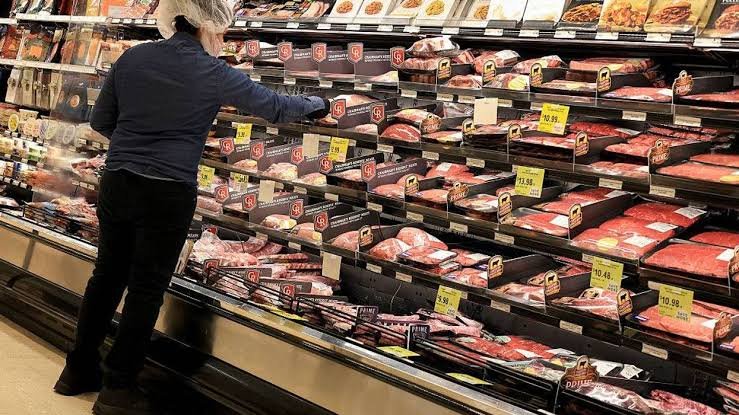
9.4% Projected beef and veal price increase in 2026 tied to supply tightness and tariff pressures
Key Takeaways:
- Price transparency tied to product quality or sourcing decisions outperforms generic cost increase messaging
- Private label switching isn’t inevitable; brand differentiation through innovation and honest communication protects margin
- Trade down bundling (premium plus value SKUs together) beats across the board price increases
The Tariff Fallout What’s Actually Changed in Consumer Behavior
The tariff landscape shifted visibly in late 2024 and became urgent by mid 2025. A universal 10% baseline tariff on most imports settled in place, with higher surcharges on specific origins 25% on Chinese goods, 10% on Brazilian goods, 46% on Vietnamese products. For food and beverage companies, that means coffee beans, cocoa, spices, aluminum cans, and imported ingredients all hit hard simultaneously. The consumer response wasn’t gradual. According to Food Dive’s 2026 research conducted with TELUS Agriculture & Consumer Goods, seventy five percent of shoppers report changed shopping behavior due to higher food prices. But here’s the part that matters for marketers this isn’t just price sensitivity. It’s trust erosion.
Brands that fell silent during tariff uncertainty saw the steepest loyalty drops. Brands that communicated transparently about sourcing changes, quality trade offs or ingredient substitutions held share better. The data shows the magnitude of consumers buying only brand name products dropped from 21% to 10% year over year, while those mixing brand name and store brands jumped 12 points, from 56% to 66%. That’s not a price problem. That’s a communication problem.
According to a 2026 Statista consumer survey on tariff impacts, sixty percent of consumers would stop purchasing their favorite brands if prices rose due to tariff-driven inflation.When combined with the private label acceleration data from CoBank analysis, the pattern is clear: consumers aren’t inherently price seeking. They’re seeking brands that communicate honestly during crisis.
Three factors predict whether a consumer sticks with a brand during tariff-driven price increases:
- Transparency about why prices rose (ingredient specific, sourcing specific, not just supply chain challenges
- Consistency in product quality despite tariff costs (consumer doesn’t feel cheated by shrinking portions or substituted ingredients)
- Visible effort from the brand to protect value (limited time value bundles, loyalty rewards, or functional innovation that justifies the price)
Generic announcements “due to unforeseen market conditions” trigger switching. Specific explanations “Brazilian coffee bean sourcing adjustment to preserve freshness” hold loyalty. Where consumers now discover the brands they’re deciding between has shifted how TikTok Shop turned discovery into a retail shelf signal. The second pattern that emerged is polarization. Consumers aren’t clustering around price conscious or quality conscious.
Basket discipline is the consumer-behavior story at its sharpest, why Gen Z’s 3-3-3 rule is quietly editing the basket, and what content survives it. They’re splitting further apart. Researchers at Forum3 observed in mid 2025 that tariff uncertainty was accelerating a “middle market squeeze” consumers were either trading hard down to private label or trading up to premium/branded alternatives that justified the price through positioning and trust. Brands stuck in the middle (mid market, undifferentiated, high tariff exposure) lost share to both segments.
Why Price Transparency Beats Price Increases
The most counterintuitive finding from 2025 brands that explained tariff impacts transparently held more customer loyalty than brands that tried to hide them. Here’s a concrete example. A specialty coffee roaster in the Pacific Northwest sourced 40% of its single origin beans from Brazil. In June 2025, Brazilian coffee bean tariffs jumped to 10%. The brand had two paths:
Path A: Raise retail prices 8% across the line. Make a brief announcement about “supply chain adjustments.” Watch competitors’ discount ads take share.
Path B: Communicate transparently that Brazilian sourcing costs up 12%, implement 4% selective price increase on affected SKUs, introduce a new value-bundled option (sourced from Ethiopia), and explain in store and on site the reasoning. Show customers the alternative source, the sourcing cost difference, and why the quality still justifies the price.
The roaster took Path B. In Month one, the volume of Brazil-sourced coffees dropped 6%. Volume on the new Ethiopia bundled option was strong. By month four, brand loyalty scores (NPS) were up, the repeat purchase rate up 18%, and the total contribution margin was actually higher than pre tariff, despite lower total unit sales.
This isn’t luck. As operators increasingly recognize, brands that treated tariff communication as a loyalty opportunity saw better retention than brands that tried to minimize the message. The connection between transparent communication and margin protection becomes clear when you examine how brands are building pricing strategies into their brand narrative rather than treating pricing as a purely operational issue.
The key insight: transparency signals respect for the customer’s intelligence. When a brand explains tariff impacts clearly, the message reads as “we’re dealing with this the same way you are.” When a brand hides it or ignores it, the message reads as “we don’t think you deserve to know,” and that breaks trust
Strategic Positioning When Margin Is Under Pressure
The brands protecting margin during tariff pressure are treating positioning as a decision lever, not an afterthought. Tariff costs are hitting retail margin hardest. A food brand typically sees 15% to 20% retail margin at shelf. After trade discounts, promotional allowances, and broker fees, the brand’s own margin is often 6% to 10%. Tariff costs consuming 3% to 5% of per unit COGS means retail margin is now compressed to 3% to 7%. That’s survival mode margin.
The response is to reposition the product away from retail price seeking and toward owned channels and brand differentiated retail. When brands understand their DTC channel economics compared to retail, the math becomes unavoidable. Research on beef DTC profitability shows that direct to consumer channels provide margin floors 30% to 40% higher than retail distribution, even after fulfillment and platform costs. In a tariff compressed environment, that margin difference becomes the primary lever for survival.
Here’s how this works. Take a premium pasta brand. Pre-tariff, it was selling at $2.50/lb at retail, 18% retail margin, brand margin roughly 7% after all costs. Tariff on Italian durum wheat and packaging adds $0.28/lb to COGS. Retail price stays $2.50 to avoid marking up visibly brand margin now -0.8% (negative).
The brand can’t absorb this. It can’t discount further. So it does three things simultaneously:
- Introduces a value-positioned SKU at $1.79 sourced from domestic or tariff friendly origin, visibly positioned as “good pasta for everyday cooking”
- Keeps the premium line at $2.50 but invests in narrative marketing (brand heritage, Italian family sourcing, functional benefits like protein content, GLP-1 friendly positioning)
- Launches a DTC subscription at $24/month for 4 lbs of premium pasta with monthly sourcing stories
The retail shelf now has three positions occupied by the brand value, premium, and exclusive. Volume on the value SKU is high captures private-label shoppers who were trading down. Volume on premium drops, but margin holds because customers buying at $2.50 are buying on brand reason, not price seeking. The subscription creates a customer cohort with 40% + repeat rate and 30% + margin after fulfillment. By Q4, total volume is down 12% (expected), but total contribution margin is flat or slightly up. The brand avoided the margin cliff and the private label collapse that hit competitors who tried to hold price uniformly.
Decision Framework Positioning Under Tariff Pressure
- Audit your margin cliff. What tariff exposed SKUs are facing 3% or more of COGS increase? Rank them by volume and current margin.
- Identify your brand loyalty anchor. Which SKUs do customers buy primarily on brand reason (heritage, quality, trust) vs price? Protect the former; address the latter with value positioning.
- Segment your customer base. Are you primarily serving price conscious shoppers (trade down risk is high) or quality conscious shoppers (trade up opportunity exists)?
- Design a three tier lineup. Value (tariff friendly sourcing, 15% margin floor), core (brand differentiated, 20% margin), premium (exclusive, storytelling, 30%+ margin).
- Shift retail relationship from “please support my promotion” to “I’m bringing three SKUs that serve different customers.”Retailers prefer this because it fills shelf, drives traffic, and reduces allowance requests.
The Private Label Trap: Why Discounting Is Losing Ground
Most brands’ first instinct when tariffs hit is familiar cut prices to hold volume. It’s a trap. Private label holds 22.9% of unit volume across CPG and that share is climbing. If a branded product cuts 5% to 10% to compete with tariff costs, it sends a signal “our brand isn’t worth the premium anymore.” Retailers interpret this as weakness. If they have shelf space, they give it to private label, which has no brand equity to protect, so it captures share at any price. Brands see volume drop anyway and margin crushed.
According to CoBank’s 2026 analysis of rising food prices, private label sales in 2025 increased nearly three times the rate of national brands (3.3% vs. 1.1%). This acceleration was driven not just by price conscious consumers, but by branded products that signaled weakness through across the board discounting.
The second problem is consumer psychology. A promotional price is temporary, tariff costs are structural. If you discount because of tariffs, you’re teaching customers “this product is negotiable during market stress.” Private label becomes the obvious choice because it’s always low-priced, never discounted customers don’t need to wait for a sale. Brands that leaned into discounting in H1 2025 to offset tariff costs saw higher velocity but dramatically lower contribution margin. By Q3, many had to choose between continuing to subsidize prices (eroding margins further) or pulling back and risking volume collapse. The operators winning made a different choice they stopped discounting and invested in brand building instead.
A regional beverage brand saw tariff costs hit hard: aluminum cans up 50%, extracts up 24%. Management cut prices 6% across the line to hold retail position. For three months, volume held. By month four, private-label share in the beverage aisle had jumped from 8% to 14% (some cannibalization, some competitive response to lower branded price). By month six, the brand pulled back discounts volume dropped 18%, and they never recovered share to private label.
A competitor in the same category took a different approach held prices on premium SKUs, introduced a value SKU, and invested heavily in owned channel marketing (DTC, retail media) around the premium line. Volume on premium dropped 12%, but volume on the value SKU was 8 percentage points higher than the private-label baseline. Total brand volume down 5%, but contribution margin was actually up because value SKU margin and premium channel efficiency offset the volume loss
Building a Tariff Resilient Marketing Strategy
The brands holding margin and market share during tariff uncertainty are following a deliberate marketing strategy that looks counterintuitive they’re not cutting ad budgets uniformly,and they’re not competing harder on price. They’re reallocating toward owned channels and brand building. When examining how to protect margins through tariff driven inflation without race to the bottom discounting, the insights from paid media strategy in tariff environments become critical. Brands that reallocate media spend away from discount promotion toward brand building and owned channel efficiency are the ones holding both margin and customer loyalty.
Here’s what this looks like in execution.
Step 1: Map Your Tariff Exposure by Channel
For your top 10 SKUs, identify:
- Which face tariff increases and how large
- Which are sold primarily retail vs DTC vs subscription
- Which have above-average brand loyalty repeat rate, NPS, review scores
SKUs with high tariff exposure and high retail dependence need different strategies than SKUs with low tariff exposure or high DTC concentration.
Step 2: Calculate Contribution Margin by Channel
Don’t estimate. Calculate:
- Retail margin (after trade discount, promotional allowance, broker fee, COGS)
- DTC margin (after fulfillment, payment processing, packaging, COGS)
- Retail media margin (after platform fee, COGS)
For most F&B brands, DTC margin is 30% to 40% higher than retail.Tariff costs that compress retail margin to 3% to 7% can still leave DTC margin at 25% to 32%.The math says shift volume to DTC.
Step 3: Redirect Paid Media Away From Discount Campaigns
Audit your paid media spending by campaign type:
- Low intent discount ads (20% off this week)
- Mid intent brand + offer (best-tasting + convenient)
- High intent brand narrative (this is who we are)
- Owned-channel conversion (buy from our site)
Cut low intent discount campaigns immediately. Redirect that spend to owned channel acquisition and high intent brand narrative. If tariff pressure forces a 10% media budget cut, the first place to cut is low ROAS discount spending.
Step 4: Invest in Retail Media Partnerships
Retail media Walmart+, Amazon Advertising, Instacart Ads, regional grocer platforms lets you promote specific products to shoppers already in buying mode, without price competition. Retailers value this because it drives sell through. You value it because margin holds you’re not running discount campaigns, you’re running demand generation campaigns to high intent shoppers.
Step 5: Build Brand Narrative That Justifies Premium Positioning
Video content, founder stories, sourcing narratives, functional benefit education. These move slower than discount ads but build the moat that private label can’t dig. When brands invest in storytelling and brand authenticity, they create the foundation for premium positioning shows that consumers discovering brands through narrative first content are 35% more likely to maintain premium pricing loyalty compared to price discovery audiences. Consumers who buy on brand reason (quality, trust, story) are less price sensitive and have higher repeat rates.
Marketing Spend Allocation Shift:
| Pre-Tariff Allocation | Tariff-Resilient Reallocation |
|---|---|
| 40% Social discount campaigns | 15% Social discount campaigns |
| 30% Retail media / in-store | 25% Retail media / in-store |
| 20% DTC paid acquisition | 40% DTC paid acquisition |
| 10% Brand narrative / owned | 20% Brand narrative / owned |
Marketing Spend ROI in a Tariff Uncertain Environment
Tariff uncertainty is creating unexpected headwinds for marketing budgets themselves. Promotional materials, packaging, digital production all subject to tariff volatility. A marketing campaign that cost $25,000 in July now costs approximately $30,000 (20% increase) in October, reflecting tariff adjusted material and production costs.
This changes the ROI calculus. Traditional mass-media discounting is losing ROI not just because margins are compressed, but because the cost of running those campaigns has increased. Programmatic digital, owned channel marketing email, app, subscription, and loyalty programs are more resilient because they’re not commodity dependent. DTC dairy brands winning market share through transparency before compliance deadlines are reframing their metrics from volume-based to margin-based and loyalty-based, creating sustainable competitive advantages.
Beyond traditional ROI metrics, the real opportunity lies in shifting how brands measure success during tariff pressure. DTC dairy brands winning market share through ransparency before compliance deadlines are reframing their metrics from volume based to margin based and loyalty based, creating sustainable competitive advantages. The brands that measure success by contribution margin per customer rather than total volume are the ones staying profitable.
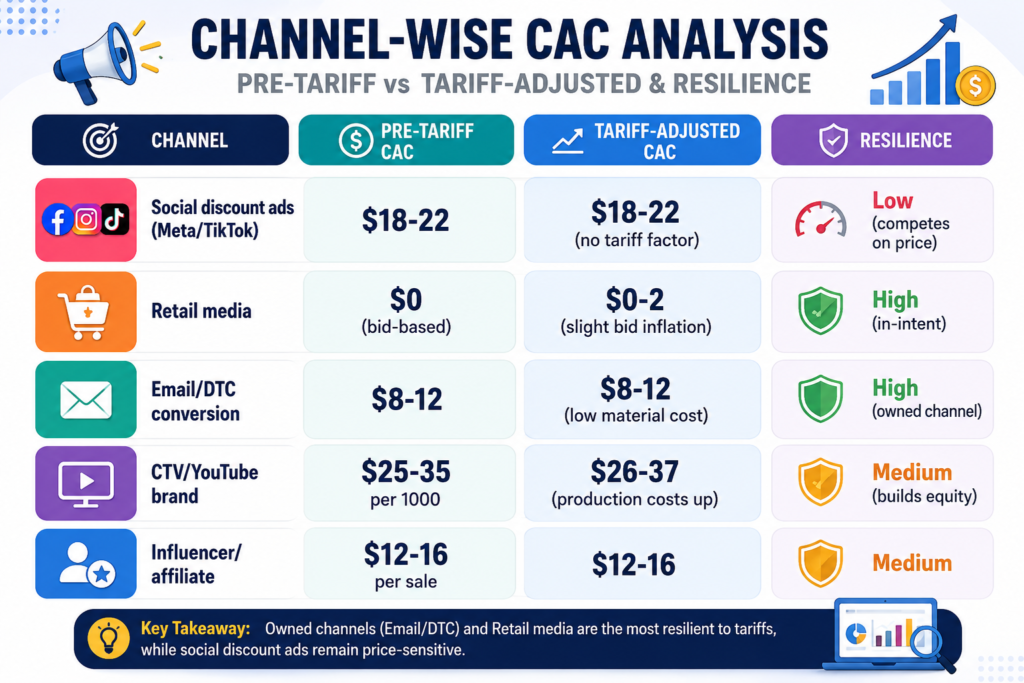
Programmatic channels email, owned apps, loyalty and retail media are outperforming mass media channels because they’re not cost inflating with tariffs and they’re not competing on discount intensity. Brands cutting media budgets uniformly are losing ROI across the board. Brands reallocating toward cheaper, higher ROI channels are protecting margin and maintaining efficient customer acquisition.
| Channel | Pre-Tariff CAC | Tariff-Adjusted CAC | Resilience |
|---|---|---|---|
| Social discount ads (Meta/TikTok) | $18-22 | $18-22 (no tariff factor) | Low (competes on price) |
| Retail media | $0 (bid-based) | $0-2 (slight bid inflation) | High (in-intent) |
| Email/DTC conversion | $8-12 | $8-12 (low material cost) | High (owned channel) |
| CTV/YouTube brand | $25-35 per 1000 | $26-37 (production costs up) | Medium (builds equity) |
| Influencer/affiliate | $12-16 per sale | $12-16 | Medium |
FAQs
How do I know if a price increase will trigger brand switching?
Consumer research shows transparency matters more than the price point itself. Price increases tied to ingredient specific sourcing changes or quality protection typically see 70% to 75% customer retention generic “supply chain” messages trigger switching to private label within two to three weeks. Before raising prices, audit your brand loyalty, if your repeat purchase rate is above 45%, you have pricing power. If it’s below 35%, every price increase needs brand investment to offset defection.
Should I introduce value SKUs or discount existing products?
Introducing new, clearly positioned value SKUs protects brand equity better than discounting premium lines. Discounting signals panic and erodes perceived quality. Bundle value SKUs with premiums in promotional campaigns buy one premium, get one value positioned to protect both margins and brand perception. Private label wins on “good enough at lower price.” You win by having both tiers in your portfolio, so customers have choice without brand equity erosion.
What’s the real tariff impact on my imported ingredients?
Depends on HS code classification and origin. Section 301 China tariffs run 25% Brazilian tariffs 10% Southeast Asian tariffs vary 10% to 46%. Work with your supply chain and customs team to identify USMCA (Mexico/Canada) or domestic alternatives for high volume ingredients. This often saves 8% to 15% vs. tariffed imports, even accounting for domestic sourcing premium. Lock in supplier relationships now tariff schedules and exclusion lists change quarterly.
Is private label cannibalizing my brand, or are consumers just price conscious?
Both dynamics are at play. Price conscious shoppers are trying private label, but they’ll return if you offer clear differentiation unique flavor, quality signaling, brand transparency. Brands that lost share during tariff pressure typically lost it to communication failures, not price alone. Fix your tariff messaging first then look at product differentiation and positioning.
How should I adjust my promotional calendar for tariff uncertainty?
Confirm Q4 production slots and pricing now rather than risk mid campaign cost surprises. Develop regional promotional plans tied to tariff scenarios assume tariffs hold through 2026 rather than assuming flat costs. Shift budget from broadcast discounts to targeted digital and loyalty programs, which deliver better ROI in uncertain environments. Lock in media commitments with flexibility clauses so you can pivot quickly if tariffs change.
Conclusion:
Tariff inflation isn’t a problem to defend against it’s a structural shift that demands new marketing strategy.
The brands treating tariff impacts as a defense problem (how do I minimize margin loss? are losing. The brands treating it as a channel mix and communication problem (how do I shift volume to higher margin channels and message transparently? are building resilience.
The data is unambiguous. Brands that reallocated paid media spend rather than cutting uniformly held or grew margin. Brands that leaned into discounting to offset tariff costs eroded margin faster. Brands that shifted volume toward owned channels and retail media improved both margin and customer lifetime value.
As tariff uncertainty stretches into 2026 and beyond, the positioning and messaging decisions you make now will determine whether tariff inflation becomes a margin problem or a margin opportunity. The brands winning in this environment aren’t hoping tariffs disappear. They’re building marketing strategies that work regardless.
