
Record cattle prices are minting profits for cow calf producers, but smaller farms attempting direct to consumer sales face an inverted margin equation. Here’s why the highest cattle prices on record don’t guarantee profitability
A rancher buys a feeder steer in June 2025 for $310 per hundredweight, a record price. She plans to finish it through the winter, ship it DTC by spring, and pocket the premium margin. But when she factors in processing wait times, cold chain shipping, packaging, and e-commerce infrastructure, that premium evaporates. This isn’t a pricing problem. It’s a structural one.
- $6.25/lb Ground beef retail price in July 2025, the highest since records began in 1984
- $906/head Estimated 2025 cow-calf producer returns over cash costs; 2026 forecast drops to $825/head
- $50-$300/head (negative) Average packer and feedlot margins through 2025-2026, despite record cattle prices
- 71% Percentage of U.S. farms and ranches with operating profit margins below 10%
Record beef cattle prices in 2025-2026 have created a profit paradox: while cow calf producers enjoy historically high returns ($906/head), nearly every other segment of the supply chain, from stocker operators and feedlots to custom processors and small DTC operations faces margin compression. For smaller producers attempting direct to consumer sales, record wholesale prices collide with fixed operational costs processing, shipping, cold-chain logistics, packaging that rise independently of cattle prices. Understanding this supply chain asymmetry is essential for operators planning pricing strategy and channel allocation in 2026.
Key takeaways:
- Record cattle prices do not distribute evenly across supply chain segments
- Small DTC operations face a margin squeeze that wholesale operators may avoid
- Operational costs processing, shipping, infrastructure are the constraint, not retail demand
The Record Price That Didn’t Fix Everything
Retail beef hit $6.25 per pound in July 2025 ,the highest since the USDA started tracking data in 1984. This isn’t subtle market movement. It’s historic. Yet the paradox sits right there in plain sight: these record prices have not made the beef industry universally profitable. They’ve done the opposite. They’ve created a two tier profitability map where one segment wins big while every other layer of the supply chain gets squeezed.
Consumer demand for beef remains strong. In fact, according to the USDA Economic Research Service, American beef consumption is running at its highest level in roughly 20 years, even as retail prices remain at record highs. People are buying more beef and paying more for it a dynamic that almost never happens together. This is demand side strength, not panic buying or hoarding. It’s a structural preference for beef in the American diet.
But here’s where the geometry breaks: the U.S. beef herd stands at 86.7 million head as of January 2026, the lowest since the early 1950s. Supply has collapsed. The cattle industry has been in a liquidation cycle for 12 years. These record prices aren’t a temporary spike. Record beef imports haven’t lowered them because the domestic herd is at a 70 year low, which is why the squeeze on downstream operators persists into 2026–2027 When supply tightens this severely and demand holds, prices spike. That’s inevitable. What’s not inevitable what actually takes structural understanding is who captures that price spike. Only one segment of the cattle supply chain is actually winning at these prices. Everyone else is getting squeezed from both directions.
Where the Profit Goes (And Where It Doesn’t)
The cattle supply chain moves like this: cow calf producers raise calves. Stocker operators or feedlots buy those calves and add value through feeding and weight gain. Packers process the finished cattle. Retailers distribute to consumers. In a normal market, margins thin at each step, but they exist. Everybody makes something. Right now, that’s not what’s happening.
Cow calf producers:
These are the winners. Calf prices have skyrocketed, and producers holding cattle benefit immediately from the price jump. According to the Livestock Marketing Information Center data cited by trade sources, cow calf operations are running returns over cash costs of roughly $906 per head in 2025. That’s historically high. The 2026 forecast drops to $825 per head, still well above break even. This is the only segment of the chain making money hand over fist.
Stocker operators:
These producers buy young cattle and hold them, usually for 6-12 months, adding weight and conditioning before selling to feedlots. They’re getting hammered. High calf prices mean high purchase costs. Meanwhile, feedlots are competing fiercely for limited feeder supply, which keeps stocker operators from pushing purchase prices down. Margins here are thin to negative.
Feedlot operators:
For a while, feedlots could stay profitable because of a built in time lag. They buy calves in one season and sell finished cattle six months later. When prices are rising, that lag works in their favour. But as cattle supplies tighten further, feedlots face fewer available calves to purchase. Margins are tightening faster now than they were even six months ago.
Packers:
This is where the squeeze is most visible. Packers are reporting losses of $50 to $300 per head in 2025 and into 2026. Why? They’re forced to buy high-priced live cattle, process them, and sell wholesale beef into a retail market where price increases haven’t kept pace with their input costs. Plant capacity mismatches the available cattle supply, and labor costs remain elevated. The spread between what they pay for live cattle and what they receive for beef has collapsed.
Small DTC operators:
These producers face a different problem entirely. They’re not buying and selling into a commodity market. They’re building a business. But they’re building it while facing record-high cattle prices input cost spike, record high processing wait times (6-8 months typical for custom FSIS processors as of Q1 2026), and fixed operational costs that don’t scale with commodity prices.
Here’s the margin reality:
| Segment | 2025 Status | Primary Pressure |
|---|---|---|
| Cow calf | Historically high ($906/head) | Heifer retention limits, drought risk continues |
| Stocker | Squeezed margins | High purchase price, tight feeder availability |
| Feedlot | Tightening margins | Fewer available placements, competing for limited calves |
| Packer | Negative ($50-$300/head losses) | Plant capacity vs. cattle supply mismatch |
| Small DTC | Compressed margins | Fixed ops costs processing, shipping, packaging unlinked to cattle price |
The pattern emerges fast: record live cattle prices don’t translate linearly down the supply chain. They concentrate at the top cow calf, then compress at every downstream layer.
The DTC Operator’s Margin Equation
Here’s the operational reality that most small producers discover too late: direct-to-consumer beef is not a scaling play on wholesale price signals. It’s a separate business model entirely.
A DTC beef operation requires 18 to 24 months from animal purchase throug final sale. Wholesale paths are 6 to 12 months. That time lag alone introduces massive risk and cash flow strain. More importantly, it means the finished steer price your DTC operation achieves is not actually determined by the wholesale market price at slaughter. It’s determined by your retail pricing ceiling, which is set by customer psychology and competitive retail positioning.
Pre selling half beef and whole-beef shares through a landing page is core to the model what a proper meat storefront needs to handle whole animal pre orders and sell by weight checkout. Your retail pricing ceiling is anchored to what customers see at Whole Foods, Kroger, and local butcher shops. When those retailers show ground beef at $7-8 per pound, you cannot sustainably price DTC ground beef at $12 per pound just because your feeder steer cost $310 per hundredweight. Customers will compare. They will balk.
So your retail price is pinned down by market perception. Your input cost, meanwhile, is floating with wholesale cattle prices. When cattle prices spike, your input cost spikes, but your revenue ceiling does not move proportionally. The margin gets crushed.
Across our implementations of direct to consumer eCommerce systems for beef producers and ranchers, we’ve observed a counterintuitive pattern: record cattle prices actually worsen DTC economics because they spike input costs while leaving retail pricing ceilings unchanged. This is a supply chain geometry problem, not a market sentiment problem. Now layer in the operational cost stack. A small producer finishing a steer in 2025 faces these expenses:
| Cost Component | Typical Range | Notes |
|---|---|---|
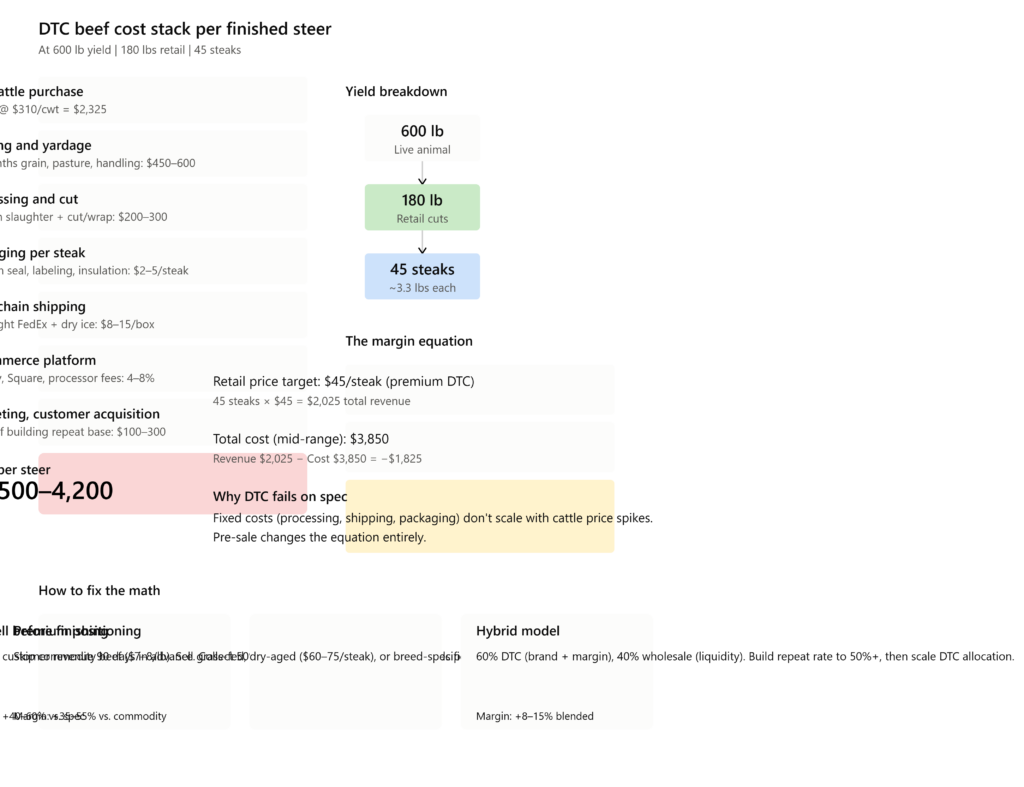
| Live cattle purchase (750 lb @ $310/cwt) | $2,325 | Market price as of Q1 2026 |
| Feeding and yardage (18 months) | $450-600 | Grain, pasture, handling, risk management |
| Processing custom slaughter + cut/wrap | $200-300 | Wait times: 6-8 months typical for FSIS facilities |
| Packaging per steak or box | $2-5 | Vacuum seal, labeling, insulation material |
| Cold chain shipping per box | $8-15 | Overnight FedEx/UPS + dry ice mandatory |
| E-commerce platform and payment processing | 4-8% of revenue | Shopify, Square, processor fees, compliance |
| Marketing and customer acquisition | $100-300 | Lower if building repeat base organically |
| Total per finished steer | $3,500-4,200 | At 600 lb yield about 180 lbs retail = 45 steaks |
A finished steer yielding roughly 600 pounds at slaughter produces about 180 pounds of retail cuts, which breaks into roughly 45 steaks at market-weight. At competitive DTC pricing of $40-50 per steak premium but not luxury, that steer generates $1,800-2,250 in retail revenue. After subtracting the $3,500-4,200 cost stack, the math shows breakeven to negative margins. That’s before accounting for spoilage, customer returns, refunds, or the cost of building brand awareness in year one. This is why small producers often use wholesale as a margin cushion while slowly building DTC customer base.
Critical point:
The packaging, shipping, and dry ice costs are the single largest controllable expense in this stack. According to reporting from Ag Proud, producers consistently identify these three items as their biggest operational challenge. One Montana rancher operating S Ranch Meats said bluntly: That’s our biggest chunk of cost.
Processing Bottlenecks and Cold Chain Reality
Here’s a logistics problem that many operators underestimate your beef can only sell DTC if your processing window aligns with your DTC customer window. Right now, those windows are severely misaligned.
Custom FSIS processors are backed up. Not slightly behind. Backed up 6 to 8 months in most regions as of Q1 2026. This is partly a carryover from the pandemic, when processing facilities saw their capacity crushed by staffing shortages and plant closures. It’s partly because feedlots and cow-calf operations are all trying to process cattle at the same time during historical supply constraints.
If you finish a steer in June and the processor won’t see it until January, you have a timing problem. Your DTC customer might have wanted that beef in July. Your competitor who pre-sold six months out has customer orders already locked in. You’re playing catch up.
The cold chain logistics are equally unforgiving. Overnight shipping via FedEx or UPS to individual consumers is not like shipping a pallet to a restaurant. You need insulated packaging, dry ice, and a carrier that understands food safety. The cost is $8-15 per box, minimum, for a box that might contain 4-6 steaks. That’s $1.33 to $3.75 per steak in shipping alone. Packaging, dry ice, and overnight freight are the single largest controllable line in this stack, and they behave very differently by distance, the break even math on cold chain shipping by region shows exactly where DTC meat margins survive or collapse.
Add packaging materials $2-5 per steak, add the initial purchase of dry ice blocks and insulation one time setup cost of $500-1,500, and suddenly the cold chain component of your cost stack is north of $2 per steak. On a $45 retail steak, that’s 4-5% of revenue, before any margin is captured.
Producers who succeed in this environment do two things:
First, they negotiate cold chain partnerships. They work with custom processors on volume guarantees to shorten processing windows. They negotiate bulk rates with FedEx or UPS. They buy packaging materials in volume from wholesale suppliers. Every dollar saved per box improves margins by 2-3% across the operation.
Second, they pre sell. They don’t finish steers on spec. They pre sell half beef or whole beef shares 90 days in advance through a landing page (Shopify, GrazeCart, or custom app). This locks in customer revenue before slaughter, de risks inventory, and creates cash flow that covers processing costs while you’re waiting for the processing slot.
A small producer finishing a steer in 2025 faces a price input timing mismatch. Feed costs and cattle purchase prices set in June 2025. Slaughter occurs 18 months later (December 2026 or later). DTC sales revenue lands in 2027. If wholesale beef prices soften between June 2025 and the time your DTC product hits the market, your retail price ceiling compresses even though your input costs are locked in. This is structural risk that wholesale producers do not carry.
Wholesale vs DTC The Distribution Paradox
The paradox is real: record wholesale cattle prices make the case for DTC look irrational on paper, yet DTC profitability is almost entirely independent of wholesale price signals. Here’s why:
Wholesale path:
You raise or buy cattle. You sell them live into the commodity market at the highest possible price taking advantage of record prices. The buyer bears all downstream risk processing, distribution, retail. You get paid fast, carry minimal risk post sale, and take your margin. In today’s market, that margin is tight for feedlot operators but generous for cow calf producers. The wholesale path is liquid and fast. Money moves in months, not years.
DTC path:
You own all the risk from pasture to plate. You fund processing. You manage the cold chain. You acquire customers. You handle returns and complaints. You carry inventory risk. You manage spoilage. But if you execute well, you capture retail margin instead of wholesale margin. Retail margin on beef can be 2-3x wholesale margin if you eliminate middlemen and build repeat customer base. Here’s the key insight:
Record wholesale prices do not auto-translate to DTC profitability.
Wholesale price is mostly noise in the DTC model. What matters is your retail price ceiling fixed by customer perception and competition and your operational cost stack partially fixed, partially variable. Wholesale price affects your input cost, but that’s only one line item in a much larger equation.
A producer strategy that actually works in this environment looks like this:
A small operation 100 head of breeding cows in Central Texas decides to split their sales: 60% DTC, 40% wholesale. In summer 2025, they sell calves wholesale at record prices $380-420 per hundredweight for feeder steers. This generates cash flow and liquidity. Simultaneously, they select 20 steers for DTC finishing. They build a landing page. They pre sell half beef and whole beef shares at $3,500-5,500 per share, locking in customer revenue in advance of slaughter.
Year one: the DTC operation runs negative or breakeven. But they acquire 50-80 customers. They capture email addresses and build repeat rate. By month six, repeat orders are running 40-50% of new customer acquisition.
Year two: they scale DTC to 60 steers and hold wholesale at 40. Now the DTC operation is cash flow positive because they’re not re-acquiring customers for every order. They’re managing repeat revenue. The repeat rate hits 60%+. They’ve built a stable margin layer on top of their wholesale business.
By year three, DTC represents 70% of sales and 80% of margin. They’re selling whole animals and premium cuts dry aged steaks at $60-75 per pound. They’ve shifted from being a wholesale commodity producer to being a brand with direct customer relationships. That’s the path to DTC profitability. It’s not about exploiting wholesale price spikes. It’s about building recurring revenue on customer retention.
Positioning Strategy for Small Producers in 2026
If you’re a small producer reading this 100 to 300 head operation, mid-range land base, And the squeeze isn’t a one year event the herd contraction means pricing for a tight supply decade, not a 2027 reversion. thinking about DTC, here’s what actually works right now:
Hybrid model first.
Don’t go all in on DTC. Run 60% of cattle through wholesale channels capture liquidity and de risk and reserve 40% for DTC pilot build brand, test operational model. Once your DTC repeat rate hits 50%+ in months 3-6, you’ve proven the model. Scale allocation from there. This approach also gives you a wholesale margin cushion if DTC operations underperform in year one.
Pre sell, don’t speculate.
Use a landing page to pre sell half beef and whole beef shares 90 days in advance. Collect 50% deposit upfront. You now have customer revenue and cash flow before slaughter. This also gives you hard demand signals for processing volume and delivery timing. You’re not guessing. You’re matching production to locked in orders.
Lock processing time early.
Identify the custom FSIS processor within 150 miles of your operation. Confirm their current wait time if it’s more than 12 months, you’re not viable for DTC right now. Negotiate a volume commitment: I’ll bring you 20-30 steers per quarter starting Q3 2026 in exchange for a shorter processing window. This is how you break the bottleneck.
Build cold chain partnerships.
Negotiate bulk FedEx or UPS accounts before you need them. Work with packaging suppliers to buy insulation and vacuum seal materials at volume rates. Partner with a butcher shop or custom processor for packaging services if that reduces your per unit cost. Every $2 saved per box is 2-3% margin improvement.
Use specialty programs to escape commodity pricing.
Don’t compete on ground beef at $7.50 per pound. You’ll lose. Record prices have also raised buyer scrutiny why independent beef branding now has to prove provenance, not just claim it which is where specialty positioning either earns its premium or doesn’t. Instead, offer grass fed beef, dry aged steaks 14-20 days aged beef commands $60-75 per pound, or breed specific programs (Black Angus, Wagyu, heritage breeds). These programs let you price at premium tiers and escape direct competition with supermarket commodity beef.
Email and SMS before social media.
Build an email subscriber base from day one. Email open rates for meat subscriptions run 25-35%. Social media reach has collapsed due to algorithm changes. Email is your highest-return channel for customer retention. Capture email at checkout, incentivize signups with a discount on first order, and you’ve got a direct line to repeat revenue.
Decision Framework for Channel Allocation
If you’re deciding right now whether to commit to DTC or stay wholesale, use this framework:
1. Audit your operation’s cash-flow capacity.
Can you carry 18-24 months of finished inventory without triggering a financial crisis? If the answer is no, wholesale is safer. Pair it with a small DTC pilot (5-10 steers) to learn the model without betting the farm. If yes, you have the runway to absorb DTC startup costs.
2. Map your processing bottleneck.
Identify the nearest FSIS custom processor. Call them. Get their current wait time Q1 2026 baseline: 6-8 months nationally. If it’s under 9 months and they’re open to volume commitments, DTC is viable. If it’s over 12 months, you’re priced out for 2026. Wait another year for capacity to clear, or explore partnering with a processor that has better access.
3. Run the margin math in reverse.
Set your target DTC price per pound based on local competitor research Whole Foods, local butcher shops, regional DTC brands. Let’s say you target $8.50/lb for ground beef and $45-50/steak for premium cuts. Now calculate your required cost structure. If wholesale cattle cost $310/cwt and your processing/packaging/shipping totals $2,000+ per steer, are you even in the ballpark for profitability? If the math doesn’t work at those prices, either your input costs are too high (negotiate harder) or your target market is wrong upgrade to grass fed/dry-aged positioning.
4. Pre-sell or lock in DTC customers before finishing.
Don’t finish inventory on spec. Use a landing page Shopify or GrazeCart takes 20 minutes to set up and collect pre orders for half-beef and whole-beef shares. Collect 50% deposit. You’ve now de risked inventory and funded processing costs with customer money, not borrowed capital.
5. Start hybrid and scale only after proving repeat rate.
Open with 30% DTC pilot, 70% wholesale (liquidity). Track customer repeat rate weekly. Once repeat hits 50%+ of new customer acquisition, you’ve proven the model. Expand DTC allocation. If repeat rate stalls at 30%, your product or pricing is wrong fix it before scaling.
6. Optimize cold chain cost through partnerships.
Before you launch, negotiate bulk shipping rates, buy packaging at volume, and partner with a processor on packaging labor if available. A 15-20% reduction in per unit cold chain cost is 2-3% margin improvement across your whole operation.
FAQs
Why aren’t small beef farms winning at record cattle prices?
Record wholesale prices benefit only producers who sell live cattle immediately (cow calf operations). Producers who take ownership risk through processing and DTC sales face fixed costs processing, shipping, packaging, cold-chain logistics that rise independently of wholesale prices. Your retail price ceiling is set by customer perception tied to Whole Foods ground beef prices, not your input costs. When input costs spike faster than retail prices, margins compress.
Should I sell my feeder steers wholesale or finish them for DTC?
Wholesale is lower risk and provides liquidity at record prices smart for 2025-2026 in a tight supply environment. DTC is higher-margin but requires 18-24 months of ownership risk, processing bottleneck navigation, and customer acquisition investment. Hybrid is safest: 60% DTC build brand and recurring revenue plus 40% wholesale liquidity buffer and margin hedge. This lets you learn DTC without betting the farm.
How much does it cost to ship beef DTC?
Overnight shipping plus insulation plus dry ice typically costs $8-15 per box roughly 4-6 steaks per box. Add packaging $2-5 per steak and processing $200-300 per finished steer, and your DTC cost stack reaches $3,500-4,200 per finished steer. That must be netted against retail revenue target. At 180 lbs retail yield per steer, you’re looking at breakeven to negative margins unless you’re pre-selling or operating at premium pricing $60+ per steak for specialty programs.
Is it worth waiting 6-8 months for custom processing?
Only if you’re pre-selling DTC in advance. If you’re finishing inventory on spec and hoping to find DTC customers post slaughter, the wait time destroys competitive positioning and cash flow. Use the processing bottleneck as a forcing function pre sell your beef 6 months out, lock in customer revenue, then send to slaughter on schedule. This flips the bottleneck from a liability into a feature scarcity marketing.
What’s the fastest path to DTC profitability?
Recurring revenue model subscription meat boxes, monthly CSA style membership. One time steaks sales require high customer acquisition cost (CAC) and rely entirely on single order margin. Monthly subscriptions reduce CAC because you’re not re-acquiring customers constantly. They increase lifetime value (LTV) because customers stay subscribed 8-12+ months. Target 50%+ repeat rate in months 1-6. Scale DTC allocation only after hitting that benchmark. Repeat revenue is where actual margin sits.
Conclusion
Record cattle prices in 2025-2026 have upended the old binary of industry profitability. You’re either a cow calf producer capturing windfall margins, or you’re every other segment getting squeezed. For small producers, the squeeze is real. But it’s not permanent, and it’s not a market failure. It’s a supply chain geometry problem with a solution.
Small producers who succeed are those who reframe DTC not as a margin play on commodity prices but as a brand and recurring-revenue business. They pre sell. They negotiate cold-chain partnerships. They invest in repeat customer infrastructure. They use hybrid channels to buffer risk. And critically, they don’t chase wholesale prices. They chase customer relationships.
The next 12 to 24 months will separate producers who adapted their operational model from those who tried to compete on wholesale prices while bearing DTC cost burdens. In a market this tight, the winners aren’t those with the highest cattle prices. They’re the ones who optimized the full margin path from pasture to plate.
