
Discovery velocity on TikTok has become the signal category buyers use to allocate shelf space, and food and beverage brands without a social commerce posture are absent from the one place their next retail decision now gets made.
You found out a competitor’s hot sauce sold out on TikTok when your own category buyer mentioned it in a review meeting, before you had finished the deck arguing for the placement they had already handed away. That is the new order of operations in food eCommerce. In 2025, US shoppers ran more than 103 billion searches on TikTok with the intent to buy something, and the brands catching that traffic are turning it into retail leverage the rest of the category cannot see coming.
$100B+ US social commerce crosses $100 billion for the first time in 2026.
3 in 4 Share of TikTok users who call it their top product discovery destination.
2x+ TikTok Shop’s food and beverage category has more than doubled year over year.
~$23B Projected 2026 US TikTok Shop sales, larger than Target or Costco online.
Key takeaways:
– Treat TikTok Shop as a discovery and shelf signal engine, not a bolt on ad channel
– The real risk is retail invisibility, not only lost online revenue.
– Category fit decides the play ambient goods convert, cold chain items sense demand.
Discovery Moved, and It Does Not Look Like a Shopping List
For a decade, food eCommerce meant capturing intent that already existed. A shopper needed oat milk, searched for oat milk, and bought oat milk. TikTok Shop broke that sequence. The purchase now happens because a creator pulled a protein bar apart on camera at nine at night, and the viewer tapped through before the video ended. That distinction matters more than it sounds. Amazon and Instacart harvest a shopping list you brought with you. TikTok Shop writes items onto a list you did not have. According to Food Dive, TikTok’s food and beverage sales have more than doubled year over year, riding what the platform calls discovery commerce.
The scale behind that phrase is not a rounding error. TikTok logged more than 103 billion purchase intent searches from US users in 2025, with total transaction volume up nearly 80 percent. For a category that has spent years fighting for a few inches of endcap, a channel that manufactures demand rather than fulfilling it changes the entire budgeting conversation.
It also changes who discovers you. Three in four TikTok users say the app is where they go to find new products, which means a brand’s next customer is increasingly meeting it mid scroll rather than mid aisle. That is a different first impression than a shelf tag, and it rewards different work. Discovery is fragmenting across surfaces, and the “be present in the signal or be invisible” logic applies well beyond TikTok why farm brand storytelling is failing in AI search, and what to build instead.
This is a top tier channel, not an experiment. TikTok Shop’s US sales are projected near $23 billion in 2026, which would put it ahead of Target’s or Costco’s online businesses. Budget for it the way you budget for a major retail account, not the way you budget for a boosted post.
The ownership question that hung over all of this is now settled. TikTok’s US operations closed a roughly $14 billion divestiture into a US led joint venture in January 2026, so the “will it even be here next quarter” objection that stalled brand planning through 2025 no longer applies. The engine is intact, and it is domestically owned.
The Shelf Became a Lagging Indicator
Here is the part worth sitting with. Category buyers at national chains now watch social velocity as an early demand signal, and they act on it before your quarterly sell through report lands on their desk. A viral moment is no longer just a sales spike. It is an audition for shelf space, scored in public.
Across the perishable and shelf stable eCommerce implementations our research team has audited, one pattern separates the brands winning distribution from the ones stuck in category review purgatory. Discovery velocity has quietly become a leading indicator that buyers track, while a brand’s own retail sales have become a lagging one. Operators losing ground are rarely losing on product quality. They are losing because they are invisible in the exact signal that now governs where product goes.
The brands riding this understand the sequence. Winning discovery velocity means little if the product never earns a second purchase why Gen Z’s 3-3-3 basket rule decides what survives the viral moment. A creator led launch generates velocity, the velocity gets noticed by a buyer, the buyer opens a category review conversation, and shelf space follows. Functional beverage names that appeared from nowhere and landed in national retail inside eighteen months did not skip the line. They built a signal loud enough that the line came to them.
A viral creator’s video drove immediate online sales, and shortly after, a noticeable lift in retail pull through.
Grace Manwaring, Co-Founder and CMO, Kava Haven (functional beverage brand) The operators who miss this treat a viral clip as a one day revenue event and move on. The ones who compound it capture the data.
A viral clip is a retail entry document. When a product moves on TikTok, screenshot the velocity and bring it to your next category review meeting, not just to your finance report. Buyers are already looking for that proof. Handing it to them shortens the path.
What Actually Sells on TikTok Shop, and What Stalls
Not every food product belongs here, and pretending otherwise wastes money. TikTok Shop is a visual medium with a short path to purchase, so products that demonstrate well and ship easily win. Products that need refrigeration, regional routing, or a reason to buy online instead of at the store nearby tend to stall.
What converts cleanly functional and sparkling beverages, specialty oils and vinegars and sauces with a craft story, and anything with a form factor a creator can show in seconds. What underperforms cold chain perishables, grocery staples with no online purchase motivation, and products locked to a regional distribution footprint.
The winners share a quality Parker calls scroll stopping. Candy salad, Dubai chocolate, and extreme sour or spicy flavors perform because they trigger a visible reaction on camera, and functional foods and drinks convert when a creator can tie the benefit to a health or wellness moment in a single clip. If the product cannot be demonstrated, it tends to struggle here regardless of how well it sells on a shelf.
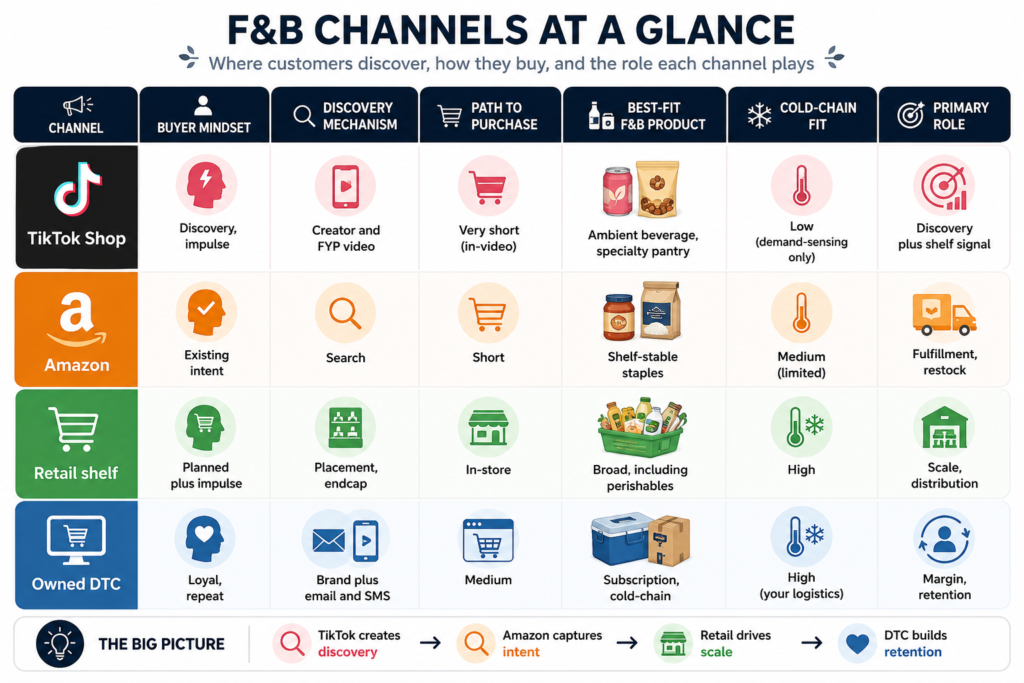
For perishable operators, the honest read is not skip it. It is use it differently. The cost structure of shipping perishable product direct rarely survives an impulse purchase built around free or fast shipping, so routing full cold chain fulfillment through TikTok Shop breaks the unit economics before the audience even converts.
| Channel | Buyer mindset | Discovery mechanism | Path to purchase | Best-fit F&B product | Cold-chain fit | Primary role |
|---|---|---|---|---|---|---|
| TikTok Shop | Discovery, impulse | Creator and FYP video | Very short (in-video) | Ambient beverage, specialty pantry | Low (demand-sensing only) | Discovery plus shelf signal |
| Amazon | Existing intent | Search | Short | Shelf-stable staples | Medium (limited) | Fulfillment, restock |
| Retail shelf | Planned plus impulse | Placement, endcap | In-store | Broad, including perishables | High | Scale, distribution |
| Owned DTC | Loyal, repeat | Brand plus email and SMS | Medium | Subscription, cold-chain | High (your logistics) | Margin, retention |
For cold chain brands, sense demand, do not ship from here. Use TikTok Shop to build audience and test which products draw a reaction, then convert that demand to DTC or retail where your logistics already work. The signal is the asset. The fulfillment stays where it is profitable.
The Cost of Sitting Out
The uncomfortable math is that absence compounds. While one brand sits out, its rivals bank velocity data that keeps buying them shelf placement and paid media justification, and that advantage does not reset each quarter. It stacks. The channel is also consolidating around brands with resources. US social commerce will surpass $100 billion for the first time in 2026, per eMarketer, and the scaled players are moving fastest to claim it. This is no longer a place where only tiny viral brands play.
Scaled brands are not waiting. Enterprise brand sales on TikTok Shop rose roughly 97 percent year over year, and the number of brands with $30 million or more in revenue joining the platform grew about 95 percent in the first half of 2025, per Digiday’s reporting.If your competitive set is above $30 million, most of them are already in.
The cost of sitting out is rarely a line item you can point to, which is exactly why it gets ignored. It shows up as a category review meeting you were not invited to, a buyer who already gave the slot to a brand with proof, and a launch window that closed while you were still deciding. Several viral moments drew the attention of retail buyers, and the platform data sped up the process of entering retail.
Ben Amaya, Marketing Director, EZ Bombs (seasoning brand) Amaya’s brand is the clean version of the loop in action. EZ Bombs used TikTok momentum to reach roughly $19 million in sales and land placement in more than 1,000 stores, including Walmart and Albertsons, inside a single year, according to retail analytics firm Charm. That is not a marketing anecdote. It is a distribution outcome that started as content.
None of this lands on the first video, though. The brands that win here treat the channel as something to build rather than a lottery ticket, and they give it enough runway to gain traction before judging it. Patience is part of the strategy, not a hedge against it.
Content, Creators, and the New Innovation Loop
TikTok Shop did not just move where product sells. It moved where product gets invented. The platform now functions as a research and development layer, a testbed for limited flavors,and a faster feedback loop than most stage gate innovation processes allow.
The clearest example is candy. A content trend around popped and freeze dried sweets appeared organically, TikTok native brands commercialized it quickly, and then Skittles itself developed a popped product on an accelerated timeline and brought it back as an exclusive TikTok Shop launch. The trend, the trial, and the commercial product all lived in the same place.
Enterprise food companies noticed. PepsiCo, Mars, and Hershey have leaned into the app to launch flavours and test concepts and engage superfans, a set of moves once reserved for grocery partners. The same reporting notes how the platform has disrupted the retail media networks run by Amazon and Walmart,giving brands a discovery route those networks cannot replicate.
Here is how the loop tends to run once a brand commits to it:
1. Seed content, not ads. Authentic creator video outperforms polished production because it reads as a recommendation, not a pitch.
2. Watch what draws a reaction. Texture, extreme flavor, and a clear benefit generate the on camera moments that convert.
3. Move on virality fast. You cannot predict which product pops, but you can be ready to supply and merchandise the one that does.
4. Extend into retail and DTC. Capture the halo effect across your other channels, where the same audience now recognizes the product.
Assortment is the quiet lever most brands underuse. Parker’s guidance is a hero product supported by variety packs and bundles that let a shopper try several flavors at once, paired with tentpole seasonal and limited time drops that spike on top of always on sales. The other consistent finding is that authentic creator content beats polished advertising, because users treat a creator’s recommendation like advice from a friend in their living room rather than a commercial.
Legacy brands get a second act here too, finding new audiences for products that have sat on shelves for years. The product did not change. The discovery surface did.
Fitting TikTok Shop Into an Existing Channel Stack
The most expensive mistake is treating TikTok Shop like a channel you already run.It is not just social media, and it is not just DTC. Amanda Parker, TikTok Shop’s head of food, describes it as a closed loop system where Shop strategy and broader media spend move together, and where treating the two as disconnected leaves performance on the table.
Discovery is only half the battle when shoppers are actively reconsidering the brands they buy — how tariff-driven inflation is reshaping consumer loyalty, and what protects it. Do not measure it like Instacart. Treating TikTok Shop as an Instacart attribution substitute misreads the buyer. One is in discovery mode, the other is in grocery planning mode. Judge the channel on the wrong KPI and you will kill a working program because it did not behave like a channel it was never meant to replace.
There is also a discipline question that separates durable programs from expensive ones. TikTok Shop rewards promotion, and it is easy to slide into constant discounting to chase volume, which erodes the margin the channel was supposed to protect. The brands that hold up apply the same restraint they use elsewhere the discipline that keeps food and beverage brands from racing to the bottom on price when input costs climb applies just as directly to a shoppable video as it does to a paid search campaign. A flavor that only moves at a permanent discount is not a TikTok Shop win. It is a margin problem wearing a growth costume.
Slotted correctly, TikTok Shop sits at the front of the funnel and feeds everything behind it. It creates the demand, DTC captures the margin and the repeat purchase, Amazon handles restock, and retail carries scale. Each channel keeps its job. The mistake is asking one channel to do another’s.
How to Set Your TikTok Shop Posture
There is no single correct level of investment. The right posture depends on your size, your category, and how your product ships. Find your row and start there.
1. Emerging or content-native brand.
Lead here. TikTok Shop is your lowest-barrier path to trial and can precede any retailer partnership, so treat velocity as the evidence you bring to future retail conversations.
2. Scaled CPG at $30 million or more.
Use it for launches, limited flavors, and R&D validation rather than core distribution.You are competing against the roughly 95 percent of peers who already joined.
3. Legacy brand with dormant SKUs.
Deploy creators to resurface existing products. The audience is new even when the product is not.
4. Perishable or cold-chain operator.
Use it as a demand-sensing and audience-building layer that feeds DTC and retail. Do not route full cold-chain fulfillment through it.
5. Regionally constrained brand.
Prioritize awareness and localized creator content over a national shoppable rollout until your distribution can meet the demand you create.
FAQs
Is TikTok Shop actually worth it for a food brand, or is it just hype?
Worth it as a discovery and signal channel. US social commerce tops $100 billion in 2026, and TikTok Shop’s food category has more than doubled year over year. The payoff is trial plus retail leverage, not only online sales, which is why category fit matters more than raw reach.
How is this different from selling on Amazon?
Amazon captures intent you already have. TikTok Shop creates it. One is a search driven shopping list, the other is discovery inside content that a creator makes compelling. They serve different buyer stages,so measure them separately or you will misjudge both channels on the wrong numbers.
Do retail buyers really look at TikTok performance?
Increasingly yes. Category buyers now track social velocity as an early demand signal, and viral moments have accelerated brands into national retail in under eighteen months. A documented velocity spike has become useful evidence in a category review conversation, not just a vanity metric.
Can I sell on TikTok Shop if my product needs refrigeration?
You can, but fulfillment friction limits it. Cold chain and catch weight brands typically use TikTok Shop to sense demand and build audience, then convert that interest to DTC or retail where their logistics already work. The signal is the asset. The shipping stays where it is profitable.
Conclusion
TikTok Shop stopped being a place to sell a few units to teenagers and became a demand engine that retail buyers now read like a forecast. For food and beverage brands, the strategic question is no longer whether the channel works. It works. The question is whether you are generating a signal in the one place your competitors, and your buyers, are already watching. Sitting out does not keep you neutral. It keeps you invisible in the data that decides your shelf.
