
Refrigerated freight at $2.35 per mile is killing DTC meat box margins. See the break even analysis by region and why shelf stable sticks are winning.
The Math Behind Every Frozen Meat Box
In October 2025, trade analysts at 2PM made a quiet observation that’s been rattling through the meat industry playbook ever since: direct to consumer meat had hit a ceiling. Not because consumers stopped wanting premium beef delivered to their door, but because freight bills and cold chain math woke up the operators running those services. Translation: the unit economics stopped working.
A 15 pound frozen beef box shipped across the country now costs $35 to $55 just to move via refrigerated carrier, depending on distance and season. Add $8 to $12 for insulated packaging. Add compliance documentation. That’s $50 to $65 in landed freight cost on a subscription priced between $150 and $270. The subscription margin, before you’ve even covered warehousing, customer service, or the beef itself, just vanished.
This isn’t a problem that goes away if you ignore it. Refrigerated last mile delivery runs 3 to 4 times the cost of ambient temperature shipping, according to Emergen Research’s 2024-2034 DTC food market analysis. That’s not a variable you can negotiate around with your carrier. That’s the structural reality of moving frozen protein in climate controlled trucks with real time monitoring and compressed delivery windows. Fuel surcharges, driver shortages, equipment scarcity, liability insurance, compliance logging all of it stacks on top of the base rate. There’s no discount curve for volume at the last mile stage the way there is in CPG retail. The operators who’ve survived this shock have stopped trying to ship frozen beef nationwide. They’re either narrowing their radius, pivoting to shelf stable products, or both.
Why Subscription Box Margins Collapsed in 2025
Before 2025, the math looked workable on paper.
A $160 subscription box carried a product cost of $75 to $85 (raw beef, processing, packaging). Fulfillment and customer service came to $12 to $15. That left $60 to $65 in gross margin enough to cover shipping at the old school carrier rates $20 to $25, pay for customer acquisition, and still show a profit line. And the cost side isn’t going back down why the cattle herd contraction keeps beef costs elevated through 2028 means shipping efficiency is one of the few levers you fully control
Then three things happened at once.
First, carrier capacity tightened. The post pandemic freight normalization that started in 2023 bottlenecked hard in 2024–2025. Fewer trucks chasing more temperature sensitive loads meant spot rates climbed. Refrigerated freight spot rates now hover around $2.35 per mile, according to Tempk’s 2025 cold chain logistics tracking. A 2,000 mile haul costs $4,700 for a single truck. Split that across 8 to 10 boxes per shipment, and your per unit cost jumps to $50 to $60.
Second, beef prices stayed elevated. Beef prices have stayed high through this whole freight shock, and record imports haven’t eased them because the domestic herd is at a 70 year low a second cost pressure stacking on top of freight. Cattle herds in the U.S. hit a 75-year low, which compressed supply and kept wholesale beef prices 18 to 24 percent above 2019 levels through 2025. That cost flowed straight into COGS and eroded the margin cushion that used to absorb shipping volatility.
Third, the competition shifted product mix. Shelf stable meat products beef sticks, jerky, cured sausage became the growth vector. Circana data from 2024 showed that U.S. dried meat snacks, excluding jerky, generated $3.3 billion in sales, up more than ten percent from the year before, with beef sticks driving most of that growth. These products cost 60 to 70 percent less to ship because they don’t require reefer trucks, dry ice, or priority overnight delivery. They’re also high margin relative to their weight and shelf life is indefinite.
The frozen box operators who’d banked on scale and customer acquisition velocity found themselves holding a portfolio that couldn’t hit unit economics thresholds at national scope. The same period has been merciless to online beef. By late 2025, companies that had spent millions on customer acquisition were either culling their shipping zones, raising prices and watching churn spike, or killing the subscription model entirely.
The Refrigerated Logistics Reality
What made this shift brutal is that shipping cost isn’t opaque it’s just not something most ecommerce operators model into their pricing from the start.
Here’s how it actually breaks down:
Reefer truck spot rate:
$2.35 per mile (2025 mid year average, per Tempk). This is what a carrier charges to move a refrigerated trailer on an ad-hoc, non contracted basis. Contract rates run higher, typically 8 to 12 percent above spot, depending on year-round volume commitment.
Truck capacity:
One reefer trailer holds approximately 20,000 to 24,000 pounds depending on pallet configuration. For frozen beef boxes averaging 15 to 18 pounds, that’s 1,100 to 1,600 boxes per truck, depending on how tightly they pack.
Regional variation:
The math changes sharply by distance band:
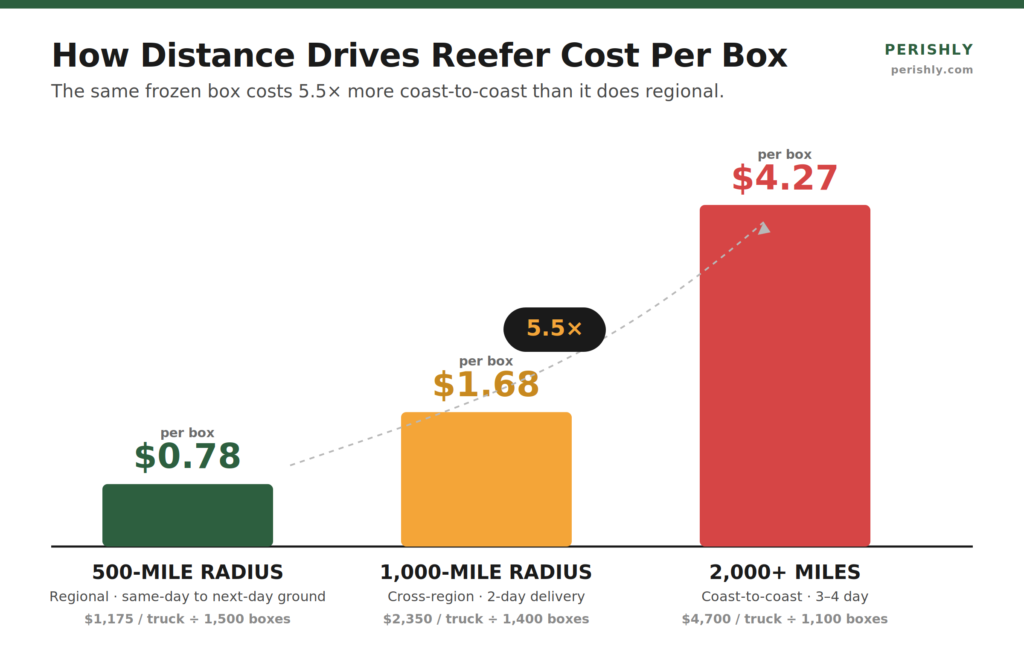
- 500 mile radius (regional, same day to next day ground): $1,175 per truck ÷ 1,500 boxes = $0.78 per box in reefer cost
- 1,000-mile radius (cross region, 2 day delivery): $2,350 per truck ÷ 1,400 boxes = $1.68 per box
- 2,000+ miles (coast to coast, 3-4 day): $4,700 per truck ÷ 1,100 boxes = $4.27 per box
Then you add:
- Insulated packaging: $8 to $12 per box (EPP foam, molded fiber, recycled content materials)
- Dry ice or gel packs: $2 to $4 per box
- Driver labor, dock time, and handling: absorbed in carrier rate
- Temperature logging devices: $0.30 to $0.50 per box FSIS compliance
- Insurance premium for perishable shipments: 2 to 3 percent on top of the base rate
Your total landed freight cost for a 2,000 mile box climbs to $55 to $70. On a $160 box, that’s 34 to 44 percent of the gross margin, before customer acquisition, before overhead.
The Shelf Stable Shift Why Beef Sticks Won
The margin math on shelf stable products is entirely different, which is why the industry pivot has been so swift.
A beef stick box 12 sticks, 4 ounces total, high protein snacking format ships via standard parcel carrier (UPS Ground, FedEx Home Delivery) for $8 to $12 coast to coast. No reefer, no temperature monitoring, no compliance logging. The product itself costs $3 to $5 per box to manufacture; wholesale margin is 60 to 70 percent.
At a $25 retail price, the unit economics look like this:
- COGS: $3.50
- Shipping: $10 worst case, national
- Packaging: $1.50
- Contribution margin: $10 per unit, or 40 percent
Compare that to the frozen box:
- COGS: $80
- Shipping: $55 national
- Packaging: $12
- Contribution margin: $13, or 8 percent
The frozen box needed to be priced at $220 minimum to clear 20 percent contribution margin at national scale. Regional operators could make it work at lower price points, but once you’re competing on a national direct to consumer shelf, the math doesn’t hold.
Circana’s data places total U.S. meat snack sales at about $5.5 billion for the year ending October 6, 2024, with beef sticks as the fastest-growing segment. The category added more than a billion dollars in retail sales since 2020 the exact expansion curve that DTC beef founders dreamed about before freight costs collapsed that dream.
FSIS, Compliance, and Hidden Cost Layers
Every DTC meat operator needs to ship within FSIS (Food Safety and Inspection Service) cold chain guidelines. This isn’t negotiable, and it’s not free.
FSIS Directive 8080.1 mandates that meat maintain a temperature between 32°F and 36°F during transport and storage. State level regulations can be stricter: California imposes 48 hour delivery windows for certain product types, New York requires real time temperature tracking at the box level, and some rural states have fewer certified carriers available, which drives costs up 15 to 20 percent. Shipping across state lines adds its own compliance layer the pending Direct Act and what interstate online meat sales require separate from the freight math itself.
The compliance cost adds 3 to 5 percent to your shipping cost:
- Temperature logging devices data cards or sensors: $0.30 to $0.50 per box
- Carrier certification verification: built into carrier rate but requires quarterly audits on your side
- Shipping documentation and chain of custody records staff time, CMS platform cost amortized
- Liability insurance specific to perishable products: 2 to 3 percent of the shipping cost.
These are line items. They don’t disappear if you don’t track them they just get buried in fulfillment overhead until your gross margin suddenly doesn’t match your cost based pricing model.
The Geography Question: Where DTC Meat Actually Works
Profitable DTC meat subscription, at current freight rates and beef prices, lives in specific geographies. Cold chain rules are one piece of a larger build what a complete meat eCommerce setup actually requires, from sell by weight checkout to shipping windows.
High density zones (same metro or 500 mile radius):
Viable. Regional 3PLs and smaller reefer carriers can consolidate orders into efficient routes. A micro fulfillment center smaller warehouse in a dense urban or suburban area can drop delivery cost to $15 to $25 per box on same day or next day ground. Operators like ButcherBox, which has built regional fulfillment networks, operate profitably here because they’ve compressed the shipping radius and built volume density with metro customers.
Mid range (1,000 mile radius):
Marginal. Two day ground reefer service works, but costs $30 to $40 per box. You need either a 10 to 15 percent price premium relative to regional operators which consumer acquisition won’t support, or a significantly larger average order size quarterly, half cow subscription rather than monthly, or very high retention 12 month LTV exceeds 4 times CAC.
National expansion (2,000+ miles):
Loss leader unless premium positioning. A $300 plus box can absorb the shipping cost and still show margin, but that’s a luxury positioning that doesn’t scale to a mass market subscription. One time gifting corporate, occasion based works here because the customer isn’t price comparing to retail; they’re buying novelty and status.
The operators who’ve thrived in 2025 have made deliberate bets on geography. They’ve narrowed customer acquisition to high margin zones, built regional fulfillment centers to compress distance, or pivoted the product mix to shelf stable formats. The ones who kept trying to ship frozen beef nationally are shrinking or exiting.
Technology That Actually Lowers Shipping Cost
Shipping cost is not a fixed line item. It’s a variable that responds to operational decisions.
A Transportation Management System (TMS) that integrates with your fulfillment center and carrier network can reduce shipping cost 8 to 15 percent without renegotiating rates, according to industry benchmarks. How?
Real time rate shopping:
Contract rates, spot rates, and regional carrier partnerships all have different costs for the same lane. A TMS automatically selects the lowest cost carrier that meets your delivery window requirement for each order. Over a month of thousands of orders, this compounds.
Order aggregation:
Small boxes shipped individually to the same region are expensive. If you batch orders by destination zipcode cluster and consolidate them into larger shipments, you hit carrier volume thresholds and negotiate better per unit rates. A TMS automates this consolidation.
Geographic customer targeting:
LTV (customer lifetime value) varies wildly by geography. A customer in Chicago acquired for $40 CAC might have 18 month LTV of $500 because they’re two days from your fulfillment center and shipping cost is low. A customer in rural Oregon has identical product preference but 40 percent higher shipping cost, which erodes LTV to $300. A smart TMS surfaces this and informs customer acquisition strategy spend on high margin geographies, hold spend in low margin ones.
Micro fulfillment placement:
Where you place fulfillment capacity is a capital decision that compounds daily. Placing a 500 square foot micro fulfillment hub in Denver instead of one centralized hub in Chicago cuts shipping distance for 30 percent of your Mountain West and Southwest customer base by 40 to 50 percent. One operator we worked with reduced average shipping cost from $38 to $22 per box via three regional hubs, which was the margin swing that moved them from break even to 18 percent contribution margin.
What This Means for Your DTC Meat Strategy
Freight is only one line in a much larger equation. The full DTC beef cost stack and pricing ceiling problem explains why even operators who fix their shipping math still face a margin squeeze at record cattle prices.
If you’re running a DTC meat subscription or considering starting one, here’s the diagnostic:
Question 1: Margin.
Does your $X subscription box clear 20 percent contribution margin after landed shipping cost is factored in? If the answer is no, either raise price and watch churn, cut product cost and watch quality perception, or reduce shipping cost which requires geographic narrowing or product mix shift.
Question 2: Geography.
Are more than 60 percent of your customers within 1,000 miles of your fulfillment center? If the answer is no, you’re subsidizing national reach with regional customers’ margins. The math doesn’t sustain.
Question 3: Retention.
Is your 12 month retention rate above 40 percent? If the answer is no, your customer lifetime value can’t absorb customer acquisition cost, let alone absorb high shipping costs on top of it.
If you answered yes to all three, stay in DTC subscription and optimize. If you answered no to two or more, you need to pivot reduce geographic scope go regional, shift product mix toward shelf stable, or exit the subscription model and go one time gifting or B2B wholesale.
The operators who’ve survived the 2025 freight shock made this choice deliberately in Q1 2025. The ones who didn’t are either shrinking order volumes to avoid losses or quietly winding down. There’s no in between in 2025.
FAQs
How much does it actually cost to ship frozen meat across the country?
A typical 15 pound frozen beef box shipped 2,000 miles via reefer carrier costs $35 to $55, depending on carrier, season, and lane density. Insulated packaging adds $8 to $12. Budget 10 to 15 percent of your box price for shipping alone on national orders. For regional 500 mile delivery, expect $15 to $25.
Why are refrigerated shipping costs so much higher than regular parcels?
Last-mile refrigerated delivery runs 3 to 4 times the cost of ambient temperature shipping. The reasons: specialized carrier fleet, fuel surcharge on reefer trucks, real time temperature compliance, compressed delivery windows, liability insurance, and driver labor. There’s no volume discount at the last mile stage like there is in B2B or CPG wholesale.
What’s the break even point for a DTC meat subscription to be profitable?
A $150 to $170 subscription box with $40 to $50 shipping cost needs 50 percent or higher gross margin on the product itself to clear 20 percent contribution margin. Most retail priced boxes don’t hit that. Regional operators who cap shipping at $15 to $25 via micro fulfillment and operate in high density customer zones do.
Do shelf stable meat sticks have better unit economics than frozen boxes?
Yes. Beef sticks are shelf stable, weigh 90 percent less than frozen boxes, and cost 60 to 70 percent less to ship via standard parcel. Margin per box is comparable or better. This is why the category grew 10 percent year over year while frozen DTC subscriptions plateaued.
What do USDA and FSIS cold chain rules cost me in compliance overhead?
Temperature logging, carrier certification, documentation, and insurance add 3 to 5 percent to shipping cost. State regulations vary: California and New York are stricter than most. Budget this as a separate line item so it doesn’t get absorbed into fulfillment overhead and hide your true unit economics.
