
$58 million in ODMAP 2024 funding is available to organic dairies. Learn how to allocate grants for ecommerce channel build, fulfillment, and customer acquisition.
The $58 Million Moment Organic Dairy Can’t Afford to Waste
Between 2021 and 2024, 19 percent of certified organic dairy operations went out of business. That’s not a market correctionthat’s an industry crisis.
In response, the U.S. Department of Agriculture announced one time relief. ODMAP 2024 provided $58 million in marketing assistance to eligible organic dairy producers, with applications closing December 13, 2024. The first tranche of payments hit producer accounts in Q1 2025, and more continue flowing.
For many small and mid size organic dairies, this is the first discretionary marketing capital they’ve held in years. But it’s also a one time check. Once spent, it’s gone. The question isn’t whether to use it it’s where. Spend it shoring up wholesale relationships? Or bet on direct to consumer channels that could rewrite the long term economics?
The answer isn’t obvious to producers who’ve never modeled a DTC channel. Most organic dairies have built their business around wholesale relationships with co-ops, regional distributors, and retail chains. Those relationships are reliable, if not particularly profitable. DTC is unfamiliar territory: higher margin, but also higher operational complexity, customer acquisition cost, and fulfillment risk.
The operators who get this right are about to build sustainable, profitable channels that don’t exist today. The ones who waste the grant on incremental wholesale support are simply delaying the next crisis.
The ODMAP 2024 Funding Mechanism What Producers Actually Receive
Let’s start with the numbers.
ODMAP 2024 provides a one-time cost share payment based on marketing costs on pounds of organic milk marketed in 2023 or estimated 2024 marketing costs for organic dairy operations that have increased milk production. The payment rate is $1.68 per hundredweight up from $1.10 in the previous year with a production cap of 9 million pounds.
This means:
- A 500k pound per year producer receives approximately $8,400
- A 2 million pound per year producer receives approximately $33,600
- A 5 million pound per year producer hits the 9M cap and receives approximately $84,000
These aren’t trivial amounts for operations accustomed to thin margins. For a small organic dairy operating at 5 percent net margin, $3 3,600 in incremental marketing capital is roughly equivalent to 12 months of free operationor the full cost of a DTC channel buildout.
The eligibility bar is straightforward: you must be certified organic, produce milk from cows, goats, or sheep, and document your 2023 or 2024 production. Eligible producers contact their local FSA office, submit certification documentation, and complete an application form. Applications have closed, but payments are being disbursed through 2025 and possibly into 2026.
One critical detail, this is cost share assistance. You’re meant to be matching it against marketing spend. That’s where most producers get stuck. They receive the check and face a blank slate: What marketing spend is this supposed to offset?
Why Organic Dairy Operations Are Losing Profitability (And Why Wholesale Alone Won’t Fix It)
The 19 percent exit rate wasn’t random. It was the result of a perfect storm.
Feed costs inflated 18 to 24 percent since 2021. Transportation and cold chain shipping surged another 15 to 20 percent. Organic certification compliance already a 3 to 5 percent cost burden stayed fixed while raw production costs exploded. For the production and certification requirements applicable to organic dairy operations, see the USDA Organic Livestock & Dairy requirements. Retailers and co-ops, facing margin pressure of their own, capped the wholesale price they’d pay organic dairies. The result: cost price squeeze.
A typical organic dairy’s wholesale contract pays $0.85 to $1.20 per liter, with co-op or retail partner keeping 35 to 45 percent margin. Actual production cost for certified organic milk sits at $1.50 to $1.80 per liter when you factor in feed, labor, compliance, and facility maintenance. That’s not break even. That’s operating at a loss while waiting for volume to absorb overhead.
Wholesale marketing support co-op advertising, retail slotting fees, promotional allowances addresses shelf velocity at the retailer level, not farm profitability. A $5,000 co-op advertising campaign might drive sales of 10,000 liters over two months. That’s an incremental $1,200 revenue at wholesale margin of 40 percent. Meanwhile, you’ve spent $5,000 to move milk that costs you $1.80 per liter to produce. The math doesn’t move the needle.
This is the trap that wholesale focused producers have fallen into. They’re pouring ODMAP dollars into familiar channels co-op marketing, slotting fees, retail sampling because those channels are proven and low risk. But they’re not addressing the structural profitability problem.
The DTC Opportunity: Margin Math and Customer Economics
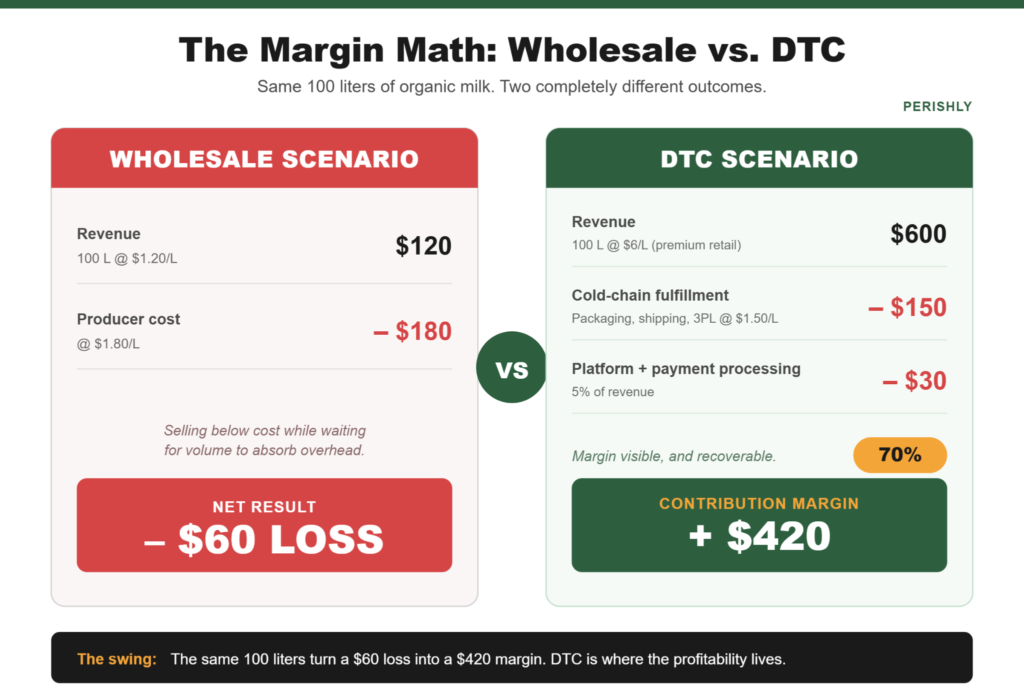
Direct to consumer dairy operates at a completely different price level.
Retail DTC dairy sold directly from producer to consumer via ecommerce or subscription commands $5 to $8 per quart, or $18 to $25 per gallon. That’s a 4x to 6x multiple over wholesale pricing. The margin structure is entirely different.
Here’s how the math works:
Wholesale scenario:
- 100 liters sold @ $1.20/liter = $120 revenue
- Producer cost = $180 (@ $1.80/liter)
- Net loss = $60
DTC scenario:
- 100 liters sold @ $6/liter premium retail = $600 revenue
- Cold chain fulfillment cost packaging, shipping, 3PL = $150 (@ $1.50/liter)
- Platform + payment processing = $30 (5% of revenue)
- Contribution margin = $420 (70 percent)
But DTC requires customer acquisition cost. If you’re acquiring customers at $25 CAC (customer acquisition cost), each new customer needs to generate $75+ in lifetime value to break even. A subscription dairy customer with 12 month retention at 50 percent and average order value of $50/month generates LTV of $300 a 12:1 return. The margin case for DTC rests on a brand buyers trust, how transparency is where DTC dairy actually wins share from conventional players.
The regional economics are critical. DTC works profitably within 500 miles of your fulfillment point, where cold chain shipping cost stays under 15 percent of retail price. National expansion requires micro fulfillment centers or partnerships with regional 3PLs, which compress but don’t eliminate the cost advantage.
How to Allocate ODMAP Funding DTC Channel Investment Blueprint
Here’s where the grant becomes tactical.
A typical ODMAP payout $30k to $80k is enough to build the foundation of a DTC channel, but not enough to fund full year operations. The allocation needs to be strategic.
Recommended budget buckets:
- Platform and ecommerce setup ($5-10k):
Shopify subscription ($300/month), Recharge subscription tool $100–200/month for recurring billing, payment processing setup, SSL certificate, initial site design and product photography. This creates the technical foundation.
- Fulfillment network ($8-15k):
Cold chain packaging audit and supplies (insulated boxes, dry ice or gel packs, labels), negotiation of rates with a regional 3PL partner RealCold, Progressive Logistics, or regional carrier, and compliance documentation setup. This is often the highest barrier to entry.
- Customer acquisition ($10-25k):
Paid media budget (Facebook/Instagram ads, Google Search), email marketing platform setup, content creation (blog, recipes, farm story), initial PR outreach. This is your growth fuel.
- Operations and compliance ($5-10k):
Warehouse Management System (WMS) software subscription, cold chain temperature tracking/logging devices, FSIS documentation systems, organic labeling compliance review using the USDA Organic Standards, insurance policy adjustments.
- Content and brand ($3-8k):
Website copywriting, professional product photography, email templates, brand guidelines, social media asset creation.
Allocation by producer size:
- Small farms (under 500k lbs/year):
Allocate 40% to fulfillment secure 3PL relationship and reliable shipping before acquiring customers, 35% to customer acquisition, 25% to platform/operations - Mid-size producers (500k–2M lbs/year):
30% fulfillment, 40% acquisition, 30% platform/operations you have more operational stability, so acquisition gets priority - Larger operations (2M+ lbs/year):
25% fulfillment, 45% acquisition, 30% platform/operations fulfillment is less of a bottleneck; acquisition is your constraint.
This allocation strategy assumes that the producer’s first priority is to get a working DTC channel operational not perfect, not fully optimized, but functional within 90 days. Then use the remaining months of the grant window to acquire the first cohort of customers and validate unit economics.
The Fulfillment and Operations Layer That Kills Most DTC Dairy Attempts
Perishly implemented ecommerce systems across dozens of agricultural supply chains. What can see consistently with dairy producers entering DTC is this: nail the website, find customer acquisition channels that work, but get crushed by fulfillment and operations.
Here’s why, Dairy DTC requires:
Cold chain compliance that doesn’t forgive mistakes.
FSIS (Food Safety and Inspection Service) mandates 32–36°F temperature maintenance during transport. State level regulations often tighten that: California imposes 48-hour delivery windows; New York requires real time temperature tracking at the box level. A single temperature-logging failure doesn’t just lose a customer it creates regulatory exposure.
Order to fulfillment velocity that most producers haven’t scaled.
When you’re selling wholesale, you sell in bulk: 500 liter pallets, weekly or bi weekly shipments. DTC inverts that: 2-4 liter orders, 3-4 shipments per week, each box individually tracked and temperature logged. Your fulfillment operation goes from 5 SKUs and 2 shipment days per week to 15 SKUs and 20+ shipment instances per week.
Cost allocation that hides the real unit economics.
We see producers treat shipping cost as a line item that scales linearly. It doesn’t. A 2 liter DTC box costs $35 to ship via reefer carrier if it’s a standalone shipment. Consolidate it into a regional micro-fulfillment hub, and the cost drops to $15 per box. That’s $20 per unit of margin swing it’s the difference between a profitable channel and a money losing one.
The ERP integration that most producers skip.
Your accounting system needs to track contribution margin by order, by customer, by geography, by acquisition channel. If you’re blind to whether your Denver customer or your Seattle customer is more profitable, you’re flying blind on paid acquisition spend. A basic WMS and order-management setup costs $200–400 per month, but it’s the difference between we’re growing and we’re actually making money. For organic operations expanding their supply chain and fulfillment activities, review the USDA Strengthening Organic Enforcement requirements to understand applicable certification, recordkeeping, and handling requirements.
Fulfillment is where most DTC dairy builds break, so it’s the first place grant dollars should de risk the cold chain and spoilage math behind a durable dairy subscription shows what get fulfillment right first actually requires. From our vantage point at the order management and fulfillment layer, we’d allocate ODMAP funding this way: get the fulfillment piece right first. That means a real 3PL contract, not DIY cold chain shipping from your farm Real fulfillment infrastructure buys you time to nail customer acquisition because you’re not fighting fires on every order. Then, once fulfillment is predictable, scale acquisition knowing you can actually deliver.
Platform, Fulfillment, and Technology Building the DTC Stack
Let’s get specific about what you’re actually building.
Platform choice:
Shopify is the fastest onboarding path for dairy DTC it’s designed for subscription businesses, has vetted fulfillment integrations, and monthly cost is $300 (basic) to $1,000 (advanced). Setup takes 4–6 weeks from zero to launch. WooCommerce is more customizable but requires technical support and typically costs $300–600/month with plugin fees. Farm specific platforms like GrazeCart can work but are optimized for meat/poultry and may be overkill for dairy-only producers.
Subscription tools:
You need to bill recurring charges. Recharge integrates seamlessly with Shopify and costs $100–200/month depending on order volume. Bold Subscriptions is another solid option. Without this, you’re manually invoicing each month that’s unsustainable.
Payment processing:
Stripe or Square will handle credit card processing. Dairy specific: some processors require compliance certificates for food products. Verify with your processor that they support perishable ecommerce.
Cold chain fulfillment options:
- DIY (producer direct):
You handle packaging and cold chain yourself. Requires capex insulated boxes, dry ice equipment, potentially a small reefer truck for local delivery. Works if customers are within 200 miles and you can guarantee next day delivery. Regulatory burden is high; you’re now responsible for FSIS compliance, cold chain logging, and liability.
- Regional 3PL (outsourced):
Partners like Progressive Logistics, RealCold, or LCX Fresh handle receiving, storage, picking, packing, and shipping. Typical cost is $15–25 per shipment plus storage. Minimum volume commitments vary; some require 50+ shipments/month. This is the smart play if your order volume is reliable.
- Hybrid (micro fulfillment hub):
You establish a small temperature controlled warehouse in a metro area and use ground carriers for regional delivery. Lower per unit shipping cost than national reefer; faster delivery than 3PL. Requires capex $5-10k for a 500 sqft hub but pays off with volume.
WMS and order management:
After your first 500 orders, you need visibility. A basic WMS (Shopify native, or third party like Cin7) tracks inventory, automates fulfillment, and surfaces your unit economics by customer and geography. Cost is $200–400/month.
Timeline to operational:
Platform setup (6 weeks) + fulfillment negotiation (4 weeks) + first orders (8 weeks) = 18 weeks from ODMAP funding decision to first revenue. That’s well within a 12-month grant cycle.
Customer Acquisition Strategy Where Organic Dairy DTC Finds Its First 1,000
Once fulfillment is locked, acquisition can scale. Before allocating grant money to national reach, confirm the geography is even legal which dairy products ship interstate and which states restrict inbound dairy can reshape where DTC economics actually work.
Organic channels high ROI, slow burn:
- SEO and content: Target keywords like organic milk delivery city, grass fed dairy subscription, organic yogurt online. Create content around farm story, herd health, sustainability practices, and usage recipes. This takes 4–6 months to see search traffic but costs only platform hosting.
- Email nurture: Build an email list from day one. Send monthly educational content farm updates, seasonal products, usage tips. Email ROI is typically 30–40:1 over 12 months.
Paid channels immediate volume, higher CAC:
- Facebook/Instagram: $15–35 customer acquisition cost for dairy subscriptions. Audience targeting: health conscious consumers, organic interested, within your shipping radius. Budget $2-3k/month and expect 100–150 new customers monthly.
- Google Ads: $20–50 CAC; high intent but lower search volume for niche dairy brands. Effective for regional targeting.
Owned channels highest LTV:
- Referral programs: Offer $15–20 per referred customer. Subscription dairy achieves viral coefficient of 1.2–1.4; this compounds.
- Sampling partnerships: Use ODMAP to fund introductory sampling at farmers markets, co-ops, corporate wellness programs. This builds brand credibility that paid ads can’t.
Channel allocation:
Dedicate 40 percent of customer acquisition budget to organic content and SEO, 35 percent to paid media, 25 percent to sampling and partnerships. Organic reaches scale after 6+ months; paid media drives immediate volume; sampling builds word-of-mouth.
Breakeven math:
If your average CAC is $30 and your customer LTV is $300 (12-month retention at 50 percent, $50/month AOV), payback occurs at month 5–6. That’s within the 12 month ODMAP cycle.
Case Study Small Organic Dairy’s ODMAP-Funded DTC Pivot
Let’s make this concrete.
A 350k pound per year organic dairy co-op in Wisconsin anonymized for confidentiality received an ODMAP 2024 payout of $31,200. Pre ODMAP, 90 percent of sales went through co-op wholesale at $0.95 per liter, netting approximately $100,000 annually at 33 percent margin after production costs.
Their ODMAP allocation:
- Platform and setup: $8,000 (Shopify, Recharge, site design, product photography)
- Fulfillment partnership: $10,000 (3PL contract negotiation, packaging audit, temperature logging setup)
- Customer acquisition: $10,000 (Facebook/Instagram ads, email platform, initial content)
- Operations/compliance: $3,200 (WMS trial, compliance documentation)
Launch timeline: 90 days to first order, 180 days to 150 active customers.
12-month projection:
- DTC volume: 50,000 liters at $6/liter = $300,000 revenue
- Fulfillment + platform cost: $75,000 (25% of revenue at scale)
- Contribution margin: $225,000 (75% pre customer acquisition and overhead)
- Customer acquisition and marketing ongoing: $25,000 (8% of revenue, declining as referral/organic scale)
- Net incremental: $70,000 (7.3% of wholesale base)
Breakeven on ODMAP spend: 4–5 months. Sustainable operation by month 9.
This producer is now building a channel that, once operational, generates incremental margin that didn’t exist before. The wholesale business remains intac, it’s now a reliable base. DTC is pure growth.
What Happens After ODMAP: Sustaining DTC Beyond the One-Time Grant
Product diversification is part of the post grant playbook, and cheese carries its own rulebook, the state by state regulations for selling artisan cheese online. Here’s the critical question: what happens in 2026 when the ODMAP check is gone?
The channel must be self-sustaining. That means:
Retention must exceed 40 percent on a 12 month basis.
If your cohort of customers acquired in month 1 is down to 30 percent by month 12, your customer acquisition cost effectively doubles. You need systems in place to drive retention: email campaigns, product surprises, loyalty rewards, seasonal offerings.
Product diversification compounds margin.
Pure milk alone is a low frequency purchase once per week to once per month. Add yogurt, cheese, butter, dairy supplements, branded merchandise. A subscription customer ordering one product per month should be ordering 2–3 products. This increases AOV average order value and margin per customer.
Operational efficiency improves with scale.
In year one, you’re paying full rates. By year two, your 3PL volumes give you negotiating power. Paid customer acquisition cost should drop 20–30 percent as organic and referral channels compound. You’re reinvesting some of that efficiency gain into volume.
Geographic expansion becomes a second wave.
If your pilot market works, year two is funding a second regional hub or national shipping capability. But this happens only if the first hub is genuinely profitable.
Community and brand become moats.
The customers you acquire in year one are worth 3–4x more in year two and beyond if you’ve built genuine loyalty. Email list, social followers, and word-of-mouth are cheap acquisition channels but only if you’ve earned trust.
Should Your Organic Dairy Use ODMAP for DTC? The Decision Framework
If raw milk is part of the organic lineup, positioning gets more complicated, how to build a brand that converts both raw milk and pasteurized audiences post H5N1. Not every organic dairy should go DTC. Some are better positioned in wholesale, and some lack the operational bandwidth for ecommerce.
Here’s the diagnostic:
Question 1: Product fit.
Do you produce milk (liquid or dairy co products like yogurt, cheese, butter)? Can it be safely shipped via cold chain? If no to either, pivot to wholesale focused strategy.
Question 2: Market access.
Are more than 40 percent of potential customers within 500–1,000 miles of your operation? Or can you aggregate demand regionally? If no, regional only or wholesale focus is more realistic.
Question 3: Operational readiness.
Can you commit to 6–12 months of customer service, order fulfillment, and cold chain management operations? If no, partner with a 3PL or hold on DTC expansion.
Question 4: Financial runway.
After ODMAP spend on platform and fulfillment, can you cover $500–1,500/month operational cost for 6+ months? If no, smaller pilot only or wholesale strategy.
Question 5: Differentiation.
Do you have a compelling story farm practice, herd genetics, sustainability, animal welfare that justifies premium DTC pricing $5–8 per quart vs. $3–4 retail? If no or weak, commodity risk is high.
FAQs
What qualifies as a marketing cost under ODMAP 2024?
ODMAP guidance defines marketing costs broadly to include digital marketing (website, paid ads, email), brand building, fulfillment infrastructure, cold chain packaging, promotional materials, and events. Regulatory guidance typically excludes production cost feed, labor but includes all consumer facing marketing spend. However, verify specific expenditure categories with your local FSA office, as state interpretations may vary slightly.
How much ODMAP funding can an organic dairy operation receive?
Payment is calculated at $1.68 per hundredweight on pounds of organic milk marketed in 2023 or estimated 2024 production, capped at 9 million pounds. For a 500k pound annual producer, this is approximately $8,400; for 2M pounds, approximately $33,600 for 5M pounds, approximately $84,000 at the 9M cap. Actual payout may be lower if funding exhausts before all applications are processed; disbursement is first come, first-served through 2025.
Can ODMAP funding be used for digital marketing and ecommerce platform setup?
Yes. ODMAP guidance explicitly includes digital channels, website development, and ecommerce platform setup as eligible marketing costs. DTC fulfillment, cold chain packaging, customer acquisition, and subscription tool fees all qualify. Verify specific expenditure categories with your FSA office before committing funds.
What’s the realistic ROI on online dairy marketing compared to wholesale channel support?
DTC dairy typically delivers 2.5x to 4x higher margin per unit sold 45–60% DTC margin vs 30–40% wholesale, but carries higher customer acquisition cost $15–50 CAC vs co-op slotting fees. ROI breakeven occurs at 12–18 months if retention stays above 40 percent and lifetime value exceeds $300 per customer. Regional DTC within 500 miles achieves better unit economics than national due to lower cold chain shipping cost.
How do I get started with a DTC channel if I’ve never run ecommerce before?
Start with Shopify (lowest friction, highest adoption among food brands), pair it with a regional 3PL for fulfillment don’t DIY cold chain, allocate ODMAP funding across platform, fulfillment, and acquisition in a 30/30/40 split, and aim for first order within 90 days. Budget 6–8 weeks for platform setup, 4 weeks for fulfillment negotiation, and 8 weeks for customer acquisition ramp. Track your first 50 orders for unit economics before scaling spend.
