
You set your subscription price eighteen months ago, and every reorder since has quietly eaten your margin because your cost per pound went up and your locked in customer rate didn’t. That’s not a bad month, it’s the structure of a market where the U.S. cattle herd sits at a 75 year low and the animals that would ease it haven’t been born yet. The brands weathering this stopped waiting for prices to come back.
86.2 MILLION HEAD Smallest U.S. cattle herd since 1951 the supply floor under every beef cost you pay.
+9.8% USDA’s 2026 retail beef price forecast the cost curve your pricing has to outrun.
$9.64 / LB Record all-fresh retail beef, April 2026 the consumer ceiling you’re pricing against.
2029–2030 earliest that heifers retained now add new beef supply the timeline you must plan around.
Key takeaways:
– Assume elevated beef costs through at least 2028 not a 2027 reversion.
– Flat or legacy introductory pricing is the biggest silent margin risk.
– New supply from today’s retained heifers can’t arrive before 2029.
Why “Prices Will Come Back Down” Is the Wrong Planning Assumption
It’s a comfortable story prices spiked during the drought, supply will recover, and by next year or the year after, ranchers will be bringing cattle to market again.
The July 2026 USDA Cattle report, released July 24, settled the question with uncommon clarity. Total U.S. cattle sat at 94.2 million head as of July 1, 2026, up slightly from 94.0 million a year earlier. That’s the headline. The story underneath is the one that matters beef cows, at 28.5 million head, are down 1 percent from a year ago.The January 1, 2026 report had already recorded the smallest total herd since 1951 at 86.2 million head. This is not stabilization with a quick rebound ahead this is stabilization masking ongoing contraction in the productive base.
What carries real operational weight is the 2026 calf crop 32.5 million head, the smallest on record and the ninth consecutive year of decline. Every calf not born now is beef that won’t enter the supply chain for two to three years after birth. The replacement heifer inventory did rise 3 percent to 3.8 million head,a first meaningful sign of retention in nearly a decade. But that uptick is not yet heifer calves entering the breeding herd in numbers that would reverse the calf crop decline.
Data callout the 2026 calf crop 32.5 million head is the smallest on record and the ninth straight annual decline. Every calf not born now is beef not available in 2028. According to the National Provisioner’s analysis of USDA supply projections, meaningful supply growth remains unlikely before late 2028 or 2029. This is not optimism. This is the structural reality operators have to price around.
The Biology of the Delay Read the Cattle Cycle Like an Operator, Not a Rancher
Here’s where the real operator pain lives retained heifers today don’t produce beef until years from now, and that lag is non negotiable biology, not a market timing question.
A heifer calf born in 2026 will be retained for breeding instead of fed for slaughter. That heifer gets bred in 2027. It calves for the first time in 2028. That 2028 calf enters a feedlot in 2029 or 2030 and reaches your wholesale box or your DTC customer’s freezer in 2030 or 2031. If ranchers begin serious heifer retention this year, the beef supply doesn’t actually grow until 2029 into 2030 at minimum. Derrell Peel,Oklahoma State University’s extension livestock marketing specialist, put it plainly if we start saving heifers, which would really be heifer calves in 2026, we breed them in 2027, they would calve in 2028, we’re talking about 2029 into 2030 before those calves would be weaned and fed out and have an impact on beef production. The implication for your business is this you cannot assume a price correction during the years when your current customer acquisition cohorts mature. You’re not waiting for recovery you’re operating inside the recovery lag.
Timeline of heifer retention impact:
1. 2026: Heifers retained for breeding (happening now).
2. 2027: Retained heifers bred; culling pressure falls supply tightens further.
3. 2028: First calf heifers calve no immediate supply increase.
4. 2029–2030: Those 2028 calves weaned and fed earliest meaningful supply increase arrives.
Across our implementations in DTC beef, the brands that accounted for this timeline built pricing and retention mechanics around a three year cost horizon, not a one year one. The ones that didn’t are the ones whose founding tier rates are now $3 to $4 per pound below cost.
What the Cost Curve Actually Looks Like Through 2027
USDA’s Economic Research Service forecasts beef and veal prices will increase 9.8 percent in 2026, within a confidence interval of 7.0 to 12.6 percent. That’s not the spike and revert story that’s a sustained climb built into the supply foundation.
Cattle prices averaged approximately $241 per hundredweight this year, roughly 8 percent higher than 2025, according to the latest USDA outlook. All fresh retail beef hit a record $9.64 per pound in April 2026, up $1.14 or about 13 percent from April 2025. Ground beef, the volume product for most DTC operations, averaged about $6.70 per pound in March, roughly 16 percent higher year over year.These are not provisional numbers these are the floor you’re building pricing against.
The critical detail most DTC operators miss retail prices have flattened for the last six months, but flattening at elevated levels is not the same as declining. Michael Swanson, chief agricultural economist at Wells Fargo’s Agri Food Institute, summed it up. Retail beef prices have flattened out for the last six months. But prices are still elevated year over year, and we are still several years away from a meaningful increase in the U.S. cattle supply.
Warning callout if your subscription rate is older than 12 months, model it against today’s cost per pound before your next fulfillment cycle legacy rates are the most common silent margin leak we see.
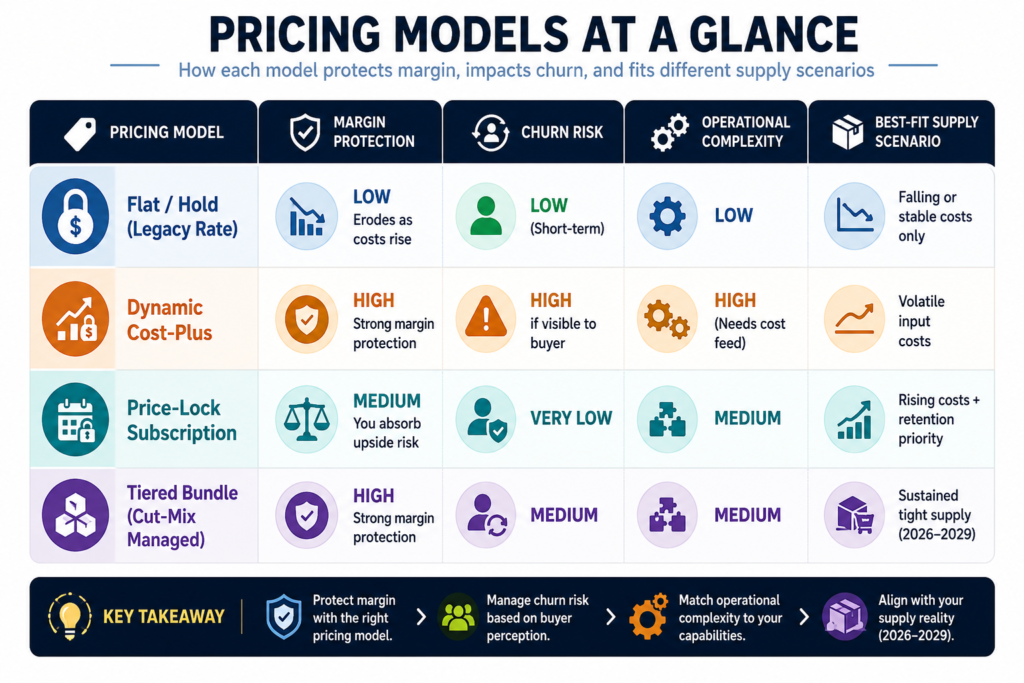
| Pricing model | Margin protection | Churn risk | Operational complexity | Best-fit supply scenario |
|---|---|---|---|---|
| Flat / hold (legacy rate) | Low — erodes as costs rise | Low (short-term) | Low | Falling or stable costs only |
| Dynamic cost-plus | High | High if visible to buyer | High (needs cost feed) | Volatile input costs |
| Price-lock subscription | Medium — you absorb upside risk | Very low | Medium | Rising costs + retention priority |
| Tiered bundle (cut-mix managed) | High | Medium | Medium | Sustained tight supply (2026–2029) |
The real threat isn’t one spike; it’s the baseline staying high long enough that your margin math breaks.A customer acquired at $179 for a Cattleman’s box is not the problem.A customer from two years ago locked into $129 because the market was different.
The DTC Margin Squeeze No Volume Target Can Fix
You can’t outgrow a structural cost problem. That’s the conversation happening in every DTC meat operation right now. See how beef imports are reshaping DTC ranch economics
When wholesale beef costs climb 8 to 10 percent but your customer acquisition cost stays the same and your retention rate holds, the pressure hits margin, not revenue. A brand selling 1,000 boxes a month at $179 each with a 35 percent margin looks fine on the top line. At $189 cost per box, that same 1,000 box volume is now running on 34 percent margin. At $199, you’re at 28 percent. At $219, if you haven’t moved the customer price, you’re operating at 18 percent margin on volume that looks identical to the board. The margin squeeze here isn’t unique to subscriptions — why smaller farms aren’t winning even at record beef prices lays out the same cost-vs-ceiling geometry across the whole DTC model.
More boxes don’t fix this. Cheaper boxes do and that’s where the real DTC beef market is fragmenting. Brands that built positioning around American sourcing, specific heritage genetics, or ranch direct provenance are seeing their cost advantage flatten or invert. A brand paying a premium for Angus genetics from a named ranch can’t compete on price with an aggregator pooling supply across ten ranches. When retail price ceiling gets tight, that margin disappears.
The operators holding position have shifted the economics of the bundle. Instead of a static cut mix at a fixed price, they’ve introduced tiered options where a customer chooses a leaner bundle at entry price, premium cuts at a higher tier, and mixed boxes at a middle rate. That shift looks like a product change it’s actually a cost basis change. You control what goes into which tier. The customer still feels like they’re choosing. Your margin math isn’t at the mercy of cattle prices in the same way.
Four Pricing Models, and Where Each Breaks
Model 1:
Flat / Hold (legacy rate) you set a price eighteen to thirty six months ago and haven’t changed it. This works until it doesn’t. When your cost per pound goes from $5.20 to $6.10, you’ve eaten $90 to $120 per box in margin. Churn stays low because customers are locked in, but you’re slowly underwater. The breaking point when input costs rise faster than your customer base will tolerate price increases. By the time you move prices, you’ve already lost six months of margin.
Model 2:
Dynamic cost plus your price adjusts to a formula tied to your wholesale beef cost. This protects margin perfectly. It also broadcasts every cost increase directly to the customer. Retention is the casualty churn spikes when a customer sees their subscription jump from $179 to $199 because spot prices moved. This model works for B2B wholesale or for a retail channel where price transparency is the baseline. For DTC subscription, it’s operationally sound but customer hostile.
Model 3:
Price lock subscription good Ranchers’ PriceShield model exemplifies this customers lock in a rate at signup and keep it as long as the subscription is active. You’re absorbing the upside risk they’re absorbing the downside risk. Churn becomes nearly nonexistent because the customer knows what they’re paying forever (or as long as they stay). But your margin is now hostage to supply costs you can’t predict eighteen months forward. If you lock a customer in at $179 and your cost rises to $199, that customer is now running against you for the duration of their subscription.
Model 4:
Tiered bundle (cut mix managed) you offer three or four preset bundles with different cut mixes and prices. Entry tier gets higher margin cuts and leaner portions premium gets prime cuts and premium proteins. The customer feels like they’re choosing you’re actually managing cost basis by controlling what’s in each tier. When your wholesale cost for chuck or ground beef rises, you absorb it in the entry tier’s mix (shorter duration, loss leader). When ribeye costs surge, you’ve already positioned it in the premium tier at $249+. This model has the highest operational complexity but the highest margin protection across a cost cycle Understand the regulatory framework for selling meat online across state lines
The Price Lock Question: Retention Tool or Margin Trap
Price lock offerings sound like a win on paper. Lock in the customer, eliminate churn, build predictable lifetime value. The operational reality is messier. A locked in customer at $189 per month, committed to a twenty four month lock, looks like $4,536 in lifetime value. If your cost per box rises from $155 to $195 during that window, you’re not capturing the $40 increase you’re eating it. You still have the customer (churn is near zero) but you’ve front loaded the loss into the contract. An unlocked customer would have churned at price increase number two and freed you from that margin drag.
The operators getting price lock right are bounding them. A twelve month lock, not a thirty six month one. A locked rate that applies only to a specific bundle (e.g., The Cattleman stays $199 for your first 12 months, then reprices). A clear renewal window where you can raise the rate before the next billing cycle. That’s not a price lock it’s a retention and margin tool with guardrails.
If you’re using price llock for customer acquisition (which most subscription boxes are) your CAC economics have to work at the locked rate, not at a future repriced rate. That means a $129 acquisition lock has to cash flow at $129, not at the $159 you hope it reprices to after twelve months. If it doesn’t, price lock is a customer subsidy, not a retention strategy.
A Pricing Playbook for the Tight Supply Decade
Cost per box is set by more than cattle price — the break even math on cold chain shipping is one of the few line items you can actually compress when input costs won’t fallHere’s what the playbook actually looks like once you’ve accepted that tight supply is the operating environment, not the anomaly.
1. Reset your baseline.
Replace any “prices normalize in 2027” assumption with a tight supply baseline running through at least 2028 every pricing decision inherits from this. This isn’t pessimism USDA data says this is the baseline. Model your LTV calculations, CAC payback, and churn assumptions around a cost environment that doesn’t fall. When it does, the margin is upside,not necessity.
2. Audit legacy rates first.
Reprice or sunset any subscriber rate older than 12 months against current cost per pound before touching acquisition pricing. This is the highest impact move you can make in ninety days. Find every customer locked into a 2024 or early 2025 rate and either reprice them (with notice) or migrate them to a new bundle. You’re not raising prices for price’s sake you’re aligning pricing to the cost structure that’s already real.
3. Set your price-lock posture.
Decide explicitly whether locks are a retention lever worth the margin risk, and if so, bound them by duration and cut mix. If you’re not using locks, that’s a valid choice just own it and optimize retention through product quality and experience instead. If you are, make them smart twelve month term, specific bundle, renewal window, clear communication.
4. Rebalance the bundle, not just the sticker.
Shift margin toward managed cut mix bundles where you control the cost basis, rather than defending a single headline price. Create an entry level bundle with ground beef and chuck as the anchor.A mid-tier with mixed steaks. A premium tier with ribeye and NY strip. Price them to hit your target margin across the portfolio, not on each SKU. Customers feel choice, you’ve optimized cost.
5. Install a reprice cadence.
Commit to a fixed review interval, e.g., quarterly, tied to USDA report releases, so pricing tracks the cost curve instead of lagging it. The second Tuesday of every quarter, USDA releases Cattle on Feed or Quarterly Hogs and Pigs data. Make that your trigger point. If cost per pound has moved more than 5 percent since the last review, run a pricing audit and model the impact. Move prices or bundle mixes proactively instead of reactively.
FAQs
When will beef prices actually come back down?
Not before the herd recovers, which USDA data puts at 2028 at the earliest. Expect elevated costs through at least 2027. If ranchers begin heifer retention at scale this year, those calves don’t reach market until 2029 or later. Plan pricing around a three year cost horizon, not a three month one.
Should I offer a price lock to keep subscribers?
Only if it’s bounded by duration and cut mix. An open ended lock hands your supply risk to the customer and can erase your margin if costs keep rising. A twelve month lock tied to a specific bundle is operationally defensible. A forever lock on an open mix is a subsidy.
Why are cattle prices so high in 2026 if there are more heifers now?
Because retained heifers don’t become beef for years. That 3 percent increase in replacement heifers today still means less supply through 2028 because those animals aren’t in the breeding herd yet they’re waiting to be bred in 2027 and calve in 2028. More heifers now buys you the start of recovery in 2029. Until then, the tight supply baseline persists.
How do I protect margin without pricing myself out of the market?
Move margin into managed bundles you control and reprice legacy rates first, before raising headline prices. Use an entry level bundle to absorb cost pressure use premium bundles to capture margin. That way you’re not raising prices on all customers equally you’re letting customers choose a tier that works for them.
Is it a bad time to launch a DTC beef brand?
Not bad, but plan for high input costs from day one. Brands launched in 2024 expecting prices to revert in 2025 struggled most. Brands launched in 2025 with the assumption that tight supply is the baseline are performing better. Build your margins assuming this cost environment holds through your first two years of operation. If prices fall, you’ve built a buffer. If they don’t, you’ve survived.
Conclusion
The cattle herd isn’t coming back to 2019 volumes anytime soon. Operators who’ve accepted this and rebuilt their pricing around it aren’t waiting for recovery. They’re protecting margin now and building the operational flexibility to respond when the cycle does eventually turn. That’s the story the July 2026 USDA data tells. Brands built on American sourcing, heritage genetics, or ranch-direct provenance are watching that cost advantage flatten — and proving that provenance is now what separates the winners from the aggregators. Not that prices will fall soon, but that the operators who stop waiting for that moment are the ones still in business when it arrives.
