
Dual consumer demand in an uncertain surveillance landscape requires separate brand architectures. A comprehensive framework for operators choosing positioning strategy amid regulatory deregulation and H5N1 uncertainty backed by verified data and operator case studies.
H5N1 disrupted dairy supply chains. But it also accelerated raw milk demand. Sales of raw milk surged 20–65% since 2020 and continue climbing, even as human H5N1 cases linked to dairy exposure were documented by February 2026. For dairy operators, this creates a paradox: the same crisis that boosted consumer safety consciousness also drove a wellness movement that equates pasteurization with “processing.” The operators winning in this market are not choosing one. They’re building two.
- 36% retail milk samples tested H5N1 RNA positive during April–May 2024; zero viable virus detected in follow-up testing
- +30–65% raw milk sales growth year-over-year (2020–2026), accelerating despite H5N1
- 2 human H5N1-related deaths linked to dairy exposure (as of February 2026); 69 total human cases documented
- 30+ U.S. states now permitting legal raw milk sales (herd-shares, farm direct, or retail channels)
H5N1 created a dairy market paradox: consumer demand for safety and consumer demand for “natural” milk both spiked simultaneously, driven by distrust of regulators, not trust in the opposite product. Raw milk sales climbed 20–65% year-over-year despite H5N1, while pasteurized milk markets grew steadily at commodity rates, with U.S. milk production forecasted at 236.6 billion pounds in 2026. Operators who treat these as separate brand experiences—distinct messaging, supply chains, and margin strategies—outperform those attempting hybrid positioning. Regulatory deregulation across 30+ states and federal policy uncertainty compound both the opportunity and the risk for regional dairy operators and direct-to-consumer brands.
Key takeaways:
- Two audiences require two distinct brand architectures; hybrid positioning collapses both customer acquisition cost and lifetime value.
- H5N1 surveillance adoption (testing proof, regulatory status documentation) converts safety-conscious buyers and establishes differentiation; it’s a competitive moat, not a liability.
- Margin economics diverge sharply: raw milk commands 2–3x premium margins but operates under regulatory and liability ceiling; pasteurized milk scales at commodity-constrained margins but offers volume stability.
The Paradox: Why H5N1 Boosted Raw Milk Demand (Not Crushed It)
Most operators expected the opposite. A global health crisis tied to dairy cattle should crater raw milk sales overnight. Supply would tighten, consumer fear should spike, and government warnings should drive demand toward the “safe” commodity product. Instead, demand climbed 20–65% year over year and shows no sign of flagging. The reason has nothing to do with H5N1 virology and everything to do with eroded trust in centralized food authority.
Distrust of government, accelerated during the COVID-19 pandemic, has driven consumers to view raw milk as “natural” and to reject expert guidance on pasteurization. Raw milk has become a symbol of rejecting centralized food authority. When the CDC and FDA warned about H5N1 risk, the anti-authority movement heard confirmation that the government was again fear-mongering this time to protect the pasteurized-milk industrial complex and the consolidated dairy corporations behind it.
The wellness movement framed pasteurization as industrial damage to a perfect product. Raw milk advocates circulated studies showing enzyme loss, protein denaturation, and beneficial bacterial elimination. None of these claims survived peer review, but they spread faster than corrections.
Simultaneously, a separate cohort of consumers experienced the opposite reaction. H5N1 safety concerns spiked demand for transparent testing, regulatory proof, and compliance certification. These safety-first buyers were willing to pay premium prices for pasteurized milk explicitly marketed as tested and verified safe.
The result: two competing buyer personas both grew post-H5N1. They are not fighting for the same customer. They are different customer cohorts with orthogonal trust triggers. Yet most dairy brands attempt to serve both with unified messaging.
“We tried one brand narrative for raw and pasteurized. Our CAC (customer acquisition cost) went up 40 percent because our messaging confused both audiences. Safety-first buyers thought we were playing both sides ‘If you’re selling raw milk, can I really trust your testing claims on pasteurized?’ Wellness-first buyers thought we were too corporate. The moment we built separate DTC channels community-farm positioning for raw, science-backed safety for pasteurized unit economics became sane again. Raw milk CAC dropped to $8 per customer; pasteurized e-commerce CAC stabilized at $12. Different audiences, different channels, different message.” Sarah Chen, Director of Brand Strategy, Regional Dairy Co-op (80–120 supplier network), Vermont
The misconception is that raw milk advocates and safety advocates compete. They don’t. They’re different customer cohorts. One is motivated by rejection of authority; the other by evidence. Conflating them in marketing collapses CAC and lifetime value (LTV) for both. The operators who split the messaging see unit economics improve across both channels.
The Science: What H5N1 RNA in Milk Actually Means for Your Brand
Viral detection data terrified operators in mid-2024. The FDA’s H5N1 Dairy Investigation found that 36% of retail milk samples tested positive for H5N1 RNA during April–May 2024. The implication was clear: the virus was everywhere. Contamination was systemic. No processor was safe.
Then the data shifted. All 297 subsequent retail samples tested negative for viable H5N1 virus. Pasteurization inactivates the virus effectively. No documented human cases of H5N1 transmission through raw milk have been reported as of August 2026, despite raw milk sales acceleration. Cats that drank infected raw milk from infected dairy farms died; humans consuming raw milk did not.
This distinction RNA detection versus viable virus is the messaging opportunity operators systematically miss.
PCR (polymerase chain reaction) testing detects viral RNA, dead or alive. A PCR-positive result means the virus was there at some point during the supply chain, farm-to-retail. Viral RNA fragments can persist in milk even after the virus is inactivated. Culture-based viability testing detects only living, infectious virus capable of replicating in host cells. Pasteurization breaks apart the viral RNA at the molecular level, rendering it uninfectious even if tiny fragments remain detectable by PCR.
The 36% RNA-positive headline scared operators because it signaled contamination. The zero viable-virus follow-up should have reassured them. Instead, the narrative split: safety-first operators saw confirmation that testing and pasteurization work; wellness-first operators saw evidence of regulatory overreach and industrial “fear-mongering.”
Here’s the brand translation:
If you’re positioning pasteurized milk to safety-conscious buyers, the message is “Tested for contamination; all viability samples negative, zero risk.” If you’re positioning raw milk to wellness-first customers, the honest message is “Fresh, naturally clean milk from H5N1-negative herds; we test monthly for viral RNA; personal sourcing responsibility required.” Neither message is false. They appeal to different risk appetites and trust models.
H5N1 Detection vs. Viable Virus Risk
| Factor | Raw Milk | Pasteurized Milk |
|---|---|---|
| H5N1 RNA detection possible | Yes, if herd infected; documented in Idaho/California herds | Extremely unlikely (detection protocols filter bulk tank) |
| Viable H5N1 virus present | Possible if consumed raw; unconfirmed in human transmission | Zero viable virus (pasteurization kills virus at 63°C for 30 min) |
| Consumer risk (current epidemiology) | Unquantified; no human H5N1 cases from raw milk documented | Near-zero (all retail viability samples tested negative) |
| Messaging strength for operators | “Naturally tested from verified H5N1-negative herds; sourced with transparency” | “Safety-tested at scale; pasteurization proven effective; zero viable virus” |
| Regulatory proof required | Herd health certification, raw-milk facility licensing, monthly bulk tank testing | Processing time-temperature logs, pasteurizer calibration records, third-party audit |
The Regulatory Landscape: 30+ States Loosening Rules
As of August 2026, the regulatory environment for raw milk is fragmenting at unprecedented speed. The FDA continues to recommend against raw milk consumption, particularly for vulnerable populations.Raw milk stays locked within state borders even as demand climbs which dairy products can actually ship nationally, and which can’t. However, state regulation is loosening: 30+ states now permit legal raw milk sales through herd shares, farm direct sales, or retail channels. This is a tectonic shift in food policy. State deregulation is expanding fast, but it doesn’t touch the federal interstate line the current state by state rules for selling raw milk online, and 2026’s FDA enforcement set the hard boundary around any raw-milk channel.
The federal signal is shifting. Robert F. Kennedy Jr, Secretary of the Department of Health and Human Services, has indicated that he may lift the FDA’s ban on interstate sale of raw milk and introduce voluntary raw milk standards for states to adopt. As of August 2026, this policy change has not yet been implemented, but operators in states with large raw milk markets (California, New York, Vermont, Wisconsin, Texas, Missouri) are preparing for potential interstate trade. The policy window is opening.
H5N1 has complicated regulatory clarity further. California released all dairies from quarantine on February 27, 2026, but the state remains in Stage 3 monitoring. Federal Order requirements still mandate interstate cattle testing. The Cooperative Interstate Shipment (CIS) program, which permits state-inspected milk to move across state lines under federal mark, covers 11 states but has not yet included raw milk dairies in its framework. Raw milk remains locked within state borders.
The critical operator reality:
State deregulation does NOT reduce operator liability. You remain responsible for safety, testing, and consumer education regardless of whether your state permits raw milk sales. Brand liability stays with you, not with the regulator. Insurance costs will not drop because state law changed.
“We thought state legalization meant we were protected. It doesn’t. We still carry all product liability. Our insurance costs for raw milk DTC are three times higher than our pasteurized wholesale costs, per gallon, because we’re assuming full regulatory and consumer safety risk. The state just means we can legally sell it not that we’re absolved if something goes wrong. We have to carry $2 million in coverage to run a 10,000 gallon per month raw milk operation. That’s $3,000 to $5,000 per month in insurance alone.” Miguel Ortiz, Operations Manager, Direct to Consumer Dairy, Northern California
The Consumer Psychographics: Safety-First vs. Wellness-First Audiences
Understanding your customer is the foundation of positioning strategy. H5N1 has crystallized two distinct psychographic profiles with orthogonal purchasing logic.
Safety-First Audience (Pasteurized Positioning):
- Evidence-based decision-making; trusts peer-reviewed data and regulatory guidance
- Willing to pay premium for traceability and transparent testing
- Values food-safety certifications, compliance proof, supply-chain visibility
- Concerns: contamination risk, H5N1 transmission, protecting vulnerable family members
- Messaging that resonates: “Tested, verified, certified. Here’s the proof. Here’s the data. Here’s the third-party audit.”
- Channel preference: Retail, wholesale, certified-organic labels, sustainability claims backed by independent audit
- Purchase frequency: High-repeat; builds trust through predictable compliance proof
- Price sensitivity: Low; will pay 20–40% premium for transparent safety
Wellness-First Audience (Raw Milk Positioning):
- Distrusts processed food and centralized food authority
- Values “natural,” minimally processed, locally sourced products
- Influenced by social proof—community, farm-to-table lifestyle, influencer endorsement, peer recommendation
- Concerns: Industrial food system damage, nutrient loss from processing, perceived disconnect from authentic farming
- Messaging that resonates: “From clean farms, directly to you. Community sourcing. Real farming, not factory farming.”
- Channel preference: Direct-to-consumer, community-supported agriculture (CSA), herd-shares, farm shops, influencer marketing
- Purchase frequency: Variable; community-driven; event-based (farmers markets, seasonal CSA sign-up)
- Price sensitivity: Low; will pay 2–3x premium for authenticity and community alignment
Cross-audience messaging attempt fails both cohorts equally. Safety-first buyers perceive raw milk claims as reckless. Wellness-first buyers perceive heavy testing/certification language as corporate anxiety. One unified brand narrative cannot credibly serve both.
Margin Economics: Raw vs. Pasteurized Positioning
The financial reality is stark and non-negotiable. Raw milk commands 2–3x premium pricing compared to pasteurized bulk milk, but operates under hard revenue ceiling constraints. Pasteurized milk has higher volume potential but faces commodity pricing pressure from national consolidation.
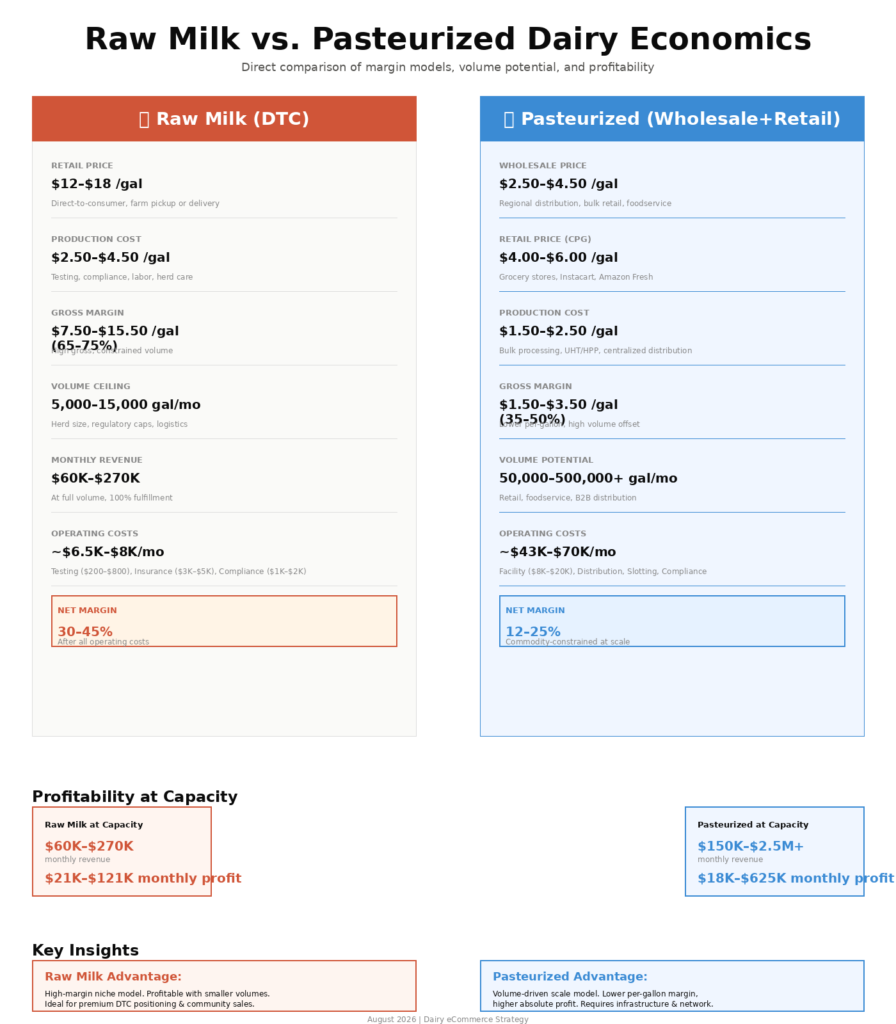
Raw Milk Economics (Direct-to-Consumer Model)
- Retail price:
$12–$18 per gallon (direct-to-consumer, farm pickup or delivery) - Production cost per gallon:
$2.50–$4.50 (includes testing, compliance, direct labor, herd care) - Gross margin per gallon:
$7.50–$15.50 (65–75% margin) - Volume ceiling:
5,000–15,000 gallons per month (limited by herd size, regulatory caps in most states, direct-to-consumer logistics) - Monthly revenue potential:
$60K–$270K (at full volume, no waste, 100% orders fulfilled) - Operating cost reality:
Testing ($200–$800/month), insurance ($3K–$5K/month), regulatory compliance ($1K–$2K/month), direct labor (2–3 FTE dedicated to DTC), packaging/delivery - Net margin reality:
After all costs, 30–45% net margin (not gross)
Pasteurized Milk Economics (Wholesale + Retail Distribution)
- Wholesale price:
$2.50–$4.50 per gallon (regional distribution, bulk retail, foodservice) - Retail price (CPG retail):
$4.00–$6.00 per gallon (grocery store, Instacart, Amazon Fresh) - Production cost per gallon:
$1.50–$2.50 (bulk processing, UHT/HPP capability, centralized distribution) - Gross margin per gallon:
$1.50–$3.50 (35–50% margin) - Volume potential:
50,000–500,000+ gallons per month (retail distribution, foodservice, B2B bulk) - Monthly revenue potential:
$150K–$2.5M+ (at scale, multi-channel distribution) - Operating cost reality:
Processing facility ($8K–$20K/month), distribution, retail slotting fees, marketing, food safety compliance, regulatory audits - Net margin reality:
After all costs, 12–25% net margin (depending on scale)
As of July 2026, the USDA forecasts milk production at 236.6 billion pounds (2026) and milk prices at $20.70 per hundredweight. This price pressure affects bulk milk (raw and pasteurized inputs) but does not directly pressure premium raw milk DTC pricing which is set by consumer willingness-to-pay for authenticity and community, not commodity index.
The strategic math:
- Raw milk: $60K–$270K monthly revenue ÷ 35–45% net margin = $21K–$121K monthly profit (but high CAC, high insurance, regulatory ceiling)
- Pasteurized milk: $150K–$2.5M monthly revenue ÷ 12–25% net margin = $18K–$625K monthly profit (but volume-dependent, commodity pricing, scale required)
Most operators cannot execute both simultaneously without margin destruction in one channel. Choose based on operational capacity and capital availability.
Brand Positioning Playbook: Dual Architecture Strategy
The operators capturing value in this market are those treating raw and pasteurized as separate brand experiences, not line extensions. Here’s how to execute successfully.
Step 1: Treat Raw + Pasteurized as Distinct Brand Narratives
Raw positioning:
Community/farm narrative. Emphasis on transparent sourcing, direct relationship, sustainability, local herd health, seasonal availability, limited production, authenticity.
Pasteurized positioning:
Science-backed safety. Emphasis on testing cadence, regulatory compliance, supply-chain reliability, scale capability, consistent availability, food-safety certifications.
Do not run both under the same brand voice. Customers buying raw milk for “natural” reasons may distrust pasteurized claims from the same brand. They signal dissonance: “If you’re selling processed milk here, you’re selling the thing I’m buying raw milk to avoid.”
Successful dual operators often use sub-brands: a premium raw milk arm (community-focused, small-batch positioning, direct-farm narrative) and a pasteurized arm (wholesale/retail, compliance-focused, scale narrative). Same supply base, completely different customer experience.
Step 2: Segment Your Go to Market Channels
Raw milk has no business in conventional retail. Its channel is direct to consumer (herd-shares, CSA, farm shop, community pickup), specialty retail (high-end grocery, organic co-ops, natural food stores), and influencer-driven social commerce (Instagram, TikTok, YouTube).
Pasteurized milk thrives in conventional retail (grocery chains, Target, Costco), institutional foodservice (schools, hospitals, corporate cafeterias), wholesale B2B (restaurants, bakeries, food manufacturers), and online CPG channels (Instacart, Amazon Fresh, subscription services).
Attempting to sell both through the same channel collapses credibility. A consumer seeing both raw and pasteurized from your brand in a Whole Foods shelf experiences brand confusion, not reassurance. They ask: “Which one do they actually believe in? If they’re selling processed milk here, why should I trust the raw milk?”
If the operation is certified organic, the DTC build behind this positioning can be partly grant Funded, how ODMAP 2024 supports an organic dairy DTC channel.
“Our split was surgical: raw milk goes through our direct-farm website, community Facebook group, and local farmer’s markets on Saturday and Wednesday. Pasteurized goes through regional grocery chains (Kroger, Publix, Safeway) and Instacart. Same dairy, zero message conflict. Our safety certifications—the testing data, the time-temperature logs don’t undermine our ‘raw and natural’ positioning because pasteurized customers never see the farm story; raw milk customers never see the processing certifications. The channels keep the narratives separate.” Jennifer Lim, Marketing Director, Mid-Atlantic Dairy Collective (45-supplier network)
Step 3: Use H5N1 Surveillance Adoption as a Trust Differentiator
This is the insight most operators miss completely. H5N1 testing is not a liability to hide. It’s a competitive moat that converts both audiences. Publishing test results and herd-health status is the same transparency play conventional dairy can’t match how DTC dairy brands convert transparency into market share.
For safety-first buyers:
“We test quarterly for H5N1; here are the results (all negative). We test herd-entry protocols. We test pasteurizer temps. Transparency proof.” This is unambiguous evidence that you take safety seriously and invest in infrastructure to prove it.
For wellness-first buyers:
“We source from verified H5N1-negative herds (tested monthly). We don’t run industrial processing that could concentrate virus from mixed-herd milk pools. Our direct-farm sourcing is our biosecurity.” This is proof of supply-chain integrity, herd-health vigilance, and commitment to source truth.
Make your H5N1 testing cadence public. Publish quarterly results (even if negative—negative results build confidence). Create a simple transparency dashboard on your website: “Monthly herd tests: negative. Latest pasteurizer calibration: [date]. Facility audit status: compliant.” This transparency is the differentiator that separates community-focused dairies from industrial consolidation.
Step 4: Price According to Positioning, Not Wishful Thinking
Raw milk premium is capped by regulatory ceiling and insurance costs, not by demand. If you’re spending $5K per month on testing and insurance for a 10,000-gallon raw milk operation, your break-even is $0.50 per gallon on those costs alone. At $15/gallon retail price, your gross margin looks attractive. But at 5,000 gallons per month (typical for direct-to-consumer), your monthly revenue is $75K before operating costs. Net that against facility overhead, direct labor (2–3 FTE), packaging, delivery.
Pasteurized pricing is commodity-constrained but volume-scalable. Your profit is volume times thin margin, not premium margin on niche demand. A 100,000-gallon-per-month pasteurized operation at $3.50/gallon wholesale gross revenue generates $350K monthly, minus processing ($15K–$20K), distribution ($20K–$30K), marketing ($10K–$20K), compliance ($5K–$10K). Net margin is typically 12–25% depending on scale efficiency.
Model scenarios: raw-only, pasteurized-only, hybrid. Choose based on operational reality, not margin fantasy.
The Misconception
Hybrid positioning is theoretically appealing “Let’s serve everyone with one brand.” In practice, it’s margin suicide. One unified brand narrative alienates both audiences equally. Safety-first buyers say: “They’re trying to make raw milk sound safe I don’t trust them.” Wellness-first buyers say: “They’re too focused on testing and compliance they don’t believe in real farming.” Build separate architectures instead. Different channels, different messaging, unified operational excellence.
Liability & Insurance: What Operators Must Know
Raw milk liability is the conversation no one wants to have but every operator must have before launch. You bear all product liability. If a customer gets sick from your raw milk even if the illness is not traceable to your operation the legal and reputational exposure is yours. Public health agencies will investigate. Social media will amplify. Insurance will defend or deny based on policy language.
Insurance costs for raw milk are material and non-negotiable. A 10,000-gallon monthly raw milk operation typically carries product liability insurance at $3K–$5K per month. For pasteurized milk, the per-gallon liability cost is lower because the volume is higher and the risk is distributed across more production units.
State regulations vary; some exclude raw milk dairies from mandatory H5N1 testing programs, creating a regulatory gap where raw milk producers are outside the public health surveillance network. This is not a feature. It’s a risk that you must manage independently. If your state does not mandate testing, you must implement private testing and documentation to prove due diligence.
Before launching raw milk DTC, verify:
- Insurance coverage exists for raw milk in your state.
Many carriers exclude raw milk entirely or require separate rider policies. Call your broker now. “Does our product liability cover raw milk sales?”
- H5N1 exposure and viral contamination are explicitly covered.
Generic product liability may not cover emerging pathogens. You need explicit H5N1 and avian flu coverage in your policy.
- Your state’s raw milk regulations align with your insurance policy terms.
If your state allows raw milk sales but your insurance requires herd certification X and testing cadence Y, verify compliance before selling.
- Your liability coverage ceiling is adequate for your monthly sales volume.
If you’re selling $75K monthly and your policy has $1 million coverage, that’s technically adequate, but a contamination lawsuit could exhaust it. Consider $2–$5 million for DTC operations.
Skipping this step is how a single foodborne illness outbreak becomes an extinction event for your dairy.
Decision Framework: Choosing Your Positioning
Not every operator can execute dual positioning. Supply chain, capital, operational focus, and team capacity are real constraints. Use this framework to choose what actually works for your operation.
Step 1: Audit Your Current Positioning
Assess whether your current brand message treats raw and pasteurized as unified or segmented. If unified, identify which audience you’re actually alienating. Honest assessment: Are you losing safety-conscious wholesale customers because they perceive raw milk risk associated with your brand? Are you losing wellness-first DTC customers because they perceive corporate messaging and scale operations? If yes to both, repositioning is urgent.
Step 2: Map Supply-Chain Reality
Can your infrastructure support dual processing (separate raw and pasteurized production lines, or outsourcing) or are you outsourcing one channel? Outsourcing raw milk production means dependency risk and margin leakage to a contract processor. In-house processing requires capital investment ($150K–$500K depending on scale and equipment). This determines whether dual positioning is operationally feasible.
Step 3: Segment Your Go-to-Market
Define which channels serve which audience. Commit to channel separation before launching messaging. Raw milk = direct-farm DTC, herd-shares, specialty retail, influencer partnerships. Pasteurized milk = wholesale, institutional, CPG retail, online grocery. Channel confusion creates brand confusion. Commit to separation.
Step 4: Build Compliance-as-Marketing
Publishing test results and herd-health status isn’t just risk management it’s the same transparency play conventional dairy can’t match, and it’s what converts both safety-first and wellness-first buyers.Make H5N1 testing cadence and results public. Quarterly H5N1 reports, testing methodology transparency, herd-health certification status, pasteurizer calibration dates. Create a “Transparency Dashboard” on your website showing: Last herd test (date + result), Latest facility audit (date + score), Testing cadence (monthly/quarterly). This is the moat. It converts both audiences because it proves you take safety seriously regardless of which product they’re buying.
Step 5: Price According to Positioning, Not Wishful Thinking
Model revenue and profit by scenario:
- Raw milk alone:
Can you sustain operations on direct-to-consumer margins if volume stays capped at 5K–10K gallons/month? - Pasteurized alone:
Can you compete on commodity pricing if margins compress to 12–25% net at scale? - Hybrid:
Can you maintain separate P&Ls and avoid margin destruction in one channel?
Choose based on honest assessment of capital, team capacity, and market opportunity in your region.
Step 6: Establish Clear Brand Narrative Separation
If dual positioning, ensure raw and pasteurized exist under distinctly different brand narratives or sub-brands. Same name + mixed messaging across channels = market failure. Different names, different channels, aligned but distinct positioning = success.
Example: “Family Farm Dairies” (pasteurized wholesale/retail) + “Direct Farm Community Milk” (raw DTC) = same supply, zero confusion.
FAQs
If H5N1 RNA was in 36% of retail milk during April–May 2024, why did no viable virus show up in later testing?
PCR detects viral RNA (dead or alive fragments). Culture-based viability testing detects only living, infectious virus. Pasteurization breaks RNA apart. The 36% figure detected RNA remnants from the contaminated milk entering the processing system; subsequent viability tests all returned negative because pasteurization works heating milk to 63°C for 30 minutes (or 72°C for 15 seconds in HTST processing) inactivates the virus. Your transparency claim for pasteurized positioning: “Tested for contamination, all viability samples negative, zero risk.” This is accurate and provable.
Is it true that raw milk contains beneficial bacteria that pasteurized milk doesn’t?
Yes, factually. Raw milk contains live lactic acid bacteria (Lactobacillus, Bifidobacterium, others). Pasteurization kills them. Pasteurized plain milk has minimal live bacteria. Pasteurized yogurt and kefir have live cultures added post-pasteurization via starter cultures. For consumers seeking live cultures naturally present, raw milk has a credible claim. For food safety, pasteurized milk has the advantage. Your raw milk positioning can lean into “naturally probiotic,” but must pair it with honest transparency about H5N1 testing, herd health status, and personal consumption responsibility. “Raw milk from H5N1-negative herds, naturally probiotic, tested monthly farm pickup only” is honest positioning.
How much does H5N1 testing cost my dairy operation?
Bulk-tank testing costs $50–$200 per test depending on lab, location, and turnaround time. Monthly testing runs $200–$800 per month. Herd-level testing (individual animals) is $15–$30 per animal. Federal Order testing for interstate movement varies by state but typically runs $100–$300 per test. If you’re in a high-risk state (California, Idaho, Texas, Michigan, Ohio, New York), factor $500–$1,000 monthly testing budget into operational overhead as permanent line item. For raw milk positioning, testing is non-negotiable for brand credibility.
Which states are loosening raw milk regulations, and does that change my liability or insurance requirements?
30+ states now permit legal raw milk sales (Alabama, Arizona, Arkansas, Colorado, Connecticut, Delaware, Florida, Georgia, Illinois, Indiana, Iowa, Kansas, Kentucky, Louisiana, Maine, Michigan, Minnesota, Missouri, Montana, Nevada, New Hampshire, New Mexico, North Carolina, North Dakota, Ohio, Oklahoma, Oregon, Pennsylvania, South Dakota, Texas, Vermont, Washington, Wisconsin, Wyoming—check your state AG department for current status). State deregulation does NOT reduce operator liability. You remain responsible for safety, testing, and consumer education. Brand liability stays with you, not the regulator. Your insurance costs will not drop because state law changed. In fact, opening raw milk sales may increase insurance premiums as carriers re-assess risk. Verify coverage before state deregulation changes your operational footprint.
Can I sell both raw and pasteurized milk to the same customer base?
Yes, operationally. But messaging must separate completely. Build separate DTC channels: raw through direct-farm website, community Facebook group, farmers market presence; pasteurized through retail grocery, Instacart, Amazon Fresh, wholesale B2B. Same supply base, completely different customer experience. Unified messaging fails both audiences because safety-conscious customers distrust raw milk positioning, and wellness-first customers distrust heavy compliance language.
Conclusion
H5N1 created a market paradox that has not resolved. Consumer demand for safety and consumer demand for natural milk both accelerated simultaneously, driven by different trust failures. Operators who treat these as unified positioning fail both audiences. Those who build separate brand architectures distinct messaging, supply chains, and go-to-market channels capture value in both markets.
The regulatory environment remains uncertain but loosening. Federal policy may shift toward raw milk deregulation under current HHS leadership. State markets are already loosening rules. Insurance and liability costs remain material and non-negotiable. But one thing is clear: transparency wins. The operators building trust across both audiences are making H5N1 testing and compliance documentation a feature, not a liability. They’re publishing results, quantifying herd-health status, and proving supply-chain integrity.
Raw milk commands premium margins on constrained volume. Pasteurized milk scales at commodity-constrained margins. Neither is wrong. The wrong choice is attempting both through unified positioning. Choose clearly. Execute distinctly. Build the moat through compliance proof and supply-chain transparency.
The market will sort those who commit to separate positioning against those who hedge both sides. Commit.
