
Most dairy subscription models fail not because of weak demand, but because they design the subscription around the customer and the cold chain around the subscription, and the economics invert within 90 days.
You built the subscription page, set the delivery cadence to weekly, chose insulated mailers that looked good in the unboxing photo, and then your first July shipment arrived warm, the butter separated, and you refunded 22% of that week’s orders. That moment, when your Slack channel fills with customer photos of spoiled product and your fulfillment team scrambles to figure out which shipments exceeded 45°F, is where most dairy subscription models start dying. The ones that survive do something counterintuitive: they let the cold chain dictate the business model, not the other way around.
~25% U.S. dairy products lost at production or wasted at retail/consumer level annually
$45 to $53 Average customer acquisition cost for DTC food and beverage, the lowest of any DTC vertical
12 to 18% Monthly churn rate for food subscription brands, where each churned subscriber costs more to replace than acquire
July 2028 New FSMA 204 compliance deadline for dairy traceability, but major retailers are not waiting
A dairy subscription model built to survive cold chain reality starts with logistics constraints, not marketing cadence. Operators who let delivery radius, SKU shelf life, and packaging thermal performance define their subscription tiers report spoilage rates under 3%, while those who retrofit cold chain onto a marketing-first model typically see 8 to 12% spoilage in the first 90 days. With FSMA 204 traceability now delayed to July 2028 but retail partners enforcing lot-level tracking ahead of schedule, building traceability into the subscription stack from day one is a margin decision, not a compliance one.
Key takeaways:
- Design delivery frequency around product shelf life and thermal packaging limits, not customer preference alone
- Budget $4 to $8 per shipment for cold chain packaging that maintains sub-40°F for 48-hour ground transit
- Build FSMA 204 lot-level traceability now, because retail partners are already enforcing it
Why Most Dairy Subscription Models Fail at the Cold Chain
The failure pattern is remarkably consistent. A dairy brand with strong local demand launches a subscription program. They pick a platform, set the pricing, design the box, maybe hire an agency for the unboxing experience. Cold chain planning happens last, almost as a procurement task: find an insulated mailer, source gel packs, negotiate carrier rates.
That sequence is the root cause. In retail, dairy rides a continuous cold chain from processor to distribution center to store shelf, all of it refrigerated and monitored. In DTC, the moment a package leaves the fulfillment center, it enters a passive cooling system with a clock running. The gel packs are melting. The ambient temperature in the delivery truck is not 38°F. It is whatever the weather and the truck’s cargo mix make it.
The three most common failure modes:
- Packaging spec does not match transit time.
The insulated liner was rated for 24 hours in a lab at 75°F ambient. The package spent 38 hours in a UPS trailer in Phoenix at 110°F. - Delivery frequency does not match shelf life.
Monthly cadence for fluid milk with a 7 to 10 day shelf life means the product is already aging before it ships. - No temperature visibility.
Without in-transit monitoring, the operator has no data on when or where the cold chain breaks. Every spoilage complaint is a mystery to investigate instead of a pattern to fix.
Build the spec sheet first:
The subscription page is the last thing you build. The cold chain spec sheet is the first. If your insulated mailer cannot hold 40°F for your longest transit lane in peak summer, your subscription tiers do not work yet. Test packaging with data loggers across your actual shipping network before committing to launch timing.
“We launched in March and everything looked perfect. Spoilage was under 2%. Then June hit, and we realized our liner was rated for conditions that don’t exist in a parcel network. We lost more subscribers in July than we’d gained in the previous three months combined.”
The Economics of Spoilage: What a 5% Spoilage Rate Actually Costs
In retail, a certain amount of dairy spoilage is absorbed across volume. The grocer marks down the yogurt approaching its sell-by date, writes off what does not sell, and spreads the cost across thousands of transactions. In DTC, every spoiled shipment lands on one brand’s balance sheet, and it brings a cascade with it.
A single spoiled subscription box triggers a chain: the cost of the original product, the cost of the replacement product, the cost of reshipping the replacement (often expedited), the refund or credit issued, and the probability that the subscriber cancels. According to research published in the Journal of Dairy Science, approximately a quarter of U.S. dairy products are lost at the production level or wasted at the retail and consumer level annually, with premature microbial spoilage as the primary contributor.
The spoilage multiplier:
Food spoilage accounts for 10 to 15% of lost revenue in dairy operations, according to industry data from Ever.Ag. But in DTC, the true cost multiplier is 3 to 5x the product value, because each incident carries replacement shipping, customer service time, and churn risk. At 12 to 18% monthly churn (the benchmark range for food subscription brands, per Recharge’s 2026 analysis), every preventable spoilage event accelerates the replacement cycle and inflates customer acquisition cost.
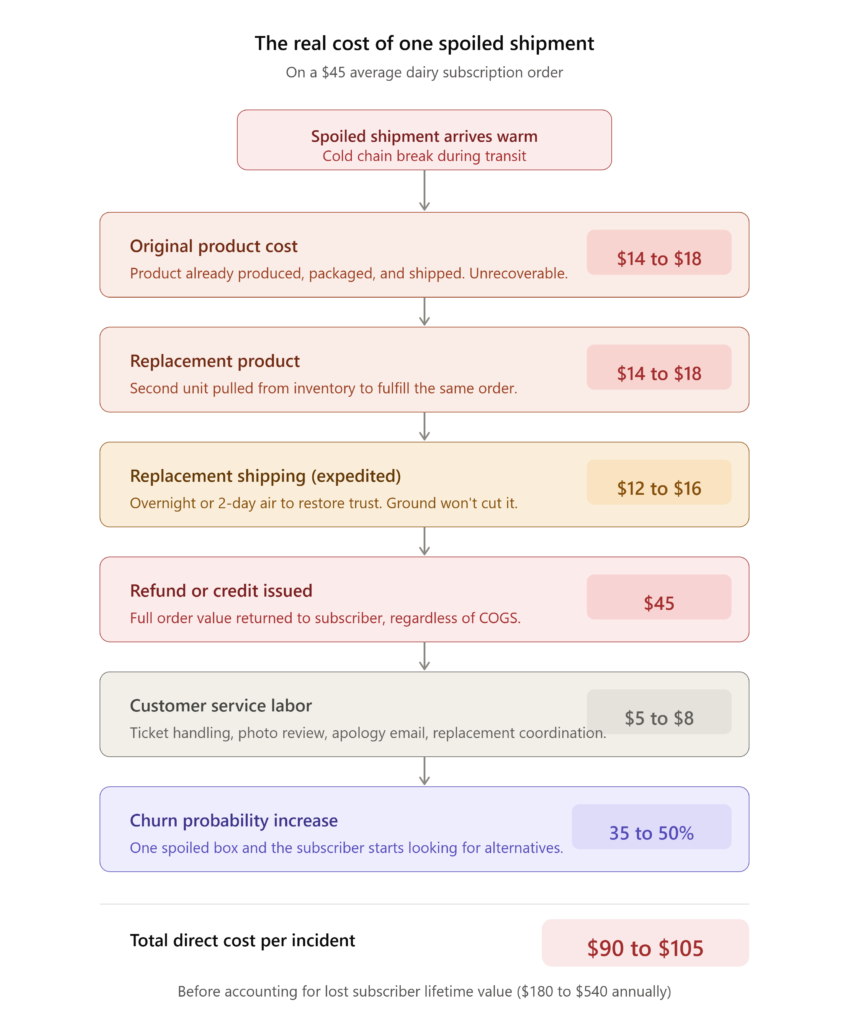
Here is what the cost cascade looks like for a single spoiled shipment on a $45 average order:
| Cost Component | Amount |
|---|---|
| Original product cost | $14 to $18 |
| Replacement product | $14 to $18 |
| Replacement shipping (expedited) | $12 to $16 |
| Refund or credit issued | $45 |
| Customer service labor | $5 to $8 |
| Churn probability increase | 35 to 50% likelihood of cancellation |
At a 5% spoilage rate on 500 weekly subscribers, that is 25 spoiled shipments per week. The direct cost runs $2,000 to $2,500 weekly before accounting for the downstream churn. Over a quarter, the math gets uncomfortable quickly.
Cold Chain Packaging: Gel Packs, Dry Ice, and the 48-Hour Ground Window
The packaging decision is where cold chain theory meets unit economics. Overnight air shipping solves the temperature problem but destroys the margin. Ground shipping preserves the margin but introduces a 24 to 72 hour window where your packaging, and only your packaging, stands between your product and the temperature danger zone. The PMO cooling rules that govern your packaging spec are the same ones at the center of the raw-milk debate, what selling raw milk online legally actually requires.
The Pasteurized Milk Ordinance (PMO) mandates that raw milk be cooled to 45°F or lower within two hours of milking and maintained at or below that temperature during storage and transport. For pasteurized dairy products in a subscription box, the operational target is tighter: maintaining temperatures at or below 40°F throughout transit to inhibit bacterial growth and maintain quality through delivery.
The 48-hour ground shipping window is where most viable dairy subscription economics live. Two-day ground reaches 60 to 70% of the U.S. population from a well-positioned fulfillment center, at roughly one-third the cost of overnight air.
| Attribute | Insulated Liner + Gel Packs | Insulated Box + Phase-Change Panels | Styrofoam + Dry Ice |
|---|---|---|---|
| Cost per shipment | $4 to $6 | $6 to $10 | $12 to $18 |
| Thermal hold time (sub-40°F) | 24 to 36 hours | 36 to 48 hours | 48 to 72 hours |
| Best for | Regional/next-day fluid milk, yogurt | 2-day ground cheese, butter, cream | Nationwide frozen/ice cream, soft cheese |
| Seasonal reliability | Fails in 90°F+ ambient without upgrade | Reliable through most summer conditions | Reliable year-round |
| Sustainability concerns | Gel packs non-recyclable in most municipalities | Some panels recyclable; higher material weight | Dry ice sublimates (CO₂ emissions); styrofoam disposal |
| Regulatory note | Must maintain PMO ≤45°F for raw; ≤40°F for pasteurized | Same | Dry ice shipping limits apply (IATA/DOT) |
Two things to note about this table. First, the “thermal hold time” figures are manufacturer specs tested in controlled conditions. Real-world parcel networks run hotter, involve more handling, and include time sitting on porches in direct sunlight. Discount lab specs by 20 to 30% for operational planning. Second, the cost ranges shift seasonally. Summer packaging for the same product and transit lane costs 25 to 40% more than winter packaging.
Delivery Radius and Frequency: Letting Logistics Set the Subscription Tiers
The instinct is to design subscription tiers around what customers want: weekly, biweekly, monthly. The discipline is to design them around what the cold chain can actually deliver without breaking.
Start with the shelf life of your anchor product. Fluid milk with no preservatives lasts 7 to 10 days in the refrigerator. That means the subscriber needs to receive it within 2 to 3 days of packaging to get a usable window. For a weekly subscription, that constrains you to a delivery radius where 2-day ground reliably arrives in 2 days, not the carrier’s “2 to 3 business days” average.
In practice, that radius is typically 200 to 400 miles from your fulfillment center for fluid milk, and 500 to 700 miles for harder dairy products (aged cheese, butter) that tolerate longer transit.
The radius trap:
Shipping dairy nationally from a single location without regional cold hubs means your farthest customers consume 60 to 70% of your packaging cost budget. If your average order value cannot absorb $12 or more in packaging and shipping, your radius is too wide. The fix is not cheaper packaging. It is a tighter radius or a regional hub.
“We tried national shipping from our creamery in Wisconsin. The math worked on paper until we realized our West Coast customers needed dry ice plus overnight air just to arrive safe in summer. Our CAC was $51, but our cost-to-serve for California was $34 per box. We pulled back to a 500-mile radius and our margins recovered within two months.”
, Founder, Farm-to-Door Dairy Subscription, Midwest
Here is how to calculate your maximum viable delivery radius:
- Identify your longest-shelf-life anchor SKU and your shortest-shelf-life SKU in the subscription box
- Test your thermal packaging against peak summer ambient temperatures (use 95 to 105°F as planning baseline, not average)
- Map carrier transit times from your fulfillment location to concentric zones at 200, 400, 600, and 800 miles
- Overlay the packaging thermal hold time against the actual (not quoted) transit time for each zone
- The zone where thermal hold time minus a 30% safety margin still exceeds transit time is your maximum radius
Every zone beyond that either needs upgraded packaging (which changes your unit economics) or a regional fulfillment hub (which changes your operational model).
FSMA 204 and PMO: The Regulatory Layer Dairy Subscriptions Cannot Ignore
The FDA’s Food Traceability Rule, known as FSMA 204, establishes enhanced recordkeeping requirements for foods on the Food Traceability List. For dairy, that means soft and semi-soft cheeses: mozzarella, brie, feta, ricotta, blue cheese. Fluid milk and hard cheeses are not on the list. Grade “A” cottage cheese was exempted in February 2026 because it is already regulated under the Interstate Milk Shippers (IMS) Program and the Pasteurized Milk Ordinance (PMO).
Retailers are enforcing FSMA 204 lot-level tracking ahead of the 2028 deadline, and the brands treating that as an asset rather than a cost are turning traceability into a transparency-led market-share advantage. The compliance deadline was originally January 20, 2026. The FDA extended it by 30 months to July 20, 2028, acknowledging that supply chain coordination across thousands of entities was not achievable on the original timeline. Congress made the extension binding through the Continuing Appropriations Act of 2026.
That delay is not breathing room. It is a trap for operators who defer.
Retail is not waiting:
Walmart’s supplier traceability requirements, including ASN-level data with key data elements, SSCC-18 pallet labels, and GS1-128 case labels, took effect August 1, 2025. Chargebacks for non-compliant shipments are being assessed now. If your subscription operation also feeds wholesale or retail channels, your traceability system needs to be live today, not in 2028.
For subscription operators, FSMA 204 compliance means:
- Assigning Traceability Lot Codes (TLCs) at the point of initial packing for every covered dairy product
- Recording Key Data Elements (KDEs) at each Critical Tracking Event (CTE): receiving, transforming, shipping
- Maintaining the ability to provide traceability records to the FDA within 24 hours of request, in an electronic sortable spreadsheet format
Even if you only ship DTC today and your products are not on the Food Traceability List, building lot-level tracking into your fulfillment workflow now pays for itself in three ways. It makes spoilage root-cause analysis possible (which batch, which packaging run, which carrier lane). It protects you during a recall. And it prevents a costly retrofit if you scale into wholesale later.
SKU Strategy: Which Dairy Products Survive Subscription Shipping
Not every dairy product belongs in a subscription box. The shelf-life spectrum across dairy categories determines which products justify the cold chain cost and which are better served through retail. Shelf life decides SKU strategy, but so does the law which dairy products can actually ship interstate, and which states restrict them sets the outer boundary on any subscription’s delivery map.
- Fluid milk (7 to 10 days, no preservatives):
- Viable only for regional, weekly subscriptions with next-day or 2-day delivery within a tight radius. High frequency anchor product, but the cold chain cost per ounce is the highest of any dairy category.
- Yogurt and kefir (2 to 3 weeks):
- Moderate shelf life gives more flexibility. Biweekly subscriptions work within 500 miles. Packaging must prevent container rupture from pressure changes and temperature fluctuation.
- Butter (1 to 3 months refrigerated):
- Forgiving on transit time, but extremely temperature-sensitive for texture. Butter that arrives partially melted and resolidifies is technically safe but aesthetically ruined for a premium subscription.
- Soft and fresh cheeses (1 to 4 weeks):
- Higher cold chain risk. These are also FSMA 204 FTL items, adding a traceability requirement. Viable for biweekly or monthly curated subscriptions with phase-change packaging.
- Aged and hard cheeses (3 to 6 months):
- The ideal subscription shipping product. Long shelf life, high perceived value, tolerant of moderate temperature variation. Monthly cheese clubs built around aged varieties have the strongest unit economics in dairy DTC.
Aged cheese is the strongest subscription SKU, and it comes with its own compliance lane the licensing and FSMA 204 rules for selling artisan cheese online. “We launched with 12 SKUs because we wanted variety. By August, we’d pulled 8 of them from the summer rotation because they couldn’t ship reliably. Now we run a 4-SKU core of aged cheeses and butter year-round, and rotate seasonal additions only in months where our packaging can handle them.”
The “anchor plus rotation” model works well here. A high-frequency staple (like a monthly aged cheese selection) anchors the subscription, and rotating seasonal items (fresh mozzarella in cooler months, flavored butter in winter) add discovery without creating year-round cold chain commitments you cannot fulfill.
Technology Stack: Temperature Monitoring, Lot Tracking, and Subscription Management
Three systems need to work together for a dairy subscription to function at scale: temperature monitoring, lot-level inventory tracking, and subscription management with flexible delivery controls. If you’re a certified-organic producer, part of this cold-chain build can be grant-funded, how ODMAP 2024 funding maps to a DTC fulfillment build.
Temperature monitoring.
Single-use IoT temperature loggers cost $2 to $5 per device and provide a complete thermal profile of the shipment from fulfillment center to doorstep. You do not need one in every box. A statistically meaningful sample (5 to 10% of shipments per carrier lane, rotated weekly) gives you the data to identify which lanes, which seasons, and which packaging configurations are producing temperature excursions.
Lot-level inventory tracking.
For FSMA 204 readiness and spoilage root-cause analysis, your inventory system needs to track products at the lot level, not just the SKU level. That means FIFO (first in, first out) enforcement is automated, not manual. When a spoilage complaint arrives, you can trace back to the production batch, the packaging date, the fulfillment run, and the carrier used.
Subscription management with pause and skip.
This is where cold chain and retention strategy intersect.
Pause protects margin:
Pause-enabled subscriptions retain 40 to 60% of paused customers who eventually return to active status, compared to just 5 to 15% of cancellers who reactivate, according to Recharge’s 2026 retention data. For dairy, where seasonal consumption patterns are real (families travel in summer, holidays shift purchasing), the pause function is not a churn risk. It is a margin-protection tool that prevents the customer from cancelling entirely during a period when your cold chain costs are highest anyway.
Minimum technology stack for launch:
- Subscription platform with pause/skip/swap functionality (Recharge, Bold, or custom)
- Inventory management with lot-level tracking and FIFO enforcement
- Shipping integration with carrier-level transit time data by zip code
- Temperature logger program (sample-based, not every shipment)
- Customer communication automation for delivery day alerts and weather-delay notifications
Decision Framework: Choosing Your Dairy Subscription Cold Chain Model
Step 1: Assess your product shelf-life envelope.
Map every SKU against shelf life from packaging to consumer refrigerator. Products with under 10-day shelf life (fluid milk, fresh cream) require regional fulfillment with next-day or 2-day delivery. Products with 30-plus day shelf life (aged cheese, butter) can ship nationally with standard cold chain packaging.
Step 2: Define your maximum viable delivery radius.
Test your thermal packaging against your longest transit lane in peak summer conditions. If your insulated mailer breaks 40°F before delivery, either shorten the radius, upgrade the packaging, or remove that SKU from the subscription. The radius defines the addressable market.
Step 3: Set delivery frequency by cold chain constraint.
Weekly works for fluid milk within a 200-mile radius. Biweekly works for mixed dairy boxes (cheese, butter, yogurt) within 500 miles. Monthly works for curated cheese clubs with 60-plus day shelf life shipped nationally. Each frequency tier gets its own packaging spec and cost model.
Step 4: Build traceability into the subscription stack from day one.
Even if you are below FSMA 204’s enforcement threshold today, implement lot-level tracking (TLCs at initial packing, KDEs at shipping) in your fulfillment workflow now. Retrofitting traceability into an active subscription operation costs 3 to 5x more than building it in from the start.
Step 5: Model unit economics at your target spoilage rate before launch.
Run your P&L at 3% spoilage (achievable with proper cold chain design), 5% (average for well-managed DTC dairy), and 10% (common in the first 90 days without logistics-first design). If the model does not work at 5%, the subscription does not work. The cold chain needs redesigning before the launch page goes live.
FAQs
How do I keep dairy subscription orders cold enough during last-mile delivery?
Use insulated packaging rated for your longest transit lane in peak summer ambient temperatures. For 2-day ground, gel packs with insulated liners hold at or below 40°F for 24 to 36 hours; phase-change panels extend that to 36 to 48 hours. Test with data loggers before launching. Thermal performance on spec sheets rarely matches real-world parcel network conditions.
What FSMA 204 requirements apply to my dairy subscription business?
If you ship soft or semi-soft cheeses (mozzarella, brie, feta, ricotta, blue cheese), you are handling Food Traceability List items. You will need traceability lot codes, critical tracking event records at receiving, transformation, and shipping, and the ability to provide data to the FDA within 24 hours. Enforcement is now July 2028, but major retailers already require compliance.
What is the real spoilage rate for DTC dairy vs. retail dairy?
Retail dairy benefits from continuous refrigeration. DTC relies on passive cooling with a limited window. Well-designed DTC operations achieve 2 to 5% spoilage. First-time subscription launches without logistics-first design commonly hit 8 to 12% in the first 90 days, driven mostly by last-mile temperature excursions during summer months.
How often should my dairy subscription deliver?
Let shelf life decide. Fluid milk with a 7 to 10 day window needs weekly delivery within a tight radius. Aged cheeses with 60-plus day shelf life can ship monthly nationwide. Mixed boxes work biweekly within 500 miles. Every frequency tier needs its own packaging cost model and seasonal adjustment plan
Can I use the FSMA 204 delay as breathing room, or should I build traceability now?
Build now. Walmart’s supplier traceability requirements took effect August 2025 with active chargebacks for non-compliance. Even if you operate DTC-only today, lot-level tracking protects you during recalls, improves spoilage root-cause analysis, and prevents a costly retrofit if you scale into wholesale later.
Conclusion:
The dairy subscription operators who make it past year one are the ones who treated the cold chain as the foundation, not the afterthought. That means accepting constraints that feel uncomfortable at first: a tighter delivery radius than you wanted, fewer SKUs than your marketing team pitched, packaging costs that eat more of the margin than you budgeted.
Those constraints are the model. They are what separate a subscription that survives July from one that does not. The demand for farm-fresh, artisan, and specialty dairy delivered to doorsteps is real and growing. The operators who capture it will be the ones who built their business model around the physics of perishability, not around the wish that perishability would cooperate with their marketing calendar.
As of August 2026, the regulatory direction is clear: traceability is coming, cold chain accountability is tightening, and the operators who build those systems now will carry a structural advantage over those who wait for enforcement. The question is not whether your dairy products are good enough for a subscription. It is whether your cold chain is.
