
You got the ELAP check. Maybe it was $367 per affected cow, maybe $420 if milk prices cooperated that month. After 60 days of near zero production and pulling full shift care, that check covered about 40% of what you actually lost. The missing 60%? ELAP doesn’t touch it. That’s customer acquisition. That’s the supply chain rebuild. That’s the trust recovery campaign you have to run to convince people who stopped buying from you during quarantine that your milk is safe again.
The H5N1 outbreak that began in March 2024 has cost the dairy industry more than $1.2 billion in economic losses. Federal ELAP compensation has distributed roughly $80 million. The gap between actual losses and federal compensation isn’t just a shortfall, it’s structured. It systematically disadvantages small direct to consumer dairy operations while large commodity producers absorb the gap across their revenue base.
- $950 Per Clinically Affected Cow Cornell University researchers calculated total economic losses per infected animal in an Ohio herd, including production loss, mortality, treatment, and culling
- $367–$420 Per Head ELAP compensation payment based on April 2024 milk pricing and production loss formulas
- $530–$583 Gap Per Animal. The uncompensated portion left to absorb, disproportionately burdening DTC operations
- $1.2–1.4 Billion Total estimated H5N1 economic losses across U.S. dairy industry through late 2024
Key takeaways:
- ELAP closes the milk loss gap by approximately 40 percent, uncompensated recovery costs fall disproportionately on DTC operations
- Raw milk producers faced involuntary market exit during quarantine with zero compensation for lost customer lifetime value
- Biosecurity adoption remains at 1 percent uptake despite $28,000 per premises federal support available, reflecting unclear ROI and operational disruption costs
What the Outbreak Cost, A Single Herd Case Study
On March 25, 2024, USDA confirmed the first H5N1 case in a U.S. dairy herd. By March–April 2024, an Ohio dairy operation with 3,876 adult cows faced a clinical outbreak that would define the economic impact of the crisis for months to come.
The losses were staggering. Over a 60 day observation period, the herd experienced infection in a subset of animals, severe mastitis, dramatically reduced milk production, and scattered mortality. When researchers from Cornell University conducted a full economic analysis of that outbreak, they quantified something federal policymakers had underestimated, the true per animal cost of H5N1.
The numbers were brutal. Total economic losses for that single herd reached $737,500 over the observation period. Per clinically affected cow, that translated to $950 in losses not just milk loss, but the compounding cascade of treatment costs, labor, culling decisions, and production collapse that follows infection.
Milk loss represented 92.3% of the total damage. Death related costs accounted for 4.7%. Treatment and labor veterinary care, monitoring, equipment cleaning consumed 1.6%. Culling costs absorbed 1.5%. The breakdown reveals a fundamental economic reality. H5N1 doesn’t kill dairy cows the way it kills poultry. It devastates their productive capacity, creating economic loss through absence of income rather than direct mortality.
The Cornell study also documented something darker, the duration of reduced milk production extended beyond the clinical outbreak period. Animals recovered from infection. Production never fully bounced back. Cornell University researchers calculated total economic losses per infected animal in an Ohio herd. When researchers looked at the herd wide impact averaging affected and unaffected animals together the cost per cow across the entire operation ran $158. That was the hidden multiplier, the virus didn’t just damage infected animals, it cascaded through the entire herd operation through increased labor, biosecurity measures, and generalized operational disruption.
What the study didn’t include made the actual cost even higher. The researchers explicitly noted their analysis did not account for ongoing herd dynamics or reproductive losses downstream from infection. In other words, the $950 per affected cow was a floor, not a ceiling.
What ELAP Actually Covers And What It Doesn’t
The federal government responded to the crisis with the Emergency Assistance for Livestock, Honey Bees, and Farm raised Fish Program (ELAP). Starting July 1, 2024, eligible dairy producers could apply for compensation to offset lost milk production due to H5N1 infection.
The payment formula is straightforward but requires unpacking. ELAP calculates compensation as, Per head rate × Eligible affected cows × Producer share × 90% payment level
The per head rate itself is derived from milk production and pricing data, Daily milk production × All milk price × 21 days of zero production + Daily milk production × 50% × 7 days of partial production
In April 2024, when milk prices averaged $0.205 per pound and herds in affected regions produced roughly 72–80 pounds per cow daily, the per head rate worked out to approximately $367.55. With 90% coverage, a producer with 40 clinically affected animals received roughly $13,232 in total ELAP compensation, enough to cover about 40% of the Cornell documented $950 per head loss.
What ELAP covers is explicit: milk production loss. What it doesn’t cover is equally important. ELAP does not separately reimburse testing costs, veterinary treatment, labor beyond routine milking, culling decisions, or biosecurity infrastructure beyond a $1,500 per premises cap for plan development and a $100 reimbursement for biosecurity purchases. Those costs must be absorbed by the operation’s herd economics or financed through other channels.
The ELAP Structure Explained. Federal support makes funding available for lost milk production, calculated retroactive to the date of positive test result, for a 120 day window. Anything beyond milk loss supply chain disruption, customer acquisition, inventory management falls outside ELAP scope and becomes the producer’s responsibility.
For commodity milk operations, where individual producer identity is abstracted away and milk enters a standardized commodity stream, the gap is manageable. The operation ships to a co-op or processor. The milk loss is compensated. Production recovers. Business resumes. For direct to consumer operations, the gap is existential.
The DTC Business Impact, Three Uncompensated Cost Centers
DTC dairy operations derive their competitive advantage and margin profile from direct customer relationships, premium positioning, and transparent supply chains. They don’t exist in commodity markets. They exist in a trust ecosystem. H5N1 disrupted that ecosystem in three ways, none of which ELAP compensation addresses.
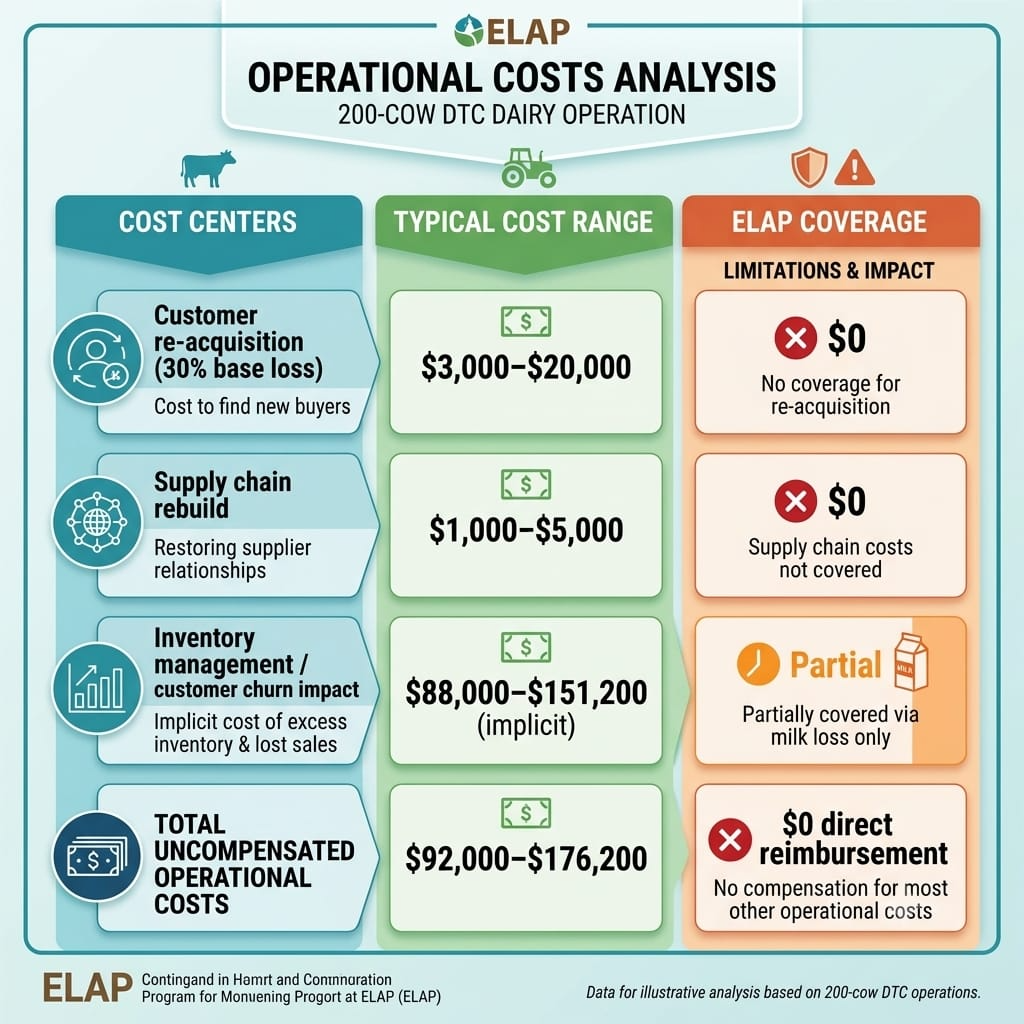
Cost Center 1. Customer Acquisition During Quarantine:
When a DTC dairy farm tests positive for H5N1, regulatory authorities issue quarantine orders. Raw milk sales halt immediately. Pasteurized milk products may be allowed to continue if biosecurity protocols are met, but customer confidence evaporates faster than inventory moves. Retail customers who bought weekly suddenly stop purchasing. They don’t resume when quarantine ends, they’ve moved to competitors.
Customer acquisition cost (CAC) in direct to consumer dairy markets typically runs $15–$40 per customer for digital channels and $5–$15 for local referral networks. For a small DTC operation serving 200–500 active customers, losing 30–40% of the customer base during a 90–120 day quarantine means re-acquiring $3,000–$20,000 in customer relationships. That cost comes from operational cash flow, not ELAP compensation.
Cost Center 2. Supply Chain Rebuild:
During recovery from H5N1, DTC operations must reverify supply chain integrity. If they source complementary products (cheese, butter, yogurt) from affiliated producers, they must retest suppliers. They must renegotiate delivery schedules and pricing that may have shifted during market disruption. For operations that source from multiple farms to maintain inventory during their own quarantine period, they must rebuild primary supplier relationships and manage the transition back.
Compliance with dairy standards of identity requires additional verification for any value added products in your supply chain. Supply chain rebuild costs run $1,000–$5,000 for small operations, including verification testing, logistics coordination, and inventory restocking. ELAP covers none of it.
Cost Center 3. Inventory Management During Quarantine:
When H5N1 is detected in a herd, milk is diverted from retail channels to pasteurization for safety verification or destroyed outright per regulatory directive. For a 200 cow DTC operation producing 1,200–1,400 gallons weekly, a 90-day quarantine means 11,000–12,600 gallons diverted or destroyed. At $8–$12 per gallon retail margin a typical DTC premium, that represents $88,000–$151,200 in lost customer inventory presence. If you also produce value added products like cheese or yogurt, those production lines halt as well, amplifying the inventory gap and customer presence loss.
That lost presence isn’t just revenue. It’s customer churn. While your milk is being diverted, competitors fill your retail shelf space, your subscription slots, your farmers market stand. When quarantine lifts and milk supply resumes, your customer base has shifted. Recapturing market share requires aggressive customer retention programs, temporary price discounts, and marketing spend. For producers with artisan cheese or value added products, the inventory impact is compounded. ELAP compensates the fluid milk loss value, it doesn’t compensate for the customer attrition that follows or the value added product revenue lost during quarantine.
Raw Milk Producers, The Hardest Hit Segment
Raw milk producers occupy a unique vulnerability in the H5N1 crisis. Their customer base is built on trust in a specific supply chain story, unprocessed, enzyme preserved milk from verified farms. H5N1 directly undermined that narrative.
Multiple states including Minnesota, California, and others issued explicit bans on raw milk sales from farms with confirmed H5N1 infections during quarantine periods. This was not a temporary disruption. This was a regulatory market closure. Understanding how to sell raw milk online legally Is foundational, but H5N1 quarantine orders override normal regulatory frameworks and force temporary market closure regardless of compliance status.
One California raw milk producer saw weekly production capacity drop from 86,000 gallons to zero retail sales during quarantine periods when H5N1 was detected in bulk tank samples. The milk wasn’t destroyed. It was diverted to pasteurization for safety verification. But retail channels were closed.
The economic impact cascaded beyond milk loss. Raw milk customers are premium paying, highly engaged consumers. They maintain direct relationships with producers. They purchase weekly or bi-weekly on subscription. They’re not interchangeable with commodity milk customers. When forced quarantine breaks that relationship, customer lifetime value evaporates. A raw milk subscription customer represents $3,000–$5,000 in annual customer value. Losing 50 customers during a 120 day quarantine means losing $150,000–$250,000 in annual customer revenue.
ELAP compensates milk loss. It doesn’t compensate for involuntary market closure or lost customer lifetime value. Raw milk producers absorbed the full impact of the gap.
The Compensation Gap, Milk Loss vs. Total Recovery Cost
The gap between actual losses and ELAP compensation is not theoretical. It’s quantifiable. A 200 cow DTC dairy operation with 40 clinically affected animals faces these economics:
1. Actual losses (Cornell model): 40 cows × $950 = $38,000
2. ELAP compensation: 40 cows × $367.55 = $14,702
3. Gap: $23,298 per herd during 60-day observation period
Extend to 120 days and add in customer acquisition and supply chain costs, and the gap expands to $35,000–$45,000 for a small operation. For a large commodity operation with 1,000 clinically affected animals.
1. Actual losses: 1,000 cows × $950 = $950,000
2.ELAP compensation: 1,000 cows × $367.55 = $367,550
3.Gap: $582,450 But the large operation can distribute that gap across 5,000 total animals and wider revenue streams.
Per animal burden is $116. For a 200 cow operation, the gap is $116 per affected animal, concentrated in a small revenue base This is why the compensation gap hits DTC operations hardest. The shortfall isn’t smaller; it’s identical per animal. But the revenue base to absorb it is proportionally smaller. The Math That Matters. A $23,000 gap represents 18–24 months of margin pressure for a small DTC operation. The same gap is absorbed in 2–3 months by a large commodity producer. Time to recovery = function of gap size divided by operation revenue. Small operations face 36–48 month recovery timelines. Large operations recover in 18–24 months.
Biosecurity Adoption Barrier, Why Producers Hesitate Despite Federal Support
The federal government made available up to $28,000 per premises in ELAP support over a 120 day window:
- $1,500 for biosecurity plan development
- $100 reimbursement for biosecurity purchases
- Up to $26,400 in additional support for testing and containment measures
Taken together, it sounds like meaningful assistance. In practice, only 1% of U.S dairy herds registered for any biosecurity assistance by November 2024, according to research from Communications Earth & Environment. Only 0.2% enrolled in voluntary testing programs despite those programs being free. Why the reluctance?
The answer is not farmer irresponsibility. It’s rational economic decision making under uncertainty. Biosecurity infrastructure requires upfront capital investment: boot baths, facility redesign, equipment upgrades, training protocols. Those costs are immediate and certain. The benefits avoiding H5N1 infection are probabilistic and uncertain. For a producer in an unaffected region, the perceived risk may not justify the capital spend.
Additionally, implementation requires operational disruption. Biosecurity protocols demand changes to employee workflows, visitor access, equipment sanitation routines. For small operations running lean on labor, that disruption has real costs that federal reimbursement doesn’t capture.
The psychological barrier also matters. Biosecurity investments feel like paying to prevent an event that may never occur. Compensation for losses feels like recovery from damage that has occurred. Psychologically, compensation is more compelling than prevention.
The result, 99% of dairy herds have not registered for available biosecurity assistance, even though the programs are free or heavily subsidized. The gap between federal support availability and producer uptake reveals something ELAP and biosecurity programs miss producers need help with recovery and cash flow, not with prevention infrastructure that adds operational burden.
Recovery Path, Calculating Your DTC Rebuild Timeline
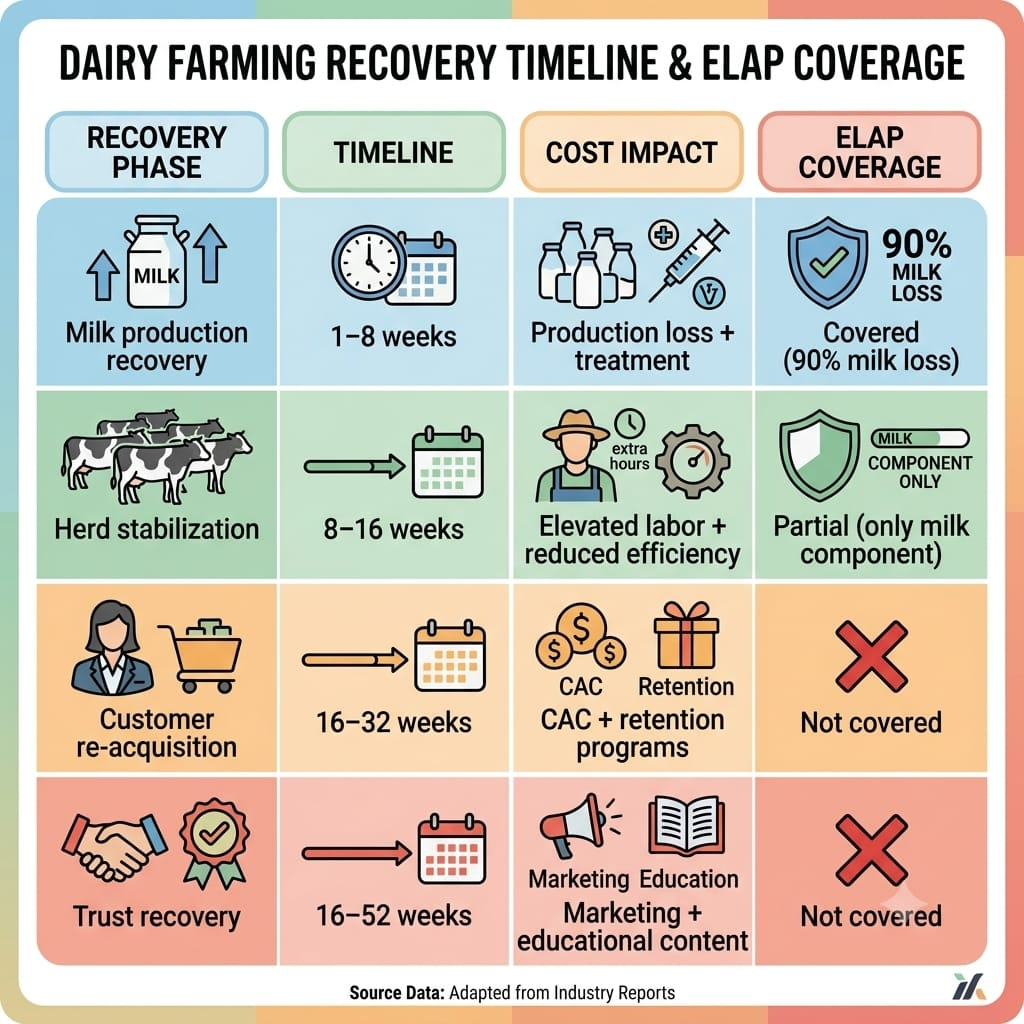
Recovery from H5N1 doesn’t follow a linear path. It comprises four overlapping phases, each with its own timeline and costs.
Phase 1. Milk Production Recovery (Weeks 1–8):
Clinical recovery happens relatively quickly. Infected animals begin producing milk again within 2–4 weeks. Production ramps toward normal over 4–8 weeks. ELAP compensation targets this phase. This is where federal support works best.
Phase 2. Herd Stabilization (Weeks 8–16):
The broader herd experiences residual stress. Feed efficiency lags. Reproductive performance may decline. Labor costs remain elevated to maintain biosecurity protocols. Production plateaus below pre outbreak baseline for 8–16 weeks. If you source cattle interstate as part of herd recovery, understanding interstate dairy shipping requirements and H5N1 testing protocols is essential to avoid recontamination.
Phase 3. Customer ReAcquisition (Weeks 16–32):
DTC operations must rebuild the customer base. This requires marketing spend, temporary price discounts to win back price sensitive customers, and aggressive retention programs. Timeline, 16–32 weeks for small operations to reacquire 50–70% of lost customer base.
Phase 4. Trust Recovery (Weeks 16–52):
Unaffected producers in affected regions must still rebuild consumer confidence despite having no infection. This requires supply chain transparency campaigns, customer education, and affirmative positioning. Timeline, 16–52 weeks depending on market positioning and customer communication strategy. Total recovery timeline, Large commodity operations 5,000+ cow herds, 18–24 months. Small DTC operations 200–500 cow herds,36–48 months
The difference is not about herd recovery. It’s about customer recovery capacity. DTC operations move slower through customer reacquisition because they depend on individual customer relationships rather than commodity volume.
FAQS
My ELAP check covers 40% of my losses. Where do I find the other 60%?
That gap comes from your operational cash flow, line of credit, or business reserves. ELAP compensates milk loss only, it doesn’t compensate for customer acquisition costs, supply chain rebuild, inventory disruption, or biosecurity infrastructure. For a $23,000 gap on a 200 cow operation, you need to either:
(1) Finance the gap through a line of credit,
(2) Defer other capital investments to absorb the cost,
(3) Accelerate customer reacquisition through temporary margin compression. Most producers do a combination of all three.
I’m a raw milk producer. We were quarantined for 120 days. Do I get compensated for lost customers?
No. ELAP compensates milk loss only. Lost customer lifetime value from involuntary market closure receives no federal compensation. Raw milk markets are particularly vulnerable because state regulations bar sales during quarantine periods. If you lost 50 regular customers due to quarantine, you must reacquire them individually. This is where customer communication and supply chain transparency becomes critical to rebuilding market share.
Should I invest in biosecurity right now, even though I haven’t tested positive?
Federal assistance for biosecurity $1,500 plan + $100 purchases is available whether you’re affected or not. The ROI question is harder. If you’re in a high prevalence region California, Michigan, Texas, biosecurity investment reduces infection probability. If you’re in an unaffected region, the risk benefit calculation shifts. Cost of biosecurity infrastructure upfront capital + operational disruption must be weighed against probabilistic outbreak risk.
Consider, If infection occurs, the gap between your actual losses and ELAP compensation is $23,000–$45,000. If biosecurity infrastructure costs $5,000–$8,000 and reduces infection probability by 30%, the expected value calculation may favor investment. But if infection probability is low and cash is constrained, the investment is harder to justify.
How do I calculate my true recovery cost, not just milk loss?
Start with Cornell’s $950 per clinically affected cow. Subtract your expected ELAP payment ~$367–$420. Add your best estimates for:
(1) Customer reacquisition CAC × lost customers,
(2) Supply chain rebuild $1,000–$5,000,
(3) Marketing/trust recovery $2,000–$10,000 depending on market,
(4) Opportunity cost of operational disruption. The sum is your total uncompensated recovery cost. Divide by your typical monthly profit margin to estimate the recovery timeline in months.
My DTC business lost 30% of customers during quarantine. How fast can I win them back?
Customer reacquisition for DTC dairy typically takes 16–32 weeks for small operations. Timing depends on your retention strategy: price discounts attract price sensitive customers quickly 4–8 weeks for 20% recovery, relationship based marketing and transparency campaigns win back premium customers slower 12–16 weeks for next 20%.
Understanding your customer segment and positioning strategy determines recovery velocity. Raw milk customers typically return slower than pasteurized milk customers because their brand loyalty is higher but their trust threshold for re-engagement is also higher.
Conclusion
The H5N1 compensation gap is not a policy error. It’s a structural limitation of a program designed to address milk loss, not to address the full recovery challenge facing DTC operations.
ELAP works well for what it targets, compensating commodity milk producers for production loss during outbreak periods. That’s a straightforward economic calculation, lost pounds multiplied by milk price. The federal government can measure it, reimburse it, and move on.
What ELAP doesn’t touch on are the DTC specific recovery challenges, customer base rebuilding, supply chain re verification, trust recovery marketing, and the customer lifetime value lost during involuntary quarantine periods. Understanding your full operational model and cost structure beyond commodity milk economics is essential to planning for recovery scenarios.
For DTC producers in affected regions, the path forward requires acknowledging the gap explicitly and planning recovery around it. Calculate your true uncompensated costs. Understand your customer reacquisition timeline. Plan your cash flow assuming a 36–48 month recovery window, not an 18 month commodity recovery. Build supply chain transparency as part of your trust recovery strategy, not as a separate marketing initiative. The H5N1 outbreak reshaped dairy economics. ELAP addressed part of that reshape. The rest falls to you to navigate.
