
USDA’s 2022 Census confirms it, direct to consumer sales have flatlined while intermediated local channels surged 33 percent, and premium farm brands that stay stall only are quietly capping their own growth.
You sell out almost every Saturday, break down the tent by two, and drive home with an empty cooler and roughly the same revenue you posted last season. The stall is full, the business is not growing. That plateau is not a demand problem. It is a distribution ceiling, and USDA’s latest data shows thousands of premium brands are hitting it at the same time.
- $17.5B Total U.S. direct marketing food sales in 2022, up 25 percent since 2017.
- 33% Growth in intermediated local channels grocery, food hubs, institutions, 2017 to 2022, while direct to consumer stayed flat.
- -10.3% Decline in the number of farms selling direct-to-consumer since 2017.
- ~60% Drop in average agricultural sales at tracked Vermont farmers markets, 2022 to 2025.
Key takeaways:
- Treat the farmers market as a discovery channel, not the whole business.
- Intermediated local channels grew 33 percent while direct to consumer stalls stayed flat.
- Diversify once one stall cannot fund growth beyond a single weekend.
The Saturday Ceiling, When Sold Out Stops Meaning Growing
A farmers market stall is the best storefront a young brand can rent. It puts your product in front of a self selected crowd that already wants what you sell, and it hands you something no digital channel gives you cheaply, a face to face conversation with the person paying you. For the first two or three seasons, that is usually enough.
Then the math stops moving. The stall has a fixed footprint, a fixed number of market days, and a fixed catchment of shoppers who can physically reach it on a given morning. You can raise prices, add SKUs, or work faster at the register, but you cannot manufacture more Saturdays. That is the ceiling, and most operators run straight into it without recognizing what they have hit. The hard limits are structural, not effort related, Geography. A stall serves whoever can drive to it before the good stuff sells out. Your addressable market is a radius, not a region. Weather and seasonality. Revenue that depends on a sunny Saturday is revenue you cannot forecast. Foot traffic. You inherit the market’s crowd. If attendance dips, so does your top line, and you had no say in it. Zero revenue between market days. Six days a week, your brand earns nothing while your fixed costs keep running.
The volatility is measurable, not just felt. In Vermont, average agricultural sales at tracked farmers markets fell nearly 60 percent between 2022 and 2025 even as the number of markets kept climbing, pushing growers toward CSA shares and farm stands for steadier money and less dependence on a sunny Saturday. We sold out by noon almost every Saturday for three seasons straight. I kept thinking that meant we were winning. Then I looked at the annual numbers and realized we had been flat the whole time. The stall was full. The business wasn’t going anywhere.
That gap between sold out and growing is the whole problem in one sentence. Selling out is a supply at a stall signal. It tells you the table is the constraint, not the demand. The brands that keep compounding are the ones that treat the market as the top of a funnel rather than the bottom line, and start converting that Saturday loyalty into revenue that does not depend on the tent. Story is part of that conversion, and increasingly it happens where shoppers actually search, a shift we cover in farm brand storytelling for AI driven discovery.
What the USDA Data Actually Shows
The plateau is not anecdotal. It is in the census. Data from the 2022 Census of Agriculture, released in February 2024, shows producers sold $17.5 billion in food through direct marketing channels, a 25 percent increase after inflation since 2017. On the surface that looks like a healthy, growing local food economy. Look at where the growth landed and the picture changes.
Almost all of it went to channels that are not the farmers market. Sales to retail outlets, institutions, and intermediate markets grew 33.2 percent after inflation, reaching $14.2 billion. Direct to consumer sales through farmers markets, on farm stores, u-pick, CSAs, and online market places stayed essentially flat against 2017 once you adjust for inflation. The money moved to the middle of the supply chain while the stall stood still.
The growth left the stall. Intermediated local channels grocery, food hubs, institutions reached $14.2 billion in 2022, up 33.2 percent since 2017, while direct-to-consumer sales held flat. If your entire brand lives at the farmers market, you are competing for a pool of dollars that is no longer expanding.
There is a second number that should stop any stall-only operator cold. According to USDA, the count of farm operations selling direct to consumer fell 10.3 percent between 2017 and 2022. Fewer farms are relying on the stall, and the ones that remain are splitting a flat pool of consumer spending among themselves.
USDA’s Economic Research Service reaches the same conclusion from a different angle. Its analysis finds that growth in the number of U.S. farmers markets has stayed modest and stable since 2016 and 2017, after two decades of rapid expansion. The agency links the plateau directly to the rise of local products in intermediate outlets like grocery stores and restaurants. Shoppers who once needed a Saturday market to buy local can now find it on a Tuesday at the supermarket.
None of this means demand for premium local food is falling. It means the buying is relocating. The consumer who values your product has more places to find it, and most of those places are not a folding table under a canopy. A brand that refuses to follow that shift is not protecting its values, it is ceding shelf space to competitors who did follow it.
The Premium Brand Paradox, A Stall Cannot Carry a Story
Here is the part worth sitting with. A premium agricultural brand is not selling calories. It is selling a story, how the animals were raised, how the soil was treated, why the price on the sign is what it is. That story is the entire justification for charging more than the commodity down the aisle. And a Saturday stall is a terrible place to tell it consistently.
Think about what the channel actually delivers. You get a few minutes with each shopper, a chalkboard, and whatever you can shout over the crowd before the next customer steps up. You cannot control the surroundings, the lighting, or who is set up next to you. The premium you have earned lives entirely in your ability to repeat the story, and the stall gives you almost no repeatable surface to repeat it on.
The paradox is that the channel best suited to premium demand, the market where shoppers actively want provenance and are willing to pay for it, is structurally the worst channel for building the durable brand infrastructure that premium positioning requires. Discovery and brand building are not the same job, and the stall only does one of them well.
Do not confuse loyalty with equity. Regulars who love you at the market are loyal to a habit and a face, not necessarily to a brand they could recognize on a shelf or a website. If your identity does not travel past the tent packaging, provenance claims, a consistent name and look, you own affection, not equity, and affection does not scale.
This is where a lot of otherwise-strong operators stall out. They have real demand and real margin, but no brand asset that works when they are not standing behind it. Getting that story to hold up in a commodity heavy market is its own discipline, one we break down in Agricultural brand PR for commodity markets. The point for now is narrower: the stall proves your story sells. It does not, on its own, let you sell that story anywhere else.
The Channel Portfolio, Five Alternatives, Ranked by What They Fix
The answer is not to abandon the farmers market. The answer is to stop asking it to do jobs it cannot do. Each alternative channel fixes a specific weakness in the stall only model, and the right move is to add the one that fixes your current constraint, not the one that sounds most ambitious.
Across farm brand implementations our research team has audited, the operations that break through the plateau tend to layer channels in a deliberate order rather than chasing all of them at once. Before you pick, look at what each option actually solves.
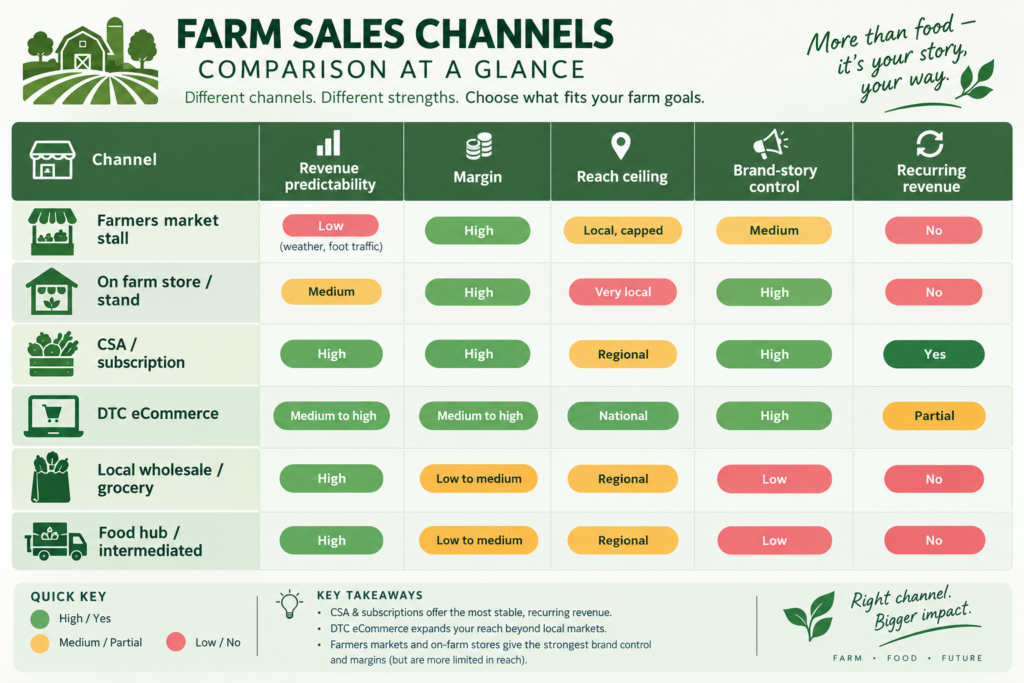
Read your own row first. If your constraint is unpredictable weekly revenue, the CSA or subscription row is where you look, because it is the only line in the table that turns a maybe they show up crowd into a committed, prepaid one. If your constraint is a hard geographic cap, DTC eCommerce is the only channel that lifts your ceiling to nationals without asking a customer to drive anywhere.
Add one recurring channel before chasing wholesale. A CSA or subscription stabilizes cash flow and locks in loyal buyers without giving up margin. Wholesale scales volume but cuts your per unit price, so it should come after your revenue base is steady, not before. Sequence matters more than speed here.
The eCommerce option deserves a specific warning, because it is the one most operators get wrong. Selling online is not the same as bolting a shopping cart onto a website built for dry goods. Perishable fulfillment, cold chain logistics, and farm-specific inventory realities break most general-purpose platforms, a failure pattern we document in why farm direct eCommerce platforms built for general retail fail. The channel is powerful. The tooling has to actually fit the product.
Local wholesale and food hubs sit at the bottom of the margin column for a reason. You trade dollars per-unit for predictability and volume, and you hand over most of your story control to a retailer or distributor. That is not a bad trade at the right stage. It is a terrible trade if you make it before your brand can survive being displayed by someone who does not care about it.
The Economics, Recurring Revenue Beats a Bigger Saturday
Operators tend to evaluate a new channel by asking how much it will sell. The better question is what kind of revenue it produces, because not all revenue is worth the same to a growing brand. A dollar you can forecast is worth more than a dollar you have to re-win every Saturday morning.
Recurring revenue is the quiet advantage the stall can never offer. A subscription or CSA member who prepays for a season removes weather, foot traffic, and competing weekend plans from your forecast in one move. That predictability is what lets you buy inputs with confidence, hire ahead of demand, and stop treating every rained out market as a small financial emergency. The margin trade offs across channels are real and worth mapping before you commit:
- Direct to consumer channels protect margin but cap scale. The stall, farm store, CSA, and your own online store all keep the retail dollar in your pocket, but each has a reach limit you will eventually hit.
- Wholesale inverts that. Selling to a local grocer or food hub can roughly halve your per unit price, so it only makes sense once your fixed costs are already covered by higher margin channels and you have the volume to make thin margins add up.
- Cost pressure changes the calculus every season. Input costs, freight, and tariffs move your break even, and a channel that pencils out this year may not next year.
Only pursue wholesale once your fixed costs are already covered. Below that volume threshold, a wholesale account dilutes your blended margin without adding real stability, because you are selling cheap units before your expensive units have paid the overhead. Run the blended margin math before you say yes to a buyer, not after.
That cost pressure point is not hypothetical. Rising input and freight costs are compressing farm marketing margins right now, and the channels you lean on determine how much of that squeeze you can absorb, a dynamic we trace in how farm input costs and tariffs are reshaping marketing margins. A diversified channel mix is partly a hedge, when one channel’s economics turn against you, the others keep the business standing.
For a concrete read on how direct to consumer margins actually behave once you account for the full cost stack. The specifics differ by product, but the lesson generalizes, the headline price a customer pays tells you very little until you have subtracted fulfillment, packaging, spoilage, and the cost of acquiring that customer in the first place. The subscription box changed how I think about the whole operation. I finally knew what next month looked like. The farmers market is still our best day for meeting new people, but it is not what pays the mortgage anymore. The recurring orders do that.
Protecting the Premium When You Leave the Stall
The biggest fear operators voice about diversifying is that leaving the market will cheapen the brand. It is a legitimate fear, and it is usually mishandled in one of two directions: either the operator refuses to leave at all, or they leave and immediately discount to win the shelf. Both are mistakes.
The premium does not live in the venue. It lives in the price integrity, the provenance claim, and the consistency of the story across every place the product shows up. A brand that holds its price and its narrative in a grocery cooler stays premium. A brand that caves to a buyer’s opening offer to get on the shelf resets its own ceiling, often permanently.
Entering grocery at a discount can permanently reset your price ceiling. Once a retailer and their shoppers anchor on a lower number, clawing the price back up is far harder than holding firm at entry. If a buyer will only take you at a price that breaks your premium, that is a signal to wait, not to fold. The shelf is not worth your positioning.
What travels well between channels is anything that makes the premium legible without you standing there to explain it. Packaging that carries the story. Provenance claims a shopper can verify. And credible third party certification, which does more work off the stall than on it, because it substitutes for the conversation you can no longer have in person. The mechanics of making those claims defensible rather than decorative are covered in regenerative agriculture branding and certification.
One brand we spoke with learned this the expensive way. They moved into a regional grocery chain fast, accepted the buyer’s price to secure the placement, and within a year found their own farmers market customers questioning why the stall price was higher than the shelf. They had trained their best customers to wait for the cheaper version of their own product. The lesson is not to avoid grocery shopping. The lesson is that channel expansion without price discipline does not grow a premium brand, it launders it into a commodity.
How to Layer Channels Without Cannibalizing the Stall
Diversification fails when it is done all at once or in the wrong order. The goal is a sequence that adds stability before it adds scale, and never lets a new channel undercut an existing one. Use this order. Anchor on the market, but cap its share. Keep the stall as your discovery engine and customer acquisition channel. Target it at no more than roughly 40 to 50 percent of revenue so a bad weather month is a dip, not a crisis. Add one recurring channel first. A CSA or subscription converts your existing market day loyalty into predictable, prepaid, weather proof income.
This is the highest leverage first move because it fixes forecasting before you touch anything harder. Stand up owned eCommerce. An on farm online store extends your reach past your driving radius while keeping full margin and complete story control. Build it on tooling that fits perishable fulfillment, not general retail. Enter local wholesale only at volume. Once fixed costs are covered and supply is reliable, add grocery or food-hub accounts for scale, and only at a price that preserves your premium. Never lead with your cheapest channel. Reweight quarterly.
Track revenue share by channel every quarter and shift effort toward the ones compounding, away from the stall as its contribution flattens. The mix that is right at $200K is not the mix that is right at $800K. The through line is simple. The farmers market earned you a following. The job now is to give the following more than one way to buy from you, in an order that protects your cash flow and your price at every step.
FAQS
If I’m selling out every Saturday, why would I add another channel?
Selling out is a supply at a stall signal, not a growth signal. A fixed table with fixed market days caps your revenue no matter how strong demand is. If you are sold out by noon, the constraint is your channel, not your customers, and the fix is adding capacity elsewhere, not working the same table harder.
Won’t going into the grocery cheapen my brand?
Only if you let it. The premium lives in your price integrity and provenance story, not the venue. Enter grocery at a price that holds your positioning, lead with packaging and certification that carry the story without you present, and walk away from any buyer who will only take you at a number that breaks your margin.
CSA or online store, which should I add first?
Add the CSA or subscription first. It delivers recurring, prepaid revenue and locks in your most loyal buyers, which fixes the forecasting problem the stall creates. An online store comes second, it extends reach nationally but does not, by itself, give you the predictable cash flow a subscription base does.
How much of my revenue should come from the farmers market?
Treat it as a discovery anchor, ideally under half of total revenue. At that share, a rained out Saturday or a slow season is a manageable dip rather than a lost month. The stall should keep acquiring customers you then convert to higher predictability channels, not carry the whole business.
Do farmers markets still matter if the growth is in wholesale?
Yes, as a brand-building and customer acquisition channel, not the revenue base. USDA data shows the stall discovers customers while intermediated channels scale the volume. The market is where people meet your brand and your story, the other channels are where that relationship turns into predictable, growing revenue.
Conclusion
The farmers market did its job. It proved your product sells, taught you who your customer is, and built you a following on a first name basis. What it cannot do is grow with you past the edge of a parking lot on a Saturday morning, and the USDA data makes clear that the operators who understand this are already moving.
The move is not to leave the market. It is to stop letting the market define the size of your business. Layer in recurring revenue, extend your reach with tooling that fits perishable products, hold your premium as you scale, and reweight the mix as you grow. Do that, and the stall becomes what it was always best at being the place people discover a brand that turns out to be everywhere they look next.
