

As AI agents reshape product discovery and purchasing, brands with unstructured data are becoming invisible. Here’s what food brands must do now before the window closes. Three years ago, product visibility meant shelf placement and SEO ranking. Today, it means something else entirely. AI agents, not humans, are increasingly making product recommendations and purchase decisions on behalf of consumers, and they operate on a principle that breaks traditional marketing logic: they prioritize structured, machine readable data over creative copy or packaging.
Welcome to the age of the invisible shelf. If your product uses sustainable packaging, an AI agent searching for ‘verified sustainable packaging’ won’t find it unless that information is structured and tagged. And if your brand’s product data isn’t optimized for machines, you’re already losing ground.
- 75% of consumers used AI shopping tools in the past six months, with 42% using them daily (Bloomreach, July 2026)
- ChatGPT Shopping activity skyrocketed 30x since January 2025, yet most food brands have no structured data strategy
- Michaels’ Ask Mike Gemini powered shopping assistant saw 27% of interactions ending in add to cart more than double the traditional site search rate
- Gartner projects 33% of enterprise software will include agentic AI by 2028, but the majority of CPG data infrastructures are not prepared
Key Takeaways:
- Agentic commerce is live and accelerating this is not a 2028 concern it’s a 2026 priority
- Structured data is now the competitive asset unstructured data is a liability
- Brands must prepare data infrastructure now before AI driven discovery becomes the default buying channel
What Changed The Shift From Search to Agentic Discovery
For decades, the rules of product visibility were simple nail shelf placement, dominate search rankings, and tell a compelling brand story. The tools changed from retail buyers to Google’s algorithm to Amazon’s A9 engine but the principle stayed the same. Visibility followed attention, and attention followed keywords. Agentic commerce breaks that rule entirely. When an AI agent processes a high intent query like healthy, sustainable, or moisturizing, it surfaces products based on structured, verifiable attributes, not keyword placement. Our analysis of the “3-3-3 shopping rule” and Gen Z food discovery patterns shows how younger consumers are using AI agents as their primary shopping interface and how structured data is the only language agents speak. The agent doesn’t read your brand story or admire your packaging. It extracts data ingredient lists, nutritional claims, third party certifications, sustainability credentials, inventory status, pricing logic. If that data is incomplete, contradictory, or unstructured if the agent cannot understand and verify it your product doesn’t appear in the recommendation set at all. Finally, TikTok Shop changed food eCommerce discovery a shift that made many brands realize their data architectures were too rigid. The agentic shelf will force that realization again, faster.
This is not hypothetical. Bloomreach’s July 2026 consumer survey found that 75% of consumers have used next gen AI to shop in the past six months, with conversion rates on AI shopping tools double or triple those of traditional search. Michaels formally launched “Ask Mike,” a Gemini powered shopping assistant, and revealed shoppers using it convert at more than double the rate of traditional site search with 27% of interactions ending in a product click or add to cart.
The Three Shelf Model: Where Your Brand Stands
Commerce now operates on three shelves and each requires a different visibility strategy:
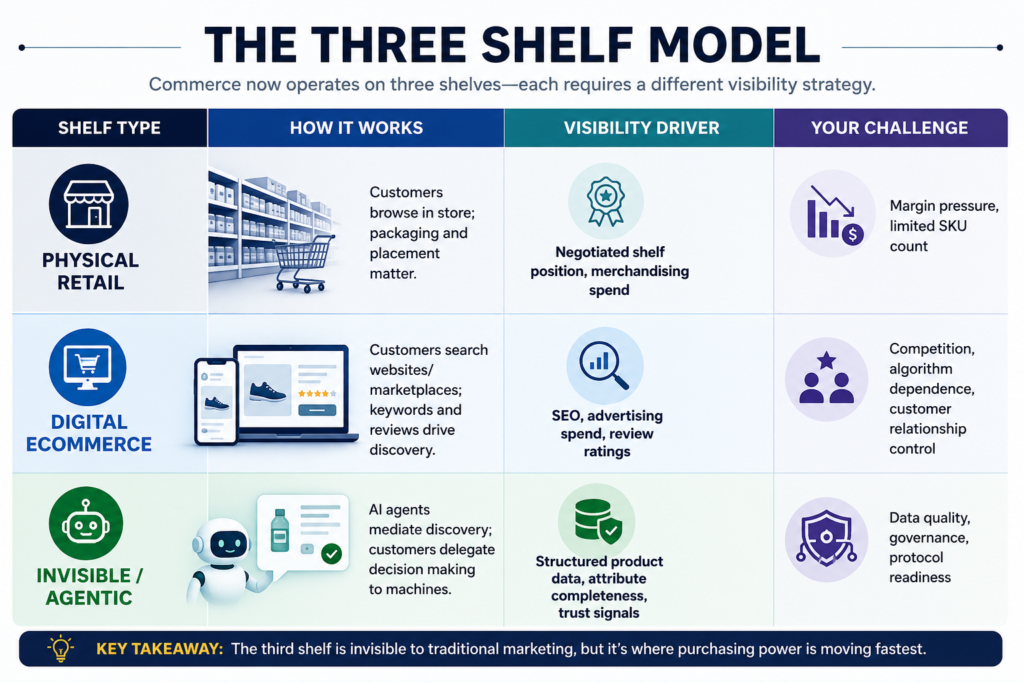
The third shelf is invisible to traditional marketing, but it’s where purchasing power is moving fastest.
| Shelf Type | How It Works | Visibility Driver | Your Challenge |
|---|---|---|---|
| Physical Retail | Customers browse in store packaging and placement matter | Negotiated shelf position, merchandising spend | Margin pressure, limited SKU count |
| Digital eCommerce | Customers search websites/marketplaces; keywords and reviews drive discovery | SEO, advertising spend, review ratings | Competition, algorithm dependence, customer relationship control |
| Invisible/Agentic | AI agents mediate discovery customers delegate decision making to machines | Structured product data, attribute completeness, trust signals | Data quality, governance, protocol readiness |
As SPINS’ Jessie Wright noted during recent industry discussions. If your data isn’t structured properly, you likely have a data problem contributing to your visibility on this third shelf. A human responds to marketing copy. An agent responds to structured data.
Why the “Invisible Shelf” Matters And Why Your Brand Might Already Be Losing
There are two reasons food brands should pay attention to agentic commerce right now not in 2027 or 2028, but in 2026.
Reason One:
Adoption is real and accelerating.
This is not a research demo or an executive prediction. Agentic commerce moved from research demos to live consumer transactions in roughly 18 months, driven by protocol launches from Anthropic (November 2024), Google’s Agent2Agent protocol (April 2025), and Stripe/OpenAI’s Agentic Commerce Protocol (September 2025), with ChatGPT Shopping launching with Etsy, Glossier, SKIMS, Spanx, and Vuori. Consumer usage of AI shopping tools jumped 30 fold since January 2025. This is happening right now.
Reason Two:
Visibility decisions are being made by algorithms before your customer ever engages.
In traditional and digital commerce, brands still have moments to influence the sale at the shelf, in search results, on the review page, at checkout. In agentic commerce, that window is gone. The agent makes its recommendation based entirely on data available before the customer even knows they’re shopping. If your product data is incomplete, conflicting, or unstructured, you’re invisible before anyone looks. This invisibility compounds. Algorithms learn. If an AI agent has been trained to exclude your category or brand because your data quality is poor, correcting that requires not just fixing your data but re training the agent’s model of your reliability a process that can take months.
What Food Brands Get Wrong About Product Data
Most food and beverage brands assume their current data practices built for SEO, retail, or direct to consumer sales will translate into agentic commerce readiness. They’re wrong. Here are the four most costly mistakes:
Error 1:
“Our SEO Keywords Will Carry Over to Agentic Discovery”
The mistake:
Brands invest heavily in keyword optimization (long tail variants, regional modifiers, intent based phrasing) and assume agents use similar search logic. They don’t.
What agents actually do:
They parse structured attributes and reason over them semantically. An agent looking for certified organic, non GMO dairy products under $6 per unit doesn’t search for that string. It extracts the taxonomy certification type, ingredient claims, price tier, package size. If your product data doesn’t explicitly tag these fields, the agent can’t parse them no matter how perfectly your SEO is optimized.
Error 2:
“Our Brand Story and Positioning Are Enough”
The mistake:
Marketing led brands rely on narrative and emotional connection. Small batch heritage, farm to table storytelling, clean label commitment these resonate with humans. Agents ignore them.
What agents actually do:
They verify claims against structured evidence. An agent evaluates a “non GMO” claim not by reading your brand story but by cross checking your product SKU against the Non GMO Project database, USDA records, or certification body registries. If your data doesn’t link to verifiable credentials, the claim has zero weight.
Error 3:
“Our Retailer Partners Manage This for Us”
The mistake:
Many food brands delegate product data management to retail partners (Walmart, Kroger, Amazon) and assume those partners are handling agent readiness.
What’s actually happening:
Most retailers are still learning this themselves. The brands sending clean, structured product data first are getting prioritized. Brands waiting for retailers to figure it out are falling behind and worse, they’re giving up control of how their data is interpreted.
Error 4:
“We’ll Fix It After We See Adoption”
The mistake:
Brands assume they have time to wait, to see how adoption plays out, to prepare after proof points emerge.
Why this is dangerous:
Algorithms learn from historical data. If an agent has been trained on poor quality versions of your data for six months, correcting that now requires retraining. The visibility damage compounds faster than you can repair it. First mover advantage in data preparation = velocity advantage in agent recommendations.
Four Critical Attributes AI Agents Evaluate (That Humans Skip Entirely)
Humans shopping for food focus on a few visible signals: price, packaging appearance, brand trust, maybe a quick nutrition label glance. If your data isn’t structured properly, you likely have a data problem contributing to your visibility on this third shelf. A human responds to marketing copy. An agent responds to structured data. Agents evaluate much deeper.
Attribute 1:
Structured Nutrition Claims vs. Marketing Claims
What agents do:
Extract the difference between marketing language wholesome, nutritious, energizing and verifiable claims 22g protein per serving, <2g sugar per serving, 15% daily value calcium.
Why it matters:
Agents can’t use marketing claims to compete. They can only match verified claims to explicit consumer queries. If your product page conflates marketing language with actual nutrition data, agents treat the entire profile as unverifiable and deprioritize it.
Action:
Separate marketing narrative from verifiable claim data. Tag each nutrition attribute with its verification source USDA, third party lab, certification body.
Attribute 2:
Certification Verification
What agents do:
Crosscheck claimed certifications organic, non GMO, fair trade, kosher, halal, carbon neutral against actual registries. An agent will verify your “organic” claim by confirming your SKU against USDA records.
Why it matters:
Certification fraud damages all brands in a category. Agents deprioritize products with unverified or conflicting certifications. Brands with crystal clear certification data rank higher both for trust and for inclusion in agent recommendations.
Action:
For each certification claim, provide the third party registry link, certificate number, and expiration date. Make verification trivial.
Attribute 3:
Inventory Real Time Signals
What agents do:
Avoid recommending out of stock products. Agents check inventory status before surfacing recommendations. Repeated out of stock events train agents to deprioritize your brand entirely.
Why it matters:
You lose visibility in agent recommendations when inventory is low or unreliable. Worse, you waste agent driven traffic on products you can’t fulfill.
Action:
Ensure inventory data syncs across all channels in real time. An out of stock status should be reflected instantly to agents querying your product availability.
Attribute 4:
Price Dynamism and Promotional Logic
What agents do:
Compare your product’s price against competitors and historical price points. They detect when promotions are sustainable vs artificial: a $10 product dropped to $4 is a red flag; a sustainable 10% discount is credible. For deeper context on how product data shapes visibility across channels, see our coverage of how food & beverage brands are using paid media to protect margin during tariff inflation without chasing race to the bottom discounting. Data ready brands can sustain premium positioning because agent recommendations reward margin-protecting strategies.
Why it matters:
Price comparing agents will stress test your margin structure. Brands with chaotic or desperate pricing lose credibility. Brands with stable pricing and predictable promotional logic get ranked higher.
Action:
Ensure your product pricing data reflects your actual cost structure and margin strategy. Agents will use this to predict sustainability.For operators concerned about margin compression, tariff driven food price inflation is reshaping consumer behavior and agents amplify this dynamic by enabling price-comparing purchases at scale. Data governance becomes a competitive advantage when competing on value rather than margin.
How to Audit Your Brand’s Agentic Readiness in 5 Steps
You don’t need a six month transformation to start. Use this framework to identify gaps today.
Step 1:
Data Inventory Where Does Your Product Data Live?
List every platform where your product data exists:
- Your brand website (if DTC)
- Shopify, WooCommerce, or your eCommerce platform
- Amazon Seller Central
- Retailer portals Walmart, Kroger, Target, etc.
- Marketplace listings Instacart, Thrive Market, iShopIndian, etc.
- Distribution partner systems
- Internal ERP or Salesforce instance
Now, identify discrepancies. Does your website say organic while your Amazon listing says conventional? Does Shopify show one ingredient list while Walmart shows another? Document all conflicts.
Why this matters:
Agents see fragmented data as a trust problem. Conflicting information across channels tanks your credibility with machine reasoning systems.
Step 2:
Attribute Completeness Check What’s Missing?
Run one of your hero products through a free AI readiness audit tool:
- Paz.ai’s AI Readiness Report free, shows missing attributes and structured data gaps
- Akeneo’s AI Discoverability Audit free, identifies what agents can’t parse
- Salsify’s AI Readiness Assessment free tier available
These tools simulate how an AI agent would interpret your product page. They’ll show you exactly what data is missing or unstructured. Most food brands discover 40–60% of their SKUs have missing or conflicting structured attributes. This is your starting point.
Step 3:
Source of Truth Alignment Which System Owns Your Data?
Identify which system is your product data and master your “source of truth”. This is typically:
- Your ERP system SAP, Oracle, NetSuite
- Your Salesforce instance
- Your product information management (PIM) platform
- Your eCommerce platform if decentralized
Establish data sync rules from this master to all downstream channels. Every change to your master data should automatically sync to Shopify, Amazon, retailer portals, and agents within minutes, not weeks.
Why this matters:
Fragmented data governance is invisible to humans but catastrophic to agents. One source of truth = one version agents can trust.
Step 4:
Protocol Preparation Understand the Commerce Protocols
You don’t need to integrate with every protocol today, but you should understand them:
- Agentic Commerce Protocol (ACP) by Stripe & OpenAI Powers ChatGPT Shopping; product discovery + merchant redirect
- Universal Commerce Protocol (UCP) by Google & Shopify Powers Google AI Mode; full journey from discovery to post purchase
- Model Context Protocol (MCP) by Anthropic Foundation layer for agent to system communication
Your technical team should audit your current API infrastructure and identify what protocol work will be needed. This is not a 2028 project to start conversations now.
Step 5:
Governance Assignment Who Owns This Across Your Organization?
Assign explicit data stewardship. This is not a marketing project; it’s cross functional:
- Operations: Nutrition data, ingredient sourcing, real time inventory
- Compliance & Regulatory, Certification claims, allergen declarations, regulatory labeling
- Marketing: Brand positioning data, visual assets, promotional calendar
- Sales: Pricing, channel specific promotions, account specific SKU configurations
A single person should own data governance overall, but ownership of specific attributes must be distributed to the teams with operational authority.
Case Study:
Early Adopters & Real Numbers (Q2 2026)
Beauty brands moved first into agentic commerce readiness. Food is moving now. Here’s what the data shows:
Walmart’s Sparky Shopper Agent (Q1 2026):
- Attributed GMV up 150% in Q1 2026
- Baskets from Sparky users are 35% larger than non Sparky users
- Most of Sparky’s volume comes from brands with structured, complete product data
Salesforce Data (Mid-2026):
- Retailers running proprietary shopper agents grew sales 59% faster than peer retailers
- The difference in data readiness. Retailers with clean, standardized product feeds saw agent velocity 3x higher than those with fragmented data
Implication: First mover advantage exists. Data infrastructure readiness = speed advantage in capturing agent driven volume.
FAQS
“How do I know if my product data is really ready for AI agents?”
Run your top 10 SKUs through a free AI readiness tool Paz.ai, Akeneo. If agents can extract ingredients, nutrition, certifications, and claims without ambiguity, you’re ready. If they can’t, you have data gaps. Most food brands discover 40–60% of their SKUs have missing or conflicting structured attributes.
“Will AI agents hurt my direct to consumer brand relationship?”
No. Modern commerce protocols ACP, UCP preserve the merchant redirect agents recommend your brand and consumers complete purchase on your site. You keep login, loyalty data, and customer relationships intact. The risk is being invisible to agents, not losing customer connections.
“How much does it cost to restructure product data for agentic commerce?”
Depends on your starting point. If data is already governed in Salesforce or ERP, incremental cost is modest $25K–$100K. If data is fragmented across systems, cost scales with cleanup and governance work $100K–$500K + depending on catalog size. Early estimates from mid market food brands suggest 6–12 month timelines once work begins.
“Can I ignore this until adoption proves itself?”
Risky. Adoption is accelerating 30x ChatGPT usage since Jan 2025, and algorithms learn from historical data patterns. Brands invisible today may take months to reverse visibility if agents have already trained themselves to exclude them. Preparation now = velocity advantage in 6–12 months.
“What if I sell only through retailers do I need to manage this myself?”
Your retailers share responsibility, but your job is non-negotiable. You must provide retailers with clean, structured product data. Retailers’ job is to surface that data to agents. Many retailers are still learning this themselves brands that send well structured data stand out and get prioritized.
The Structural Opportunity
The invisible shelf isn’t a threat, it’s a forcing function for solving data fragmentation that was always costing you money. Unstructured, conflicting product data was masking invisibility even in traditional and digital channels. Agentic commerce simply surfaces it faster. Brands entering this transition today have an opportunity to use agentic commerce readiness as cover to solve the underlying data governance problem that impacts every channel. The investment in structured, governed product data pays dividends across retail visibility, supply chain efficiency, compliance automation, and agent driven commerce simultaneously.
The window to build a structural advantage is open but it won’t stay open. Brands that move now will capture agent driven volume before competitors catch up. Brands that wait will spend the next two years playing catch up.
Conclusion
The invisible shelf is here. It’s not coming in 2028. Consumers are using AI agents to shop right now, and the algorithms making recommendations are already learning which brands to trust and which to exclude. Food brands with structured, governed product data will win volume, margin, and velocity. Brands with fragmented, conflicting data will become increasingly invisible not because their products are inferior, but because machines can’t interpret them.
The work is not as hard as you think. It’s not as optional as you hope. Start auditing your data gaps today. Assign governance ownership. Plan for protocol readiness. The brands that move now will be the ones agents recommend in six months.
The question is not whether agentic commerce will reshape food brand visibility. It already has. The question is whether your brand will be visible or invisible when customers delegate their shopping decisions to machines.
