
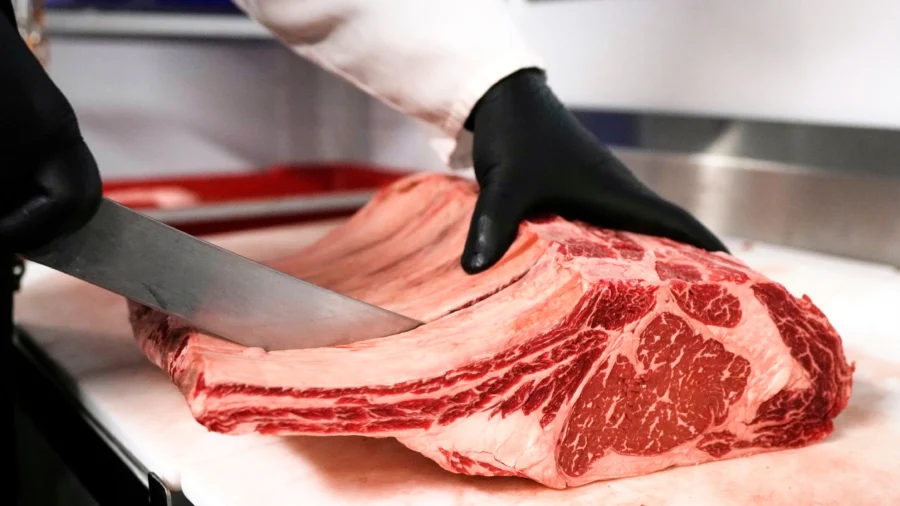
As federal investigators scrutinize the Big Four, the real shift is happening on product pages and farmers market signs. The producers who prove provenance are pulling ahead of those who just claim it. Customers walk up and ask me point blank now are you one of the big four? That question, unthinkable to most ranch direct sellers two years ago, is showing up in buyer conversations from farmers markets to Shopify checkout notes. A federal antitrust probe most producers will never be interviewed for is quietly reshaping what shoppers expect a small beef brand to say for itself.
85%+ Share of U.S. beef processing controlled by four packers. The structure now under DOJ scrutiny.
$9.64/lb Record all fresh retail beef price (USDA ERS, April 2026), up approximately 13% year-over-year.
86.2M head Smallest U.S. cattle herd in 75 years (USDA, Jan. 1, 2026). Tight supply. High buyer scrutiny.
3M+ documents Reviewed by DOJ/USDA in the probe confirmed May 4, 2026. Criminal and civil tracks running in parallel.
Key takeaways:
– Lead with verifiable provenance, not “family-owned” sentiment
– Product of USA is now defined. Claim it only if you qualify.
– The positioning window is widest in 2026, before the story normalizes.
Why the probe matters to producers who’ll never be named in it
On May 4, 2026, Acting Attorney General Todd Blanche and Agriculture Secretary Brooke Rollins confirmed what had been suspected for months a formal DOJ/USDA investigation into Tyson Foods, JBS USA, Cargill, and National Beef Packing. The probe, launched in November 2025 following a presidential executive order, examined allegations of price fixing, collusion, and anti competitive procurement practices. This wasn’t background noise. Federal teams reviewed over 3 million documents and conducted hundreds of industry interviews.
The criminal track matters most. The Wall Street Journal has reported that prosecutors are pursuing charges under Sherman Act Section 1, which carries penalties up to $100 million per corporation and 10 years in prison for individuals. A civil lawsuit is running in parallel. For most small producers, that legal machinery has zero direct impact. You won’t be deposed. You won’t pay a settlement. But here’s what changes your customer’s definition of trustworthy just shifted.
The probe didn’t create the appetite for transparent, independent beef. Record prices and a 75 year herd low did that. What it did was hand small producers a rare window where not the big four is a claim consumers actively reward. The producers gaining share right now aren’t the ones shouting loudest about consolidation. They’re the ones who can prove the alternative at the moment of purchase. Four packers control 85% of U.S. beef processing capacity. That concentration hasn’t changed since the DOJ started investigating, but the spotlight on it has. Buyer skepticism follows.
“Independent” is now a claim, not an adjective
Two years ago slapping “independent ranch” or “family owned” on a label was enough. Consumers saw it and felt the difference. Today that language still works, but only as window dressing for something deeper. The real work happens underneath the claim.
Maria Hernandez, owner of High Desert Angus in eastern New Mexico, has watched this shift unfold in real time. Customers walk in with a list of questions now, she says. They want to know who processes the beef, how far the animal traveled, whether it’s actually from our land. They’ve read something, seen something online about consolidation, and they’re checking.
That checking is the thing. It’s methodical and retail specific. It’s not ideological anger at Big Ag. It’s a practical question: if I’m paying record prices for beef, can I trust the claim being made about where it came from?
For brands still leading with sentiment, that’s brutal. “Family owned” without a named processor and a plausible supply chain looks like marketing. A breed name and a five generation story without provenance data looks like a pitch. The operator’s pain has shifted from customers don’t care to customers care, and I can’t back up what I’m saying.
If you can’t name your processor and show a born raised processed chain, don’t lead with “independent.” Lead with the one provenance fact you can verify. Build from there.
What “Product of USA” can and can’t say for you now
The “Product of USA” rule tightened on January 1, 2026. Before that date, the rule had a loophole: beef could be imported, processed here, and still carry a “Product of USA” claim. It was a compliance headache and a competitive distortion that punished domestic producers who held animals through the full cycle. Civil Eats Will ‘Product of the USA’ Give Cattle Ranchers a Boost? .
The updated rule closed that gap. As of January 2026, “Product of USA” on beef legally requires that the animal was born, raised, and slaughtered in the United States. No imported feeder Cattle & Beef Market Outlook, cattle fattened domestically. No imported beef repacked and relabeled. Nothing hybrid. That sounds like a gift to small producers who run fully domestic operations. It is,up to a point. But it’s also a compliance trap for anyone tempted to blur the line.
A mid market rancher in Texas told us he lost a DTC order last month when a customer fact checked his “Product of USA” claim and found he’d purchased two dozen feeder calves from a Canadian operation two years earlier. The “Product of USA” rule is now the sharpest tool in this box, and using it wrong is a compliance exposure — exactly what the 2026 “Product of USA” standard requires, and where sellers trip. The transaction was legal, the beef was domestic raised, but the claim was technically wrong. The customer canceled and left a review. The damage was reputation tier, not revenue tier, but it mattered. “Product of the USA” legally requires cattle born, raised, and slaughtered domestically. Using it on imported then repackaged beef is now a compliance risk, not a gray area.
The USDA is actively enforcing the rule. Civil Eats has reported on the debate around Country of Origin Labelling (COOL) which some lawmakers want to make mandatory rather than voluntary. The pressure is unlikely to ease. If you’re going to claim “Product of the USA,” have the documentation ready. Born date records, ranch geography, processor name, slaughter date. All of it. The bar is no longer whether the claim sounds credible. It’s whether it’s auditable.
The provenance stack: what actually converts at checkout
Our research team has audited dozens of ranch direct and DTC meat brands across implementations, and one pattern separates the producers who convert a regulatory moment into durable demand from those who merely ride the news cycle the winners had their sourcing story systematized before it became sellable.
What does systematized mean? It means you’ve built a repeatable way to communicate four things at the point of sale where the animal was born, who raised it, which processor handled it, and which cut is going into the package. Not as flavor text in a brand story. As scannable data on every product page and checkout.
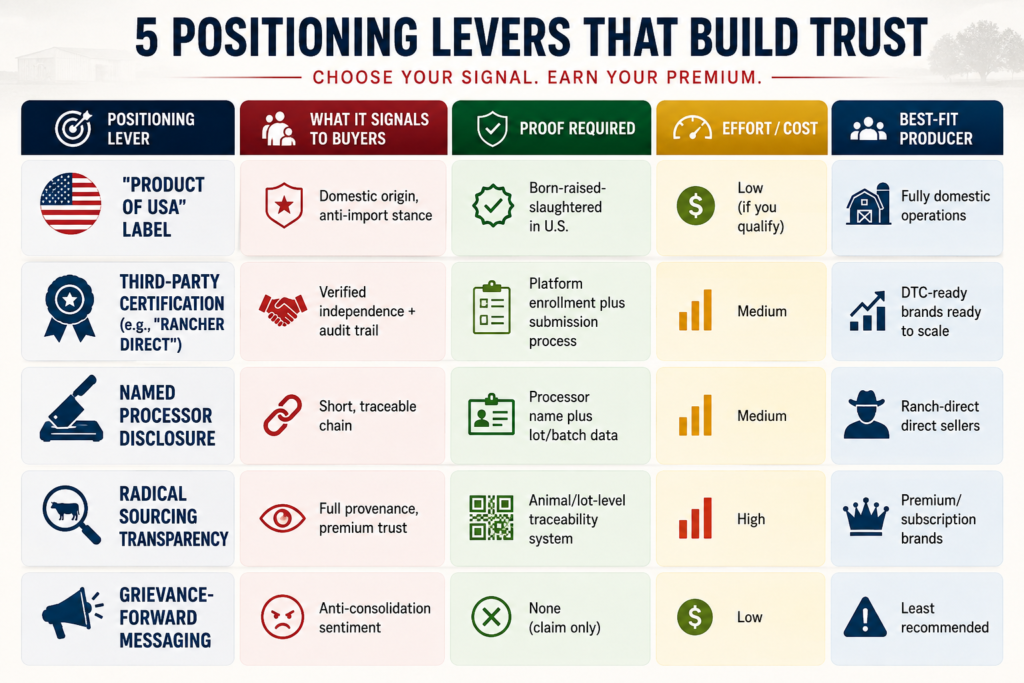
The table matters because it’s scannable. An operator should identify which row applies to them within five seconds, without reading prose descriptions.
| Positioning Lever | What It Signals to Buyers | Proof Required | Effort/Cost | Best-Fit Producer |
|---|---|---|---|---|
| “Product of USA” label | Domestic origin, anti-import stance | Born-raised-slaughtered in U.S. | Low (if you qualify) | Fully domestic operations |
| Third-party certification (e.g., “Rancher Direct”) | Verified independence + audit trail | Platform enrollment plus submission process | Medium | DTC-ready brands ready to scale |
| Named processor disclosure | Short, traceable chain | Processor name plus lot/batch data | Medium | Ranch-direct direct sellers |
| Radical sourcing transparency | Full provenance, premium trust | Animal/lot-level traceability system | High | Premium/subscription brands |
| Grievance-forward messaging | Anti-consolidation sentiment | None (claim only) | Low | Least recommended |
Third party certification is having a moment. New platforms like “Rancher Direct Certified” (launched earlier this year) offer independent producers a middle path enough verification to stand out, less infrastructure than a full traceability build. These platforms absorb some of the proof burden. You join,you audit, you submit your supply data, and the platform handles the badge on behalf of members. It’s not foolproof, but it’s credible, and it costs less than building internal traceability systems from scratch.
Going direct while prices are at record opportunity and trap
Record beef prices have made the DTC math look better than it has in years. Retail beef is at $9.64 per pound as of April 2026. At those price points, the margin case for selling direct is compelling. You capture what the middleman would have taken. You reach consumers who have money to spend on premium cuts. On paper, DTC looks like the move. The trap is supply and expectation management.
Cold-chain shipping is the secondary headache the DTC math has to absorb — the real per-pound cost of reefer shipping, and where it breaks DTC margins. Record prices attract buyers, but they also raise expectations to record levels. A customer paying $13 per pound for a steak wants proof that every claim on the label is airtight. They want processing details. They want to know the ranching practices. They want to feel that they’re getting what they paid for.
We launched a DTC box program last year, right as prices hit, a rancher from Montana told us, speaking on condition of anonymity. The margins were insane. But we ran into two problems. First, our processing capacity couldn’t keep up. We’d promise quarterly shipments, and halfway through a quarter, our processor would have a scheduling conflict, and we couldn’t deliver. Second, people wanted cuts we weren’t producing enough of. We scaled too fast and couldn’t fulfill what we’d sold.
Processing capacity is the bone deep constraint. The USDA’s Ranchers First Initiative has allocated $500 million to support independent and regional slaughter facilities, but that funding is rolling out slowly, and construction of new facilities takes years.For producers looking at DTC right now, accessing processing is still the biggest bottleneck.
Cold chain shipping costs are a secondary headache. Reefer shipping to the coasts can run $0.50 to $1.20 per pound on small orders, depending on distance. Add that to a $6 product margin, and your DTC math gets tight in a hurry. Prices widen the DTC margin case but raise buyer expectations sharply. Go direct only if you can back your claims and hold supply. Over promising at these prices costs more trust than it earns.
The messaging line most small brands get wrong
This is the part worth sitting with.Most small beef brands, when they discover the tailwind of consumer skepticism about consolidation, lead with grievance. We’re not the Big Four. We’re not a corporate meatpacker. “We fight consolidation”. Support independent ranchers.
All of this is true. All of it is also boring. It’s a complaint, not a promise. It tells the customer what you’re against, not what they’re getting. The producers gaining share right now lead differently. They lead with what they can prove
Here’s exactly where your beef came from (then name the processor and the ranch). This steak came from animal #47, born April 2024, raised on pasture, and processed in September 2025 Product of USA, verified, from a ranch that’s been here since 1987 (then sell the history and the continuity, not the grievance). Proof outsells grievance at checkout. The customer doesn’t need you to tell them consolidation is bad. They already know, or they don’t. What they need is a reason to believe you’re the exception.
Retail beef prices set a record at $9.64/lb in April 2026. The DTC premium case has never been stronger, but neither has buyer scrutiny of every claim.
How long this window stays open
Here’s what nobody talks about: this window closes faster than most producers think.
The DOJ probe won’t stay in headlines forever. Once charges are filed (or not filed), once a settlement is reached, the story normalizes. A year from now, the DOJ investigated meatpacking becomes background noise. The tight-supply backdrop that makes provenance valuable is also a pricing problem — how to rebuild DTC beef pricing for a 75-year-low herd. Regulatory context. Not a live shopping decision driver. That doesn’t mean consolidation stops mattering. It means it stops being novel. Shoppers will still care about provenance. They just won’t suddenly discover they should care because a federal probe made it relevant.
The producers building infrastructure now have the advantage of building on tailwind. A branded traceability system you launch today, with verified by DOJ investigation era transparency standards, carries urgency. “DOJ confirms antitrust investigation into major beef processors”
The same system launched a year from now, after the probe settles, is just a traceability system. It’s table stakes, not differentiation.
Herd rebuilding makes this worse. The cattle inventory is at a 75 year low, but it’s starting to inch up. The USDA’s Livestock Risk Protection endorsements for heifer retention are seeing uptake. Processing capacity is being added through the SPUR program. Over the next 24 to 36 months, supply will start easing. When supply eases, price pressure eases.When price pressure eases, buyer scrutiny eases. You’re sitting in a window right now where independent beef is both high margin and high reputation. That window is open because of the probe, the high prices, and the tight supply all happening at once. It won’t stay this wide for long.
Decision Framework
1. Verify before you claim.
Confirm which claims you legally and factually qualify for Product of USA, named processor, and certification before writing copy. Compliance isn’t optional.
2. Lead with your strongest provable fact.
Put the one verifiable provenance point front and centre. Don’t bury it under sentiment or story. What can you prove today?
3. Systematize the proof.
Turn provenance into repeatable data (lot tracking, processor disclosure, birth date records) so every product page carries it automatically.
4. Calibrate the tone to proof, not grievance.
Frame as here’s where it came from, not here’s who we’re against. Proof converts. Complaints don’t.
5. Build for supply reality.
With the herd at a 75-year low and processing capacity still constrained, don’t promise volume you can’t hold. Position scarcity as premium,not as a broken promise.
FAQS
“Does this DOJ probe actually help my small operation, or is it just headlines?”
It doesn’t change your legal standing, but it’s shifted buyer expectations. Independent now gets scrutinized and rewarded. The advantage goes to producers who can prove provenance, not just claim it. The window is open now. A year from now, it won’t be.
“Can I put Product of USA on my beef?”
Only if your cattle were born, raised, and slaughtered in the U.S. The rule tightened effective January 2026. If any step happened abroad, using the label is now a compliance exposure, not a marketing gray area. Have your documentation ready if you use the claim.
“Is calling myself ‘independent’ enough, or do I need certification?”
Alone, “independent” is a weak claim in 2026. Buyers verify. A named processor or third party certification converts far better than an unbacked adjective. You don’t need a full traceability system from day one, but you need one proven fact tied to your brand.
“Should I go direct to consumer now that beef prices are at records?”
The margin case is strong, but record prices raise expectations sharply. Before you scale DTC, map your processing capacity and cold chain costs. Overpromising at these prices costs more trust than it earns. Go direct only if you can back your claims and hold supply.
Conclusion
The DOJ antitrust probe into meatpacking is real, ongoing, and consequential for competitive policy. For small beef producers, though, the real consequence isn’t legal. It’s perceptual. Record prices don’t guarantee anyone wins — why smaller farms aren’t winning even as beef hits record retail prices is the margin reality underneath the positioning opportunity. Your customer’s bar for independent just got higher, and the timeline for building defensible supply stories got tighter.
The producers who win in the next 18 months are the ones who treat this window as a building moment, not a selling moment. You build traceability. You document provenance. You nail the compliance details. You systematize your proof, and when price pressure eases and supply tightens less, you’re not starting from ‘we’re independent’. You’re starting from here. Here’s exactly where your beef came from: audited, verified, proven. That’s the difference between a trend and a durable positioning. Make the move now, while the tailwind is still there.
