
The FSIS is moving its headquarters from Washington to Iowa. For DTC meat producers relying on label approvals and policy guidance, the administrative shift creates a compliance uncertainty window. Here’s what you need to know before it impacts your operations, usda.gov Your label submission has been sitting in the FSIS queue for 29 days. Your facility inspection is scheduled in Q3.
Your recall protocol references a National Capital Region office that’s now relocating 200 staff members to Iowa and Georgia. The USDA’s announced reorganization of the Food Safety and Inspection Service sounded like bureaucratic reshuffling until you realized it directly affects three critical DTC workflows, label processing, technical guidance, and incident response.
- 200 positions Relocating from Washington, D.C. to Iowa, Georgia, and Colorado (April 2026)
- ~85% of FSIS workforce Frontline inspectors remaining at 6,800+ facilities nationwide no reduction
- 29 business days Current label submission processing time as of April 2026
- ~500 FSIS employees Already lost to Deferred Resignation Program in prior year
Key takeaways:
- Frontline inspection presence is stable, but administrative capacity that supports label approvals and technical guidance is transitioning from D.C. to Iowa through early 2027
- Label processing timelines may experience delays or inconsistency during relocation, submit urgent submissions before transition completes
- Your recall protocol and FSIS emergency contacts will change, update these before reorganization takes effect
The FSIS Reorganization, What’s Actually Happening
On April 23, 2026, the USDA announced a reorganization of the Food Safety and Inspection Service that fundamentally reshaped where and how the agency operates. This isn’t a budget cut or a staffing reduction. It’s a geographic and operational realignment driven by Secretary of Agriculture Brooke Rollins’ view that USDA operations became too centralized in Washington, D.C, and need to be positioned closer to the agricultural systems they regulate.
Here’s what’s changing, National Food Safety Center In Owa. FSIS will establish a new National Food Safety Center (NFSC) in Urbandale, Iowa, serving as the primary hub for administrative, technical, and support operations. This facility will house approximately 200 employees currently based in Washington, D.C. These roles include training coordination, food safety education, financial operations, and IT support the infrastructure that enables rapid compliance response and technical guidance for the meat and poultry industry.
Simultaneously, FSIS will expand its science capabilities in Athens, Georgia, through an upgraded Science Center focused on microbiology, chemistry, and epidemiology. A smaller international focused team will establish a presence in Fort Collins, Colorado. About 100 FSIS positions will remain in Washington, D.C., specifically for congressional engagement, policy development, and interagency coordination.
The critical distinction. This is not moving the inspectors. FSIS’s frontline inspection workforce, the 85% of FSIS staff who work directly in federally inspected meat, poultry, and processed egg facilities across 6,800+ establishments remains unchanged. Your facility’s assigned inspector will continue their work. Inspection activities will not pause. What is moving, however, is the administrative apparatus that supports those inspectors and services the industry. That distinction matters enormously for how DTC producers operate during the transition.
Frontline Inspections, No Immediate Changes (But Context Matters)
Let’s state this clearly, USDA has committed that the reorganization does not impact FSIS frontline inspection personnel, and there is no reduction in force. The 6,800+ federally inspected establishments will continue to receive regular inspections on schedule. Your facility’s inspector doesn’t move. Your inspection frequency doesn’t change. Your compliance obligations remain constant.
But context adds nuance. FSIS has already experienced significant staffing losses through the Deferred Resignation Program implemented in the prior year, which resulted in approximately 500 employee departures. On top of that structural loss, the current reorganization is relocating 200 more positions during a transition period. Senate concerns, raised in June 2026 by Senators Klobuchar, Heinrich, Luján, Gillibrand, and 17 colleagues, pointed to the potential for institutional expertise loss and institutional knowledge gaps.
What this means operationally. Your assigned inspector remains in place. But if your inspector has limited tenure, if they’re recently reassigned, or if they lack deep experience with your product category, institutional knowledge gaps during the transition period could affect your experience with technical interpretation or compliance guidance.
For most mid size to large DTC producers with dedicated in-plant inspection, this is a low impact concern. Your inspector’s role is stable, how to sell meat online. For custom exempt or smaller operations that interact with FSIS less frequently, pay attention to who your assigned inspector is and their tenure. If you’re uncertain, request clarification from your regional FSIS office during this transition window.
What FSIS Functions Are Moving vs Staying:
- Moving to Iowa (NFSC), Training programs, food safety education, financial operations, IT support, technical resource management, labeling guidance coordination
- Staying in Washington, D.C. 100 positions, Congressional affairs, policy development, high level interagency coordination
- Moving to Georgia Science Center, Expanded microbiology, chemistry, epidemiology lab capacity
- Staying at Facilities Nationwide Inspectors, all 85% of frontline workforce, 6,800+ establishments.
Label Approval Processing, The DTC Compliance Chokepoint
Here’s where DTC meat producers should focus urgent attention. FSIS maintains a Labeling and Program Delivery Staff (LPDS) responsible for reviewing and approving meat and poultry product labels before they can be used. Current processing time is approximately 29 business days from submission to approval (as of April 2026). This timeline allows DTC producers to iterate on labels, make corrections, and launch new products on a predictable schedule. The reorganization creates uncertainty around this timeline. LPDS staff are being relocated from Washington, D.C. to Urbandale, Iowa, during a 6-12 month transition period. During relocation, three things could happen:
(1) processing time extends due to transition disruptions,
(2) staffing gaps create bottlenecks,
(3) staff departures during relocation reduce capacity.
None of this is guaranteed, but it’s operationally prudent to assume that label processing may experience delays or inconsistency between now and early 2027. If you have labels in the queue, you should know where they are in the approval process now. If you have labels you need approved before Q3 2026, submit them immediately. If you can delay non urgent label submissions until FSIS confirms full operational status in Iowa likely early 2027, that’s the safest approach, product of usa meat labeling compliance.
This matters because label delays directly impact product launch timelines and inventory turnover for DTC operations. A 30 day delay in label approval means your production run sits idle, cold storage costs accumulate, and your product launch window shifts. For subscription based or seasonal DTC models, a label delay can be disruptive. Action, Contact your regional FSIS office or your labeling contacts now. Ask:
(1) What’s the current processing time for label submissions?
(2) Are there any backlog warnings?
(3) Should I prioritize submissions before transition or wait until post transition operations stabilize in Iowa? Get this in writing if possible.
Technical Guidance and Policy Decisions, Transition Risk
Beyond label approvals, many DTC producers rely on FSIS technical guidance for product specific questions. Your question might sound like:
- Can I call this all natural if I use a certain preservative?
- Does our marinade process count as value added, and how does that affect labeling?
- What’s the threshold for claiming grass fed without USDA certification?
- Our new sous vide process does this change our labeling requirements?
These are gray area questions. They don’t have one line regulatory answers. They require FSIS technical staff to evaluate your specific product, process, and claim against regulatory guidance and precedent. The reorganization affects this workflow. Policy staff will remain in Washington, D.C, but the technical support infrastructure, the staff who provide detailed product specific guidance is relocating. During a 6-12 month transition period, institutional knowledge is in transit. The person who knew your facility’s history, your previous labeling approvals, and your product category’s regulatory nuances may be in Urbandale establishing new operations. That’s expertise loss in real time.
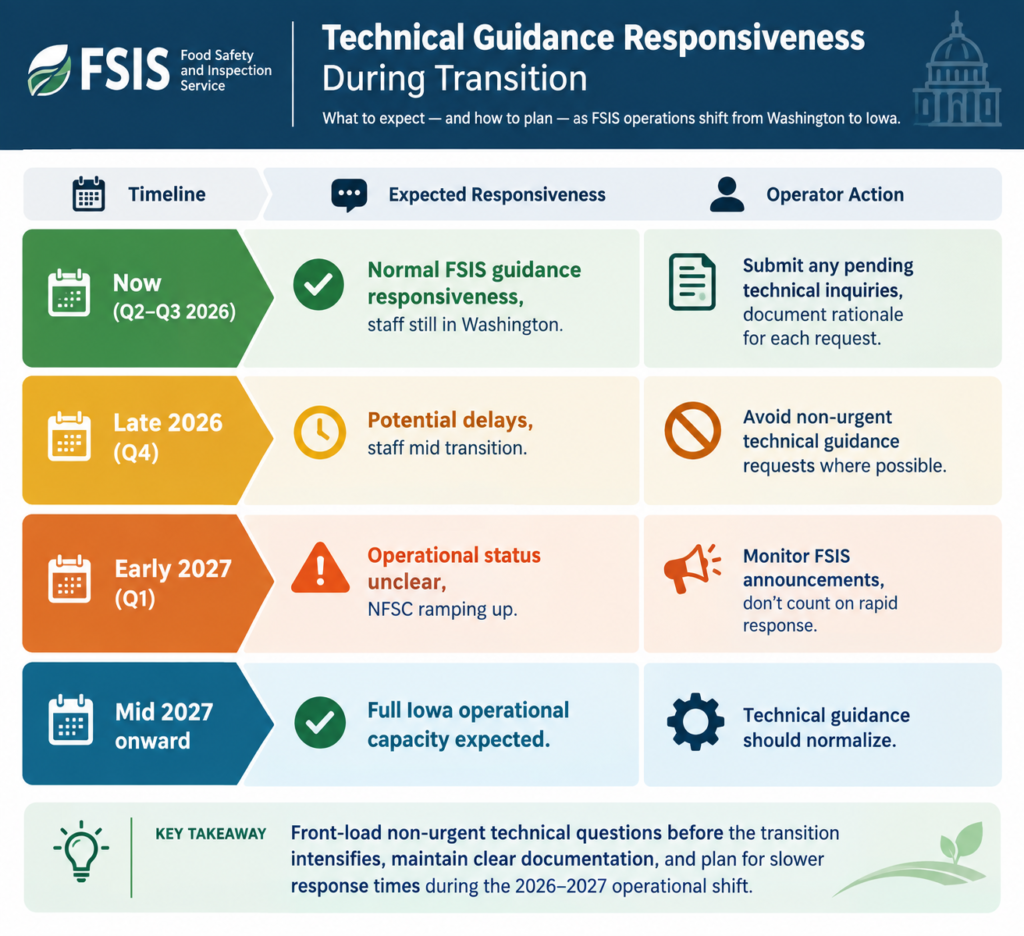
For small to mid scale, DTC producers heavily dependent on FSIS technical guidance, this creates risk. If you’re awaiting guidance on a gray area labeling claim, submit your inquiry NOW while the institutional knowledge is still concentrated in Washington. If you’re considering a novel product category or process innovation, document the decision rationale independently. Don’t count on rapid FSIS guidance during the transition.
FSIS Technical Guidance Responsiveness During Transition:
Outbreak Response & Recall Coordination, Operational Workflow Changes
When a recall happens, speed matters. FSIS coordinates with the FDA, state health departments, and local authorities to identify contaminated products, notify consumers, and prevent illness spread. This coordination originated from Washington, D.C, where FSIS maintained direct relationships with federal and state partners.
The reorganization creates operational uncertainty around this workflow. Two thirds of FSIS’s National Capital Region staff are relocating. That includes support staff who coordinate multistate recalls and traceback investigations. Senate concerns specifically highlighted the risk of delayed identification and containment of outbreaks involving Salmonella, E. coli, or Listeria.
For DTC producers, this matters in two ways. First, if your facility is involved in a foodborne illness outbreak, the speed at which FSIS can investigate, trace contamination, and coordinate response may slow during transition. That’s not FSIS’s intention, but it’s an operational risk when institutional knowledge is mid relocation and coordination protocols are uncertain.
Second, your own facility’s recall protocol likely references FSIS National Capital Region contacts and procedures. Those contacts and procedures are about to change. If you have a recall triggered tomorrow, you’ll need to reach the right FSIS person or office. After reorganization, that office moves to Iowa, contact procedures change, and your protocol becomes outdated. Schedule a call with your regional FSIS office or your facility’s assigned inspector to understand:
(1) How will FSIS handle recalls in my facility post reorganization?
(2) Who is my emergency contact for recall coordination going forward?
(3) When will updated recall procedures be distributed?
(4) Should I update my facility’s recall protocol before or after the transition?
(5) Get clear answers and update your documentation.
Small vs Mid Scale Producers, Who Feels Impact Most
This reorganization does not affect all DTC meat producers equally. Impact varies by scale and operational complexity. Large federally inspected operations dedicated to plant inspectors and internal compliance teams experience minimal direct impact. Your inspector is stable. Your labeling process is managed internally or through established vendor relationships. Your recall procedures are well established. The reorganization is background noise to your operation.
Mid scale DTC producers under $10M revenue, custom processing, novel product categories, frequent label changes feel this most acutely. You’re likely submitting labels regularly. You may have pending technical guidance questions. You may have less institutional knowledge internally and rely on FSIS responsiveness. The 6-12 month transition window affects your compliance pace and product development timeline.
Small custom exempt or state inspected producers have variable impact depending on state oversight. If your state has robust meat inspection capacity, federal FSIS reorganization matters less. If your state defers to FSIS guidance or you’re pushing into federally inspected territory, transitions matter more.
For mid scale DTC producers specifically, this is the time to take inventory. How dependent are you on FSIS? How many pending label submissions? How many technical guidance questions? How often do you use FSIS resources? If your answer to most of these is frequently, then the reorganization warrants proactive operational planning.
Budget & Timeline, What You Need to Plan
The reorganization timeline spans April 2026 through early 2027 approximately 6-12 months. USDA has requested $50 million in its FY 2027 budget to fund relocations, salary adjustments, facility modifications, and operational transition costs.
FSIS staff are required to accept relocation or accept alternative roles within the agency. If they refuse, they must leave the agency. This creates typical relocation scenario outcomes, some staff depart rather than move, some relocate and then leave within 12-24 months, institutional knowledge loss accelerates. Consumer Federation of America analysis compared this to the 2019 ERS Economic Research Service relocation, which resulted in significant productivity loss and expertise gaps documented by the Government Accountability Office.
For DTC operators, the timeline implication is clear, the transition period is your window to lock in compliance. Submit labels now rather than later. Get technical guidance on gray area questions before staff relocate. Solidify your recall procedures and FSIS emergency contacts before transition completes. Late 2026 through early 2027 is the transition risk window. By mid 2027, operations should stabilize, but the uncertainty period is now.
Pre-Transition Action Items, 5 Step Compliance Readiness
1. Audit Your Current Label Status. Contact FSIS or your label submission contact today. Request:
(1) What labels do I have currently submitted?
(2) What is their current approval status?
(3) When will they be approved?
(4) Are there any labels in the queue that I should prioritize or re-submit before transition?
Document this in writing. Create a spreadsheet, submission date, product name, current status, expected approval date, priority (urgent vs standard). Identify any labels that are critical to your Q3 or Q4 2026 product launches and ensure they’re on track for pre-transition approval. For non urgent labels, you may want to defer submission to early 2027 after FSIS Iowa operations stabilize.
2. Clarify Your Inspection RelationshipCall your regional FSIS office or your assigned facility inspector. Ask:
(1) Who is my assigned inspector and what is their tenure?
(2) When is my next facility inspection scheduled?
(3) If my inspection falls during the April early 2027 transition period, will there be any delays?
(4) How does my facility contact FSIS during and after the reorganization? Is there a new procedure?
Get names, phone numbers, email addresses. Verify everything in writing if possible. If your inspector is transitioning or newly assigned, understand their background and product knowledge. This is basic due diligence during an organizational transition.
3. Update Recall Protocol References. Pull out your facility’s recall procedure document. Note every reference to FSIS contacts, procedures, and jurisdictions. Most recall protocols reference “FSIS National Capital Region” or list Washington, D.C. contact numbers. Those will change. Create an action item list:
(1) Which FSIS contacts do I need to update?
(2) When will FSIS publish new post reorganization contacts?
(3) Should I update my protocol before or after transition completes?
(4) Who in my organization needs to understand the new recall workflow?
You don’t need to rewrite your entire recall procedure yet, but you need to know which sections will become outdated and who owns updating them.
4. Document Current Guidance. If you’re currently awaiting FSIS technical guidance on a labeling question, product interpretation, or compliance question, the timeline is NOW. Submit your inquiry immediately while institutional knowledge is concentrated in Washington. Get the response in writing. Even if FSIS guidance takes 2-3 weeks, you’ll have documented rationale should questions arise later.
For any gray area product decisions you’ve been sitting on, don’t wait for FSIS transition to stabilize. Get clarity now. This applies especially to novel claims, emerging product categories, or process innovations where FSIS interpretation matters to your compliance posture.
5. Monitor FSIS Announcements. Subscribe to FSIS updates. The agency will announce:
(1) specific dates when NFSC becomes operational in Iowa,
(2) new staff assignments and organizational structure,
(3) updated contact procedures and emergency protocols,
(4) any changes to label submission procedures or timelines,
(5) updated facility inspection scheduling procedures.
These announcements will come between now and mid 2027. Mark your calendar to check FSIS communications monthly. When key announcements drop, update your internal procedures immediately. Don’t let yourself be the operation that still has the old FSIS contacts in your recall protocol because you missed the transition announcement.
FAQS
Will my facility’s inspections be delayed or disrupted during the FSIS move?
No, according to USDA commitment. FSIS frontline inspectors remain at facilities and inspection schedules won’t change, usda meat inspection ecommerce However, if your facility inspection is scheduled during the transition spring/summer 2026 or early 2027, confirm your scheduled inspector and facility assignment directly with your regional FSIS office to avoid surprises.
How does the move to Iowa affect my label approval timeline?
Unclear during transition. Current turnaround is approximately 29 business days. If you’re submitting labels between now and late 2026, plan for potential delays as FSIS label approval staff relocate. Submit urgent labels now. For non urgent submissions, consider waiting until FSIS confirms full operational status in Iowa likely early 2027.
My company relies on FSIS technical guidance for labeling claims. What happens during the move?
Policy staff stay in D.C., but technical support staff are relocating. If you need FSIS guidance on a gray area labeling question, submit your inquiry immediately while the current team is still in Washington. Document everything in writing. Don’t count on rapid responsiveness during transition.
How do I know if my facility is affected by the reorganization?
All meat and poultry facilities remain under FSIS inspection. The primary effects are indirect label processing delays, technical guidance delays, recall coordination changes. For facilities seeking to understand inspection requirements in detail, contact your regional FSIS office.
Where do I contact FSIS for recalls or food safety emergencies going forward?
This is still being clarified. The NFSC in Iowa will become the new primary hub. Your facility’s assigned inspector remains your first point of contact. Updated procedures and emergency contact details for the post transition period will be announced by FSIS before relocation completes. Monitor USDA announcements closely.
Conclusion
The FSIS reorganization is real, but it’s not a food safety failure. Frontline inspections continue. Facilities remain inspected according to USDA requirements. Compliance enforcement doesn’t pause. But the administrative backbone that makes rapid compliance adaptation possible label approvals, technical guidance, policy responsiveness enters a transition window from April 2026 through early 2027.
For DTC meat producers, that window matters. The operators who will navigate this transition most smoothly are the ones taking action now auditing label status, updating recall protocols, documenting technical guidance decisions, and monitoring FSIS announcements. The reorganization is coming. Your compliance infrastructure doesn’t need to wait for it to stabilize before you prepare.
Understanding the broader regulatory landscape for DTC meat operations provides additional context for operators managing multiple compliance dimensions. Stay informed, stay proactive, and update your procedures before the transition impact becomes operational reality.
