
The FDA extended the deadline to July 2028, but major retailers have already moved theirs up. Here’s why your brand can’t wait and where to start.
Your eCommerce brand just landed a Walmart order. Congratulations. Now you have 24 hours to provide traceability data that meets FSMA 204 standards except your supplier relationships aren’t aligned, your data lives in three different systems, and nobody’s told you what Key Data Elements even means. The FDA extended its compliance deadline to July 2028, but that extension may be irrelevant, 70+ major retailers have set their own requirements, and most are demanding compliance now, not in 2028. FSMA Final Rule on Requirements for Additional Traceability Records for Certain Foods
- 70+ Major retailers and wholesalers Walmart, Kroger, Albertsons, Target, KeHE, Sam’s Club have already mandated their own traceability requirements.
- August 1, 2025 Walmart began requiring ASN shipment notices carrying FSMA 204 Key Data Elements from all food suppliers.
- 24 hours Time frame in which brands must provide traceability records to FDA or retailers upon request.
- 30 months FDA’s extension of compliance deadline, from January 2026 to July 2028 though retail pressure remains ahead of federal deadline.
Key takeaways:
- Retailer deadlines are ahead of FDA timelines, compliance is a condition of doing business with major retailers, not a 2028 milestone.
- FSMA 204 is a supply chain transformation requiring supplier alignment,it’s not a single company technology project.
- Small brands that start preparation now gain negotiating leverage and operational resilience against recalls and supply chain disruptions.
What FSMA Rule 204 Actually Requires
The Food Safety Modernization Act Section 204 is a federal recordkeeping mandate aimed at reducing the time it takes to trace contaminated food from months or years down to days or weeks. The rule itself went into effect January 20, 2023, but compliance didn’t kick in until three years later, a grace period most brands wasted.
Here’s what the rule actually demands: if your operation manufactures, processes, packs, or holds foods on the FDA’s Food Traceability List you must maintain detailed records called Key Data Elements KDEs at every Critical Tracking Event CTE.
The regulatory language is dense, but the practical reality is simpler. A CTE is any point where your product changes ownership or form, receiving ingredients, manufacturing, packaging, warehousing, or shipping. At each of these moments, you capture specific data points: product identification, origin date, lot code, receiving/shipping timestamp, and who sent or received the shipment.
The rule applies only to foods on the FTL fresh and fresh cut produce, certain seafood, eggs, dairy, and specific meat products. But here’s the catch, retailers often demand compliance for all products, regardless of FDA classification.
You maintain these records for 24 months. If the FDA or a retailer asks, you must produce them within 24 hours. This isn’t optional. A production run without a traceability code, a supplier shipment without origin documentation, or a storage event without a timestamp all represent compliance gaps. And gaps cascade through your entire supply chain.
Why the FDA’s July 2028 Deadline Isn’t Your Real Deadline
In March 2025, the FDA announced a 30 month extension. The original compliance date was January 20, 2026. The new date is July 20, 2028. Across nearly every industry publication and compliance forum, this announcement was framed as a reprieve, You have more time than you thought. That framing is dangerous.
The federal deadline is irrelevant to most small F&B eCommerce brands because the real deadline arrived in August 2025, issued not by the government but by Walmart. On August 1, Walmart mandated that all food suppliers, not just those handling FDA listed foods, begin submitting Advanced Ship Notices (ASNs) containing FSMA 204 Key Data Elements with every shipment. Failure to comply results in shipment holds, chargebacks, or account suspension.
Walmart didn’t wait for the FDA. Neither did Kroger, Albertsons, Target, Sam’s Club, or KeHE. According to a comprehensive review of retail traceability demands, 70+ major retailers and wholesalers have already set their own requirements, many requiring broader product coverage and faster data turnaround than the federal mandate.
Comparison, FDA vs Retailer Timelines
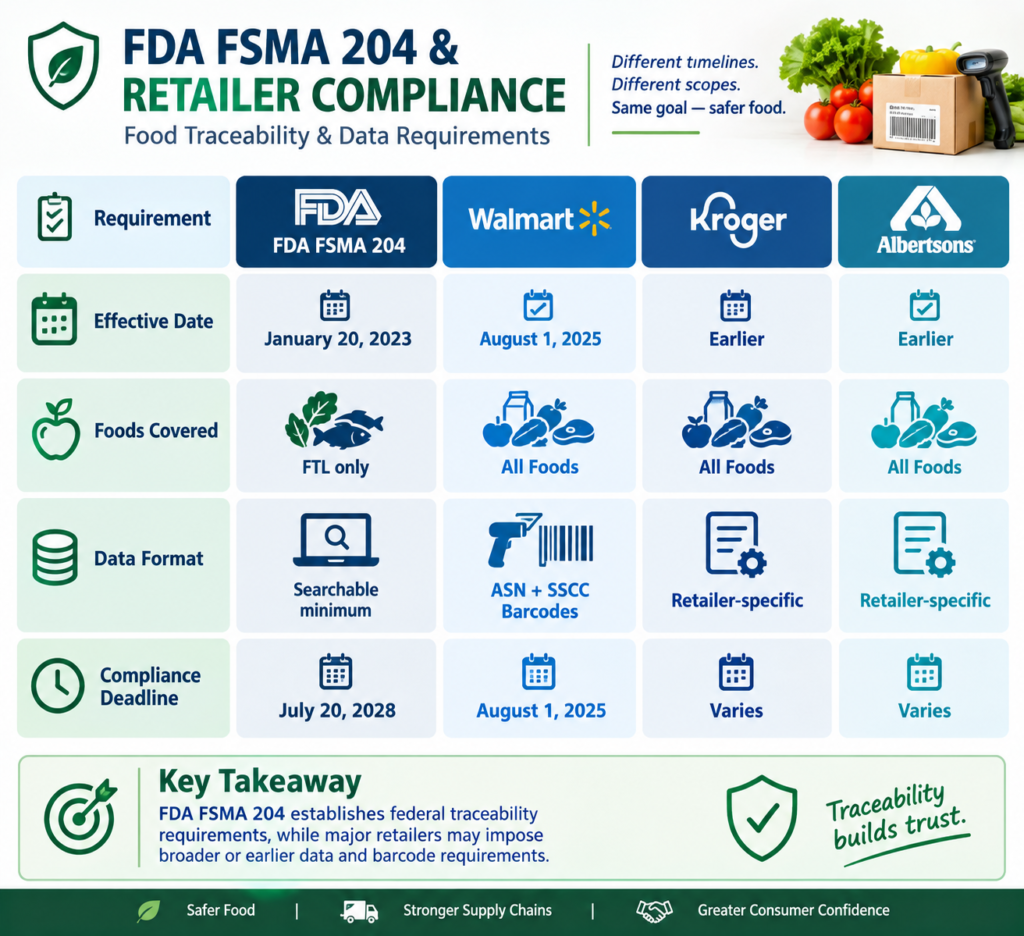
The pressure isn’t coming from Washington. It’s coming from your customers. And it’s here now.
The Cost of Non-Compliance Retailer Penalties & Supply Chain Risk
Non-compliance has two distinct consequences, immediate retailer penalties and long term public health liability.
Law and order to the retail range. On the retailer side, the penalties are swift and expensive. When Walmart audits your data and finds gaps, your shipments get placed on hold. Perishable products begin to spoil. Your invoice doesn’t get paid for 30, 60, or 90 days. That’s a cash flow crisis for a small brand. Many retailers also assess chargeback fees typically 2 to 5 percent of order value for traceability failures. On a $10,000 shipment, that’s $200 to $500 out of your margin, sometimes from a retailer relationship that’s already running on thin percentages.
Repeated failures lead to account suspension or outright delisting. You lose access to a retailer that represents 60 to 80 percent of consumer packaged food sales. For small brands, that’s catastrophic.
On the public health and legal side, the risk multiplies if your products are involved in a recall. FSMA 204 exists because previous foodborne illness outbreaks exposed how fragmented food traceability was. A contaminated item could take months to trace back to its source. Consumers got sick. Brands went out of business. FDA investigations cost hundreds of thousands of dollars.
With proper traceability data, a recall investigation that once took weeks can now take hours. Your brand owns the entire cost of a recall, product destruction, consumer notifications, potential lawsuits, regulatory fines up to $100,000 or more per violation. But the upside is visibility and speed. Brands with clean traceability data can isolate a problem to a single supplier lot, preventing wasteful recalls of entire product categories.
Brands without traceability data face a recall nightmare. They can’t pinpoint the source. They recall everything. The cost multiplies. The brand damage is permanent. FSMA 204 compliance isn’t primarily a regulatory burden. It’s a supply chain resilience investment. Brands that complete it gain negotiating leverage, retailer trust, and protection against catastrophic recall scenarios.
Traceability for Small Brands Where Your Data Lives Today
Most small F&B eCommerce brands operate in one of three scenarios. Find yours.
Scenario A, Spreadsheet & Email You track orders in a spreadsheet, suppliers send shipping confirmations via email, lot codes are inconsistent, and data is scattered across three platforms.
- FSMA 204 readiness, Low
- Complexity to fix, Medium you need to centralize and standardize
Scenario B, Basic ERP QuickBooks, Shopify, Xero You have an order management system, but it doesn’t talk to supplier systems or retailer portals. Lot level tracking isn’t granular enough to isolate a single production run.
- FSMA 204 readiness, Medium
- Complexity to fix, Medium to High you need EDI integration and lot level visibility
Scenario C, Partial Integration You have an ERP, but compliance data flows one way. You can generate reports, but you can’t quickly pull records to send to a retailer on demand in their required format. This level of data visibility is also becoming increasingly important as consumers and retailers place greater emphasis on transparency
- FSMA 204 readiness, Medium to High
- Complexity to fix, Medium you need query/export workflows and trading partner channels
Start here. Audit your current state:
- Do you have a central data source listing all FTL foods you handle?
- Are Traceability Lot Codes assigned consistently to every production run or shipment?
- Can you capture and store origin, processing, shipping, and receiving dates for each lot?
- Do you have a process to quickly pull this data and send it to a trading partner within 24 hours?
- Can you receive and verify traceability data from your suppliers?
- Do you have a written traceability plan, even a simple one?
If you checked fewer than four boxes, your brand is months away from compliance. If you checked all six, you’re in the home stretch.
Step by Step Preparation Framework for F&B eCommerce Brands
Step 1.
Map Your Product Risk Weeks 1–2:
Audit which products in your lineup fall on the FDA’s Food Traceability List. Download the official list and check every ingredient. Document which foods you handle that require traceability. Retailers often demand traceability for non FTL products too, so map both. If you have zero FTL products, you’re not off the hook expect retailers to ask soon anyway, and you may underestimate your exposure.
Step 2.
Assess Current Data Gaps Weeks 3–4:
Pull a recent shipment. Can you trace every ingredient back to its source? Do you have documented origin dates, lot codes, receiving dates, and shipping dates? Can you send this information to a retailer in two hours? If not, flag the gaps. This audit is uncomfortable. It exposes how fragmented your current state really is but it’s essential.
Step 3.
Standardize Traceability Lot Codes Week 5:
Establish a consistent format for Traceability Lot Codes TLCs. For example, BRAND SKU-YYMMDD-SEQUENCE. Communicate this standard to suppliers and manufacturing partners. Ensure every batch produced going forward carries a TLC. Retroactively assigning lot codes to past production is messy, move forward with discipline starting now.
Step 4.
Map Critical Tracking Events Weeks 6–7:
For each FTL product, document the exact supply chain steps where you capture data ingredient receipt from supplier, production/transformation start, packaging/lot assignment, warehouse storage location, shipment to retailer. For each CTE, define what data gets captured and who’s responsible. A shared spreadsheet works here, formalize it as your traceability plan.
Step 5.
Choose a Traceability Technology Weeks 8–10:
Options range from spreadsheet with discipline to EDI integration to full supply chain visibility platforms. Start with what fits your current tech stack:
- Spreadsheet baseline, GS1 compliant data format, shared with key suppliers $0–$1k, timeheavy.
- ERP enhancement, Lot level tracking modules in QuickBooks, Shopify Plus, or mid market ERPs $500–$1.5k/month.
- EDI integration, ASN 856 formats to major retailers, requires a technical partner $3k–$10k setup + $500–$1.5k/month.
- Full traceability platform, ReposiTrak, TrueCommerce, blockchain based solutions overkill for most small brands initially, $2k–$5k/month. Most small brands start with ERP enhancement or basic EDI integration and scale from there.
Step 6.
Pilot with One Supplier & One Retailer Weeks 11–14:
Don’t overhaul your entire supply chain at once. Pick your largest supplier and largest retail customer. Share your TLC standard. Do a test shipment. Capture data. Send to retailers. Get feedback. Refine. Then roll out systematically. This pilot phase reveals gaps in your processes and builds confidence before full implementation.
Step 7.
Document Your Traceability Plan Week 15:
Write a one to two page plan, Which foods you handle, where data lives, how you capture KDEs, how you share with trading partners, retention timeline, how you’d respond to an FDA request. This satisfies the regulatory baseline and gives you an operational playbook. Share it with your supply partners.
Managing Supply Partner Readiness The Hidden Complexity
Here’s where most small brands get stuck, FSMA 204 compliance is only possible if your suppliers, logistics partners, and retailers are ready too. You can’t comply alone.
Partner alignment challenges:
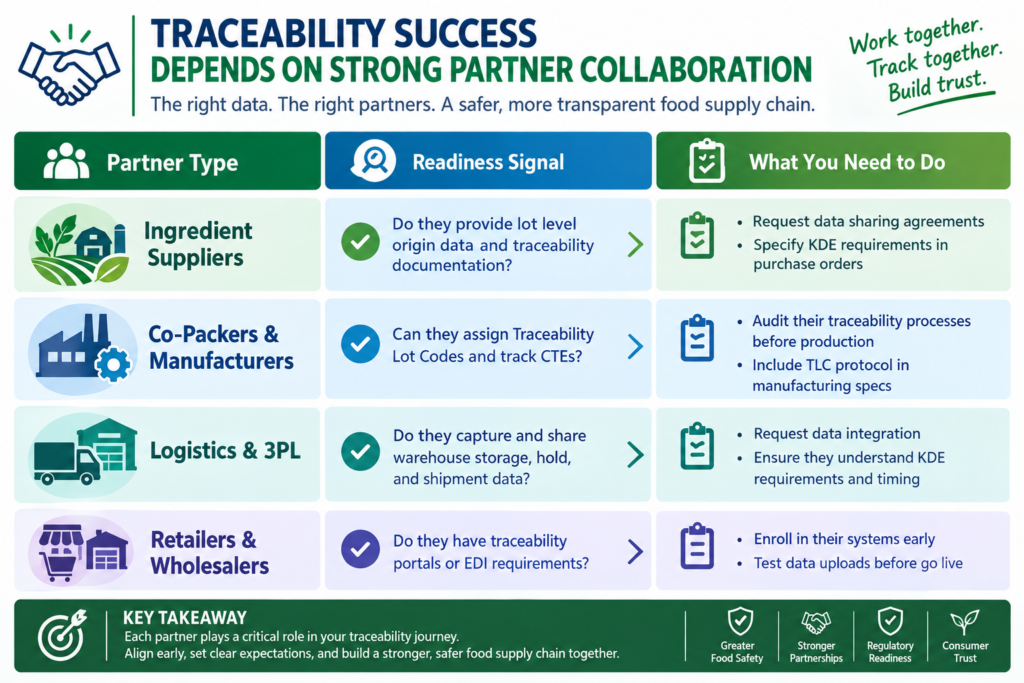
The most common bottleneck is ingredient suppliers who haven’t invested in lot level tracking. They ship bulk ingredients with minimal documentation. Your solution, start with their largest products. Create a spreadsheet template they can fill. Gradually move toward standardized data feeds. This takes patience, but it’s the only way forward if your suppliers are behind.
Retailers set the timeline. Retailers control shelf space. So start with the retailers you currently supply or want to supply. Understand their specific traceability requirements, their data format expectations, and their escalation process if something’s missing. Then work backward through your supply chain to ensure every partner can meet those retailer specs. This is especially important as tariff driven cost pressures continue to affect food pricing and consumer behavior.
Technology, Standards & Tools Beyond the Spreadsheet
GS1 Standards,The Industry Baseline. GS1 is the global data standard for supply chain traceability. Learn these core terms:
- GTIN Global Trade Item Number, Your product’s barcode UPC.
- Lot Code, Your internal lot identifier.
- Serial Number, Optional but increasingly required by retailers.
- SSCC-18, Case/pallet barcode linking to shipment data.
- ASN Advance Ship Notice, EDI 856 format for telling retailers what you’re shipping and when it arrives.
These aren’t optional jargon. They’re the language your largest retail customers speak. Using them correctly is the difference between a shipment that gets accepted and one that gets held at the dock.
EDI Basics, For Brands Scaling to Retail. If you’re selling to Walmart, Kroger, or major distributors, you’ll need EDI Electronic Data Interchange. EDI allows your system to automatically talk to theirs without manual uploads.
- EDI 850, Purchase order retailers tell you what to ship.
- EDI 856, ASN you tell retailers what you’re shipping, with KDE data.
- EDI 810, Invoice.
- EDI 861, Shipment tracking updates.
For mid size brands, EDI integration is complex but necessary. It’s why many companies hire EDI consultants or use managed platforms like TrueCommerce.
Entry Level Tools for Small Brands:
- Spreadsheet + GS1 discipline, Minimal cost, manually managed works for 1–3 retail customers.
- Shopify + third party traceability app, $500–$2k/month suitable for direct to consumer + 1–2 retail partners.
- TrueCommerce, VendorNetwork, or Eka, $1k–$3k/month EDI management, retailer integration.
- ReposiTrak Traceability Network, Cooperative model, retailers + suppliers collaborate on data sharing growing standard for mid market brands. Start learning. As you scale, layer in technology. The worst move is buying an expensive platform and discovering your suppliers can’t feed data into it.
When to Start FSMA 204 Preparation Your Readiness Check
1. If you’re currently selling to retail Walmart, Kroger, Albertsons, Whole Foods, etc. Start immediately. Your retailer has likely already sent or will soon send a compliance notice. Delays equal chargebacks or delisting. Timeline, 30–60 days to basic compliance 90+ days to full optimization.
2. If you handle any foods on the FDA’s Food Traceability List fresh produce, seafood, certain dairy/eggs/meat. Start within 30 days. Even if you’re purely direct to consumers today, you’re on the FDA’s radar. Scaling into retail will require retroactive compliance documentation. Map your current state first.
3. If you’re planning to scale into retail in the next 12–24 months, start now. Retailer onboarding takes time. Retailers audit traceability capability before approving accounts. Preparation now accelerates sales cycles later.
4. If you’re direct to consumer only, handling non-FTL foods, e.g., prepared meals, packaged snacks with no FTL ingredients. Monitor quarterly. FSMA 204 isn’t a legal mandate yet for pure D2C, but retail scaling plans change things. Set a reminder to check FDA guidance and retailer announcements every 90 days. Understanding food & beverage compliance frameworks now positions you to move faster when retail becomes strategic.
FAQS
We only sell direct to consumers via eCommerce. Do we have to comply with FSMA 204?
Not immediately under FDA law. You’re exempt if you’re not selling to retailers or wholesalers. But if you plan to scale into retail. Whole Foods, independent grocers, regional chains, start preparing now. Retailers will require retroactive documentation if you haven’t been tracking data all along.
Our products aren’t on the FDA’s Food Traceability List. Can we ignore this?
No, not if you want to sell to major retailers. Walmart, Kroger, Albertsons, and others require traceability for all foods, not just FTL. They’ve already moved the deadline up. Plan for total traceability, regardless of FDA classification.
Can we use a spreadsheet for FSMA 204 compliance?
Yes, technically. The rule doesn’t mandate digital systems; it just requires searchable, retrievable data available in 24 hours. A GS1 compliant spreadsheet with clear lot codes, dates, and supplier/receiver info works legally. But it doesn’t scale. If you’re shipping to multiple retailers with different portal systems, automation becomes essential. Managing data across multiple sales channels requires more than spreadsheets.
What if a supplier can’t or won’t provide traceability data?
You have a supply chain risk. Either invest time to help them set up tracking, move to a supplier who can comply, or don’t handle that product. Retailers will ask about supplier compliance. If your supplier can’t produce data, your shipments get held.
How much does FSMA 204 implementation cost?
It depends on your current state. Spreadsheet + discipline equals $0–$1k time. EDI integration with retailers equals $3k–$10k setup plus $500–$1.5k per month. Full supply chain visibility platform equals $2k–$5k per month. Most small brands spend $500–$2k per month once at scale and see ROI through avoided chargebacks and faster settlements. The real cost is operational time spent auditing suppliers, redesigning production workflows, and training teams.
Conclusion
The FSMA 204 compliance game changed in March 2025 when the FDA extended its deadline to July 2028. That extension masked the real shift, retailers moved the real deadline up. Small F&B eCommerce brands competing for retail shelf space or wholesale accounts can no longer treat traceability as a 2028 project.
It’s a 2026 and 2027 requirement, imposed by retailers, not by the government. Walmart has already moved. Kroger has already moved. Target, Albertsons, Sam’s Club, and 60+ others have already set their own standards. Brands that start preparation now position themselves to pass retailer audits, avoid chargebacks, build retailer relationships confidently, and strengthen their supply chain resilience.
Understanding supply chain resilience and how to navigate retailer onboarding processes are foundational capabilities. FSMA 204 compliance is no longer optional for brands with retail ambitions. It’s table stakes.
Brands that delay discovering compliance is a supply chain transformation, not a single company fix. And by then, they’re locked out of their largest revenue channels. The window for starting is now. The cost of waiting is exponentially higher.
