
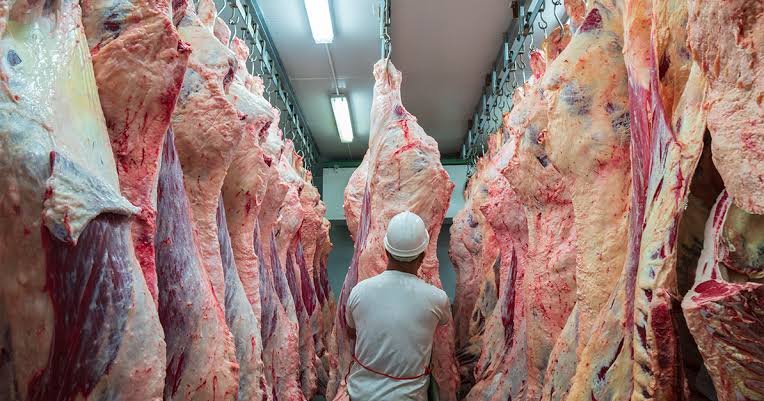
Your Meat Is as Safe as National Brands. But It Can’t Ship Across State Lines. Here’s Why That’s About to Change.
Your processing facility passes inspections with flying colors. Your safety protocols exceed requirements. Your product quality rivals anything from the largest federally inspected plants in the country. Yet when a customer in Tennessee wants to order, you have to say no. State inspection regulations lock you in. Until now.
The Numbers That Define Your Market Access
11 states Now participate in the Cooperative Interstate Shipment (CIS) program, up from a handful five years ago (as of July 2026)
12 to 18 months Faster path to interstate shipping via CIS compared to federal USDA inspection pathway alone
60 percent FSIS cost reimbursement to states for providing CIS inspection services to qualifying facilities
85 percent Of U.S. fed-cattle slaughter controlled by 4 companies, the gap CIS is designed to help regional processors address
State-inspected and USDA-inspected meat meet identical safety standards. The difference is not quality or food safety it’s market geography. State-inspected facilities have historically been locked to intrastate sales. The Cooperative Interstate Shipment (CIS) program, which expanded dramatically in 2026, changes that calculus entirely. For eCommerce operators, CIS eligibility can accelerate interstate shipping by 12 to 18 months compared to pursuing federal inspection alone, with materially lower compliance costs. Which pathway fits your business depends on your target market, growth timeline, and current state’s CIS participation. Understanding which inspection architecture matches your stage prevents leaving 18+ months of competitive runway on the table.
Key takeaways:
- State-inspected meat is equally safe; the market restriction is geographic, not regulatory.
- CIS-eligible facilities can reach interstate eCommerce markets 12 to 18 months faster than federal inspection alone.
- CIS is available in 11 states as of July 2026; check your state’s participation before choosing facility location.
State vs. USDA Inspection: More Similar Than You Think
When most operators hear “state-inspected,” they picture a lower bar less rigorous oversight, smaller operations, local-only capability. The reality is more nuanced and, frankly, more opportunity-rich.
Both state-inspected and federally USDA-inspected meat undergo mandatory inspection for commercial sale. Both enforce food safety. Both have inspectors verifying that only wholesome, properly labeled products enter commerce. State inspection programs operate in 27 to 29 states with active Meat and Poultry Inspection (MPI) programs. Federal USDA inspection via the Food Safety and Inspection Service (FSIS) operates in all 50 states.
The inspection process itself is identical in both pathways. Pre-mortem inspection evaluates the animal as it arrives at the facility, ensuring it’s healthy before slaughter. Post-mortem inspection examines the carcass and internal organs for wholesomeness. Product inspection checks finished items for contamination and proper labeling. Documentation requirements—animal health records, facility sanitation logs, recall procedures—match federal standards or exceed them.
State-inspected meat requires the facility to maintain sanitary premises, equipment, and personnel. HACCP (Hazard Analysis and Critical Control Point) plans must identify food-safety risks. Sanitation Standard Operating Procedures (SSOPs) must be written and followed. Recall plans must be in place and tested. For operators in participating states, the compliance burden is materially equal to federal inspection, not reduced.
The single meaningful difference: geography. Not safety. Not quality. Where that meat can be sold.
The Core Difference: Market Access, Not Safety
Here’s where the confusion cost you 18+ months.
State-inspected meat, until the CIS program expansion, could only be sold within state lines. A facility in Iowa producing state-inspected beef could not legally ship to Illinois customers, even though both states have meat inspection programs. The inspection was equally valid, the safety equally proven, the product equally wholesome. The geographic restriction was pure policy a feature of licensing law, not safety science.
Federal USDA-inspected meat, by contrast, is certified for nationwide commerce and export. A facility with federal inspection can ship to any state and internationally (subject to trade agreements). This is the only material difference that has historically mattered for eCommerce operators.
Until July 2026, when the USDA expanded the Cooperative Interstate Shipment program with Georgia’s addition, this was a binary choice: pursue federal inspection and accept 18 to 24 months of compliance build-out for nationwide access, or accept state inspection and build your business within state lines only.
The CIS program changes this equation entirely. State-inspected facilities can now qualify to ship across state lines, provided they meet CIS participation criteria and their home state has signed a CIS agreement with USDA.
The distinction between state standards and CIS standards is worth understanding: state inspection requires facilities meet standards “at least equal to” federal requirements. CIS requires they meet standards “same as” federal requirements. This means CIS facilities must comply with federal inspection Act requirements exactly, but they remain under state enforcement and funding rather than federal enforcement and costs.
For eCommerce operators, this distinction means CIS-eligible facilities can access multi-state markets without pursuing full federal inspection.
The Cooperative Interstate Shipment (CIS) Program Explained
The CIS program wasn’t invented in 2026. It was authorized in the 2008 Farm Bill and launched in 2012. What changed is political and commercial momentum. As of July 27, 2026, 11 states now participate: Indiana, Iowa, Maine, Missouri, Montana, North Dakota, Ohio, South Dakota, Vermont, Wisconsin, and Georgia.
Here’s how it works: A state with a state MPI program can apply for CIS certification. To qualify, the state must demonstrate that its inspection requirements are identical to federal FMIA (Federal Meat Inspection Act) requirements. The state must prove it has legal authority to enforce these requirements. The state must show that it collects regulatory samples at federal frequency and uses laboratories meeting FSIS accreditation levels.
Once a state qualifies, participating facilities can operate under “same as” federal standards. FSIS provides ongoing oversight and reimburses the participating state for 60 percent of inspection service costs. The facility receives a federal mark of inspection and can ship products across state lines into interstate commerce.
This is not a workaround or second-class pathway. It’s a parallel federal program that leverages state infrastructure and reduces federal staffing overhead while maintaining identical food safety standards.
CIS isn’t the only pathway widening for state-inspected sellers. A separate bill would let state-inspected processors ship direct-to-consumer across state lines without converting to federal inspection at all — and how the DIRECT Act differs from CIS is worth understanding before you commit to a compliance path.
How CIS Differs from State-Only Inspection
| Dimension | State MPI Only | State MPI with CIS |
|---|---|---|
| Safety Standard | “At least equal to” federal | “Same as” federal |
| Market Geography | Intrastate only | Interstate and intrastate |
| Inspection Mark | State mark | USDA federal mark |
| FSIS Oversight | Periodic review | Ongoing oversight |
| State Cost Reimbursement | None | 60% from FSIS |
| Operator Eligibility | Any facility in state | Facilities meeting “same as” federal criteria |
Which States Have CIS Now? And What’s Coming?
As of August 2026, 11 states participate in CIS. Here’s the enrollment status:
CIS-Participating States (11):
- Indiana (pilot state, 2015)
- Iowa (2017)
- Maine (2015)
- Missouri (2019)
- Montana (2020)
- North Dakota (2015)
- Ohio (2020)
- South Dakota (2015)
- Vermont (2015)
- Wisconsin (2021)
- Georgia (July 27, 2026)
States with State MPI Programs but No CIS Agreement (18+):
These states operate meat inspection programs but haven’t pursued or completed CIS agreements. Includes states like Michigan, Minnesota, Colorado, Texas, and others. Legislative or political barriers vary by state.
States with No State MPI Program (12+):
These states rely entirely on federal USDA inspection. No state-level inspection program exists.
What’s Coming in 2027:
The USDA momentum is expanding. USDA Secretary Brooke Rollins has signaled that additional states are in discussion for CIS expansion. The rationale: meat processing consolidation has reached 85 percent market concentration among 4 companies. CIS isn’t the only pathway widening for state-inspected sellers — how the pending DIRECT Act differs from CIS is worth understanding before you commit to a compliance path. CIS is presented as a tool to help family-owned and regional processors compete nationally without waiting 18 to 24 months for federal inspection approval.
Expect 2 to 4 additional states to join CIS in 2027. Your state may be one of them. Monitor your state’s Department of Agriculture for CIS discussions.
The Economics of State vs. Federal Inspection
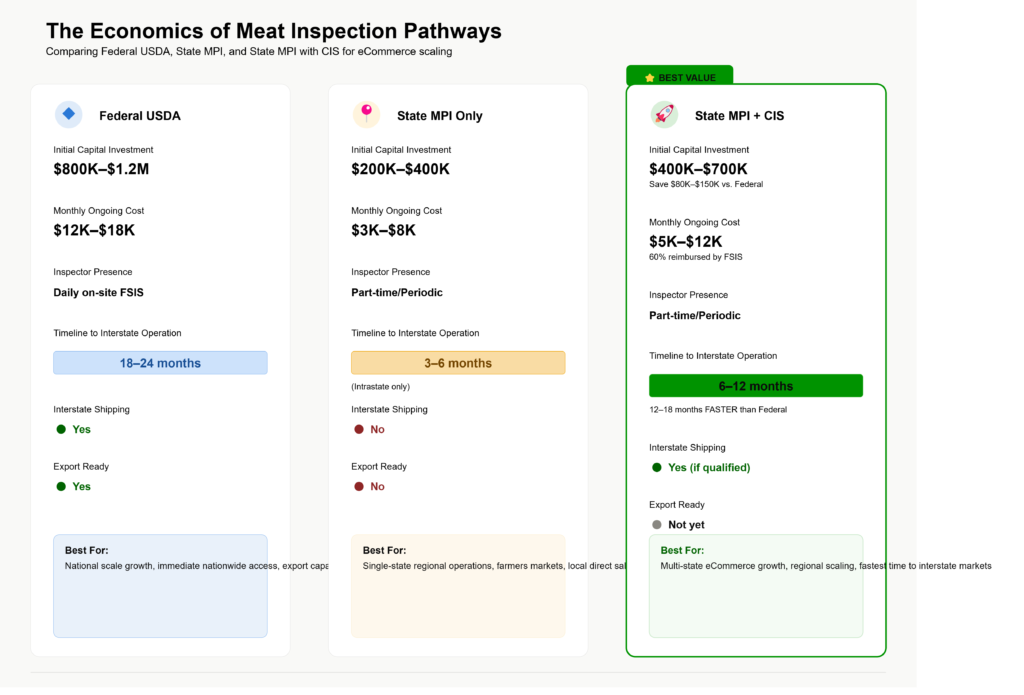
📊 Cost & Timeline Breakdown by Inspection Pathway
| Cost/Timeline Factor | Federal USDA Inspection | State MPI Only (Intrastate) | State MPI with CIS (Interstate) |
|---|---|---|---|
| Initial Capital Investment | $800K to $1.2M | $200K to $400K | $400K to $700K |
| Monthly Ongoing Cost | $12K to $18K | $3K to $8K | $5K to $12K (60% FSIS reimbursed) |
| Inspector Presence | Daily on-site FSIS inspector required | Part-time or periodic state inspector | Part-time or periodic state inspector |
| Interstate Shipping Capability | Yes, after grant of inspection | No | Yes, if CIS-qualified |
| Timeline to Interstate Operation | 18 to 24 months | 3 to 6 months (intrastate only) | 6 to 12 months (with interstate access) |
| Export Capability | Yes | No | No (CIS standard states don’t have export agreements yet) |
What These Numbers Mean
For a $500K to $1M processing facility, choosing state inspection with CIS saves $80K to $150K in startup capital compared to federal inspection. Monthly ongoing costs run 40 to 50 percent lower because state inspection staffing is part-time and FSIS reimburses states for 60 percent of CIS costs.
The timeline difference is critical. Federal inspection requires all compliance systems operational before FSIS grants inspection. HACCP plan, SSOP documentation, recall procedures, personnel training, facility upgrades all must be complete, tested, and verified before you receive the federal mark. This process takes 18 to 24 months from first application to operational approval.
State inspection can be achieved in 3 to 6 months. Facilities enter compliance, state inspector verifies, and intrastate sales begin. CIS qualification adds another 3 to 6 months but still lands you at 6 to 12 months total to interstate capability half the federal timeline.
💰 The Financial Reality
For eCommerce operators targeting multi-state expansion within 24 months, CIS offers a faster path with materially lower capital requirements. The tradeoff: export capability remains limited (no CIS state has export agreements), and eventual national scale or consolidation typically requires federal inspection anyway.
Timeline to Interstate Shipping by Inspection Pathway
The path from facility planning to interstate eCommerce sales differs dramatically by inspection type.
Federal USDA Inspection Timeline (18-24 months total)
- Month 1-3: Facility design and initial FSIS consultation
- Month 4-12: Facility construction and equipment installation
- Month 13-18: HACCP plan development, SSOP documentation, training implementation
- Month 19-24: FSIS review, on-site inspection verification, grant of inspection approval
- Month 25+: Interstate and export-ready operation
State Inspection (Intrastate Only) Timeline (3-6 months total)
- Month 1: Facility completion and state inspection application
- Month 2-3: State inspector review and facility approval
- Month 4-6: State-inspected product sales (single-state eCommerce only)
- Year 2+: CIS application (if state participates), or federal inspection pursuit for interstate expansion
State Inspection with CIS (Interstate-Ready) Timeline (6-12 months total)
- Month 1-3: Facility completion and state MPI application
- Month 4-6: State inspection approval and product sales (intrastate)
- Month 7-12: CIS qualification review and FSIS approval to operate under federal mark
- Month 13+: Interstate eCommerce sales under USDA mark of inspection
⏱️ What This Means
An operator in a CIS-eligible state can reach interstate eCommerce customers 12 to 18 months faster than waiting for federal inspection approval. For a high-growth eCommerce business, 12 to 18 months of interstate sales at scale represents millions of dollars in revenue and customer relationships that federal-only operators haven’t yet accessed.
How to Choose Your Inspection Path for eCommerce Scaling
The choice between state and federal inspection hinges on three variables: your target market geography, your facility location and state’s CIS participation, and your capital runway. Inspection status is one decision inside a larger build — what a complete meat eCommerce setup actually requires, from checkout to compliance.
Step 1: Map Your Market Stage
Define where you want to sell revenue by year one and year three. If you’re targeting single-state eCommerce (year one: $100K to $500K in-state sales), state inspection suffices. If you’re targeting multi-state eCommerce (year one: $500K in-state, year two: $1M to $2M multi-state), CIS eligibility becomes critical. If you’re planning national scale or wholesale to major retailers (year three: $5M+), federal inspection becomes the eventual requirement.
Step 2: Check CIS Availability in Your State
Visit your state’s Department of Agriculture website or call the meat inspection division. Ask: “Does our state have a state MPI program? Are we CIS-eligible?” If yes to both, CIS is your acceleration pathway. If no to state MPI, federal inspection is required. If state MPI exists but no CIS agreement, you have two options: pursue federal inspection immediately, or wait/advocate for CIS expansion (risky if timeline-dependent).
Step 3: Model Compliance Costs and Timeline for Your Operation
Federal inspection: $800K to $1.2M startup, $120K to $180K annual. State/CIS: $400K to $700K startup, $60K to $120K annual (60% FSIS reimbursement on CIS portion). Calculate your available capital and break-even timeline. CIS economics favor businesses with constrained capital seeking 2 to 3 year regional growth before scale.
Step 4: Build Your Facility Location Strategy
If you have flexibility on facility location, prioritize CIS-eligible states. A processor in Iowa (CIS-eligible) reaches interstate markets 12 to 18 months faster than an equivalent processor in a non-CIS state. If you’re locked into a non-CIS state, plan federal inspection and accept the 18 to 24 month pre-launch timeline as a business constraint.
FAQs
Is state-inspected meat actually as safe as USDA-inspected meat?
Yes. State-inspected meat meets safety standards “at least equal to” federal inspection. CIS-qualified facilities meet standards “same as” federal inspection. The distinction is not safety it’s market access. Both require pre-mortem inspection, post-mortem inspection, product inspection, HACCP plans, written SSOPs, recall procedures, and lab accreditation. Consumers can trust state-inspected meat to be equally safe. The regulatory restriction is geographic, not safety-related.
Can I sell state-inspected meat across state lines?
Not without the CIS program. State-inspected meat (without CIS) is locked to intrastate sales. CIS-qualified state-inspected meat can ship across state lines under the USDA mark of inspection. If your state participates in CIS and your facility meets CIS requirements, yes. If your state doesn’t participate in CIS, no you’d need federal inspection for interstate sales.
How much does federal USDA inspection cost compared to state inspection?
Federal inspection: $800K to $1.2M startup capital, $120K to $180K annually. State inspection: $200K to $400K startup, $40K to $80K annually. State inspection with CIS: $400K to $700K startup, $60K to $120K annually (60% FSIS cost reimbursement). Federal inspection costs roughly 2 to 3 times more than state inspection but enables immediate nationwide access. CIS offers a middle ground: about 50 percent of federal costs with 12 to 18 months faster interstate access than federal alone.
How long does it take to get federal USDA grant of inspection?
Typically 18 to 24 months from application to operational approval. All compliance systems (HACCP, SSOP, recall plan, facility certifications) must be complete and verified before FSIS grants inspection. State inspection can happen in 3 to 6 months. CIS qualification adds another 3 to 6 months, landing at 6 to 12 months total to interstate capability accelerating your market access by over a year compared to federal inspection alone.
Is CIS available in my state, and when might it expand?
CIS is available in 11 states as of July 2026: Indiana, Iowa, Maine, Missouri, Montana, North Dakota, Ohio, South Dakota, Vermont, Wisconsin, and Georgia. If your state isn’t listed, contact your state Department of Agriculture. USDA is actively expanding CIS to additional states in 2027. Monitor USDA FSIS announcements for your state.
Conclusion: Positioning Your Processor for 2027 Growth
The inspection pathway you choose is a capital and timeline decision that shapes your eCommerce trajectory for the next three years. For decades, the choice was binary: state inspection (limited markets) or federal inspection (long wait, high cost). CIS changes the equation.
If you’re in a CIS-eligible state, you have a genuine competitive advantage a pathway to interstate eCommerce markets that opens 12 to 18 months faster than federal inspection alone, with materially lower compliance burden. That runway matters. Eighteen months of interstate eCommerce growth at scale represents millions in revenue and customer relationships that operators stuck in non-CIS states or pursuing federal inspection haven’t yet reached.
The consolidation this program is meant to counter — 85% of slaughter in four companies — is the same dynamic behind the import paradox: why record beef imports still aren’t lowering prices. If you’re not in a CIS state yet, monitor your state’s Department of Agriculture for potential CIS discussions. USDA momentum is behind expansion. Your state may join in 2027.
For operators targeting national scale or export, federal inspection remains the eventual destination. CIS is not the final pathway for consolidation-stage businesses. But for regional eCommerce growth through 2027 and 2028, CIS offers a ramp that federal inspection cannot match.
The question isn’t whether state inspection is “legitimate” or “safe” it is, equally to federal inspection. The question is which pathway accelerates your eCommerce business to multi-state customers fastest, with capital efficiency and timeline alignment to your growth stage.
Choose accordingly. The processing consolidation crisis in beef (85 percent of slaughter controlled by 4 companies) exists partly because regional and family-owned processors have been locked out of interstate commerce. CIS is designed to level that playing field. For eCommerce operators, it represents the single biggest policy shift in meat market access in a decade.
Your facility is compliant. Your product is safe. Clearing the interstate-access hurdle is only half the compliance picture. Once your product can cross state lines, your origin labeling has to hold up under FSIS’s “Product of USA” verification too. Your brand is ready. The question now is which inspection pathway gets your meat in front of multi-state customers in 2027. For 11 states, CIS answers that question. For the rest, federal inspection remains the only path. Know which one applies to you before you commit to a facility location.
