
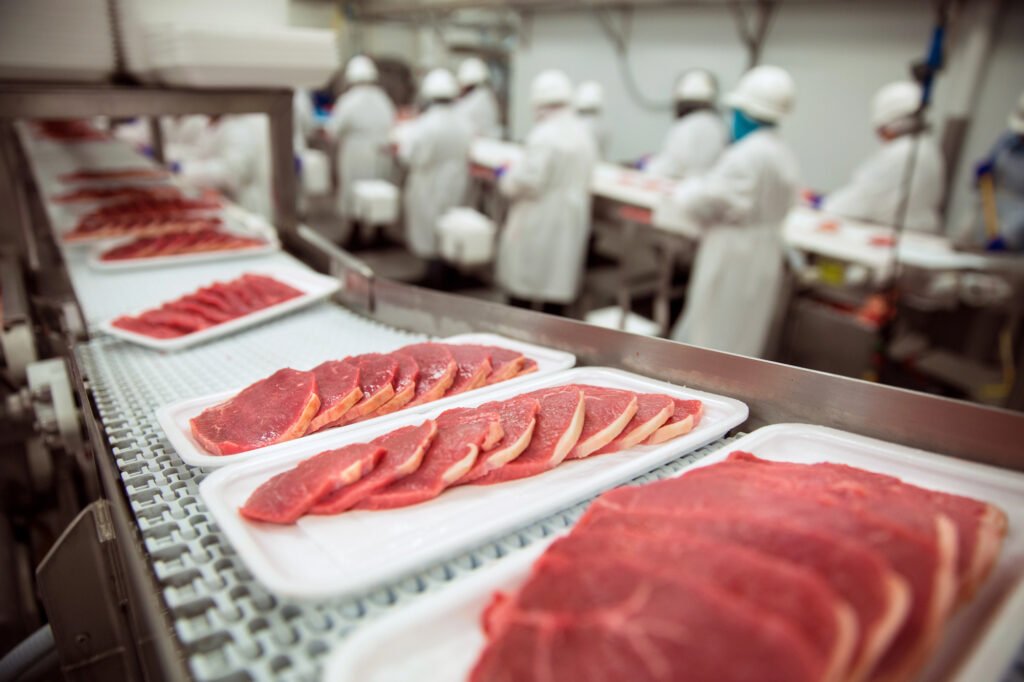
As USDA withdraws the Packers and Stockyards safeguards built to check concentration, the producers insulated from the fallout are the ones who already own their customer, not their cattle buyer.
You watched the cash bid come in this week and did the math you have done a hundred times: the number that decides your year was set by one of four buyers, and you had no leverage in it. Using the term “regenerative agriculture” online without eroding your own credibility means being able to show what stands behind the word, not just print it on the label. For a few years at least, there were federal rules meant to keep those buyers honest. As of this summer those rules are being pulled again.
85% Share of U.S. steer and heifer purchases handled by the four largest packers
3 rules Packers and Stockyards safeguards USDA moved to rescind in 2026
86.7M head Smallest U.S. cattle herd since 1951, so leverage is scarcer than ever
$17.5B U.S. direct to consumer food sales in 2022, up 25% (real) since 2017
With USDA rescinding three Packers and Stockyards Act rules in 2026, independent producers lose the federal safeguards built to check meatpacker consolidation, where four firms handle roughly 85% of cattle purchases. The most durable protection is no longer regulatory. It is a direct to consumer brand that creates a second market a producer controls, priced independently of the packer’s bid.
Key takeaways:
- Own the customer relationship, not just the cattle a brand is a second market
- The lost safeguards will not return soon so do not wait on Washington to price your beef
- USDA inspected processing is the gate to legal online cut sales, so plan it first
What USDA Actually Rolled Back in 2026
In July 2026, the National Chicken Council and the Meat Institute publicly thanked USDA for a decision most producers barely had time to register: the department confirmed it would rescind three Packers and Stockyards Act rules finalized under the previous administration.These were not minor technical corrections. They were the first serious update to the Act in more than thirty years.
The three rules on the chopping block each did something specific:
- Inclusive Competition and Market Integrity
prohibited discrimination, retaliation, and deception in contracting, and protected producers’ right to join co-ops and other business relationships. - Transparency in Poultry Grower Contracting and Tournaments
forced companies to disclose contract terms to growers before and during production. - Poultry Grower Payment Systems and Capital Improvement Systems
limited how integrators could use the tournament pay system to dock grower payments.
By the August 14, 2026 Federal Register Unified Agenda, all three were formally listed at the rescission stage. The poultry payment rule, originally set to take effect July 1, 2026, was pushed to December 31, 2027.
Don’t plan around their return.The rescissions are not a pause. Two rules are in formal rescission and the third is delayed to the end of 2027. If your risk plan assumes these protections come back on a predictable timeline, rebuild the plan. As of August 2026, there is no schedule that gets them reinstated.
The framing matters here because the industry and the advocates describe the same event in opposite terms. Trade groups call the rules rushed one size fits all mandates that added compliance cost without helping farmers. Producer advocates like R-CALF call the rollback a return to the hands off era that let packers exert market power without consequence. You do not have to resolve that fight to see the operational reality the external check you may have been counting on is being removed and you had no vote in it.
Concentration Was Already the Ceiling on Your Price
Here is the part worth sitting with. The rules being rescinded were designed to police a market that is already about as concentrated as a market gets. According to USDA’s Economic Research Service, the four largest firms handle roughly 85% of all steer and heifer purchases and 67% of hog purchases. In a market with four real buyers the “market price” is a number set for you not negotiated with you.
What four buyers means for your bid:
When four firms handle 85% of fed cattle purchases (USDA ERS, 2024) you are selling into an oligopsony many sellers few buyers.That structure hands the price setting power to the buyer side and no single producer can negotiate around it.
Be careful with the consolidation story though because the honest version is more useful than the outraged one. The Meat Institute is correct that beef packing concentration is high but stable not accelerating the four firm ratio sat near 82% in 1994 and hovers around 81% today. The problem was never that consolidation is suddenly spiking. The problem is that it locked in three decades ago and never loosened, and the rules meant to check its abuses are now going away. The same consolidation forces are now drawing federal scrutiny, and it’s already shifting buyer expectations, how the DOJ meatpacking probe is rewriting the way small beef brands sell “independent”.
The squeeze shows up in two directions at once. Retail beef prices hit record highs through 2025 and 2026, yet the share of that retail dollar reaching producers is contested.Farm Action estimates ranchers now capture less than 30 cents of every retail beef dollar and calls it a historic low. The Meat Institute, using a broader measure, reports the producer share closer to 54% in 2025. Both cannot be casually true, which is exactly why you should treat any single producer share figure with suspicion and read who is doing the counting.
What is not contested:
the U.S. cattle herd has fallen to roughly 86.7 million head the smallest since 1951.Fewer cattle should mean more producer leverage.In a four-buyer market it mostly means tighter packer margins and plant closures not a windfall for the person who raised the animal.
“The number that sets my whole year gets handed to me.I don’t set it. I don’t argue it, I take it. Losing the one rule that was supposed to keep that honest doesn’t feel like deregulation from where I stand. It feels like the referee walking off the field.”
Cow-calf producer independent operation Northern Plains
Why a Brand Functions as a Second Market
Most producers hear “build a brand” and picture a logo, a Facebook page, and a farmers market tent.That is not what changes your exposure. What changes your exposure is where the price comes from.
When you sell cattle to a packer, one of four buyers sets your price. When you sell a branded box of beef to a repeat customer you set your price. That is the whole thesis and it is structural not cosmetic. A brand is not marketing paint on a commodity business. It is a second market that behaves independently of the first.
Product or brand? A one-question test:
If your buyers would follow your name to a new cut, a new season, or a higher price, you have a brand. If they only buy when you are the cheapest option on the shelf, you still have a commodity. The test is loyalty that survives a price change.
The reason this qualifies as protection, and not just extra revenue, is what happens when the packer bid drops. If your entire income rides on the cash market, a bad bid is a bad year with no recourse. If part of your volume clears every month through a subscription or a repeat customer base, that portion of your income does not move when the packer bid moves. You have decoupled a slice of your revenue from the one number you cannot control.
That decoupling is why the deregulation headline lands differently for producers who already own a customer. They are not waiting to find out whether Washington will protect them. They have quietly routed part of the question somewhere Washington does not reach.
The Economics: Commodity Bid vs. Branded Margin
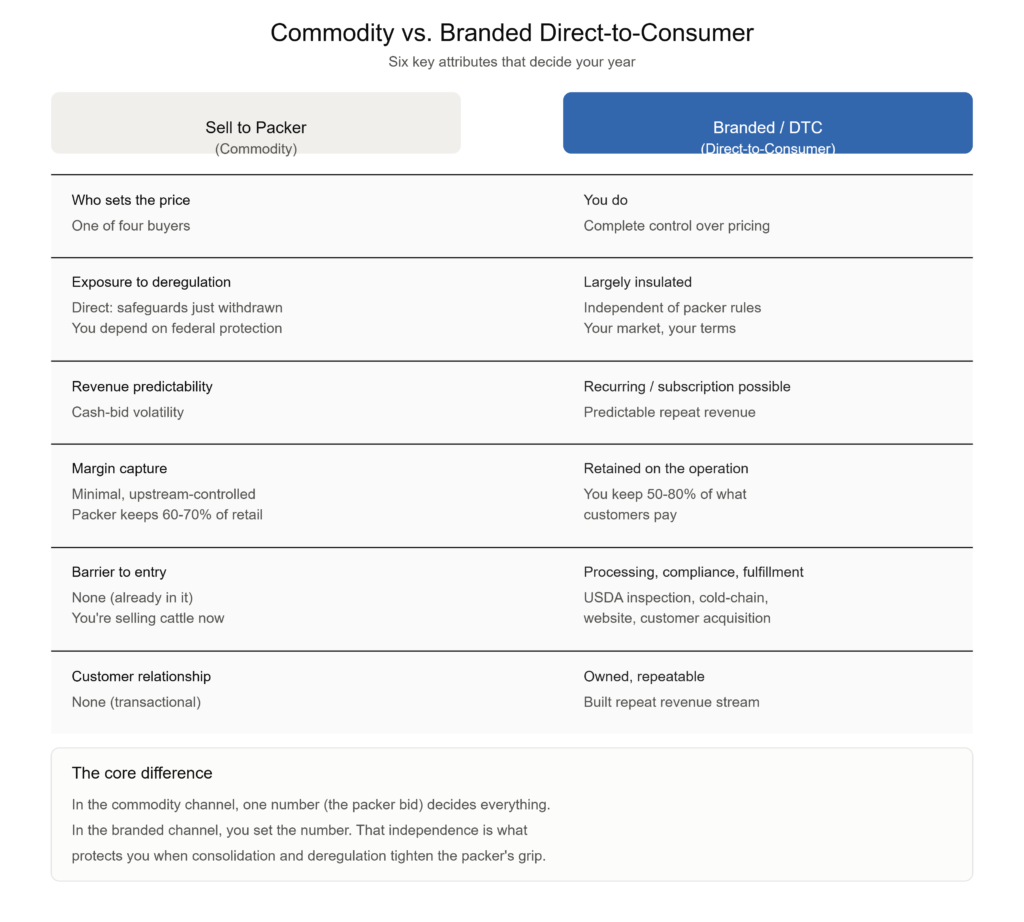
The margin math is what makes this more than a values argument. Selling into the commodity channel, you capture a bid you did not set, minus nothing you control. Selling branded and direct, grass-finished beef commonly realizes $6 to $10 per pound, and premium or dry-aged cuts can command $30 to $75 and up. That spread is the value the middle of the supply chain normally keeps.
The comparison that matters is not which is easier. It is which one controls the variables that decide your year.
The catch is real, and pretending otherwise does you no favors. That higher per-pound number comes loaded with costs the commodity sale never had USDA inspected processing, cold-chain packaging, shipping, payment processing, and the ongoing cost of finding and keeping customers. The trend line pushing more producers to run that math is not only about consolidation. It is also about input costs, which is a story we have covered in how tariffs pushed farm input costs up sharply and moved margins from production to marketing. When the cost of raising the animal climbs and the bid does not, the marketing side of the ledger stops being optional.
“People assume direct-to-consumer means I’m leaving money on processing and shipping. Sure. But I keep the part of the dollar that used to disappear upstream, and I keep it on my terms. My best month direct beat my check from the sale barn, and I set every price in it.”
Owner, direct to consumer beef brand, Midwest [representative quote: source a real operator or cite a documented DTC operation before publish]
The point is not that direct-to-consumer is free money. It is that the money you capture is money whose price you controlled.
The Real Barrier Isn’t Marketing, It’s Processing
Ranchers who stall on going direct usually think the hard part is marketing. It rarely is the hard part is inspection and compliance, and it is where most first attempts either get delayed for months or quietly break the law. If you are weighing which inspection tier fits your plan, the practical trade offs between state and USDA inspection for selling meat online come down to how far you intend to ship and what it costs to get there.
The rule that governs almost everything to sell packaged cuts across state lines, your beef must be processed at a federally (FSIS) inspected facility. State inspected plants let you sell cuts within your own state. Custom-exempt processing, the cheapest and easiest to book, cannot be sold by the cut at all. The decision cascade looks like this:
- Custom-exempt:
lowest cost, but you can only sell the live animal or shares, not individual retail cuts. - State-inspected:
allows individual cut sales inside your state’s borders. - Federal (FSIS) inspection:
required for any interstate shipping, which is most real online businesses.
Confirm your tier before you take a single order selling packaged cuts across state lines without FSIS inspection is not a paperwork slip, it is an illegal sale. Booking custom-exempt processing and then listing cuts on a website is the single most common way new direct-sale operations expose themselves. Verify processing access before you build demand, not after.
This is also where the near-term policy news is not all bad. In October 2025, USDA announced measures aimed at small and mid-sized processors: expanded grants, reduced inspection fees, and new funding through the Meat and Poultry Processing Expansion Program. Processing capacity has been the choke point on direct sales for years, and the number of small federally inspected plants has been climbing, from a low near 626 in 2007 toward 937 in 2025. If you have been told the local plant has no slots, that picture is slowly improving.
If you are weighing which inspection tier fits your plan, the practical trade-offs between state and USDA inspection for selling meat online come down to how far you intend to ship and what it costs to get there. Solve that question first. Everything downstream depends on the answer.
What “Building a Brand” Actually Requires
Assume the processing question is answered. Now the brand has to be real, and “real” means infrastructure, not aesthetics. A logo is the last five percent of this. The other ninety-five percent is systems.
At minimum, a brand that functions as a second market needs four things working together:
- Positioning and story that gives a buyer a reason beyond price to choose you, and to choose you again.
- A genuine storefront that takes orders, handles payment, and manages inventory by cut and by weight.
- Cold-chain fulfillment that gets frozen product to a doorstep intact and compliant.
- A repeat-purchase engine, usually subscription or reorder mechanics, because a one-time sale is a transaction, not a brand.
The story piece is where most farm brands quietly fail now, and the failure has moved. It used to be that a farm brand failed because nobody found it. Increasingly it fails because AI search summarizes the category without ever surfacing the farm, a problem we dug into in why farm brand storytelling is failing in AI search and what to build instead. If your entire story lives in a video caption and a founder’s memory, an answer engine has nothing to cite, and a growing share of your would-be customers never reach your site at all.
Then there is the credibility trap. Reaching for terms like regenerative, grass-fed, or pasture raised is the obvious move, and it is also where operations undercut themselves, because an unbacked claim reads as marketing and a growing share of buyers know it. Using the term “regenerative agriculture” online without eroding your own credibility means being able to show what stands behind the word, not just print it on the label.
“We had the practices. What we didn’t have was any way to prove them online, so the word ‘regenerative’ on our page was doing nothing except making us sound like everyone else. The claim only started converting once we could back it.”
Across the direct-commerce implementations our research team has audited, the operations that treat the brand as infrastructure, and not as a graphic, are the ones whose second market actually holds up when the packer bid turns against them.
Sequencing It Without Betting the Ranch
None of this argues for walking away from the cash market tomorrow. Most producers cannot, and most should not. The mistake at both extremes is the same: treating this as all or nothing when the entire advantage of a brand is that it is additive.
The move is to route a defined share of your volume into a channel you control, prove it, and grow that share on your timeline. You keep selling cattle. You just stop letting a single buyer’s bid be the only number that decides your year.
How to Build the Independent Channel Without Overcommitting
- Secure your processing tier first before any customer facing work, confirm whether you have USDA/FSIS inspected access, which is required for interstate cut sales. This gates everything else, so solve it before you build demand.
- Route a slice of volume, not all of it move a defined share of your annual head into a branded or direct channel while keeping the cash market for the rest. Prove the second market before you lean on it.
- Build the repeat engine, not just the storefront prioritize subscription and reorder mechanics over one off sales, because recurring revenue is what turns a brand into a genuine hedge against the packer bid.
- Scale the independent share deliberately as repeat revenue proves out, grow the branded channel’s share of your volume on your own timeline. The goal is to route as much as viable around the concentrated market entirely.
FAQs
USDA just pulled the packer rules. Does that actually change anything for me day to day?
Not immediately, but it removes the enforcement backstop against discrimination, retaliation, and opaque contracting that the 2024 to 2025 rules created. Practically, it means fewer external checks on the terms you are offered, and no near term prospect of their return, since two rules are in rescission and the third is delayed to December 2027.
Is a direct to consumer beef brand actually profitable, or just extra work?
It can be materially more profitable per head grass-finished direct beef commonly realizes $6 to $10 per pound, and premium cuts far more, versus a commodity bid you do not control. The catch is real cost processing, packaging, cold-chain fulfillment, and customer acquisition. It rewards operators who treat it as a business line.
Do I need my own USDA inspected plant to sell beef online?
You do not need to own one, but your beef must be processed at a federally (FSIS) inspected facility to sell packaged cuts across state lines. State inspected plants allow in state cut sales. Custom exempt processing cannot be sold by the cut at all. Confirm access before taking orders.
If I still sell most of my cattle to packers, does a small brand even protect me?
Yes, and that is the point. A brand does not require exiting the cash market. It creates a second, independently priced market for a share of your volume. Even a modest branded channel reduces how much of your income a single buyer’s bid can dictate.
The Protection You Can Actually Build
For a few years, the answer to packer leverage was supposed to be federal: rules that made discrimination, retaliation, and opaque contracting harder to get away with. As of the 2026 Unified Agenda, that answer is being withdrawn, and there is no date on its return. Waiting for it to come back is not a strategy.
The protection that does not depend on an administration is the one you own outright. A brand gives you a second market, priced on your terms, that keeps clearing when the cash bid turns against you. It will not replace the sale barn overnight, and it should not. But every share of your volume you move into a channel you control is a share the next round of deregulation cannot touch. That is the hedge that is still yours to build.
