
A roadmap to federal, foundation, and state funding opportunities specifically designed for small farms and producer networks scaling direct to consumer channels. Small farms attempting to launch or scale directly to consumer sales face a stubborn capital gap. The infrastructure costs eCommerce platform build out, cold chain logistics, market training, compliance far exceed what most farms can self fund. In 2025, USDA, private foundations, and state agriculture departments allocated more than $50 million in grants specifically for this use case. Knowing where that money is and how to access it separates farms that scale from farms that stall.
- $33.5 Million USDA Agricultural Marketing Service grant awards October 2024 across FMPP, LFPP, and RFSP programs for 113 projects in 43 states
- $50K–$500K Individual grant award range for Farmers Market Promotion Program in FY 2025, farmers market alternatives. Local Food Promotion Program ranges $25K–$500K
- June 27, 2025 Application deadline for USDA’s two major local food grant programs, 25% cost share required from all applicants
- $13 Million+ Estimated funding from private foundations Whole Foods Market, Sprouts, UNFI, others supporting local food initiatives in 2025
Key takeaways:
- FMPP funds direct to consumer channels online sales, CSAs, farmers markets, LFPP funds intermediaries and regional aggregation.
- Federal grants require 25% cost share, foundation funding is often 100% grant with no match required.
- Strategic sequencing of USDA + foundation + state grants multiplies capital access and reduces total project cost.
The Three Major USDA Grant Programs for Local Food in 2025
The USDA’s Agricultural Marketing Service administers three grant programs designed to strengthen local and regional food systems. Understanding the difference between them is the first step in targeting the right funding source.
Farmers Market Promotion Program FMPP:
The FMPP invites applications for Fiscal Year 2025, aimed at enhancing direct producer to consumer markets with an estimated total funding of $11 million and an expected 245 awards. Award sizes range from $50,000 to $500,000. Eligible applicants include agricultural businesses, cooperatives, nonprofits, local governments, tribal organizations, and producer networks. The program focuses on direct producer to consumer sales channels, farmers markets, usda.gov.services. CSAs, roadside stands, agritourism activities, and online platforms.
Eligible uses include marketing and promotion, technology upgrades, food safety certifications, value added product development, on farm food waste reduction, and training programs. Construction and major equipment purchases are not eligible, though working capital and software/platform costs are. A 25% cost share requirement applies to all applicants. The application deadline is June 27, 2025, submitted via Grants.gov.
Local Food Promotion Program LFPP:
The LFPP offers $11 million available in FY 2025, with grants ranging from $25,000 to $500,000, and applicants must meet a mandatory cost sharing requirement of 25% of the federal funding amount. Eligible applicants are agricultural businesses, nonprofits, local governments, and tribal organizations. ams.usda.gov. The program targets indirect producers to consumer marketing, aggregators, distributors, processors, and regional food chains.
Eligible uses include feasibility studies, business development, cold storage infrastructure excluding construction, transportation, processing equipment, labor and training, and market development. The same June 27, 2025 deadline and 25% cost share requirement apply.
Regional Food System Partnerships RFSP:
The RFSP program supports multi stakeholder regional food system infrastructure and coordination. Award sizes typically range from $100,000 to $500,000 or more. Eligible applicants are regional planning organizations, food councils, university consortiums, and government agencies. This program funds food hub development, supply chain coordination, and workforce development.
The key distinction is operational, FMPP supports individual farmers and direct to consumer channels, LFPP supports intermediaries and regional aggregation, RFSP supports systems level infrastructure. A farm direct eCommerce platform fits FMPP. A food hub aggregating multiple farms for restaurant delivery fits LFPP. A regional processing cooperative fits RFSP.
The Timing Advantage in 2025:
The 2025 grant landscape is unusually favorable. Federal funding remained stable despite economic uncertainty. Foundation interest in local food has intensified post pandemic. State programs expanded support for eCommerce and market access. For farms, this means less competition per grant dollar and higher approval rates for well documented projects. The moment to apply is now, before funding cycles close and competition increases.
How FMPP and LFPP Differ Which One Fits Your Farm?
Applying to the wrong program wastes application effort and misses funding. This decision matrix clarifies the difference.
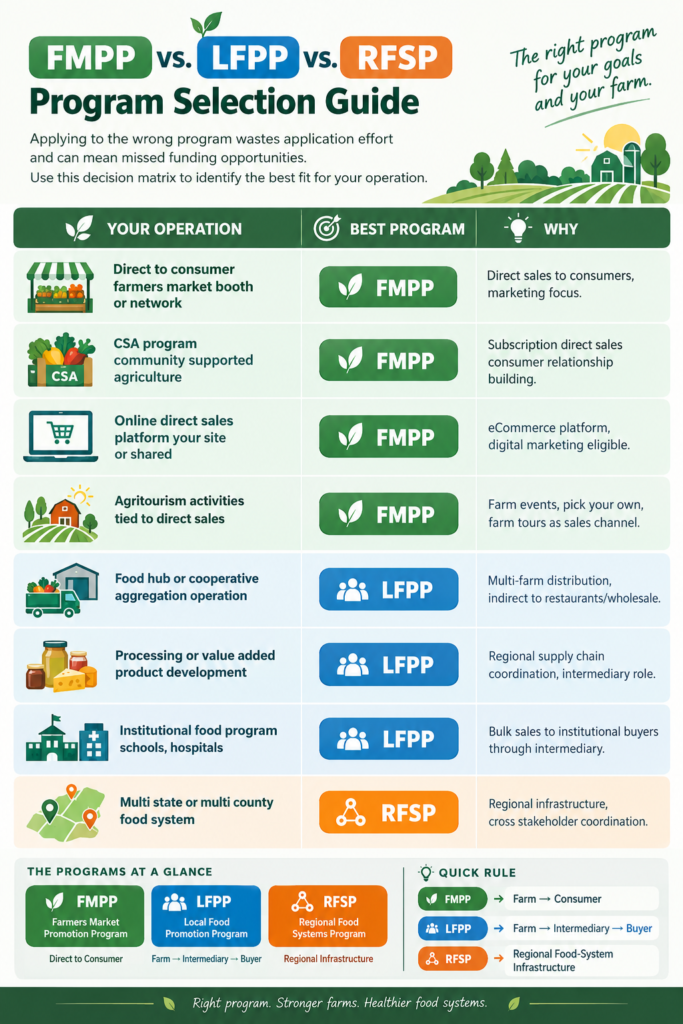
Many producer networks operate in both direct and aggregation channels. A fruit cooperative that runs member farmers’ market booths and also aggregates for regional restaurants is a dual eligible candidate. Both applications are separate both due June 27, 2025 to Grants.gov, but many networks apply to both if they operate across both channels.
| Your Operation | Best Program | Why |
|---|---|---|
| Direct to consumer farmers market booth or network | FMPP | Direct sales to consumers, marketing focus |
| CSA program community supported agriculture | FMPP | Subscription direct sales consumer relationship building |
| Online direct sales platform your site or shared | FMPP | eCommerce platform, digital marketing eligible |
| Agritourism activities tied to direct sales | FMPP | Farm events, pick your own, farm tours as sales channel |
| Food hub or cooperative aggregation operation | LFPP | Multi-farm distribution, indirect to restaurants/wholesale |
| Processing or value added product development | LFPP | Regional supply chain coordination, intermediary role |
| Institutional food program schools, hospitals | LFPP | Bulk sales to institutional buyers through intermediary |
| Multi state or multi county food system | RFSP | Regional infrastructure, cross stakeholder coordination |
The Sequencing Advantage, Most farms think of grants as one time infusions. The effective approach differs significantly. Use FMPP to build direct sales capability, eCommerce platform, market training, marketing assets. Then use LFPP to build the aggregation backbone, cold storage, transportation logistics, and processing infrastructure. Then layers in foundation funding often require no cost share to cover gaps the federal programs don’t address. Total capital access, 3–5x higher than applying for one grant alone. For farms serious about scaling in 2025, this sequenced approach is the operating standard.
Eligible Uses, What Grants Can and Cannot Fund
Knowing what you can and cannot fund is critical. Many applications fail because applicants request ineligible items or misclassify costs.
FMPP & LFPP CAN Fund:
- Marketing and promotional materials website redesign, social media strategy, digital advertising.
- eCommerce platform development and technology upgrades.
- Training and technical assistance financial management, farm business planning, food safety, record keeping.
- Food safety certifications and compliance organic certification, food handler permits, liability insurance.
- Feasibility studies and business plans.
- Value added product development equipment for on-farm processing in some cases, recipe development, labeling.
- Workforce training and recruitment programs.
- On farm food waste reduction initiatives.
- Limited working capital for grant funded project activities
FMPP & LFPP CANNOT Fund:
- Construction facility building, permanent structure installation.
- Major capital equipment purchases with limited exceptions under specific conditions.
- Real estate acquisition.
- Routine operating expenses unrelated to project activities.
- Debt repayment or refinancing
The Platform Investment Case, A small farm spending $15,000 to build a Shopify based direct sales platform qualifies for FMPP funding. The same farm spending $50,000 on a permanent greenhouse structure does not. This distinction drives which projects get funded and which don’t. Grants excel at enabling market access and business development. They are not a substitute for capital equipment financing. Understand this boundary before writing your application it determines project eligibility and competitiveness.
The Foundation Funding Landscape in 2025
Beyond federal grants, private foundations allocated substantial resources to local food in 2025. These are often easier to access because they typically require no cost share.
Whole Foods Market Foundation Community First Grants:
The foundation awarded $938,877 to 71 nonprofit organizations across the U.S and Canada in 2025. Focus areas include fresh food access, nutrition education, and local food system infrastructure. Award sizes typically range from $5,000 to $25,000 per organization. Eligibility requires 501(c)(3) nonprofit status. No cost share is required. Applications vary by program year; check wholecitiesfoundation.org for current deadlines and categories.
The foundation prioritizes organizations serving underserved communities and expanding access to fresh, locally grown food. Farmer cooperatives, food councils, and community food organizations are typical recipients. Individual farms can partner with an eligible nonprofit to apply jointly, positioning the nonprofit as lead grantee and the farm as a collaborative partner.
Sprouts Healthy Communities Foundation 2025 Grants Program:
Sprouts announced $3 million available in 2025 across nutrition education, nutrition access, and wellness programs. Award sizes reach up to $10,000 per nonprofit. Eligibility requires 501c3 nonprofit status operating in Sprouts communities primarily Southwest and West Coast. Three grant categories are available, Sprouting School Gardens school gardening programs, Growing Healthy Kids children’s nutrition access, and Wellness programs broader nutrition initiatives.
Applications are typically open March through April annually. No cost share is required. For farms, the pathway is partnership with a school district or community nonprofit in your region.
UNFI Foundation 2025 Impact Grants:
The UNFI Foundation awarded $1.8 million to 80 nonprofit organizations in 2025, the largest funding round in the foundation’s history. Focus areas include food systems equity, sustainability, and resilience. Award sizes vary; typical range is $15,000 to $75,000. Eligibility requires 501c3 nonprofit status working in food, agriculture, or sustainability. Geographic focus spans 32 U.S states and 2 Canadian provinces.
Grantees include organizations advancing organic farming practices, food rescue and redistribution, and community led local food systems. Application timelines are rolling, check unfifoundation.org for current opportunities. Like other foundation funding, no cost share is required, making UNFI grants valuable for matching the 25% federal cost share requirement.
State and Regional Grant Opportunities
Beyond federal and foundation programs, state agriculture departments and regional economic development agencies offer supplementary funding. These vary significantly by location but often support specific activities that federal grants do not.
Minnesota New Markets Cost Share Program:
Minnesota farms and food businesses with fewer than 500 employees can access reimbursement for up to 50% of eligible eCommerce, digital marketing, and trade show costs. The program operates on a reimbursement model you spend first, then apply for reimbursement. Eligible uses include platform development, social media strategy, email marketing, and industry trade show participation. Agricultural brand pr commodity markets Rolling deadlines apply, check the Minnesota Department of Agriculture website for current cycles.
State Processing Grants Multi State:
Many states offer dedicated grants for food processing facility development and licensing. Award ranges vary from $1,000 to $150,000 depending on state and project size. Eligible applicants are meat, poultry, egg, and milk processing startups or expansions. Cash match requirements typically apply 50% of the first $50K, 75% of the remainder. Contact your state’s Department of Agriculture for availability and current application windows.
Regional Food Hub Development Grants:
USDA’s Regional Food System Partnerships grant program is coordinated by regional USDA Rural Development offices and supports multi state or multi county food hub infrastructure. Award ranges typically span $100,000 to $500,000 or more. Eligible applicants are government agencies, nonprofits, and agricultural organizations focused on regional food system coordination. Applications follow USDA timelines, check Grants.gov for current cycles.
County and Local Economic Development Grants:
Many counties and municipalities offer small agriculture and business grants often focused on main street revitalization, agritourism, or local economic development. Award ranges typically span $1,000 to $10,000. Competition is lower compared to federal programs because fewer applicants target local funding. Contact your county economic development office and city/town business development department for available programs and deadlines.
Action item, Contact your state’s Department of Agriculture and your regional USDA Rural Development office for a current list of state and regional funding opportunities. Programs change annually, the best source is government agency websites and Grants.gov filtered by state and agency.
Application Strategy and Timeline for 2025
Successful grant applicants plan their submission in phases. Here is a realistic timeline for the June 27, 2025 USDA deadline.
March 2025, Eligibility Assessment and Program Selection:
Confirm your organization’s eligibility. For FMPP, any farm or agricultural business qualifies. For LFPP, agricultural business, nonprofit, or local government. Decide whether to apply to FMPP, LFPP, or both. Download the Request for Applications RFA from the USDA’s Agricultural Marketing Service website or Grants.gov. Assess your project against eligible uses and create an initial project summary.
April 2025, Project Planning and Budget Development:
Define your project scope with precision. What will you accomplish? Over what timeframe? Identify your 25% cost share cash, in kind labor, donated services all count. Build a realistic budget aligned to eligible uses. Gather supporting documentation, organizational capacity statements, financial statements, letters of support from partners or market participants. If partnering with other organizations, secure partnership commitments in writing.
May 2025, Application Drafting and Review:
Complete the narrative section, project narrative, target market, budget justification, measurable outcomes, timeline. Have peers, mentors, or consultants review for clarity and competitiveness. Prepare supplemental materials, organizational charts, staff resumes, prior project results if applicable. Create a Grants.gov account if you don’t have one now. Account creation can take 2–3 weeks, so do this early to avoid delays.
June 1–27, 2025, Submission:
Submit via Grants.gov never via email by 11:59 PM ET on June 27. Verify submission receipt. Grants.gov sends confirmation emails, keep these for your records. Document everything you submitted, application narratives, budgets, attachments, timestamps.
July–September 2025, USDA Review and Notification:
USDA evaluates applications using a scoring rubric typically based on proposal quality, organizational capacity, market impact, and alignment with program goals. Notifications are typically issued by September–October 2025.
October–December 2025, Award Implementation Begins:
If funded, you’ll receive a grant award letter and funding agreement. Implementation of project activities begins according to your approved timeline and budget. Document expenses and progress carefully for USDA reporting requirements.
Parallel strategy. While pursuing federal grants, submit foundation grant applications simultaneously typically March–June deadlines and state grants rolling or calendar year deadlines. Stack funding sources so multiple grants are in flight simultaneously. This approach distributes risk and maximizes total capital access, reducing dependence on any single funding source.
Cost Share Requirements and Matching Funds Strategy
USDA federal grants require a 25% cost share. This is not optional, and it can be a barrier for resource constrained farm input cost tariffs marketing margins.
Understanding how to calculate and source your match is critical. What counts as cost share?
- Cash, Your farm’s direct financial contribution to the project.
- In kind donations. Volunteer labor, donated equipment or services, facility use contributed by your farm or partners.
- Third party contributions. Cash or in kind from partner organizations, local businesses, or community members.
Valuing in kind contributions:
- Volunteer labor, Use prevailing wage rate for similar work USDA or state labor departments publish these.
- Donated services, Use market rate for comparable services.
- Facility use, Use fair market rental rate for comparable space.
- Equipment use, Use depreciation schedule or fair market value of equivalent rental.
Cost share calculation example: Total project cost: $100,000 USDA grant request, $75,000 75%. Required cost share, $25,000 25%. Cost share sources, $10K farm cash + $8K volunteer labor valued at $40/hour × 200 hours + $7K partner nonprofit cash contribution = $25K match
Strategies for securing cost share without breaking the farm budget. Partner with nonprofits, educational institutions, or local governments that have grant budgets to contribute. Leverage donated services from consultants, marketing firms, or tech providers. Use labor from farm staff, family, and committed community members properly valued. Pursue complementary foundation grants that require no match, use them to fund the 25% share for federal grants. Apply for state cost share assistance programs designed to help cover the local match.
Foundation funding is particularly valuable here. Use a $25K foundation grant to cover your 25% USDA match, then apply the full USDA grant amount to the core project work. This approach multiplies capital access without requiring additional farm resources.
For more context on how farms are using DTC strategies to protect margins and adjust pricing, see our guide on farm input costs, tariffs, and marketing margins. On building profitability in direct to consumer operations, our analysis on DTC farm profitability models breaks down the cost structure. And for broader agricultural brand strategy context, check our overview of agricultural branding and commodity market dynamics.
Grant Funding Decision Framework, Choosing and Stacking Funding Sources
Step 1. Assess Your Operation Type and Sales Channel:
Determine whether your farm is direct to consumer farmers market, CSA, online or aggregate/intermediary co-op, food hub, processor. FMPP fits direct to consumer LFPP fits aggregation. This drives which federal grant to prioritize and informs your overall funding strategy.
Step 2. Calculate Your Capital Need and Project Scope:
Define exactly what you need to fund: eCommerce platform $15K–$40K, cold chain logistics $20K–$100K, marketing $10K–$30K, training $5K–$15K. Total need determines which grant programs to target. Smaller needs fit FMPP, larger infrastructure projects fit LFPP. Projects under $50K have lower competition; projects $100K–$500K attract institutional applicants but also higher quality project designs.
Step 3. Identify Your 25% Cost Share Source:
Before applying for USDA funding, secure your match.
Option 1, Farm cash or in kind from your operation.
Option 2, Partner nonprofit or local government provides the match.
Option 3, Foundation grant funds the match. Do not apply to federal grants without your match identified and committed.
Step 4. Pursue Parallel Funding Streams:
Do not rely on one grant. Apply to FMPP and LFPP if you’re eligible for both. Simultaneously pursue foundation grants Whole Foods, Sprouts, UNFI if nonprofit eligible. Apply to state programs. Submit all by their deadlines. This parallel approach improves odds and reduces risk.
Step 5. Sequence Funding by Timeline and Need:
Foundation grants typically have a faster turnaround than federal grants. Use foundation funding to bridge gaps while federal grants are under review. State cost share programs can fund the 25% match. Sequence funding so you’re not waiting on a single source to begin implementation.
Step 6. Document Everything and Plan for Reporting:
Grants require tracking and reporting. From day one, keep receipts, time logs, and documentation of every grant funded expense. Maintain a simple spreadsheet of costs incurred against your budget. Federal grants require final reports, foundation grants may require outcome reporting. Planning this infrastructure early prevents scrambling at year end.
FAQS
Do I have to be a nonprofit to apply for these grants?
No. FMPP accepts applications from agricultural businesses, cooperatives, and nonprofits. LFPP accepts agricultural businesses, nonprofits, and local governments. Individual farms operating as for profit businesses are eligible for both. Foundation grants typically require nonprofit status, but you can partner with a local nonprofit food council, farmer cooperative to apply as co grantees or have the nonprofit apply on behalf of your farm.
What does 25% cost share actually mean, and can I use my own labor?
Cost share means you contribute 25% of the total project cost. The USDA pays the remaining 75%. Yes, you can use your own or your team’s labor, but you must value it at the prevailing wage rate USDA publishes. Volunteer community labor also counts. In kind donations facility use, equipment, services count. You must document and value all contributions, they don’t happen automatically. Spreadsheet discipline is essential.
Can I use a grant to build a farmers market stand or greenhouse?
Not directly. FMPP and LFPP do not fund construction. You can use grants to fund equipment refrigeration units, point of sale systems, processing equipment in some cases, technology, marketing, and training. For physical infrastructure, pursue equipment financing, state construction grants, or SBA microloans. Grants work best for market access and capability building, not capital infrastructure.
When are the deadlines, and can I apply late?
FMPP and LFPP application deadline for FY 2025 is June 27, 2025, submitted via Grants.gov. No late applications are accepted. Foundation deadlines vary typically March–June check individual foundation websites. State programs have rolling or annual deadlines. Mark all dates now and plan backward from June 27 if pursuing federal funding.
If I don’t get funded this year, can I reapply in 2026?
Yes, absolutely. Many successful grantees were rejected once or twice before securing funding. If you receive feedback some programs provide it, use it to strengthen your application. Reapply with better documentation, stronger letters of support, or a more refined project scope. Persistence is often more important than perfection on the first try. Several funded LFPP and FMPP projects in 2025 were submitted two or three times before success.
Conclusion
The 2025 grant landscape represents a rare alignment of opportunity, federal funding remains stable, foundation interest in local food systems remains elevated, and state programs actively support eCommerce and market access for small farms. For small farm operators and producer networks, this creates a window where capital constraints need not block scaling.
The key is navigation. FMPP and LFPP serve different parts of the value chain; applying to the right program multiplies approval odds. Foundation funding, requiring no cost share, provides both direct project capital and match funding for federal grants. State programs offer smaller awards but lower competition. Sequencing these sources strategically stacking them so they complement rather than compete multiplies total capital access by 3–5x compared to applying for one grant alone.
Operators who apply by June 27, 2025 will secure awards by year end. Those who wait until autumn or 2026 will compete in a more crowded field with tighter timelines. The competitive window is now.
For guidance on regenerative and specialty farming as a brand positioning strategy that foundation and grant programs often favor, see our overview on regenerative agriculture branding certification. On direct to consumer farm profitability models and how to structure your operation for growth, our analysis on farm profitability through DTC channels covers operational architecture and margin mechanics. And for understanding how agricultural brands build consumer trust in direct channels, our piece on, farm brand storytelling ai search. The grants are available. The timelines are clear. The question is whether you’re ready to apply. If you are, June 27 is the date that matters.
