

Gen Z discovers food faster than any generation before it, but a viral inflation era shopping rule is deciding what actually survives the weekly cut, and most F&B content still optimizes for the wrong half of that equation.
You watched the video hit 400,000 views, saw the spike in site traffic, and then watched the reorder rate flatline three weeks later.The product got discovered. It just never got kept. That gap,between the impression and the second purchase, is where the 3-3-3 rule is now doing its quiet damage.
70% of Gen Z name TikTok their number one food discovery platform
under 30 min from a TikTok impression to the product being consumed
~11.6% projected 2026 rise in cattle prices, the kind of gap forcing 3-3-3 trade-offs
$12T Gen Z global spending power by 2030, earned through repeat, not reach
Key takeaways:
- Optimize content for the second purchase, not the viral first trial
- A viral spike with no repeat signal is a cost, not a win
- Prove three uses per product to survive the 3-3-3 basket cut
Two Trends, One Squeeze: Discovery Velocity Meets Basket Discipline
Two things are true about the Gen Z food shopper at the same time, and most brand teams only plan for one of them. The first discovery has never been faster or cheaper to trigger. The second, the basket that discovery is supposed to fill is getting smaller and more deliberate by the week.
Those two forces usually land on different desks. Discovery belongs to the social team and the influencer budget. The shrinking basket belongs to the pricing deck and the finance review. Kept apart, they produce a strategy that spends heavily to be found and almost nothing to be kept.
That split is the expensive mistake. A shopper can meet your product on TikTok at 9 p.m. and eat it by 9:30, then open a grocery app on Sunday and apply a mental filter that quietly removes it from next week’s cart. The discovery worked. The retention never got a brief.
The rest of this piece treats the two as one problem. Gen Z food discovery and the 3-3-3 shopping rule are not separate trends to react to. They are the front and back half of a single purchase, and the content that wins is the content built for both halves at once.
Inside the 3-3-3 Rule: What a Shrinking Basket Does to Trial
The 3-3-3 rule is almost aggressively simple. As trade coverage of the trend describes it, you buy three vegetables, three fruits, and three proteins for the week. That is the whole system. Not restriction for its own sake, just focus a small basket of versatile items a shopper can recombine across the week instead of a cart full of one meal ingredients that may never get cooked.
It caught on in 2026 for a reason that has nothing to do with recipes. Shoppers stopped treating higher food prices as a temporary condition. They started building routines around the assumption that prices may stay structurally higher for years, and rules like 3-3-3 put guardrails around impulse spending and food waste.
The economic backdrop makes the discipline rational rather than trendy. Overall grocery inflation has largely normalized, but the basket is mixed, not uniformly cheaper. According to the USDA Economic Research Service Food Price Outlook, farm level cattle prices are predicted to rise by 11.6 percent in 2026, even as some categories fall. Shoppers are not cutting spend across the board. They are editing it item by item.
That projected jump in cattle prices is exactly the kind of pressure forcing basket trade-offs why the cattle-herd contraction is keeping beef prices elevated into 2028. The basket is mixed, not cheaper In 2026, cattle prices are projected up around 11.6 percent while eggs and a few other categories fall (USDA ERS, as of July 2026). Shoppers respond by consolidating around fewer, higher utility SKUs. The 3-3-3 rule automates exactly that editing, which is why it spread.
Understood plainly, the rule is doing three jobs for the shopper at once:
- Cutting impulse.
A fixed count per category kills the aisle by aisle add ons that inflate the bill. - Cutting waste.
Fewer single purpose items means fewer forgotten vegetables rotting in the drawer. - Forcing versatility.
Every item now has to earn its slot by working in more than one meal.
That third job is the one brands keep missing. A 3-3-3 basket does not have room for a product that does one thing. Chicken stays because it becomes tacos on Tuesday and salad protein on Thursday. The basket is tightening because shoppers now treat higher prices as structural, not temporary, how tariff-driven inflation is reshaping consumer behavior and brand loyalty. Spinach stays because it goes into omelets, pasta, and sandwiches. Your product stays only if the shopper can already see it doing that kind of double duty before it goes in the cart.
We are watching shoppers consolidate. They will buy fewer distinct items but ask more of each one. A product that only fits one occasion is the first thing that gets left on the shelf when the list gets tighter.
The takeaway for a brand is uncomfortable and useful. The 3-3-3 rule did not make your product less appealing. It raised the bar on how many jobs your product has to prove it can do, and it moved that proof point earlier, to before the purchase rather than after it.
How Gen Z Actually Finds Food Now (And Why That’s the Easy Part)
Here is the part that flatters everyone’s dashboard. Gen Z finds food constantly, fast, and mostly on their phones. In a 2026 industry session on Gen Z loyalty, Gopuff’s head of partnerships noted that 70 percent of Gen Z call TikTok their number one food discovery platform, and that an item can move from a TikTok impression to being consumed in under 30 minutes.
The journey rarely stops on one app. Research from YouGov, reported alongside NielsenIQ’s spending projections, found that 40 percent of Gen Z discover new products through influencers, compared with 26 percent of non Gen Z adults, and that a single product often travels from a TikTok clip to a Reddit thread to a YouTube review before it converts. Discovery is fragmented across platforms and creators, which sounds complicated but is actually the good news.
It is good news because it means attention is abundant and increasingly cheap to trigger. The Hartman Group’s Gen Z research found that 55 percent of the cohort use social media to find new foods and recipes, with roughly three quarters using TikTok specifically for food. The discovery engine feeding these baskets deserves its own read, how TikTok Shop rewired food discovery into a retail shelf signal. When that many people are actively hunting for their next thing to try, getting discovered stops being the hard part. Velocity hides the flatline. A 30 minute impression to cart cycle can mask a zero repeat product. If your reporting celebrates the spike but cannot see the reorder, you are measuring the loud half of the funnel and ignoring the half that pays. A viral moment with no second purchase is a marketing cost you booked as a win. The fragmentation of that journey is worth sitting with. A product surfaces on TikTok, gets debated on Reddit, gets reviewed on YouTube, and converts through TikTok Shop or a retailer or the brand’s own site.
That path breaks down into a rough but recognizable sequence:
- Spark on TikTok or Reels, usually creator led, not brand led.
- Validation in a comment section, a Reddit thread, or a group chat.
- Proof through a review, a duet, or a second creator’s version.
- Conversion wherever friction is lowest at that moment.
Every one of those steps is a discovery step. None of them is a retention step. The entire machine most brands have built is optimized to complete this sequence once, and then it goes quiet. That is the structural blind spot the funnel ends at the exact moment the 3-3-3 rule starts deciding whether the product comes back.
The launch video did numbers we had never seen. Trial spiked,we sold through, everyone was thrilled. Then month two came and the reorder rate told a completely different story. We had bought a crowd, not a habit.
The Versatility Test Earning a Permanent Basket Slot
Put the two forces next to each other and the strategic move gets obvious. Discovery is easy and getting easier. Basket inclusion is hard and getting harder. So the content that matters is not the content that earns the most impressions. It is the content that earns the second purchase.
Under a 3-3-3 filter, a product does not compete on novelty. It competes on how many jobs it does. The winning question in the shopper’s head is not is this new and interesting, which social already answered. It is what else does this do, which social usually never addresses at all.
This is where the three signals connect into one insight. You have cost pressure editing the basket item by item, a shopping rule that rewards versatility, and a discovery engine that only ever proves a product exists. Across the perishable brand implementations our research team has audited, the brands converting Gen Z attention into reorders are the ones whose content pre-answers “what else does this do” before the shopper thinks to ask it.
Run the three use test:
If your content cannot show a product doing three distinct jobs across the week, it will not survive a 3-3-3 basket. Map every hero SKU to at least three eating occasions before you brief a single video. If you can only name one, the product needs occasion development before it needs a campaign.
The reframe changes what good content even means. A single hero video that makes a product look craveable is a discovery asset. It does its job in the Spark step and then stops helping. A content set that shows the same product as a weeknight dinner, a next day lunch, and a late night snack is a retention asset. It keeps working every time the shopper rebuilds the list.
Notice what this does to the “fourth meal” behavior brands already know about. Gen Z snacks late, often between 10p.m. and the small hours, and treats that occasion as real rather than incidental. A versatile product that owns dinner and also earns the late night slot is not chasing two trends. It is proving two jobs, which is exactly what the basket rewards. Versatility is not a tagline. It is a testable property of your content library, and most libraries fail the test because they were built to win discovery, not to survive the cut that comes after it.
Content That Survives the 3-3-3 Cut
If the goal is basket fit, the format follows. The content that survives is content that demonstrates reuse, and Gen Z already rewards the formats that do it. Grocery hauls, mini meal hacks, snack prep, and influencer reviews are the formats that resonate, and they resonate precisely because they show a product in context rather than in isolation.
Retire the one hit hero:
Replace the single viral swing with a recombination series: same product, three eating occasions, three posts. You are not selling a moment. You are auditioning for a recurring slot on the list, and a recurring slot is what pays the reorder line.
The practical playbook has a handful of moves that all point at the same target. Show recombination, not novelty. Integrate into the haul, do not stand apart from it. Lower trial friction with familiar flavor frameworks so a new product reads as a safe basket bet, not a risky one. FoodNavigator’s reporting on frozen food discovery found that 50 percent of Gen Z say social media influences those purchases, compared with 16 percent of Boomers, and that snack sized, reuse friendly formats outperform traditional campaign storytelling.
Here is how the three dominant content postures actually perform once you judge them against the basket rather than against the view count.
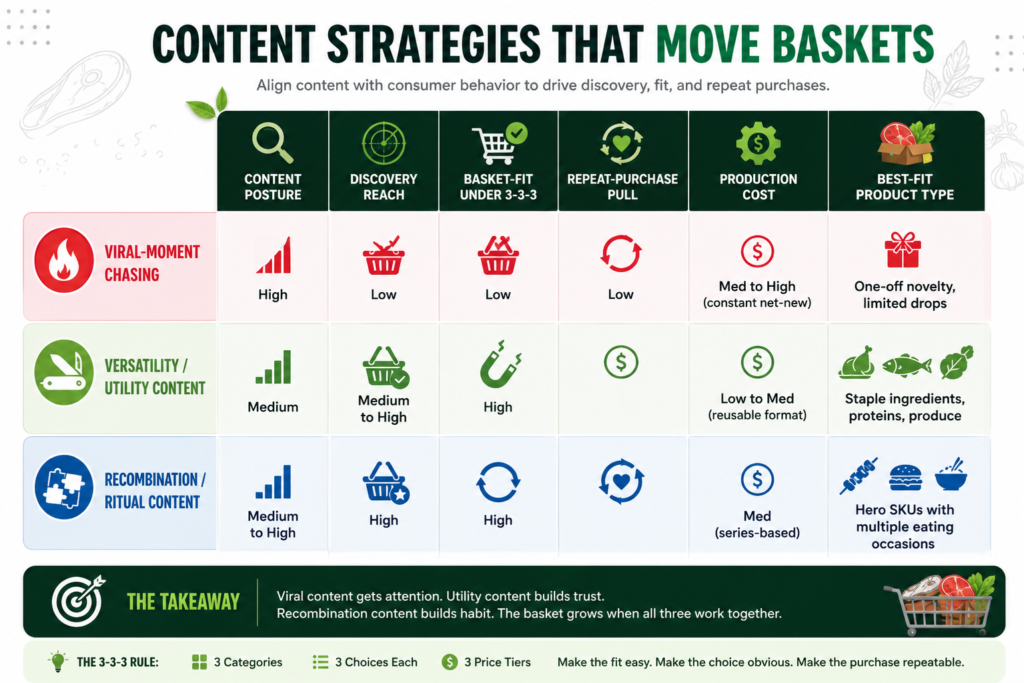
The table settles an argument brands keep having internally. Viral moment chasing buys the most reach and the least basket fit, which is fine if you sell limited drops and terrible if you sell a staple. For anything that needs to come back next week, recombination content is the only posture that scores high on the line item that matters, which is repeat purchase pull. We stopped briefing ‘make it go viral’ and started briefing show three ways to use it in one week. Same product, same budget. The reorder rate moved for the first time in a year. Reach was never our problem. Keeping people was.
| Content posture | Discovery reach | Basket-fit under 3-3-3 | Repeat-purchase pull | Production cost | Best-fit product type |
|---|---|---|---|---|---|
| Viral-moment chasing | High | Low | Low | Med to High (constant net-new) | One-off novelty, limited drops |
| Versatility / utility content | Medium | High | Medium to High | Low to Med (reusable format) | Staple ingredients, proteins, produce |
| Recombination / ritual content | Medium to High | High | High | Med (series-based) | Hero SKUs with multiple eating occasions |
None of this requires a bigger budget. It requires pointing the budget at the second purchase instead of the first, and building content that keeps proving its worth every time the shopper tightens the list.
Where Brands Get This Wrong
The most expensive Gen Z content strategy in 2026 is a full funnel discovery machine with no repeat purchase content behind it. You pay to fill a basket that gets edited empty the following week, and you call the spike a success because the spike is the only thing your dashboard was built to see.
The errors cluster into three failure modes:
- Optimizing for the algorithm at the cost of the second purchase. Reach metrics reward the spike. The reorder line rewards the habit. Teams that only report the first one keep winning the wrong game.
- Treating discovery and retention as separate briefs. When two teams own the two halves of one purchase, nobody owns the handoff, and the handoff is where the money leaks.
- Chasing trend cycles that compress faster than production can react. By the time the trend product ships, the discovery window has closed, and there was never a versatility story to keep it in the basket anyway.
There is a fourth mistake that deserves its own line, because it is the one finance usually reaches for first. When the basket tightens, the reflex is to discount your way back into it. That works for exactly as long as the promotion runs, then it trains the shopper to wait for the next markdown and quietly erodes the margin you were protecting.
Discounting is not basket fit. Cutting price to win a 3-3-3 slot buys a slot you have to keep re-buying, and it teaches Gen Z to value the discount over the product. The durable move is to earn the slot on utility, not to rent it on price.
There is a better way to defend margin than a race to the bottom, and it is worth studying the mechanics rather than assuming discounting is the only lever. Perishly’s analysis of how F&B brands protect margin during tariff inflation without race-to-the-bottom discounting walks through the paid media approach in detail, and the logic carries directly into the basket problem you hold price and win on demonstrated value, or you cut price and win nothing that lasts. The pattern underneath all four mistakes is the same. Each one treats the viral first trial as the finish line, when the 3-3-3 rule has quietly moved the finish line to the second purchase.
A 3-3-3-Proof Content Model
The fix is a sequence,not a slogan. Run these five steps in order, and each one has a clear owner and a clear output.
- Audit for the second purchase.
Pull reorder and repeat data on your last three high reach products. If reach outran repeat, you have a basket fit problem, not a discovery problem, and the rest of this model is where you fix it.
- Run the three use test on every hero SKU.
Document at least three distinct eating occasions per product before briefing any content. If you cannot name three, the product needs occasion development before it needs a video.
- Build recombination series, not one hit heroes.
Replace single viral swings with a same SKU,three occasion content set that proves versatility across the week, so the product keeps qualifying for the list.
- Instrument for repeat, not reach.
Add reorder rate and occasion coverage to the content dashboard alongside views. Reach is the cost of entry. Repeat is the win condition, and you cannot manage what you refuse to measure.
- Sequence discovery and retention as one brief.
Assign discovery content and repeat purchase content to the same owner, so the funnel stops handing off attention it then fails to keep.
Building content for how people actually discover and keep products is the same discipline in another channel — why farm brand storytelling is failing in AI search, and what to build instead. An operator can scan those five titles and find their own situation without reading the descriptions. That is the point. If step one already surfaces a repeat problem, you know the work is in steps two through five, not in buying more reach.
FAQs
Does going viral on TikTok actually grow a food brand?
Not on its own. Virality drives trial, but with Gen Z discovering products in under 30 minutes and editing baskets weekly under rules like 3-3-3, reach without a repeat purchase content plan often produces a spike and a flatline. Growth comes from converting that trial into a recurring basket slot.
How is the 3-3-3 rule changing what Gen Z buys?
It rewards versatile, reusable ingredients over single purpose novelty. Shoppers building a small basket of recombinable items favor products that stretch across multiple meals, so a product’s number of jobs now matters as much as its flavor or trend status when the list gets tight.
Should F&B brands chase food trends or build repeat purchase?
Both, but sequenced as one brief. Trend content earns discovery, and recombination and utility content earns the reorder. Brands that treat them as separate teams tend to pay for attention they cannot retain, because nobody owns the handoff between the two.
Why isn’t my viral product converting to reorders?
Usually because the content proved the product exists, not that it belongs in a weekly rotation. If your videos show one use, one occasion, one moment, they will not survive a shopper’s next basket edit under a 3-3-3 filter. Show three uses instead.
What content actually gets a product into Gen Z’s weekly basket?
Recombination series one SKU, multiple eating occasions, grocery haul integration, snack and late night occasions, and reuse focused user content. The unifying signal is versatility proof content that answers “what else does this do” before the shopper thinks to ask it.
Conclusion
The 3-3-3 rule did not arrive to punish brands. It arrived to help shoppers manage a basket that inflation made harder to fill, and in doing so it changed the rules of the game brands are playing. Discovery is now the easy, cheap, abundant part. The scarce thing is the slot on next week’s list.
That means the metric that deserves the top of the dashboard is no longer reach. It is the second purchase, and the content that earns it looks different from the content that earns a viral moment. Build for the shopper who already found you and is now deciding, on a Sunday, with a tighter list, whether you make the cut. Prove three jobs, hold your price, and let versatility do what discounting never could.
