
The middle market that built CPG empires for decades is collapsing. Premium and private label growth mask a structural crisis, mainstream brands squeezed from both ends. Here’s what the data shows, why it’s happening now, and which F&B brands are actually winning the bifurcation.
Your Playbook for a Market That No Longer Exists
Your mid tier brand’s playbook isn’t broken; the market it was designed for doesn’t exist anymore. For decades, the middle was where CPG brands built empires. A single product at a single price point captured 60-70% of category volume, with predictable margins and broad appeal. That reliable center is now under siege.
Retailers are reducing shelf space for mainstream products because premium offerings deliver higher rings and value options drive impressive turns. Your brand is caught between private labels undercutting on price and direct to consumer premium brands stealing affluent customers. You’re losing volume to both. This isn’t a marketing problem. It’s structural bifurcation.
Key takeaways:
- Middle market contraction is structural, not cyclical
- Private label and premium are growing, mainstream declining
- Dual track premium DTC + value variants outperforms single position strategy
The Middle Market That Built CPG Is Collapsing
For sixty years, the middle worked. A mainstream product at a mainstream price reached mainstream shoppers. The volume was predictable. Margins were stable. Retail shelf space was abundant. The formula was so reliable that most large CPG companies built their entire operational structure around it, manufacturing plants optimized for volume, supply chains built for predictable demand, and marketing campaigns designed for broad appeal. That structure is now working against them.
(cite index=26-1> Danone said the middle segment is a bit squeezed, while the low price segment and high price segment are both growing fast. This isn’t Danone specific. It’s the story across categories, frozen foods, dairy, processed snacks, beverages, pet food.
The middle segment of CPG is collapsing, forcing brands to rethink long held strategies. In some categories, mainstream SKUs are declining 5-7% annually, while value and premium variants are growing at double digits. Data on mainstream SKU decline and value/premium growth acceleration marketing formula 2. Recent CPG marketing analysis also points to the continued decline of the mainstream middle, with growth concentrating at the value and premium ends of the market. The squeeze isn’t uniform, which makes it more dangerous. Some categories bifurcate quickly, others take longer. But they all bifurcate.
Nestlé’s frozen food business in North America quintessentially mid range territory saw volume fall 5.8% in Q1 2024. That contributed directly to the company missing quarterly sales growth estimates. The CEO didn’t blame product quality or marketing. The problem was structural the middle shelf was shrinking.
Insight, Structural vs. cyclical. The middle market collapse isn’t temporary. It’s driven by permanent shifts in consumer behavior, K-shaped income, retail efficiency, profitable channel focus, and information access online price transparency. Brands betting the middle will return are making a strategic mistake.
The K-Shaped Consumer Who’s Trading Up, Who’s Trading Down
The reason the middle is collapsing is consumer bifurcation. Picture an economy divided into two trajectories, affluent households with asset growth and discretionary spending power, and lower income households facing persistent affordability pressure. This creates a “K” shape one segment accelerating upward, the other flat or declining.
According to the OECD and recent retail earnings commentary, value tiers continue to outperform in traffic among budget constrained shoppers, while premium SKUs are maintaining and expanding margin contribution among affluent consumers. two tier economy is reshaping food retail. Recent retail location data similarly describes a two tier food economy, with consumers increasingly separating into value oriented and premium oriented purchasing patterns.
Bifurcation of consumers and strategic implications for CPGs. The divide has tangible implications. Affluent consumers are increasingly purchasing premium brands. Lower income consumers are migrating to private labels. The middle pretty good at a fair price appeals to neither.
This plays out differently across categories. In pet food, the K-shaped effect is dramatic, super premium dog food is growing 7-10% annually while value segments decline. Why? Pet humanization. Affluent pet owners treat dogs like family members and are willing to pay premium prices for higher quality ingredients, fresh formats, and nutritional claims. Budget conscious pet owners stick with value brands or private labels. The middle mainstream pet food at mainstream prices is nobody’s first choice.
Same dynamic in premium beverages, specialty snacks, functional foods. The brands that win are either authentic premium clear ingredient story, premium retail positioning, DTC channels or engineered value supply private label, optimized for COGS, volume plays.
Red Flag, The middle lost appeal because it represents neither value private label offers better price nor premium DTC/fresh offers better quality/story. A product positioned as pretty good at a fair price has no buyer in a bifurcated market.
Why Private Label Is Winning While Mainstream Brands Lose
Private label is no longer store brand in the pejorative sense. Retail chains have invested billions in private label quality, and shoppers have noticed.
Private label brands reached 25.5% of sales last year, which amounted to over $200 billion. This is not a niche phenomenon. For budget conscious shoppers, private labels offer comparable quality at a 15-25% lower price. That price difference matters more than brand loyalty when household budgets are tight.
What makes this worse for mainstream national brands is that retailers have financial incentive to push private labels. Higher margins, better inventory control, direct customer relationships. Supermarkets are optimizing their shelves for profitability, not for national brand support. If private label pasta outsells mainstream pasta at better margins, guess which one gets the premium shelf space and promotional support?
Mainstream national brands are caught in the middle, too expensive compared to private label, not differentiated enough compared to premium DTC brands, losing shelf support from retailers who prefer private label margins.
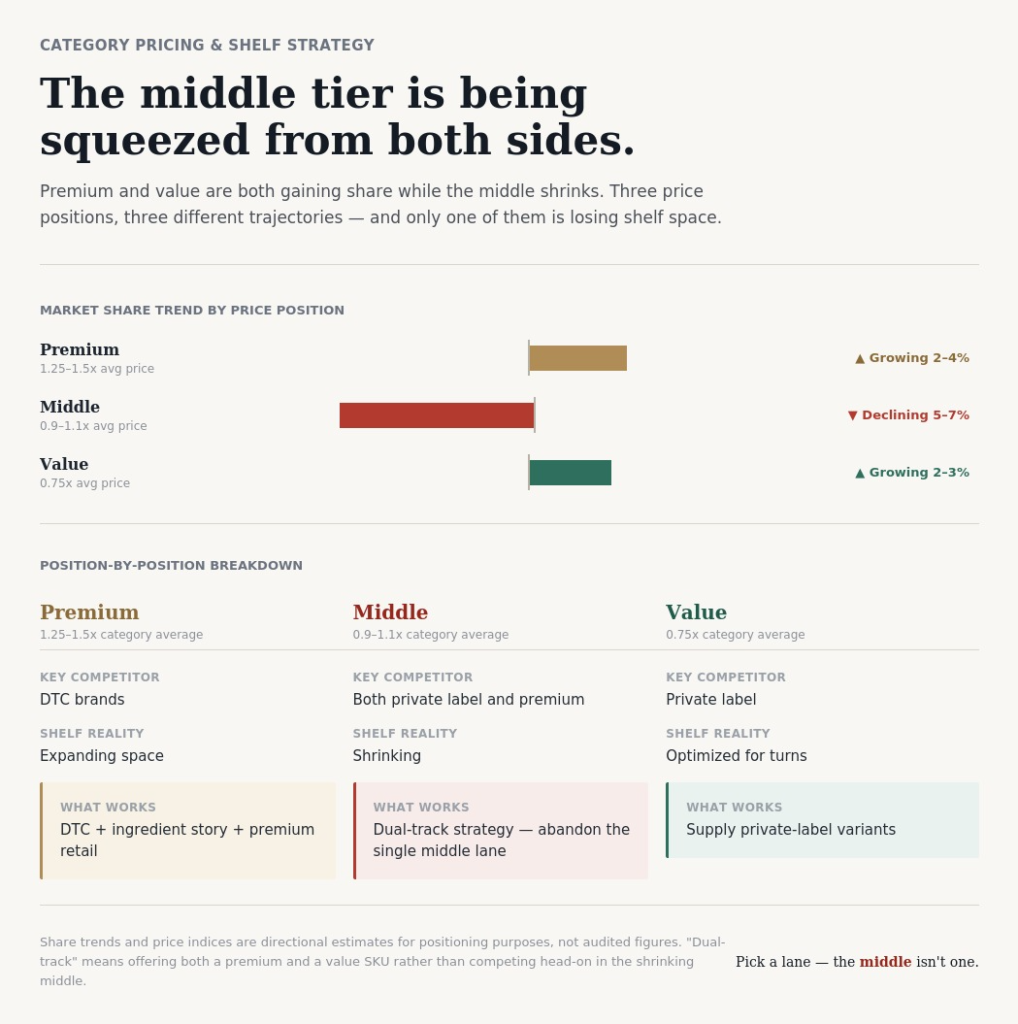
Market Position Reality Table:
| Position | Market Share Trend | Key Competitor | Shelf Reality | What Works |
|---|---|---|---|---|
| Premium (1.25-1.5x avg) | Growing 2-4% | DTC brands | Expanding space | DTC + ingredient story + premium retail |
| Middle (0.9-1.1x avg) | Declining 5-7% | Both PL and premium | Shrinking | Dual track strategy (abandon single) |
| Value (0.75x avg) | Growing 2-3% | Private label | Optimized for turns | Supply PL variants |
The Supermarket Shelf Strategy,Retailers’ Role in the Squeeze
Retailers aren’t neutral observers of bifurcation. They’re architects of it. Retail shelf optimization has become sophisticated. Supermarkets use AI-driven analytics to determine which products deliver the highest dollar per square foot of shelf space. Premium offerings often win because they have higher margin per unit. Value offerings win because they drive higher volume. Mainstream offerings struggle because they do neither particularly well.
Result:
Less shelf space for mainstream brands. More space for premium and value. Fewer promotional slots for mainstream. More for extremes. This accelerated during inflation and hasn’t reversed. Retailers learned that bifurcation focused category management is more profitable than balanced portfolios. They’re not going back.
For F&B brands, this means, If you’re competing in that middle, you need to assess your portfolio. Do you have something that can compete with private labels on price? Do you have a super premium offering? Because a mainstream only strategy is increasingly indefensible on retail shelves.
Super Premium Success,Brands That Moved First
The brands winning the bifurcation are the ones that moved first to premium positioning and built separate channels.
In pet food, super premium brands account for 19% of the US$27 billion dog food market. They’re growing 7-10% annually even as overall pet adoption stagnates. Why? Pet humanization. Younger pet parents treat dogs like family members and spend accordingly. Aggressive marketing by super premium brands has normalized the idea of feeding dogs fresh, high quality food the same way affluent owners feed themselves.
The infrastructure behind super premium success is critical, separate product lines, separate DTC channels direct to consumer via website + subscription, premium retail partnerships specialty pet stores, online only retailers, and marketing messaging that resonates with affluent consumers ingredient sourcing, nutritional science, sustainability.
Understanding the premium positioning foundation helps F&B brands identify where they have differentiation that justifies premium pricing.
Across food and beverage, the same pattern holds. Brands that built separate premium lines not just premium pricing on existing products and developed direct to consumer channels saw revenue growth and margin stability. Brands that tried to maintain mainstream position with premium pricing saw volume erosion and no margin lift.
Premium Insight, Super premium success isn’t about price alone. It’s about infrastructure, separate product lines, separate channels, and distinct marketing. Brands that tried to serve premium customers through mainstream retail distribution failed. Separation is the leverage point.
The Dual Track Strategy, How Winning Brands Are Responding
Here’s the strategic choice facing mainstream brands. You can’t defend the middle alone anymore. But you don’t have to choose between premium and value. You need both. Winning F&B brands in 2026 are implementing dual track strategies,simultaneously scaling premium DTC channels while supplying private label variants for mainstream retail. This looks like:
Premium Track, Separate product line with higher quality ingredients, premium positioning, sold primarily through DTC website and specialty retail. Higher margin per unit, lower volume. Target affluent consumers trading up.
Value Track, Engineered cost variants sold as private labels to major retailers. Lower margin per unit, higher volume. Target: budget conscious consumers trading down. Engineered value strategies require different product development, sourcing, and manufacturing optimization than premium lines.
This requires separate operating structures. Most mainstream brands tried to manage premium and value from a single team, with a single supply chain, a single P&L. That creates organizational gridlock, the team defending the value play conflicts with the team building premium. Pricing battles ensue. Product development gets caught in the middle pun intended.
Winning brands separated the operations. Two P&Ls. Two product teams. Two marketing teams. Two go to market strategies. The separation felt inefficient at first. It wasn’t. It allowed each track to optimize for its market without compromise.
The E-Commerce Accelerant, Why Online Is Amplifying Bifurcation
E-commerce is making bifurcation worse and faster. ecommerce solutions, which increase convenience and price transparency, are driving 35% of the food and beverage dollar sales growth, even though they only hold a 10% market share. That gap signals where growth is concentrated.
Online shopping exposes the middle to direct price comparison. A consumer sees your mainstream product at $9.99 on Amazon, private label at $7.99 on Walmart’s website, and your premium variant at $19.99 on your DTC site. Suddenly, the middle position of $11.99 on your brand’s site offers no reason to buy. It’s more expensive than private labels and less premium than your own premium offering.
Retailers understand this and are using online to accelerate their shift away from middle SKUs. Amazon and Instacart put best-sellers front and center. Value and premium outperform mainstream in algorithmic recommendations. Mainstream products get buried.
Online first distribution strategies are becoming table stakes for premium and value plays. Mainstream only brands that haven’t developed separate online strategies are falling further behind.
eCommerce Reality, Online price transparency kills the middle position. When consumers see all options at once, the middle offers no differentiation. Your margin protection depends on channel separation premium DTC, value supply to retailers and algorithmic discoverability. Single channel mainstream positioning is increasingly indefensible.
Evaluating Your Brand, Are You Stuck in the Middle?
Three diagnostic questions:
1. Is your core SKU declining 5%+ annually?
This is the first signal. If volume is dropping faster than inflation, bifurcation is affecting you. This assumes you’re not cutting prices. If you’re maintaining price but losing volume, that’s bifurcation driven loss.
2. Are you losing customers to both premium competitors AND private labels simultaneously?
Track where your former customers went. Are some trading up to premium DTC brands or fresh format competitors? Are others trading down to private labels? If you’re losing to both, you’re caught in the squeeze.
3. Is your retailer reducing shelf space and promotional support?
Retailers optimize for efficiency. If your shelf allocation is shrinking while private label and premium grow, retailers have decided your middle position isn’t profitable. This is the final warning sign. If two of three are true, you’re experiencing bifurcation. The question then becomes: Do you have the execution speed and organizational will to implement dual track strategy?
The Speed Factor, Why Execution Matters More Than Strategy Choice
Here’s the thing most strategic advice misses, The best strategy choice doesn’t matter if you execute too slow. Bifurcation accelerates. Retailers make category decisions quarterly. Consumers shift spending monthly. Competitors respond weekly. Brands still operating on annual planning cycles are already behind. Winning brands in 2026 adjusted strategy quarterly, reviewed P&L monthly, and changed pricing/assortment in real time based on market response. They could say this isn’t working after a month instead of waiting six months to see quarterly results.
This requires organizational flexibility that mainstream CPG structures don’t have. But it’s the actual competitive advantage separating winners from losers not whether premium or value was chosen, but how fast it was implemented and adjusted.
F&B Portfolio Architecture for Bifurcation
The technical work of dual track strategy involves portfolio redesign, supply chain optimization for parallel production, and distinct go to market models. Channel specific pricing strategies become critical when managing premium DTC alongside value private label supply.
FAQS
How do I know if my brand is actually stuck in the middle?
Three signals: (1) Volume declining 5%+ annually while maintaining price,
(2) losing customers to both premium and private label simultaneously,
(3) retailers reducing shelf space while expanding premium and value sections.
Two of three = bifurcation diagnosis.
Should I move to premium or value?
Don’t choose. Dual track (premium DTC + value supply) outperforms single position strategy. The mistake is either/or thinking instead of both/and. Separate the operations and compete on each turf.
How fast do I need to move?
Faster than annual cycles. Bifurcation accelerates quarterly. Competitors adjust monthly. Brands still making annual decisions are behind. Successful responses involve quarterly strategy adjustments and real time pricing/assortment changes.
Can I defend my middle position with better marketing?
Not reliably. Marketing can’t overcome structural market forces K-shaped consumer, retail efficiency, price transparency. Better ads don’t solve the core problem. You need product and distribution change.
What happens if I don’t move to premium or value?
Volume erosion accelerates. Retailers reduce shelf space. Margins compress. Your brand becomes residual neither premium enough to command price nor value enough to drive volume. Slow irrelevance is the default outcome.
Conclusion
The middle market that built CPG empires for decades no longer exists as a reliable foundation for F&B brands. Bifurcation is structural, not cyclical. It’s driven by K-shaped consumers, retail efficiency optimization, and online price transparency. Brands that treat the middle as a defensive position are losing. Brands that treat it as a transition zone moving capital and attention to premium DTC and value supply simultaneously are winning.The data is clear. The strategic choice is clear. What separates winners from losers is execution speed. Your playbook needs updating. Not because the market changed. Because it transformed.
