
Your dairy products never touched H5N1. You operate in a region with zero confirmed cases. Your supply chain is clean. And yet your customer trust just took a hit you didn’t cause and can’t defend against. That’s the trust environment created by the March 2024 H5N1 outbreak in dairy herds, the first bird flu transmission to cattle in U.S. history. Sixteen states were affected. Over 800 herds. 36% of retail milk samples testing positive for viral RNA by April 2024. None of it involved your farm. All of it reshaped how consumers think about “dairy” as a category.
- 800+ Herds Confirmed H5N1 infections across 16 U.S. states from March 2024 through February 2025, with 10–20% infection rates within affected herds
- 36% Of retail pasteurized milk samples tested positive for H5N1 RNA in April–May 2024, though zero viable virus was detected after pasteurization
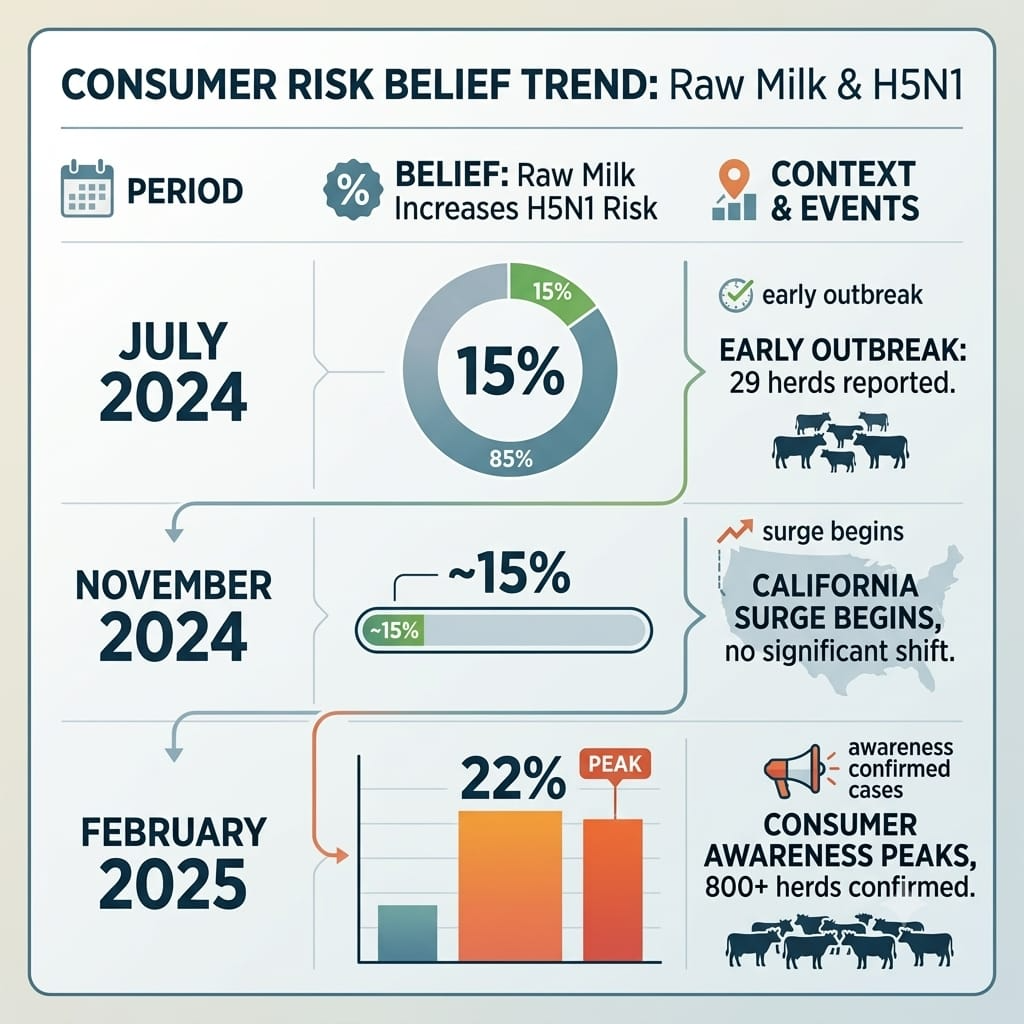
- 22% Of U.S. consumers now believe drinking raw milk increases bird flu risk, up from 15% in July 2024, reflecting a 47% increase in consumer anxiety
- $80 Million In federal relief payments issued to dairy producers by January 2025 for milk losses, testing, and containment due to H5N1
Key takeaways:
- Trust damage is categorical, not regional even unaffected producers face consumer skepticism about dairy safety across all segments
- Transparency through supply chain traceability, testing protocols, and regional safety documentation is the fastest path to trust recovery
- The raw milk category was disproportionately hit, pasteurized positioning became a competitive advantage, but only when backed by verifiable data
The H5N1 Outbreak, Scale, Timeline, and Why It Spread
On March 25, 2024, USDA confirmed the first ever case of H5N1 bird flu in a U.S dairy herd, an unprecedented spillover event that scientists weren’t prepared for. The virus, normally associated with birds, had never before infected cattle at scale. When veterinarians first saw the symptoms in Texas herds decreased milk production, thickened milk, gastrointestinal distress, they didn’t immediately recognize it as influenza because the virus behaved differently in cows than it does in birds.
By April 12, only 29 cases were officially reported. By December 2024, that number had exploded to over 800 confirmed herds across 16 states. California became the hardest hit region, accounting for more than 75% of national cases by December.
The virus spread through cattle movements, contaminated equipment, and environmental transmission likely through water sources or surfaces exposed to infected bird droppings from wild waterfowl, the natural reservoir. Within each affected herd, 10–20% of cattle showed symptoms. Remarkably, there was little to no associated mortality, the disease was debilitating, not lethal.
But here’s where the story takes a trust turn, human spillover begins immediately. Dairy workers exposed to infected cattle developed conjunctivitis, eye inflammation and mild respiratory symptoms. By February 2025, 65+ human cases had been confirmed. The good news for public health, all cases were mild. The bad news for trust: the media coverage was not mild.
Why H5N1 in dairy is unprecedented and why the surprise makes it newsworthy. For 30+ years, H5N1 had infected only birds and caused rare spillovers to humans and other mammals. The jump to dairy cattle was novel enough to break through news saturation. The fact that experts didn’t immediately recognize it elevated alarm, if veterinarians missed it, what else were they missing?
How One Regional Crisis Became a National Trust Problem
The outbreak started regionally. Texas, New Mexico, Kansas, and California were the primary zones. That should have been the trust boundary, a regional story, relevant to producers and consumers in affected areas. Instead, it became a categorical crisis.
The shift happened in April 2024, when 36% of retail pasteurized milk samples tested positive for H5N1 RNA across 13 states. The finding was scientifically sound: viral RNA fragments of dead virus, inactivated by pasteurization, were detectable in a third of all tested samples. But the public narrative became that one third of milk is contaminated. That’s not what the data said, but that’s what consumers heard.
A consumer in New York or Florida or Minnesota reading 36% of milk samples test positive for bird flu doesn’t think RNA fragments inactivated by pasteurization. They think my milk might have bird flu. Geographic location becomes irrelevant in that psychology. The category dairy becomes the threat.
From that point, milk buying behavior changed nationwide. Raw milk producers, who had operated in a niche market for wellness focused consumers, suddenly faced existential demand destruction. Pasteurized milk retained volume, but consumer confidence eroded even though safety remained unchanged. The trust crisis became decoupled from actual exposure risk and tethered to category anxiety. This is why understanding the role of transparency in building DTC dairy market share became critical not just for marketing, but for operational survival.
The trust gap. Why pasteurization science didn’t stop consumer fear, Federal agencies and FDA consistently repeated that pasteurization inactivates H5N1, that no viable virus had been detected in any tested sample, and that the commercial milk supply was safe. The science was clear. The messaging was consistent. Consumer belief remained skeptical. This is the trust paradox, scientific reassurance doesn’t dismantle category level anxiety once it forms.
Consumer Perception Shift, What Changed in 10 Months
In July 2024, three months after the outbreak, the Annenberg Public Policy Center surveyed Americans on H5N1 risk perceptions. Fifteen percent believed drinking raw milk increased bird flu risk.
In November 2024, midway through the California surge peak month for new detections , perception remained stable at around 15%.
In February 2025, one year into the outbreak, the same researchers surveyed again. Twenty two percent now believed raw milk posed H5N1 risk. That’s a 47% increase in concern in just four months.
What changed between November and February? Public awareness. Media attention peaked in December California case spike, sustained through January farm worker cases, and had time to consolidate consumer belief by February. The outbreak wasn’t accelerating, consumer psychology was catching up.
Parallel to that concern, massive knowledge gaps persisted. A majority of U.S. adults (56%) correctly knew that raw milk is less safe than pasteurized milk, but over 4 in 10 Americans either unsure 25%, thought raw milk was just as safe 12%, or believed it was safer 6%. The asymmetry is stark, half the country knows the hierarchy, half doesn’t. Among the uncertain half, H5N1 became a focal point for broader doubt about dairy safety.
For raw milk producers specifically, the impact was acute. One California dairy reported retail raw milk production peaking at 86,000 gallons per week before the outbreak. During quarantine periods November 2024–January 2025, when H5N1 was detected in bulk tank samples, that production was diverted to pasteurization as a regulatory containment measure. The market didn’t just shrink it was forcibly restructured.
Pasteurization Science, What the Research Actually Shows
The scientific evidence on pasteurization’s effectiveness against H5N1 was rapid and rigorous. In April–May 2024, CDC researchers conducted the first retail milk surveillance. 168 unique pasteurized samples from 13 states. Result, 36% contained H5N1 RNA evidence the virus was present in milk. But when those same samples were tested for a viable infectious virus, none was found. The RNA fragments were dead, inactivated by the pasteurization process.
FDA escalated testing immediately. From June–July 2024, they tested 167 manufacturer blinded retail dairy products (milk, cheese, butter, ice cream, aged raw milk cheese) collected from multiple states. All 167 samples tested negative for viable H5N1. Zero. By December 2024–January 2025, CDC expanded surveillance to 477 samples across 25 states. The pattern held, improved detection of viral RNA showing the outbreak’s true geographic spread, zero viable virus in pasteurized products.
The science is unambiguous: Grade A, Pasteurized Milk Ordinance (PMO) requirements inactivate H5N1. High temperature short time HTST pasteurization the industry standard was explicitly validated against H5N1 in controlled studies. But here’s where science met psychology. When the FDA announced results showing viral RNA in milk even though it was dead, headlines read Bird Flu Found in Retail Milk. The caveat but pasteurization kills it landed in the second paragraph, if at all.
Raw milk posed a different risk profile. Cornell University research showed that H5N1 remains viable in refrigerated raw milk for weeks. Mouse studies conducted at NIH showed that mice fed infected raw milk developed systemic infection within 24 hours. The virus survived the digestive tract and spread through the body. That finding was genuine; the risk differential was real.
Zero viable virus in 464+ pasteurized samples why science says commercial milk is safe, but consumers doubt it. The credibility gap isn’t about the science, it’s about how risk gets communicated when anxiety is elevated.
Raw Milk Category Impact, A Case Study in Market Disruption
Before H5N1, raw milk occupied a wellness niche marketed as nutrient dense, enzyme rich, and positioned by producers who believed pasteurization was destructive to milk’s nutritional profile. Understanding the regulatory requirements for selling raw milk online was already complex before the outbreak. H5N1 added consumer skepticism to the regulatory burden. The outbreak changed that positioning overnight.
Raw milk went from premium and safe to risky in the media narrative. That California dairy we mentioned producing 86,000 gallons per week faced state quarantine orders in November 2024 when H5N1 was detected in bulk tank samples. The regulatory response was protective, diverting milk to pasteurization to prevent risk. But the market impact was existential. Retail raw milk sales collapsed during quarantine periods.
What makes this a trust case study is that raw milk consumers, the most engaged and informed segment of dairy consumers, were caught in a trust inversion. They had chosen raw milk believing it was safer and more nutritious than pasteurized. H5N1 data suggested the opposite for infectious risk. The dissonance was severe.
For DTC operators selling pasteurized milk, the raw milk market disruption created an unexpected competitive opportunity. But it also spreads reputational damage. If one milk category was risky, were all dairy categories risky? Consumers didn’t make fine distinctions, they updated their beliefs about dairy as a risk category. This uncertainty extended to all value added dairy products, from bottled milk to Artisan cheese, where supply chain clarity becomes a differentiating factor.
Trust Rebuilding Framework for DTC Dairy Brands
Trust recovery isn’t about defending industry narrative. It’s about owning your specific supply chain story. Here’s a three part framework:
Part 1. Affirmative Transparency (Not Defensive):
Don’t say we weren’t affected. That implies others were and reinforces category anxiety. Instead, be specific. Our milk is sourced from [region/farm], tested on schedule, and pasteurized to Grade A PMO standards using HTST protocols. Compliance with dairy standards of identity is baseline, transparency about sourcing is your differentiator. Make your supply chain verifiable. Publish:
- Which FMMO region(s) you source from with H5N1 status
- Your testing frequency if beyond industry baseline
- Your supplier relationships names and transparency commitments
- Pasteurization protocols specific time/temperature
Transparency isn’t about proving safety that’s regulatory. It’s about demonstrating you have nothing to hide and everything documented.
Part 2. Science Backed Positioning:
Lead with pasteurization effectiveness using FDA validated data, not industry claims. Link to primary sources (CDC, FDA) rather than dairy industry associations. Let the science do the speaking.
For raw milk producers specifically, address risk transparently. Don’t pretend concern doesn’t exist. Say, Raw milk carries higher pathogen risk than pasteurized milk. We source from [region], test protocol, and customers are fully informed of risks and benefits. Transparency about risk builds more trust than denying risk exists.
Part 3. Operational Confidence Signals:
Beyond H5N1 specific protocols, document your cold chain operations, storage conditions, and shipping protocols. Understanding and communicating your full dairy operational and supply chain model builds confidence that extends beyond bird flu to broader food safety.
Highlight certifications orthogonal to H5N1 organic, grassfed, Demeter, etc. These don’t protect against bird flu specifically, but they signal quality commitment and operational discipline. Invest in customer education, blog content, FAQ pages, transparency hubs where customers can verify your claims.
Pre-Purchase Consumer Objections and Your Response
Objection 1. Isn’t all dairy exposed to bird flu now?
Response, H5N1 is confirmed in specific herds in 16 states California, Texas, Michigan, and 13 others. Our supply chain is [your region], with zero confirmed cases as of date. We also test your protocol beyond baseline. FDA confirms zero viable virus in 464+ pasteurized samples nationwide. If you source dairy across state lines, understanding interstate dairy shipping regulations ensures compliance and customer confidence in supply chain safety.
Objection 2. Should I switch to raw milk because pasteurization damages nutrients?
Response, Pasteurization heats milk to 161°F for 16 seconds HTST standard. This inactivates viruses and pathogens while preserving protein, fat, calcium, and most vitamins. Raw milk poses higher pathogen risk not just H5N1, but Salmonella, E. coli, Listeria. FDA data from 2024 confirms this safety differential. Choose based on informed preference, not misperception about risk.
Objection 3. Why should I trust your milk when 36% of retail samples were contaminated?
Response, That 36% finding was RNA detection dead virus killed by pasteurization. The same study found zero viable virus in any pasteurized sample. FDA tested 464 additional samples, all negative for viable virus. Your milk is pasteurized to the same PMO standard, validated by federal testing.
Objection 4. Organic/grass fed dairy is safer than conventional?
Response. Farming practice doesn’t predict bird flu exposure. H5N1 affected both organic and conventional herds in California. Safety depends on sourcing location, testing protocols, and pasteurization effectiveness not farm type. Organic and conventional dairy offer different benefits, neither has inherent H5N1 advantage.
FAQS
My region has zero H5N1 cases. Do I need to change my messaging?
Yes. Consumer trust is categorical, not regional. Even unaffected producers face skepticism. Lean into transparency: where your milk comes from, how it’s tested, how it’s pasteurized. Make your specific supply chain story clear and verifiable. Silence on H5N1 creates a vacuum consumers fill with worst case assumptions.
Should I emphasize pasteurization more aggressively to differentiate from raw milk?
Strategically, yes. Pasteurization was revalidated by FDA (zero viable virus in 464+ samples). It’s now a competitive advantage. But frame it as safe, nutrient preserving processing, not as a defensive response to scare. Lead with product quality; follow with process transparency. Pasteurization isn’t a concession, it’s a competitive feature backed by federal research.
How do I talk to customers about raw milk safety without sounding anti raw milk?
Acknowledge the real science, raw milk can carry H5N1 detected in April 2024, pasteurization inactivates it (FDA confirmed) neither is an opinion. If you sell raw milk, own the conversation. Raw milk carries higher pathogen risk we source from safe regions, test protocol, and customers are informed. Transparency beats silence
What’s the long term trust impact? Will this fade?
Consumer perception takes 18–24 months to revert once shifted. H5N1 is still active February 2025, so concern will persist. Build trust infrastructure now supply chain transparency, testing protocols, customer education that works long term, whether H5N1 ends next year or continues. This is not a crisis response message, it’s an operational upgrade.
My costs went up due to testing and transparency protocols. How do I price this?
Transparency is a premium positioning signal. DTC customers who prioritize safety and supply chain clarity will pay for it. Price the transparency as part of your value proposition: Sourced from a trusted region, tested by protocol, made with process. Justify cost through specificity, not apology. The customer willing to pay premium DTC prices is exactly the customer who values verified safety claims.
Conclusion
The H5N1 outbreak didn’t damage your milk supply if you were in an unaffected region. But it reshaped the environment your customers navigate when buying dairy. Consumer anxiety about dairy safety became categorical, not geographic. That’s the new operating context.
Trust recovery requires three moves, affirmative transparency to make your supply chain verifiable, science backed positioning link to FDA/CDC validation, not industry assurance, and operational confidence signals document protocols beyond baseline, and invest in customer education.
The operators rebuilding fastest are those who treat H5N1 not as a crisis to defend against, but as an inflection point to own. Transparency around supply chain costs builds trust and supports premium positioning not because your customers fear H5N1 specifically, but because they’ve learned to demand clarity about where food comes from and how it’s processed.
The outbreak is still active. Consumer psychology is still settling. The window to build your supply chain story is now before trust defaults to doubt and another operator owns transparency in your category.
