
Record breaking sales are real. But 70% of growth is concentrated in just three platforms. Here’s how to evaluate whether you should prioritize Walmart, Amazon, Instacart, or a blend and what it costs to compete on each. Your competitor just landed a Walmart grocery ecommerce account. They’re now competing for shelf space in digital aisles that reach 61% of American households.
Meanwhile, your brand is still split across a few regional accounts and a direct to consumer channel that’s hitting a ceiling at $2 million annual revenue. The August 2025 online grocery market reached $11.2 billion, a record but the growth isn’t distributed evenly. Walmart, Amazon, and Instacart are capturing the lion’s share, and the math of entry, platform fees, and required supply chain investment is forcing smaller F&B brands to choose which platform to prioritize.
- $11.2B U.S online grocery sales in August 2025, marking 14% year over year growth and a new monthly record.
- 61% Percentage of American households 148 million people who have purchased groceries online as of mid 2025.
- $452B Projected total online grocery sales by 2028, up from approximately $230 billion in 2025 (11.6% annual growth rate).
- 3 platforms Walmart, Amazon, and Instacart account for approximately 70% of all online grocery sales growth.
Key takeaways:
- Platform choice is not one size fits all, Walmart, Amazon, and Instacart serve fundamentally different grocery shopping behaviors.
- Online grocery penetration is now 61% of households, regional only distribution is no longer a sustainable brand strategy.
- Retail media Walmart Connect, Amazon DSP, Instacart Ads is now table stakes for online grocery brands;, organic visibility alone is insufficient.
The August 2025 Record What’s Actually Driving Growth
The $11.2 billion figure is real, but the composition matters more than the headline. Delivery surged 30% year over year to hit $5.0 billion in sales, now accounting for 45% of total e-Grocery spend. Ship to home grew 19% YoY to reach $2.1 billion, while pickup slipped slightly, down from $4.3 billion last year to $4.1 billion, representing 36.5% of sales.
This shift tells a story. Consumers are choosing convenience delivery to their door over friction like driving to a store for pickup. But they’re also more willing to wait two to three days for ship to home delivery than they were in 2023 or 2024. Cold chain logistics have improved dramatically. Trust in shipped produce, meat, and dairy has grown. For F&B brands, this means the platforms optimize for delivery speed. Amazon, Instacart, DoorDash are capturing disproportionate growth. Walmart, historically strong in pickup, is being forced to invest heavily in last mile delivery to compete.
Fulfillment shift takeaway, If your supply chain is designed around store pickup, you’re already behind. Delivery-optimized logistics regional distribution centers, partner networks that can access orders within hours are becoming the operational baseline.
The overall monthly average user base for e-grocery expanded by 1% in August 2025. The gain came largely from re-engagement of infrequent or lapsed customers and year over year penetration gains in 18-29 and 45-60 age groups. Delivery’s monthly average user base reached a record high, jumping 11% in August, driven by strong gains in the 18-29 and 30-44 age groups.
For F&B brands, this consumer adoption pattern is critical. Younger shoppers are becoming heavy online grocery users, not just young professionals. Older consumers 45-60 are also adopting. This isn’t skewed toward a single demographic anymore. It’s broadening.
Platform Dynamics Walmart vs Amazon vs Instacart Economics & Audience
These three platforms operate on fundamentally different economic models, serving different shopper behaviors and requiring distinct operational approaches from F&B brands.
Walmart The Daily Essentials Player:
Walmart generated $87.5 billion in food and beverage sales in Q3 2025 alone dwarfing Amazon’s $11.9 billion in the same period. Walmart’s ecommerce business has grown 116% since 2022, nearly double Amazon’s rate. Digital now represents almost one fifth of Walmart’s total U.S revenue.
The Walmart model is built on store fulfilled pickup and delivery. You don’t ship from a warehouse to your customer. A Walmart associate picks your product from a physical store shelf and delivers it, or the customer picks it up at the store. This model has three implications for brands:
- Shelf position matters more than digital visibility, Your physical SKU location in a Walmart store directly impacts online discoverability and picker efficiency. A product buried in the back corner gets picked less frequently, creating friction that translates to lower online velocity.
- The supply chain must be optimized for store delivery. You need consistent stock status, accurate inventory data feeds, and packaging that withstands handling. A stock out in store becomes a stock out online. An overstock becomes a clearance opportunity on both channels simultaneously.
- Margin compression is real. Walmart’s fulfillment costs are lower than Amazon’s, but competitive pressure means promotions and co-op fees eat margins fast. Walmart is also demanding. FSMA 204 compliance, EDI integration, sophisticated demand forecasting. Brands that can’t meet these requirements don’t get shelf space.
Walmart opportunity, if your product is impulse driven, replenishment driven, or high velocity staple, Walmart’s daily habit shoppers represent massive scale. Walmart’s advertising platform Walmart Connect is now a $5 billion plus business. Brands using it strategically see measurable incremental sales lifts. The key is treating Walmart as a long term customer acquisition channel, not just a transactional vendor relationship.
Amazon, The Infrastructure Play:
Amazon dominates in logistics but underperforms in grocery relative to its overall retail business. Amazon Fresh struggled for years and was recently deemphasized in favor of leveraging Whole Foods and Amazon’s broader ecommerce fulfillment network.
The Amazon model is capital intensive. You either use Amazon Fresh’s limited store presence, leverage Whole Foods’ premium positioning, or use Amazon’s general marketplace for ship to home CPG and specialty food sales. For mainstream F&B brands, this means you’re competing in a channel where Amazon takes 15-45% commission depending on category and fulfillment, and you’re often shipping against Amazon owned private labels that undercut your pricing.
The upside is real, Amazon’s audience is affluent, willing to pay for speed, and price insensitive on premium products. Fresh and Whole Foods shoppers skew toward health conscious, organic seeking consumers who trade up in price. For beverage brands, specialty foods, and premium categories, Amazon represents a fast growing channel with less price compression than traditional grocery.
Instacart, The Marketplace Layer:
Instacart operates as a concierge layer on top of 600+ retail partners. Whole Foods, regional grocers, specialty chains. It doesn’t own the stores or logistics. Instead, shoppers select items from partner stores, and Instacart’s network picks and delivers them.
Instacart’s upside, it reaches consumers across dozens of retail partners, not just a single brand’s retail footprint. If your product is stocked in regional chains, Instacart can aggregate those opportunities into a single digital storefront. A brand with products in Kroger, Safeway, and independent natural food stores gets discovered through Instacart without adding new retail accounts.
The downside is clear, you’re competing on price and reviews across 600 plus retailers with different pricing and promotional strategies. Instacart Ads Instacart’s retail media platform, is growing fast, but ROI is harder to isolate than Walmart Connect.
Platform comparison reality, Market share estimates vary because ecommerce is an unmeasured channel not captured by traditional scan data. But consensus from FMI and NielsenIQ’s revised sales estimates shows online sales will reach $363 billion this year, up 4% from projection in last year’s digital trends report, with online grocery sales projected to total $452 billion by 2028, driven by rapid growth of omnichannel shopping, indicates that Walmart is gaining share fastest in pickup and delivery, Amazon is holding steady in ship to home and Fresh/Whole Foods, and Instacart remains the largest third party fulfillment player.
Fulfillment Methods & Supply Chain Implications
The August data showed a clear trend, delivery is now 45% of online grocery sales, egrocery sales trends and it’s growing fastest. This has operational consequences for every F&B brand.
Delivery 45% of sales, +30% YoY growth. Delivery requires cold chain discipline if your product is perishable. Walmart, Amazon, and Instacart all use third party logistics networks. Shipping times are now averaging two days versus three to five days in 2023. Packaging must protect the product through two plus days of temperature variance. Returns and damage claims eat margin if execution is loose.
For your supply chain, you need real time inventory visibility, fast replenishment from distribution centers near major metro areas, and the ability to forecast demand by region. Delivery patterns vary geographically. Urban areas get next day service. Suburban areas get two days. Rural areas may not be serviceable at all through delivery channels.
Pickup 36.5% of sales, -4% YoY, Pickup’s decline is real, but it’s not disappearing. Walmart is still the dominant player here. The advantage for brands is lower fulfillment cost, no shipping damage, and high conversion once the customer is in store. Your product’s shelf position and promotional strategy must be aligned between physical and digital channels. A product on sale in store but full price online creates confusion and lost sales.
Ship to Home 18.5% of sales, +19% YoY, Ship to home is Amazon’s strength, and it’s growing fastest. The model works best for shelf stable foods, beverages, and specialty items. Margin is tight because Amazon takes 15-45% commission, but the audience is large and national. Brands competing in beverage and packaged food categories should treat ship to home as a long tail discovery channel, not a primary revenue driver.
The Retail Media Trap, Why Advertising Is Now Mandatory
Here’s a hard truth, organic visibility on Walmart.com, Amazon Fresh, or Instacart is nearly nonexistent for new or unfamiliar brands. Algorithms prioritize bestsellers, high rated products, and brands willing to advertise. For most F&B brands, this means you can’t enter a platform and expect to sell without paid support.
Walmart Connect allows you to bid on search terms, sponsor shelf placements, and retarget shoppers. ROI varies, but brands report three to five times ROAS return on ad spend when campaigns are well structured.
Amazon DSP Demand ide Platform uses Amazon’s first party audience data to target shoppers across Amazon properties and third party sites. It’s powerful but requires sophisticated setup and ongoing optimization.
Instacart Ads lets brands bid for search placements on the Instacart platform. It’s newer and less mature than Walmart Connect, but growth is accelerating.
The math is brutal, a small F&B brand entering Walmart or Amazon should budget $5,000-$20,000 per month in retail media to gain traction, acquire customers, and build reviews. This is on top of COGS, packaging, logistics, and platform fees. Understanding paid media dynamics and margin protection is essential before committing to platform expansion.
Retail media reality, Brands that don’t invest in platform advertising are invisible. Brands that do invest often operate on thin 5-15% net margins after all costs. The platform economics reward scale and efficiency, not sentiment or brand heritage.
Category Specific Opportunities
Not all categories are winning equally on online grocery. Fresh & Perishable 41% of online grocery market share, Fresh produce, meat, seafood, and dairy are now 41% of online grocery sales, a dramatic shift from early skepticism about shipping perishables. Cold chain improvements and trust building have unlocked this category. Brands in these categories are well positioned on Walmart’s strong cold chain infrastructure and Instacart partnered with specialty grocers who prioritize fresh.
Beverages fastest growing food category. Beverages lead food category growth on online grocery, followed by meat, coffee, and prepared foods. Beverages benefit from high repeat purchase rates and impulse friendly digital placement. Unlike produce, beverages have long shelf life, predictable unit economics, and strong margins. Beverage brands discovering Gen Z consumers through content and digital platforms have natural advantages in online grocery.
Packaged & Convenience Foods These are growing at 19.6% CAGR through 2030. Bulk ordering, long shelf life, and subscription potential make this category attractive on Amazon and Instacart. Snacks, coffee, pantry staples items people reorder monthly perform best.
Specialty & Premium Amazon and Whole Foods are winning here, tariff driven food price inflation consumer buying groceries online are 30% more likely to trade up in price than in-store shoppers. If your product commands a 20-30% price premium, online grocery is a strong channel for customer acquisition.
Entry Costs, Platform Fees & Margin Math
This is where many brands get stuck. The math is brutal if you’re not prepared.
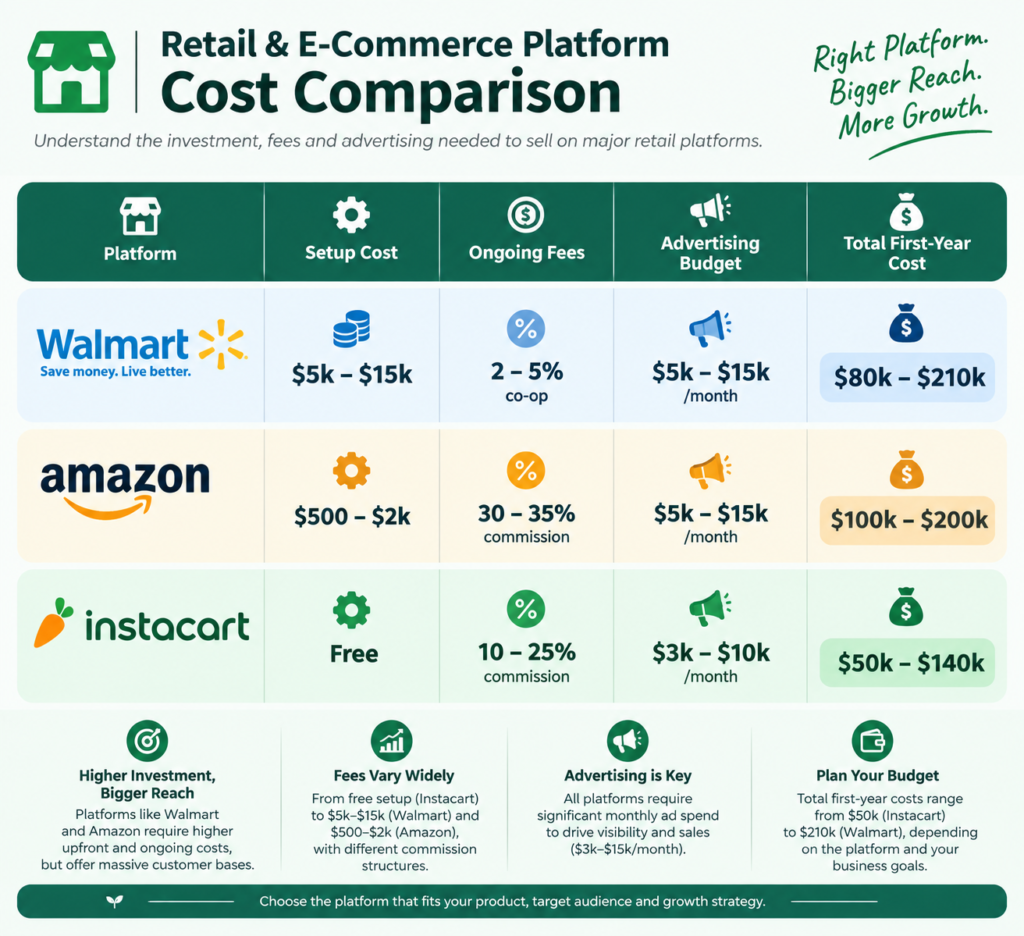
Walmart Entry & Ongoing Costs Supplier account setup costs $5,000-$15,000 third party service. You must meet Walmart’s EDI and traceability standards including FSMA 204 compliance. Co-op fees and advertising run 2-5% of wholesale revenue. Slotting allowances cost $500-$2,000 per store for initial placement. Ongoing volume rebates often take 1-3% of sales if you don’t hit targets. For a $500,000 annual Walmart grocery account, budget $15,000-$25,000 in fees before you sell a single unit.
Amazon Entry & Ongoing Costs Seller Central setup is minimal $39 per month for professional selling. Amazon commission ranges 15-45% depending on category groceries and CPG typically runs 30-35%. Fulfillment fees run $0.20-$1.50 per unit depending on weight and size. Advertising minimum is $2,000-$10,000 per month for visibility. Budget 2-5% of sales for returns and chargebacks. For a $500,000 annual Amazon account, expect 45-55% of gross revenue to go to Amazon across commission, fulfillment, and advertising.
Instacart Entry & Ongoing Costs Instacart Seller setup is free, but requires API integration and technical overhead. Commission runs 10-25% depending on partner retailer and negotiation strength. Promotional funds are expected, $3,000-$10,000 per month for co-op support. Instacart Ads budget $2,000-$5,000 per month to gain visibility.
For a $500,000 annual Instacart account across partner retailers, expect 25-40% blended take rate after all costs. Margin reality. If your product has a 40% gross margin common for food brands, entry into all three platforms simultaneously leaves 15-20% net margin before overhead, R&D, and brand investment. This is why platform prioritization is critical. Brands that spread thin across all three often end up underwater.
Omnichannel Strategy Online Grocery as One Piece, Not the Whole
The biggest mistake brands make is treating online grocery as a separate channel rather than as part of a cohesive go to market strategy. Winning brands do this:
Price consistency across channels. Premium positioning on Amazon and Whole Foods, volume positioning on Walmart pickup, regional positioning on Instacart partners. Inconsistency creates arbitrage and confuses retailers. A product that’s $9.99 on Walmart.com but $12.99 on Amazon signals weakness and confuses consumers.
Inventory synchronization. Your Walmart in store inventory, Walmart.com inventory, Amazon, and Instacart inventory must be coordinated. Running out of inventory on one channel while stuck with excess on another is a capital trap that eats profitability fast.
Promotions aligned to platform dynamics. Walmart runs weekly promotions. Amazon runs targeted deals. Instacart follows partner retailer timing. Your promotional calendar must account for these rhythms. Brands leveraging storytelling and agentic commerce across channels gain visibility on all platforms simultaneously.
Customer data integration. Different platforms give you different customer insights. Walmart shows demographic penetration in store and online. Amazon shows affluent, fast delivery customers. Instacart shows regional, on demand shoppers. Using this data to refine product, positioning, and targeting increases velocity significantly.
Building Your Platform Prioritization Framework
Not every brand should pursue all three platforms simultaneously. Your choice depends on product type, margin structure, and existing retail relationships.
Step 1.
Evaluate your product against platform fit weeks 1–2:
Fresh and perishable or high-velocity staple? Walmart. Premium or specialty? Amazon or Whole Foods. Regional or artisanal? Instacart. Shelf stable bulk? Amazon.
Step 2.
Calculate margin impact weeks 3–4:
Use the cost tables above to model your net margin on each platform. If net margin falls below 10%, the platform is not viable without significant pricing or COGS reduction.
Step 3.
Assess your competitive position weeks 4–5:
How many competitors are already on the platform you’re targeting? What’s their average rating? What’s their price? Can you differentiate, or will you be a price taker?
Step 4.
Pilot with one platform months 1–3:
Launch with your chosen platform. Budget $3,000-$5,000 for setup, $5,000-$15,000 per month for advertising. Don’t diversify until you’ve achieved profitability and operational stability on one channel.
Step 5.
Measure and optimize before expanding months 4–6:
Track CAC customer acquisition cost, repeat purchase rate, review rating, return rate, and net margin. If all are positive, expand to a second platform. If not, optimize the first platform before moving on.
FAQS
Should small brands start with DTC or jump straight to online grocery platforms?
Platforms offer scale DTC dairy transparency market that can’t match. For most F&B brands, DTC represents less than 1% of total revenue. Online grocery even one platform will generate 10-50x more volume than a bootstrapped DTC channel. Start with one platform, likely Walmart or Instacart depending on your product, build operational competence, then expand.
Is the August 2025 record sustainable, or is growth slowing?
Online grocery sales will continue at a projected 11.6% annual rate through 2028, with online grocery now accounting for about one fifth of total grocery spending. Growth will moderate from 14% annual to roughly 11% annual by 2026. But slowing growth in double digits is still five to ten times faster than in store grocery. Online will continue taking share from physical retail for the next three to five years.
What if I can’t afford to advertise on all three platforms?
Pick one. Walmart is the easiest entry for new vendors and has the lowest take rate. Instacart carries the lowest risk upfront. Amazon is the hardest but offers the most affluent audience. Establish competence on one platform before diversifying.
How long before we see ROI on an online grocery investment?
Six to nine months is realistic if you’re executing well operational readiness, competitive pricing, responsive advertising, review management. Brands seeing ROI in three to four months are usually expanding existing relationships or have high existing brand awareness.
Fresh food is our specialty. Which platform should we prioritize?
Walmart is the natural home for fresh food, strong cold chain, daily shopper base, pickup and delivery speed. Instacart is the second regional specialty grocers to emphasize fresh. Amazon Fresh or Whole Foods is an option but requires premium positioning and tolerates lower volume per account.
Conclusion
The $11.2 billion August 2025 online grocery milestone is real. The growth is sustainable. The concentration of that growth on three platforms. Walmart, Amazon, and Instacart is a clear signal that omnichannel strategy is no longer optional for F&B brands. For brands already in retail but not yet online, entry is urgent but doesn’t need to be chaotic. Pick one platform. Build operational competence. Invest in retail media. Measure relentlessly. Then expand.
For brands already online but scattered across platforms without strategy, consolidation might be smarter than expansion. Doubling down on one platform’s profitability beats spreading thin across three with watered down execution. The platform economics are tight, but they’re not impossible. Brands that treat online grocery as an integrated, omnichannel component of their go to market strategy not as a separate experiment are the ones capturing the growth.
Understanding how to position your brand across multiple retail channels while maintaining margin is the difference between scaling profitably and burning cash on platform fees. The window to enter online grocery at scale without the highest competition is closing, but the opportunity remains massive. The $452 billion projected market by 2028 can accommodate new entrants, but only those who move with strategic clarity and operational discipline.
