
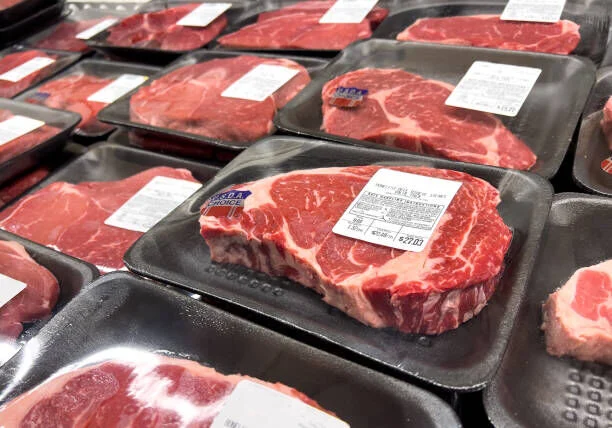
As of January 1, 2026, FSIS is verifying Product of USA claims with documentation, and for DTC meat brands, the claim usually lives in more places than the label.
A ground beef SKU that shipped compliant in December can be non compliant in January without a single ingredient changing. Nothing about the meat is different. What changed is what has to back up the words on the package.
As of January 1, 2026, FSIS is verifying Product of USA and Made in the USA claims, and the standard is tighter than most sellers assume the animal has to be born, raised, slaughtered, and processed in the United States, with no exceptions beyond spices and flavourings. For a lot of online meat brands, that’s a bigger ask than it sounds, because the claim isn’t sitting in one place waiting to be checked. It’s on the label, sure, but it’s also in a product description a merchandiser wrote two years ago, a subscription box insert card, an Amazon listing, and a retargeting ad that’s still running. Origin is a live consumer issue precisely because imports are at record highs why record beef imports haven’t lowered prices, and what that means for DTC ranchers which is exactly why a verifiable Product of USA claim carries weight right now.
What Actually Changed on January 1, 2026
The rule itself isn’t new. FSIS finalized it in March 2024, publishing it in the Federal Register as 89 FR 19470. What’s new is that January 1, 2026 was the uniform compliance date, and establishments choosing to use Product of USA or Made in the USA now have to meet the revised standard to keep using it.
The old standard was loose enough to be a running argument in the industry for years. A label could say Product of USA on meat processed domestically even if the animal was born and raised somewhere else, Mexico, Canada, wherever, as long as the final processing step happened on U.S soil. Ranchers hated it. Consumers, it turns out, mostly had no idea it worked that way.
The new standard collapses that gap. For a single-ingredient product like ground beef, the animal has to be born, raised, slaughtered, and processed here all four steps. For anything with more than one ingredient, like sausage, every FSIS regulated component has to meet that same bar independently, with spices and flavorings carved out as the one allowed exception.
One thing worth being precise about: this is still voluntary. Nobody is required to put Product of USA on a package. The rule only bites once you choose to use the claim, at which point you’re on the hook for the full standard, not a softer version of it. FSIS grandfathered in product that was already packaged and labeled before January 1, 2026, so a case of pre-2026 inventory sitting in a warehouse isn’t suddenly illegal. New labels are where the rule applies.
Why FSIS Tightened It
This didn’t come out of nowhere. FSIS ran a consumer perception study back in 2022 and found that most people already believed Product of USA meant the animal was born, raised, and slaughtered in the U.S which is to say, consumers were reading a stricter meaning into the label than the label actually guaranteed. That gap between what the claim implied and what it legally required is more or less the entire reason the rule exists.
There’s an older thread here too, for context mandatory country-of-origin labeling for beef and pork got repealed back in 2016 after Canada and Mexico challenged it at the WTO and won. That left a hole where COOL used to be, and Product of USA became one of the few origin signals left standing, except it wasn’t held to nearly the standard people assumed. The 2026 rule is FSIS closing that gap without touching COOL itself.
Worth noting FSIS received more than 3,300 comments on the proposed version of this rule before finalizing it, trade associations, ranchers, foreign governments, consumer groups, all weighing in. That’s a lot of comment volume for a labeling rule, and it’s a decent sign the industry already knew this one would actually change behavior instead of sitting unenforced.
Product of USA vs. Made in the USA Two Regulators, Two Bars
This part trips people up if they sell across categories, because meat isn’t governed by the same rule as everything else with “Made in USA” stamped on it.
FSIS has jurisdiction over meat, poultry, and egg products specifically. Everything else, kitchenware, apparel, electronics, you name it, falls under the FTC’s Made in USA Labeling Rule, finalized in 2021, which uses an all or virtually all standard. The FTC’s rule is also the one with real teeth already in 2023, the FTC went after Instant Brands over Pyrex marketing, not because the individual products were mislabeled they were correctly marked “Made in China, but because the company’s broader marketing implied a domestic origin that wasn’t accurate. That case ended in a $129,416 penalty plus ongoing compliance and monitoring requirements, and notably, the FTC didn’t even need to prove a labeling-rule violation to get there. Section 5’s general prohibition on deceptive advertising was enough.
That’s the part worth sitting with if you sell meat online. FSIS governs the package label. It does not govern your homepage copy, your email subject lines, or your Instagram captions. If those drift out of alignment with what your label actually says, or with what’s true, you’re not just exposed to FSIS anymore. You’re exposed to the FTC’s broader deceptive advertising authority, the same one that got Instant Brands.
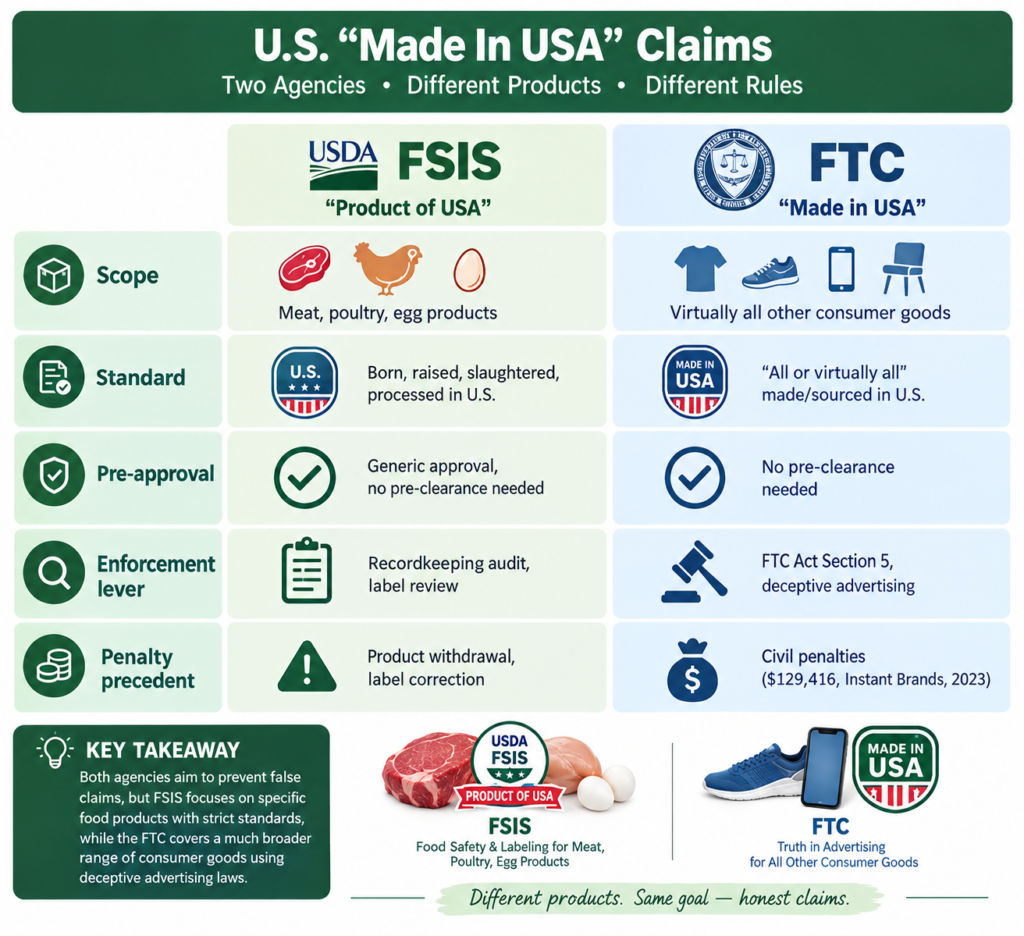
The two standards are converging in spirit, FSIS explicitly said the new rule aligns with the FTC’s all or virtually all thinking, but they’re enforced by different agencies, through different mechanisms, and a seller can be technically fine with one and exposed under the other.
The Documentation Requirement Nobody’s Marketing Team Budgeted For
Because Product of USA and Made in the USA get generic approval, there’s no pre-submission step where FSIS signs off on your label before you print it. That sounds like less friction. It isn’t, really. It just moves the friction to later.
What FSIS actually wants, if it asks, is documentation sufficient demonstrate the product meets the criteria and that the claim isn’t false or misleading. In practice that means traceability and segregation records, controls showing where the animal was born and raised, and a signed statement affirming the claim is accurate. FSIS gave one example during a December 2025 webinar that’s become the go to illustration in the industry a single ingredient beef product backed by ranch records from Wyoming showing the animal was born there and raised there until slaughter. That’s the level of specificity they’re pointing to.
Origin labeling sits on top of inspection status, so it helps to be clear on the layer beneath it what state vs. USDA inspection actually means for an eCommerce business. There’s no fixed checklist of acceptable documents, FSIS deliberately left that open, but sufficient to demonstrate is doing a lot of work in that sentence, and it’s on you to decide what sufficient looks like before an inspector asks. FSIS’s updated Guideline for Label Approval, revised in December 2025, gives more examples, and FSIS said it would start focusing verification efforts on exactly these two claims, Product of USA and Made in the USA, beginning in January. This isn’t a rule sitting quietly on the books. It’s one FSIS is actively watching.
Where the Claim Actually Lives for an Online Seller
Most of the coverage of this rule has been written from the processor’s chair, the plant that prints the physical label. That’s a real compliance surface, and it’s the one FSIS actually audits. But if you’re running a DTC or online meat brand, the printed label is often the easiest place to fix, because it’s one file, updated once, approved once.
The harder problem is everywhere else the words Product of USA got typed by someone, at some point, who isn’t thinking about this rule today. This is the same content governance gap that shows up in variable weight checkout and subscription box operations more broadly a lot of systems that touch an online meat storefront were never built with this level of regulatory precision in mind, and product claims are one more thing quietly drifting out of sync across them.
A product description page written eighteen months ago by a merchandiser who’s since moved to a different role. A subscription box insert card that was designed once and hasn’t been touched since. An Amazon or Thrive Market listing that syncs from a product feed nobody’s audited recently. An email welcome series with the claim baked into a template. A retargeting ad still running from a campaign built last spring. None of those get checked when someone audits the physical package, and all of them can say Product of USA long after the actual sourcing changed, or long after the printed label was already corrected.
A practical starting checklist, for anyone who wants to know where to actually look:
- Product detail pages (PDP copy, both current listings and older/archived ones)
- Subscription or box insert print materials
- Marketplace listings (Amazon, Thrive Market, Instacart storefronts)
- Email templates: welcome series, abandoned cart, promotional sends
- Paid social and retargeting ad copy, including creative that’s technically live but low spend
- Site search snippets and meta descriptions, which often lag behind PDP edits
None of this is a physical label problem. It’s a content-governance problem, and it’s the part of this rule that a lawyer reviewing your FSIS labels won’t catch, because it isn’t a label.
Multi-Ingredient Products Where Sellers Trip
If you’re only selling ground beef or single cut steaks, the standard is at least conceptually simple, one animal, one origin chain to document. Sausage, marinated cuts, seasoned products, anything with more than one component gets harder fast.
The rule requires every FSIS regulated ingredient in a multi ingredient product to independently meet the born raised slaughtered processed standard, with only spices and flavorings exempted. That means a sausage where the pork is fully domestic but the casing is imported, or where a seasoning blend contains something outside the spice/flavoring carve out, doesn’t qualify for an unqualified Product of USA claim, even if 95% of the product by weight is clean. There’s no proportional or mostly domestic version of this claim. It’s binary.
This is where a lot of well intentioned sellers are going to get caught out, not because they’re trying to mislead anyone, but because nobody mapped every input ingredient against the standard before the claim went on the label or the website.
The practical fix isn’t complicated, just tedious: pull the full bill of materials for every SKU carrying the claim, and check each FSIS regulated component against the standard individually, not the finished product as a whole. A casing supplier, a natural flavor blend, a co-packed component from a different facility, any one of them can be the thing that breaks an otherwise clean claim, and none of them show up if you’re only reviewing the primary protein source.
What This Means for Operators: A Decision Framework
Every SKU currently using Product of USA or Made in the USA, on package or in marketing, falls into one of three practical paths. None of them requires guessing; each one just requires deciding, deliberately, instead of leaving the claim on autopilot.
| Keep the claim | Use a qualified claim | Drop the claim | |
|---|---|---|---|
| When it fits | Full domestic chain, documentable end to end | Some U.S. processing, but sourcing isn’t fully domestic | Imported livestock or ingredients, or documentation gaps you can’t close quickly |
| Documentation burden | High: ongoing recordkeeping, ranch/supplier records | Moderate: document only the step you’re claiming | Low: no substantiation obligation |
| Marketing risk | Low, if records are real, high, if they’re assumed | Low, but requires precise language sliced and packaged in the USA, not Product of USA | None on origin, may lose a differentiator vs. competitors |
| Timeline | Can start immediately if records already exist | Fast: mostly a copy change | Fast: mostly a copy change |
The middle path is underused and worth calling out specifically: FSIS’s rule explicitly allows qualified claims for products that are minimally processed domestically using imported meat, language like sliced and packaged in the USA using imported beef. That’s a real, compliant option for sellers who do meaningful domestic work but can’t claim the full chain, and it’s often a better fit than either fully keeping or fully dropping the unqualified claim.
The claim has also become a positioning weapon why Product of USA now anchors how independent beef brands sell against the Big Four, but only for sellers who can actually document the born raised slaughtered chain. Whichever path a given SKU lands on, the decision needs to be made per product, not brand wide. A brand can legitimately have some SKUs that clear the full standard and others that don’t. Treating Product of USA as a blanket brand claim rather than a per SKU one is itself part of how sellers end up out of compliance.
This same discipline, checking a per SKU compliance detail rather than assuming brand-wide coverage, applies just as directly to online meat sellers evaluating pending interstate shipping legislation like the direct Act, a rule change on paper doesn’t automatically mean every SKU or every sales channel is covered on day one.
FAQs
Do I need to remove Product of USA from my meat website?
Only where it’s not true, or you can’t currently prove it’s true. If a SKU clears the born raised slaughtered-processed standard and you have records to show it, the claim can stay.
What documentation does FSIS require for Product of USA claims?
There’s no fixed checklist. FSIS’s language is documentation sufficient to demonstrate the claim, which in practice means traceability and segregation records, origin records from the supplier or ranch, and a signed statement affirming the claim is accurate. Proving it, not just saying it.
What happens if I use Product of USA without records?
At minimum, a label correction or withdrawal if FSIS asks and you can’t back it up. If the claim also shows up in marketing that overstates origin, that’s separate exposure under the FTC’s Section 5 authority, the same authority behind the Instant Brands penalty in 2023, which didn’t even require proving a labeling-rule violation.
Is Product of USA still legal to use in 2026?
Yes. It’s still voluntary, not banned. The standard behind it is just stricter now, and FSIS has said it’s actively verifying claims starting this year.
Does the Product of USA rule apply to online meat sellers?
It applies to anyone selling FSIS regulated meat, poultry, or egg products under the claim, regardless of channel. FSIS enforces the label itself; the same claim showing up in your marketing can also draw FTC scrutiny separately, under the general rules against deceptive advertising.
