
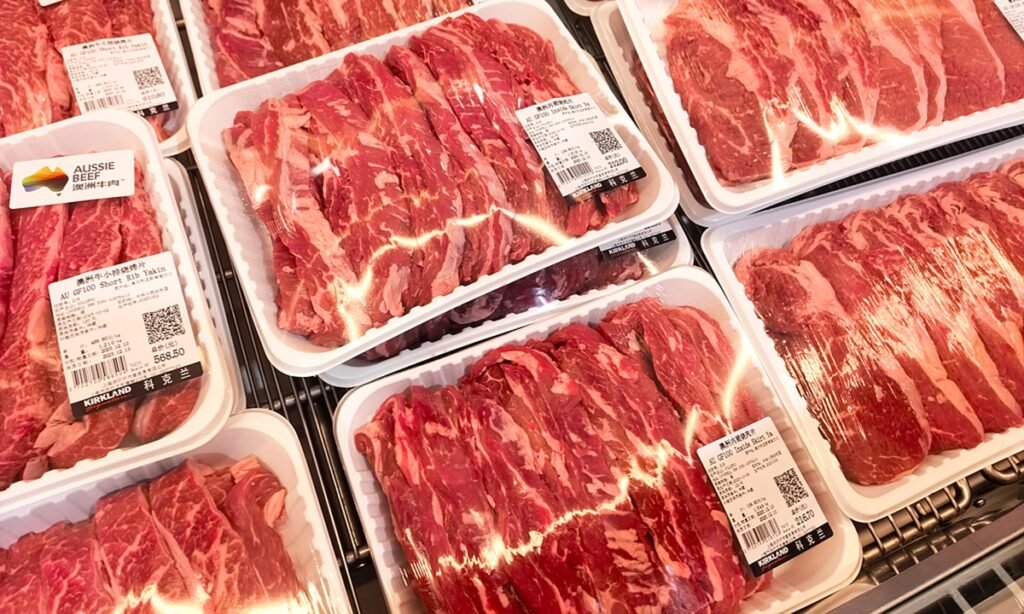
Record Import Volumes Meet Record Retail Prices: The Paradox Reshaping Beef Economics
Your costs haven’t moved. Your cattle performance hasn’t declined. But your margin to the packer keeps shrinking, even as ground beef hits unprecedented retail prices. The U.S. is importing beef at all-time highs—yet prices for operators like you have never been more complicated.
The Numbers You Need to See
4.64 billion pounds U.S. beef imports in 2024 a 24.4% increase from 2023, the highest level ever recorded
$6.69 per pound Ground beef price in December 2025 the highest since the Bureau of Labor Statistics began tracking in the 1980s
70+ years Age of the U.S. cattle herd’s lowest point down from the 2022 peak, with rebuilding expected through 2027
81 to 85 percent Portion of the fed-cattle market controlled by four meatpacking companies Tyson, JBS, Cargill, and National Beef
The U.S. imported record volumes of beef in 2024–2025, yet retail prices climbed 14% instead of falling. This counterintuitive result stems from a domestic cattle herd at 70+ year lows. Imports cannot substitute for collapsed domestic production when the herd is this depleted. Meatpacker consolidation and tariff volatility have captured margin gains while operators face compressed spreads. DTC ranches competing on commodity pricing alone will struggle; those repositioning toward direct consumer relationships, transparency, and brand differentiation are capturing value that imports cannot undercut.
Key takeaways:
- More imports don’t lower prices when domestic supply is structurally broken.
- Tariff policy and packer consolidation control margin distribution, not import volume.
- DTC differentiation (traceability, direct relationships) outperforms commodity-pricing strategies in this environment.
The Paradox: Why Record Imports Haven’t Eased Prices
When supply increases, prices typically fall. It’s one of the first principles taught in agricultural economics. Yet in 2024 and 2025, the U.S. experienced something that violates that rule entirely.
The United States imported a record 4.64 billion pounds of beef in 2024, a 24.4% year-over-year increase from 2023. The forecast for 2025 climbs even higher, with projections reaching 4.77 billion pounds. Meanwhile, ground beef prices reached $6.69 per pound in December 2025, the highest since the Department of Labor started tracking beef prices in the 1980s.
This is the core tension: more beef in the supply chain, yet prices at retail have moved in the opposite direction. According to the Coalition For A Prosperous America, despite record beef imports in 2025, prices have risen 14% over the past year, proving that more imports do not lower costs.
The knee-jerk assumption among operators and observers is that imports were supposed to be the relief valve. Imports were supposed to bridge the gap. Instead, they’ve created a textbook market failure where the traditional supply-and-demand relationship has broken down entirely.
Understanding why requires looking upstream at cattle supply, not at import volumes.
The Root Cause: Domestic Herd Collapse vs. Import Timing
A basic fact is worth stating plainly: imports cannot replace domestic production when the domestic herd has been eliminated at the herd-building level. Import volumes will fall before the herd recovers, and the contraction means elevated costs and tight supply well into 2028–2030 — the window you’re actually pricing around.
Since 2022, the U.S. cattle herd has contracted dramatically. Drought across the Great Plains, rising feed costs, and low cattle prices in 2023 forced ranchers into a brutal choice: liquidate breeding stock to survive cash-flow pressure, or watch the operation fail. Most chose immediate survival. The consequence is a 70+ year low in the national herd.
According to USDA projections, U.S. beef production is expected to hit a low of 24.8 billion pounds in 2027, before climbing through 2034 as production climbs to better meet domestic beef demand. That rebuild timeline matters. Rebuilding a herd takes 18 to 24 months minimum. Calves born today won’t reach slaughter weight for two to three years. A rancher who sold breeding cows in 2023 and 2024 cannot rapidly restart production. The decision made under desperation two years ago has locked in lower supply through 2027.
Imports cannot compress this timeline.
A shipment of Australian beef or Brazilian ground beef arrives in weeks, not years. But it also doesn’t rebuild domestic breeding stock. Packers have filled some of the supply gap with imported product, which has prevented retail shortages. But shortages and prices are not the same thing. The shortage never materialized because packers were willing to pay enough to pull imports forward. What appeared to happen was price stability. What actually happened was margin compression for everyone except the packers themselves.
Here’s the pattern operators miss:
when you’re importing to fill a shortage of domestic production, the imported product doesn’t undercut the domestic product. It sits alongside it at packer-set prices. The operator still competes on commodity pricing. The import solves a volume problem, not a margin problem.
Tariff Policy as a Hidden Price Lever
Tariff rate quotas (TRQs) exist to manage import supply while protecting domestic producers. The system works like a tiered tax: imports within a quota threshold face a base tariff rate. Imports above the quota face a much steeper “over-quota” tariff.
In 2025, this mechanism became a price-setting lever that most operators never tracked directly, yet it influenced every penny they didn’t receive from the packer.
The timeline tells the story:
According to recent trade data, the tariff landscape shifted dramatically throughout 2025:
January 2025:
Brazil tariff at quota level (zero to low tariff). Packers front-loaded Brazilian beef purchases. Prices to ranchers stayed firm because packers were confident in supply.
April 2025:
New 10% reciprocal tariff imposed on most major suppliers, layered on top of existing over-quota rates. Brazil imports faced a cumulative 36.4% tariff (26.4% over-quota plus 10% reciprocal). Import volumes dropped sharply.
August 2025:
Additional 40% tariff imposed on Brazilian beef specifically, pushing the total tariff to over 76% for that supplier. Brazilian beef effectively became uncompetitive. Packers shifted to Australian and Canadian sources instead, which faced lower tariff barriers.
November 2025:
All additional tariffs removed on Brazilian beef. Packers could once again access Brazilian product at base over-quota rates only (26.4%), triggering another front-loading rush in January 2026.
The operator consequence:
Each tariff spike compressed packer margins on imported beef, which should have created negotiating room for domestic cattle. It didn’t. Packers managed the tariff volatility by shifting supplier preferences rather than paying higher prices for domestic cattle. When tariffs dropped, the packer margin recovered, and domestic cattle prices didn’t participate in that recovery.
One operator from Colorado, who transitioned to DTC sales in late 2025, put it plainly: “We watched tariff cycles ripple through packer behavior three times in a year. Not once did that volatility translate to higher prices offered to us. We were commodity sellers competing against tariff arbitrage.”
Meatpacker Consolidation: Where Imported Beef Margin Actually Goes
Four companies control 81 to 85% of fed-cattle slaughter. That level of consolidation means packer profit isn’t derived from cattle purchase prices rising or falling relative to competition. It’s derived from the spread between what they buy (at a price they set) and what they sell (at a price they influence across multiple value-added product categories).
When domestic production fell, packers had two options: accept margin compression on total volume, or diversify the product mix to capture margin elsewhere. They chose the second. The same four-packer concentration driving this dynamic is now under federal scrutiny, how the DOJ meatpacking probe is reshaping the way small brands sell “independent”.
Imported beef is used for three main purposes: ground beef production, value-added product inputs (ready-to-eat meals, processed meats), and lean trimmings for blending. Each has different margin profiles. Imported fresh-chilled beef from Australia commands different pricing than frozen trimmings from Brazil. Packers can blend domestic grass-fed cattle, domestic finished beef, and imported products across these categories to optimize total spread rather than optimizing for any single supply source.
The result: when a packer buys your domestic cattle, it’s not competing with itself on imported beef. It’s blending your cattle into a portfolio where imported beef handles the price-sensitive categories (ground beef, low-end retail) and domestic beef handles the premium categories (steaks, high-end retail). The domestic cattle price isn’t set by import supply. It’s set by the packer’s margin target across the entire product mix.
This is why imported volume and domestic cattle prices move in opposite directions during import surges. The import surge isn’t competitive pressure. It’s portfolio optimization by firms that control both sides of the market.
What This Means for DTC Ranch Economics
Retail prices are at all-time highs. The opportunity looks obvious. But the opportunity only exists for operators who can capture the full retail margin, not for those selling commodity cattle to packers. Building direct customer relationships requires the infrastructure to match — what a complete meat eCommerce setup actually requires.
The math:
Ground beef at retail is $6.69 per pound. A packer buying your commodity cattle at $225 per hundredweight (cwt) is acquiring beef at roughly $1.50 per pound wholesale. The spread between wholesale and retail, after processing, distribution, and retail margin, is captured by everyone except you.
A DTC operation selling ground beef directly to consumers at $10 to $12 per pound captures most of that spread. The processing, packaging, and direct shipping costs money, but the per-pound margin is dramatically higher than selling commodity cattle. Capturing that retail spread is easier to model than to run. The full margin math of DTC beef, processing, cold chain, packaging, and the pricing ceiling set by supermarket beef — shows why record cattle prices don’t automatically translate into DTC profit.
The barrier is not price environment. The barrier is operational. A DTC model requires:
- Relationships with regional or custom processing facilities (typically booked 4 to 8 weeks out)
- Working capital to bridge the gap between purchasing/processing and cash-in from sales
- Marketing assets (website, email list, social proof) that take 6 to 12 months to build
- Regulatory compliance across state lines if shipping
For operators with existing direct relationships (farmers markets, restaurants, retail accounts), the current environment is a wealth transfer moment. Prices at retail are elevated, and the input you’re selling (live cattle or processed product) has a stable or rising cost. The spread is real.
For commodity operators, the same environment offers no relief. Your packer margin is fixed by packer logic, not by retail prices. Import volumes don’t change that.
Three Strategic Moves for DTC Operators in 2025–2026
The current environment is temporary. The U.S. cattle herd will begin rebuilding in earnest in 2026. According to USDA projections, beef imports are expected to begin a steep decline, reaching a 10-year low in 2029 of 3.0 billion pounds, as production climbs to better meet domestic beef demand. When that happens, packer margins on imported beef will compress, and domestic cattle prices will finally participate in commodity price recovery.
But that recovery is 18 to 24 months away at minimum. The strategic question for DTC operators is how to use the next 18 months to lock in value that herd recovery will erode.
Step 1:
Assess Your Current Margin Position
If you’re selling to packers at commodity prices, your margin is fixed by packer logic and import supply. No relief is expected through 2026 or into 2027. The retail price elevation is irrelevant to you.
If you have existing direct relationships (restaurants, retail partners, farmers markets, CSA accounts), the current environment is a genuine opportunity window. Retail prices are elevated, and your cost of goods hasn’t moved proportionally. The margin gap is widest right now.
The question to ask yourself: Do I control the price the customer pays, or does someone else (a packer, a distributor, a retailer) control it?
If someone else controls it, move to Step 2. If you control it, move to Step 3.
Step 2:
Evaluate Direct-to-Consumer Readiness
This is the harder path, but it’s the only path for commodity operators seeking to capture margin.
A functioning DTC model requires 3 to 6 months of working capital runway. You’re paying for cattle, paying for processing, paying for packaging and shipping, and waiting for customer payment. That cycle is typically 30 to 60 days. Can your operation bridge a 90-day cash flow gap without strain?
It also requires marketing assets. A website, an email list, social proof (reviews, repeat customers, word of mouth). These take 6 to 12 months to build to a revenue-generating scale. A DTC model that ships across state lines runs into an access question before a marketing one which inspection pathway (state, federal, or CIS) actually lets you sell interstate determines your addressable market.
Finally, it requires regional processing capacity that aligns with your volume and timing. The most common constraint for emerging DTC operators is not brand-building. It’s processing availability. Book capacity now, even if you don’t use it for 6 months.
If you have the cash reserves, can build a website and email list, and can secure processing capacity, a DTC transition is feasible in a 6 to 9 month window. The current environment (elevated retail prices, commodity cattle prices still lagging) is the ideal entry point.
If you don’t have those preconditions, don’t force it. Move to the next option instead.
Step 3:
Time Your Transition
Tariff policy is volatile. Every 6 to 8 weeks in 2025, the tariff landscape shifted. Expect 2 to 3 more major shifts through 2026.
Each tariff shift creates a window of opportunity or compression for packer negotiations. When tariffs spike, packer margins compress, and packer appetite for cattle drops. When tariffs fall, packer margins recover, and packer buying pressure returns.
DTC operators should lock in direct contracts during tariff-spike periods, when retail prices are high but packer demand is low. This is a counterintuitive point: the period of maximum retail price elevation combined with minimum packer demand is the ideal moment to shift volume from commodity to direct sales.
Domestic herd rebuilding won’t materially impact prices until 2027 to 2028. The current environment (high retail prices, import dependency, tariff volatility) persists for 18+ months. This is the runway. Use it.
Tariff Timeline & Imported Beef Prices in 2025
| Date | Tariff Event | Packer Response | Operator Consequence |
|---|---|---|---|
| January 2025 | Brazil zero tariff (quota cleared) | Front-load Brazilian imports | Packer margins tight, cattle prices firm |
| April 2025 | 10% reciprocal tariff added | Shift to Australian/Canadian suppliers | Packer margins recover, domestic prices don’t rise |
| August 2025 | 40% Brazil tariff spike | Brazilian beef uncompetitive | Packer consolidation tightens, commodity leverage lost |
| November 2025 | Tariff removal on Brazil | Brazil quota fills rapidly in Jan 2026 | Packer margins protected, operator margins squeezed |
FAQs
We hear imports are ‘record high.’ If there’s so much beef coming in, why can’t we get higher prices from packers?
Import volume hasn’t eased packer buying prices because the domestic herd is so depleted. Packers control pricing power. Imports just absorb additional volume at packer-set wholesale prices. Your bargaining position with a packer is unchanged—you’re still a commodity seller in a 4-firm market. DTC models bypass that dynamic entirely by selling directly to the customer at retail prices you set.
If tariffs are supposed to protect American beef, why did they get removed on Brazilian beef in late 2025?
Tariff policy is trade-negotiation driven, not supply-protection driven. Tariffs temporarily suppress imports; when removed, packers front-load purchases at lower landed costs, then compress margins across all beef (domestic and imported). The operator sees no lasting benefit from tariff cycles.
How much longer until domestic cattle supply recovers and prices start coming down?
USDA projections show herd rebuilding through 2027 to 2029, with measurable production increases arriving in 2028 at the earliest. Retail price relief is unlikely before late 2027. DTC operators should plan strategies for the next 18 to 24 months assuming prices stay elevated and volatility persists.
Is importing live cattle from Mexico a viable alternative for DTC ranches?
Live cattle imports from Mexico carry regulatory and disease-risk complexity. They’re used by large-scale feedlots to add volume, not by DTC operations to differentiate. Focus instead on direct processing agreements with regional facilities and transparency-driven marketing. Your story is your land, your management, your customer relationships. Live cattle imports don’t fit that model.
What happens to DTC beef pricing if domestic prices eventually drop in 2027–2028?
DTC operators who’ve built brand equity and direct relationships maintain pricing power independent of commodity prices. That’s the core advantage. Your margin comes from consumer loyalty and story, not commodity spread. This environment (elevated prices, import uncertainty) is your best window to establish that differentiation before commodity prices eventually recover and margin compression returns.
Bottom Line: Differentiation Over Commodity Positioning
The paradox of record imports and record prices isn’t complicated once you understand the structural constraint: you cannot replace domestic production via imports when the domestic herd has been liquidated at the breeding level.
The implication for your operation is equally straightforward. If you’re selling commodity cattle to packers, tariff volatility and import volumes are noise. Your price is set by packer margin logic, and that logic is insulated from retail price dynamics. Imports don’t help you. Import relief is years away.
If you’re building or operating a DTC model, the current environment is the most favorable window available. Retail prices are at all-time highs. Commodity cattle prices are lagging. The spread is widest right now. Processing capacity still has availability (though not unlimited). Your opportunity to establish direct customer relationships and capture full retail margin is genuine and time-bound.
The domestic herd will rebuild. Import volumes will decline starting in 2027 to 2028. Commodity prices will recover. When that happens, the current margin advantage disappears. The operator who spent the next 18 months building DTC infrastructure, direct relationships, and brand differentiation will have locked in a value-capture mechanism that commodity price recovery cannot erode.
The operator who waited for commodity prices to recover will find that recovery never grants them pricing power. It just reduces their margin back to historical norms.
The question isn’t whether imports will eventually stop being the price-setter. They will. The question is whether you’ll have a customer relationship outside the commodity market by then. If you do, the herd recovery is irrelevant to your economics. If you don’t, you’re back to waiting for the next crisis.
