
Federal bans on raw milk, 18 state level import restrictions, and FSMA 2025 compliance costs force DTC dairy brands to choose: ship regionally, limit product mix, or build multi warehouse infrastructure. Here’s the regulatory map and cost reality.
Your DTC dairy brand is ready to scale. You’ve perfected a premium yogurt. You’ve built a farm story customers love. You’ve hit profitability in your home state. Now you’re planning the national push.
Then you hit the wall.
The product you can freely sell in California doesn’t ship legally to Massachusetts. What’s pasteurized and shippable in Maine faces import restrictions in Texas. Your logistics partner says cold chain compliance costs 12–18% of COGS. The FDA’s FSMA 2025 rule, rolling out in January 2026, added IoT sensor requirements you didn’t budget for. And you still don’t know which of your seven product SKUs can legally reach which states.
The interstate dairy shipping problem isn’t cold chain technology. It’s regulatory complexity stacked with cost pressure. And for DTC brands planning national expansion, it’s the decision that determines whether you scale or stay regional.
$86 Billion North American cold chain logistics market (2025), projected to reach $140B+ by 2030 as DTC food grows 18.7% CAGR
18 States Completely ban raw milk sales intrastate. 32 allow intrastate sales with restrictions. Zero uniform federal guidance on which states accept shipped-in dairy products.
12–18% COGS impact: Cold chain fulfillment cost for dairy shipped interstate. Dry ice, insulated packaging, expedited shipping, temperature monitoring.
$50K–$150K Annual cost: FSMA 2025 IoT sensor compliance mandate for interstate food shipments. Rolls out January 2026 with enforcement escalation through Q4 2026.
Here’s the operational reality: Federal law bans raw milk interstate commerce except for raw cheese aged a minimum of 60 days at 35°F. Among 50 states, 18 completely prohibit raw milk sales intrastate, while 32 allow some form of intrastate sales with conditions. Your DTC dairy can ship pasteurized milk, ultra-pasteurized products, yogurt, and aged cheese nationally—but state import restrictions reduce your addressable market significantly. Cold chain logistics cost 12–18% of COGS. FSMA 2025 IoT sensors cost $50K–$150K annually starting January 2026. National shipping only works if your product mix qualifies, your fulfillment geography clusters around high-density states, and you’ve planned compliance costs into unit economics.
key takeaways:
- Federal rules define what moves interstate (pasteurized yes, raw milk no except aged cheese). State rules define what each state accepts inbound.
- Cold chain cost forces geographic clustering: regional shipping saves 30–40% in logistics vs. single-center national distribution.
- FSMA 2025 compliance is mandatory and non-negotiable. Plan it as operating expense, not surprise capital project.
Federal Interstate Dairy Shipping Rules: What’s Allowed, What’s Banned
The FDA’s Interstate Milk Shippers List and Pasteurized Milk Ordinance establish which dairy products can legally move across state lines. The rules are specific, but operators often misunderstand the boundaries.
Grade A milk products approved for interstate commerce include: pasteurized milk (any fat level), ultra-pasteurized milk, aseptic milk, yogurt, cottage cheese, cultured butter, cream, half-and-half, and whey (liquid or dry). These products can move nationally if your facility meets Grade A standards—meaning 90% sanitation compliance rating, state inspection every 24 months, and ongoing testing protocols.
Raw milk for pasteurization is approved for interstate commerce, but only for further processing. If you’re a small artisanal producer shipping raw milk to a co-packer for processing, that’s permitted. But raw milk in final package form intended for direct consumer consumption faces a federal ban. There is one exception: raw cheese aged a minimum of 60 days at 35°F. This exception is federally approved and applies nationally. No state can legally ban aged raw cheese if it meets the 60-day aging requirement and is properly labeled.
Non-Grade A products face higher FDA oversight. If your facility doesn’t meet Grade A standards, interstate shipping becomes significantly more complex. You’ll need direct FDA approval, more rigorous testing, and stricter compliance documentation. For most small and mid-market DTC dairy brands, achieving Grade A status is a prerequisite for national shipping.
Your facility must be on the Interstate Milk Shippers List to legally ship Grade A products across state lines. The IMS listing process takes 90–180 days. It’s not optional if you want national reach. Start that application now if you’re planning 2026 national expansion.
The Raw Milk Question: Federal Ban and State-by-State Exception Map
The federal prohibition on raw milk interstate commerce is clear: 21 CFR 1240.61 prohibits the shipment of raw (unpasteurized) milk across state lines for direct human consumption. This rule has been in place since 1987. The one federally recognized exception is raw cheese aged 60+ days, which science shows is safe because the aging process at 35°F kills pathogens. The federal ban on shipping raw fluid milk is absolute, but the state by state reality of selling raw milk online, and 2026’s FDA enforcement against shipped sales is where most sellers get caught.
But here’s where operator confusion begins: state intrastate rules don’t match federal interstate rules.
Raw milk regulation is a state by state patchwork. Eighteen states ban raw milk entirely. Thirty two states allow some form of raw milk sales with conditions some permitting farm-direct only, others allowing retail sales, and others limiting sales to specific product categories like yogurt or cheese. Vermont allows raw milk intrastate; Massachusetts does not. Pennsylvania permits raw milk from licensed producers; New York does not. The result: operators navigate contradictions that trap products in intrastate commerce or force reformulation.
If your product mix is 40% raw milk products (yogurt, kefir, raw cream), national shipping is off the table without either 60 day aging or a federal rule change. You’re geographically locked to states that permit raw dairy intrastate.
Recent legislative activity adds uncertainty. The Interstate Milk Freedom Act, introduced in June 2026, challenges the existing federal raw milk ban. Its status remains unclear, and federal compliance guidance still defaults to treating the ban as enforceable. Until that legislation is resolved, treat the federal ban as the operating reality. Which products you can ship also shapes how you position raw versus pasteurized lines how to build a brand that converts both audiences in a post H5N1 market. State level operators: Check your state’s USDA agreement. Some states may permit intrastate raw milk but prohibit receipt of shipped-in dairy from other states entirely.
The Interstate Milk Freedom Act outcome will reshape dairy eCommerce geography. Operators should monitor this closely. If the ban changes, shipping geography expands dramatically.
Product-by-Product Shipping Reality: Which Dairy Products Ship Nationally
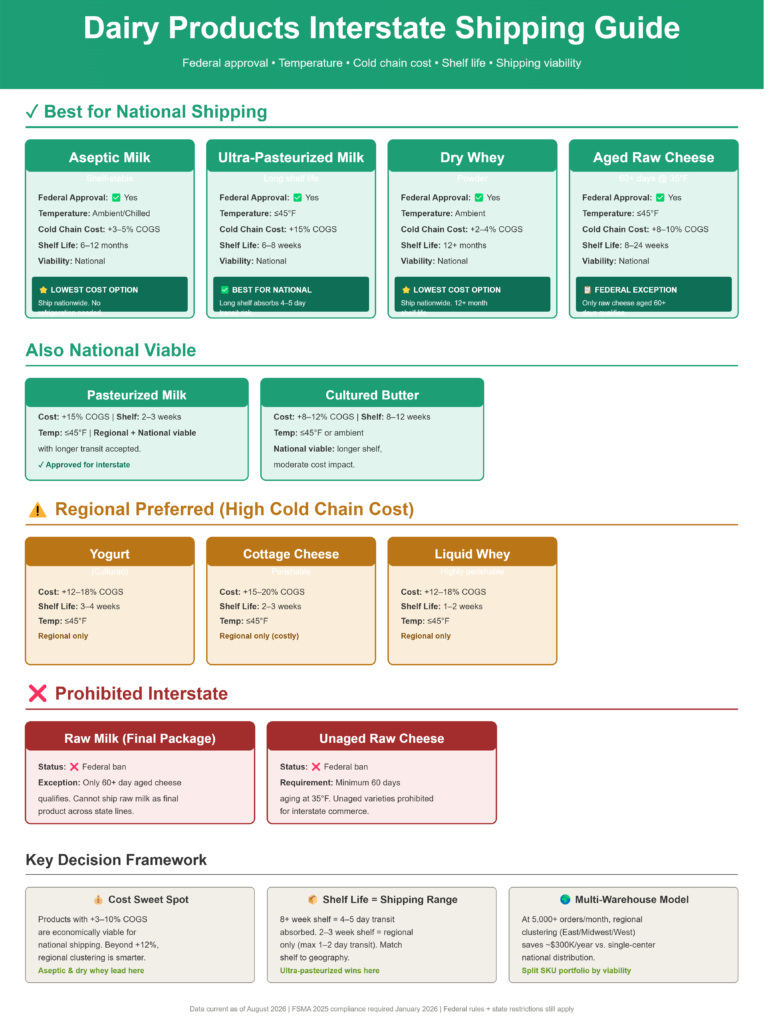
Not all dairy products are created equal under interstate shipping rules. Shipping viability depends on federal approval, temperature stability, cost implications, and shelf life. The one federally recognized raw exception is cheese aged 60+ days, and the licensing lanes and cottage food traps for selling artisan cheese online determine whether you can actually ship it.
The data tells a story: Aseptic and dry products have the lowest cold chain cost. Ultra-pasteurized and aged cheese have long shelf lives, making national shipping economically viable. Raw milk products and fresh yogurt are regionally trapped the cost to ship nationally exceeds margin recovery at typical DTC price points.
Operator Decision Point: Map your revenue by product category. If 60%+ of revenue is from aseptic, ultra-pasteurized, aged cheese, or dry whey, national shipping is viable. If 60%+ is from fresh yogurt or raw milk products, stay regional or reformulate.
State Import Restrictions: Geographic Map of Shipping Barriers
Every state has authority to regulate which dairy products can be received from outside its borders. The result is a patchwork of import rules that operators must navigate.
High-Restriction States
(Pasteurized Products Only; No Raw Dairy Import)
- Massachusetts, New York, Maryland, New Jersey: These states require Grade A certification and restrict all raw dairy imports. If your customer base is concentrated here, you’re limited to pasteurized milk, ultra pasteurized, and yogurt. Raw aged cheese requires state-by-state verification.
Moderate-Restriction States
(Pasteurized + Aged Raw Cheese; Some Raw Restrictions)
- California, Texas, Wisconsin: Allow pasteurized + aged raw cheese (60+ days). Unclear on receipt of other raw dairy from shipped-in sources. Contact state dairy office before launching DTC shipments.
Low-Restriction States
(Most Permissive)
- Vermont, New Hampshire, Maine, Idaho, Colorado, Washington: Allow pasteurized + raw dairy + aged cheese interstate and intrastate. Most DTC-friendly for product variety. However, always verify current state regulations—dairy law changes state-by-state annually.
Operator Action Step:
Map your top 10 target customer states. Research each state’s dairy import rules. If concentrated in high-restriction states, plan product mix around pasteurized-only. If distributed across moderate/low-restriction states, you have more product flexibility.
Cold Chain Logistics Cost Breakdown: The Reality of Shipping Dairy Nationally
Cold chain fulfillment is the largest variable cost in dairy eCommerce. Get this wrong, and national shipping destroys unit economics. Cold-chain cost is the largest variable in dairy eCommerce, and it compounds in a recurring model designing a dairy subscription around cold chain and shelf life reality is how brands keep spoilage under 3% instead of 12%.
Regional Fulfillment Model (California → Pacific Northwest)
- Fulfillment center: Oakland, CA
- Transit time: 1–3 days (400–800 miles)
- Packaging per order: Insulated box + 2–3 lbs dry ice + gel packs
- Cost per shipment: $12–18 (residential); $8–12 (B2B bulk)
- Cold chain COGS impact: 8–12%
- Dry ice cost: $4–8 per order
- Compliance: Basic temperature log + FSMA labeling
- Profitability: ✅ High (30–40% price premium absorbs cost)
National Single-Fulfillment-Center Model (Chicago Hub)
- Fulfillment center: Chicago (geographic middle)
- Transit time: 2–5 days (1,500–2,500 miles average)
- Packaging per order: Heavy-duty insulated + 5–7 lbs dry ice + phase change materials
- Cost per shipment: $22–30 (residential); $16–22 (B2B)
- Cold chain COGS impact: 15–20%
- Dry ice cost: $10–14 per order (heavier load for longer transit)
- Compliance: IoT temperature sensors ($0.50–$2 per unit) + FSMA backend infrastructure
- FSMA 2025 annual cost: $50K–$150K for sensor network and monitoring
- Profitability: Marginal (requires 40%+ price premium + high order volume)
Multi-Warehouse Regional Clustering (Recommended for Scale)
- Fulfillment centers: East Coast (New Jersey), Midwest (Illinois), West Coast (California), South (Texas)
- Transit time: 1–2 days average (400 miles per shipment)
- Packaging per order: Standard insulated + 2–3 lbs dry ice
- Cost per shipment: $10–14 (residential); $6–10 (B2B)
- Cold chain COGS impact: 8–12% (reduced transit distance)
- FSMA 2025 cost: $50K–$150K annually amortized across 4 centers (cost per center: $12K–$37K)
- Profitability: ✅ Sustainable (30–40% savings vs. single-center national)
The Dry Ice Cost Reality:
Dry ice is priced per pound at approximately $2–4 depending on volume and supplier. A 1–2 day regional shipment uses 2–3 lbs ($6–12). A 4–5 day national shipment uses 5–7 lbs ($12–28). That $10–16 difference per order, multiplied across 5,000 monthly orders, equals $50K–$80K in additional annual cost compared to regional fulfillment.
Breakeven Analysis:
For a dairy eCommerce brand with average order value $60:
- Regional fulfillment (8% COGS): $60 × 0.08 = $4.80 cold chain cost per order
- Single-center national (18% COGS): $60 × 0.18 = $10.80 per order
- Difference: $6 per order. At 5,000 orders/month: $30K/month = $360K annually
- Multi-warehouse (10% COGS): $60 × 0.10 = $6 per order, amortized infrastructure: $40K–$60K annually total
Multi-warehouse regional clustering saves approximately $300K annually vs. single-center national at 5,000+ monthly order scale.
FSMA 2025 Compliance: IoT Sensors, Temperature Monitoring, and the Cost Reality
Federal Mandate Timeline
- January 2026: FSMA 2025 IoT sensor requirement rolls out for interstate dairy shipments
- Enforcement escalation: Q2 2026 (warning letters), Q4 2026 (citations and fines)
- Penalties: Up to $500K per shipment violation; product seizure; business suspension in extreme cases
What FSMA 2025 Requires
- Real-time temperature logging (minimum every 4 hours during transit)
- Proof of cold chain maintenance (≤45°F for milk; ≤35°F for temperature-sensitive products)
- Digital traceability: Farm → Processing → Distribution → Final Customer
- Lot-level documentation: Which batch went into which shipment, delivered when/where
- IoT sensor placement: Inside insulated package (not exterior; shows transit conditions, not ambient temperature)
- Labeling compliance: Shipping label indicates “Temperature-Controlled Transit” + QR code linking to real-time tracking dashboard
Three Compliance Options (Cost-Benefit Analysis)
Option A: Third-Party Logistics Provider (3PL) with Built-In FSMA Compliance
- Outsource to FedEx Premium LTL, UPS, or specialized food logistics (ArcticFresh, Instacold)
- Cost: $3–8 per shipment (on top of base shipping)
- Benefit: No capital investment. Pre-certified compliance. Fast deployment.
- Drawback: Loss of customer-facing tracking. Higher per-unit cost at scale. Limited branding.
- Best for: Startups with <1,000 orders/month
Option B: Hybrid Model (Basic IoT + 3PL Compliance)
- Partner with FedEx or UPS Premium for cold chain handling
- Add basic IoT sensors to select high-value shipments ($1–3 per unit)
- Monthly cloud monitoring subscription: $500–$1,000
- Cost: $2–5 per shipment (FedEx baseline + sensor cost amortized)
- Benefit: Moderate complexity. Lower infrastructure investment. Transition path to in-house.
- Best for: Brands with 1,000–3,000 orders/month
Option C: In-House IoT + Monitoring Infrastructure
- Purchase IoT sensors in bulk ($0.50–$1.50 per unit at 1,000+ volume)
- Integrate with backend system (Easypost, Shippo, or custom API)
- Monthly cloud monitoring subscription: $500–$2,000
- Upfront infrastructure: $20K–$50K (setup, API integration, labeling automation)
- Ongoing staff: 0.5 FTE for compliance monitoring and documentation
- Annual cost: $50K–$150K total (sensor costs + infrastructure + staffing + monitoring)
- Benefit: Full transparency. Better margins at scale (>5,000 orders/month). Customer-facing tracking.
- Best for: Established brands with 5,000+ monthly orders and technical infrastructure
Honest Assessment:
Most small-to-mid-market DTC dairy brands use 3PL compliance initially (FedEx Premium LTL or specialty food logistics). After 10,000+ monthly orders, in-house IoT becomes cost-effective. The breakeven point is approximately 5,000–7,000 monthly orders.
Fulfillment Geography Strategy: Regional vs. National Shipping Model
The decision between regional and national shipping is fundamentally about product mix, revenue, and cost tolerance.
Choose Regional Fulfillment (1–2 Centers) If:
- Annual revenue under $500K
- Target customer density in 1–2 adjacent regions (West Coast only, Northeast only, Midwest only)
- Product mix includes significant fresh dairy (yogurt, fresh milk, cottage cheese)
- Willing to limit addressable market in exchange for 30–40% cold chain cost savings
- Not pursuing national brand positioning yet
- Timeline: 3–6 months to launch
Regional Model Financial Reality:
- Fulfillment center locations: California + Pacific Northwest OR Texas + Southeast OR New Jersey + Northeast
- Shipping reach: 400–800 miles from fulfillment center (1–3 day transit)
- Customer base addressable: 15–20 million (single metro region or bi-regional)
- Cold chain COGS: 8–12%
- Revenue potential: $500K–$3M annually (per region)
- Profitability: High (if premium positioning + 30–40% price premium)
- FSMA 2025 compliance cost: $15K–$25K annually (single 3PL partnership)
Choose Multi-Warehouse Regional Clustering (3–4 Centers) If:
- Annual revenue $1M–$5M+
- National brand positioning (want national reach, not just regional)
- Product mix: Predominantly pasteurized, ultra-pasteurized, or aged cheese (lower shipping complexity)
- Can manage distributed inventory and logistics complexity
- Timeline: 12–18 months to full implementation
- Breakeven: 5,000+ monthly orders across multiple regions
Multi-Warehouse Model Financial Reality:
- Fulfillment center locations: East Coast (New Jersey/Pennsylvania), Midwest (Illinois/Ohio), West Coast (California), South (Texas/Georgia) — 4 centers for 85%+ national coverage
- Shipping reach: 1–2 day transit to 85%+ US population
- Customer base addressable: 250 million+ (national)
- Cold chain COGS: 8–12% (shortened transit distance amortized across regions)
- FSMA compliance: Distributed infrastructure across 4 centers ($50K–$150K total annually)
- Revenue potential: $3M–$20M+ annually (national scale)
- Profitability: Moderate (higher revenue, but distributed logistics overhead)
DO NOT Attempt Single-Center National Shipping Unless:
- Ultra-high price point ($150+/order minimum) can absorb 15–20% cold chain COGS
- Product shelf life supports 5-day transit (ultra-pasteurized milk, aged cheese, aseptic products only)
- You have 10,000+ monthly orders to amortize FSMA compliance infrastructure
Decision Framework: Six Steps to Choose Your Interstate Shipping Model
Step 1: Audit Your Product Mix
List every SKU. Classify by federal shipping approval:
- Interstate-Approved: Pasteurized milk, ultra-pasteurized, yogurt, cultured butter, aged cheese (60+), whey, aseptic products
- Interstate-Prohibited: Raw milk (final package), unaged raw cheese, raw cream, raw kefir
- State-Dependent: Certain raw milk products (verify with state dairy office)
Calculate revenue percentage:
- If >40% revenue is from prohibited products: National shipping not viable without federal rule change or reformulation.
- If >60% revenue is from approved products: National shipping is possible. Proceed to Step 2.
Step 2: Map State Import Restrictions
Identify your top 10 target customer states. Research each state’s dairy import rules:
- Does it accept interstate pasteurized milk? (All 50 states: Yes)
- Does it accept raw dairy products from other states? (Varies per state)
- Does it require IMS listing for Grade A products? (Some states do; others don’t enforce strictly for DTC)
Decision:
If top 10 states have moderate-to-low restrictions (VT, NH, ME, CA, ID, CO, WA), national shipping is feasible. If concentrated in high-restriction states (MA, NY, MD, NJ), stay regional or pivot product mix toward pasteurized-only.
Step 3: Calculate Cold Chain Cost Impact
Model three scenarios:
- Regional (1–2 centers): 8–12% COGS
- Multi-warehouse regional (3–4 centers): 8–12% COGS (same per-order, amortized infrastructure)
- Single-center national: 15–20% COGS
Calculate breakeven for your average order value and monthly order volume.
Step 4: Evaluate FSMA 2025 Compliance Option
Choose:
- 3PL with built-in compliance ($3–8 per shipment): Best for startups <1,000 orders/month
- Hybrid model: Best for 1,000–3,000 orders/month
- In-house IoT ($50K–$150K upfront): Only viable if >5,000 orders/month
Timeline: Plan implementation by December 2025 for January 2026 enforcement.
Step 5: Choose Fulfillment Geography Model
Decide based on product mix, revenue, target market, and cost tolerance:
| Model | Annual Revenue | Monthly Orders | Regions Covered | Cold Chain COGS | Implementation Timeline |
|---|---|---|---|---|---|
| Regional (1 FC) | <$500K | <1,000 | 1–2 | 8–12% | 3–6 months |
| Regional + Partner FC | $500K–$2M | 1,000–3,000 | 2–3 | 8–12% | 6–9 months |
| Multi-Warehouse (3–4 FC) | $2M–$20M | 3,000–10,000+ | 4 (National) | 8–12% (+infrastructure) | 12–18 months |
Step 6: Execute Operational Checklist
- IMS listing (if Grade A products): Apply through state dairy office. 90-day approval cycle.
- Logistics partner selection: FedEx Premium LTL, UPS, or food-specific 3PL. Negotiate volume rates if >1,000 shipments/month.
- FSMA 2025 compliance: Choose 3PL vs. hybrid vs. in-house by September 2025. Implement by December 2025.
- State-by-state sales tax + dairy licensing: Varying requirements per state. Engage tax/legal specialist.
- Packaging procurement: Order insulated boxes, dry ice compatibility liners, cooling packs in bulk. Lead time: 4–6 weeks.
- Labeling compliance: Add temperature-control callout, FSMA QR code, state-specific requirements.
- Customer communication: Set expectations on shipping geography and delivery timeframes.
- Soft launch: Test first 50 orders. Verify temperature logs. Refine packaging if needed.
FAQs
Can I ship raw milk interstate if I age it for 60 days?
Yes, but only if it’s cheese. Raw milk in final package form is banned federally. Raw cheese aged 60 days at 35°F is the sole raw dairy exception. It must be properly labeled and certified. This is the only raw dairy product that moves across state lines legally.
Which states are most restrictive about dairy imports?
Massachusetts, New York, Maryland, and New Jersey are the most restrictive. They require Grade A certification and don’t accept raw dairy imports. Vermont, New Hampshire, Maine, and Idaho are most permissive. Contact the state dairy office for specifics before launching shipments.
How much does cold chain cost for national shipping?
Single-center national costs 15–20% COGS (primarily dry ice, insulated packaging, expedited shipping). Multi-warehouse regional clustering costs 8–12% COGS (same per-order cost, but distributed centers reduce transit distance). Regional fulfillment costs 8–12% COGS.
Do I need FSMA 2025 IoT sensors?
Yes, starting January 2026. Fines up to $500K for non-compliance. You have three options: outsource to a 3PL (cost: $3–8 per shipment), hybrid model (moderate complexity), or in-house IoT (viable at 5,000+ monthly orders). Plan implementation by December 2025.
Is multi-warehouse infrastructure worth it?
Yes, if you have 5,000+ monthly orders across multiple regions. Breakeven analysis: Multi-warehouse saves $300K annually vs. single-center national at that order volume. Below 5,000 orders, regional fulfillment is more cost-effective.
Conclusion
Interstate dairy shipping is not a binary decision. It’s a product-by-product, state by state calculation that determines whether your DTC dairy brand scales regionally or nationally. FSMA compliance is a cost line for some and a moat for others how DTC dairy brands turn traceability into a market share advantage.
The market is clear: $86 billion in cold chain logistics opportunity. DTC dairy growing 18.7% CAGR. Brands that map this calculation right scale nationally. Brands that guess get stuck.
Your path forward:
- Audit your product mix first.
Everything flows from whether your products qualify for interstate shipping. - Map state restrictions second.
Know which of your top 10 customer states accept your product categories. - Calculate the cost.
Decide whether regional (8–12% COGS) makes sense vs. national (15–20% single-center, or 8–12% multi-warehouse with infrastructure). - Plan FSMA 2025 compliance now.
January 2026 enforcement is fixed. The decision between 3PL, hybrid, or in-house determines your cost structure. - Choose your fulfillment model.
Regional scales faster. Multi-warehouse scales bigger. Single-center is the profit trap.
The operators who succeed at dairy eCommerce are the ones who solve this puzzle early. They don’t guess. They map. They calculate. They decide.
Federal rules define what moves interstate. State rules define what each state accepts. Cost math defines what’s profitable. Master all three, and national shipping becomes a path forward instead of a barrier.
