
The FDA’s crackdown on synthetic dyes is reshaping product formulation right now and state level fragmentation is making compliance more complex than a simple deadline. Your product formulation was working. Consumer demand was steady. Then January 2025 happened the FDA banned (Red Dye No. 3) and suddenly, every brand with red colored candies, beverages, or bakery items faced an immediate decision: reformulate now or risk discontinuation.
Four months later, the FDA announced a plan to phase out six additional petroleum based synthetic dyes by the end of 2026. At the same time, California, West Virginia, Texas, and Hawaii passed legislation banning these same colors from food sold in schools and, in some states, from all retail sales. For F&B eCommerce operators especially those with multi state distribution and complex product portfolios clean label compliance is no longer a brand positioning choice. It’s an urgent operational mandate.
By The Numbers
- 6 synthetic dyes FDA plans to phase out by December 31, 2026
- 50% Of new U.S. food and beverage product launches still contain petroleum based synthetic dyes despite consumer preference for clean labels
- 69% Of U.S. consumers actively seeking products free from artificial colors, flavors, and preservatives up from 54% in 2009
- 4 states + federal California, West Virginia, Texas, Hawaii and the FDA all implemented or announced color additive restrictions in 2024–2025
Key takeaways:
- Regulatory fragmentation is real: state bans create supply chain complexity and may require different product formulations for different markets.
- Natural color alternatives exist but require testing: plant based colors offer clean label credentials but differ in stability, pH sensitivity, and cost often 2–5x higher than synthetic dyes.
- Reformulation is a 12–18 month timeline, not 6, ingredient sourcing, batch testing, stability validation, and inventory transition cannot be rushed without production failures and margin compression.
The FDA’s Multi Phase Crackdown, What Changed and When:
Red Dye No. 3 Already Here (Effective January 2025) , On January 16, 2025, the FDA revoked the color additive listing for Red Dye No. 3 in food and ingested drugs. This dye had been used for decades in candies, beverages, and baked goods. The Delaney Clause, a 1960s food safety provision mandates that any color additive found to cause cancer in animals must be banned for human food use, with no tolerance for risk. Studies showed potential carcinogenicity in male rats, prompting the FDA to invoke the Delaney Clause. For manufacturers who used Red Dye No. 3, the ban was immediate. Existing inventory could be sold through phase out periods set by the FDA, but new production using this dye became prohibited as of January 2025.
Phase Out of Six Additional Dyes Target: December 31, 2026, On April 22, 2025, the FDA announced plans to phase out six petroleum based synthetic dyes by the end of 2026: Blue 1, Blue 2, Green 3, Red 40, Yellow 5, and Yellow 6. This is not an immediate ban but a planned phase out. Operators will have 18–20 months from the April announcement to reformulate, test, and transition supply chains. Unlike Red Dye No. 3, which was tied to proven carcinogenicity, the phase out of these six colors reflects broader regulatory pressure from consumer groups, legislators, and the Trump Administration’s Make America Healthy Again (MAHA) initiative, which has prioritized removal of synthetic, petroleum based food dyes from the U.S. food supply.
Regulatory Timeline (Critical Dates)
- January 16, 2025, Red Dye No. 3 banned effective immediately for new manufacturing
- April 22, 2025, FDA announces phase out of 6 additional dyes
- December 31, 2026: Six additional dyes must be phased out from food supply
- Early 2027, California Food Safety Act takes effect bans Red Dye No. 3, plus additional synthetic dyes in all food sold in the state
The January to December 2026 window is tight. Operators who delay reformulation until mid 2026 will face compressed timelines, ingredient sourcing bottlenecks, and potential supply chain failures as the December 31 deadline approaches.
State Level Legislation Creates a Fragmented Compliance Landscape
The FDA’s actions have accelerated state level bans, creating a critical complexity for eCommerce operators, you may need different product formulations for different states. This fragmentation means that national distribution is no longer a given. A single product SKU sold in California, West Virginia, and Texas may require three different formulations if those states enforce different restrictions on different timelines.
California, most aggressive became the first state to ban certain color additives in October 2023, prohibiting the manufacture, distribution, and sale of foods containing. Red Dye No. 3. In 2024, California expanded this ban to include:
Red No. 40
Yellow No. 5, Yellow No. 6
Blue No. 1, Blue No. 2
Green No. 3,
For school food sales effective December 31, 2027 and all retail sales starting early 2027. For operators selling nationally, California’s timeline means that reformulation cannot be pushed past mid 2026 without missing the state’s implementation window.
West Virginia, Texas, Hawaii, and Others, West Virginia banned the same dyes from school lunches starting August 1, 2025, and from all food sold in the state beginning January 1, 2027. Texas, Hawaii, and Virginia introduced similar legislation in 2025. These state level restrictions create overlapping timelines: some states restrict school food only, others restrict all retail sales, and timelines vary August 2025 in West Virginia vs. January 2027 in others. Operators must track which states restrict which dyes and when and adjust product distribution accordingly.
State by State Compliance Landscape
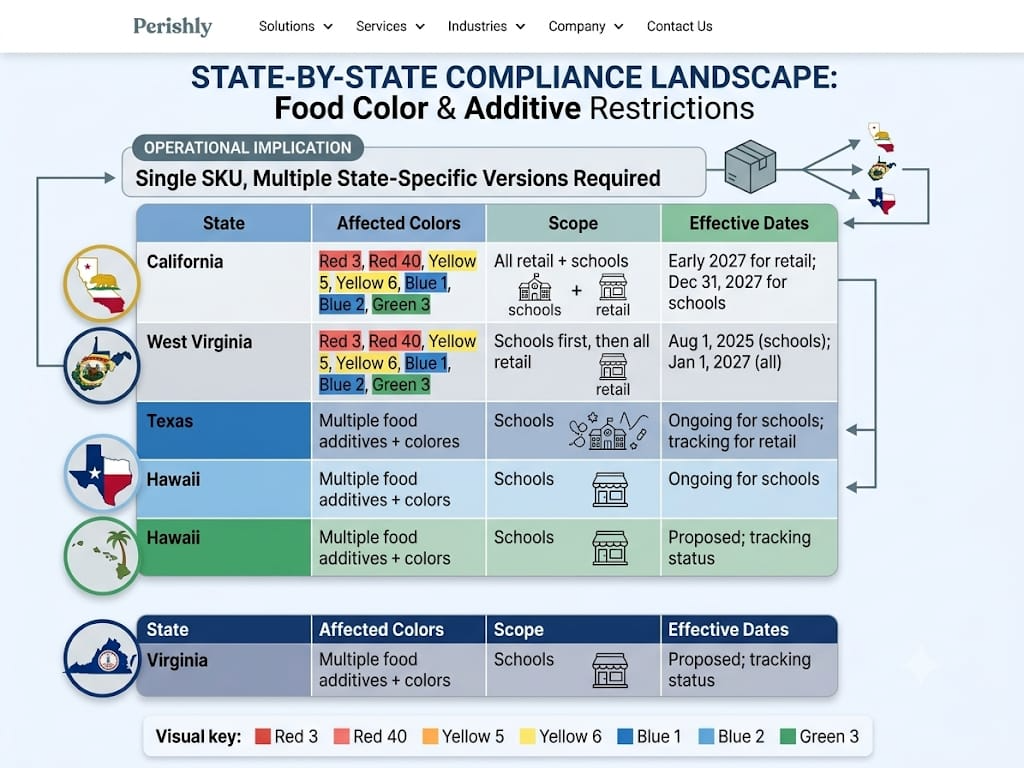
Implication for eCommerce operators, A single product SKU may require different formulations if it ships to school approved channels versus retail channels across multiple states. This means your supply chain strategy, packaging, and distribution tracking all become more complex. Operators without infrastructure for managing channel specific SKU variants risk compliance failures or costly emergency reformulations.
Why Brands Are Reformulating Fast (And Why They’re Struggling)
Consumer Demand Has Already Shifted
Consumers seeking foods free from artificial colors, flavors, and preservatives rose from 54% in 2009 to 69% in 2020. Major brands like Walmart, Kraft Heinz, Nestlé, Hershey, and PepsiCo are already reformulating products to align with clean label standards. However, compliance is not keeping pace, petroleum based synthetic food dyes are still present in almost half of new U.S. food and beverage product launches. This gap between consumer preference and product reformulation represents both risk and opportunity.
Brands that delay reformulation risk losing shelf space to competitors who have already transitioned to clean label alternatives. Conversely, brands that reformulate early and maintain quality and taste can position themselves as leaders in the clean-label shift and command premium pricing if consumers perceive added value.
Reformulation Is Not Just a Label Change
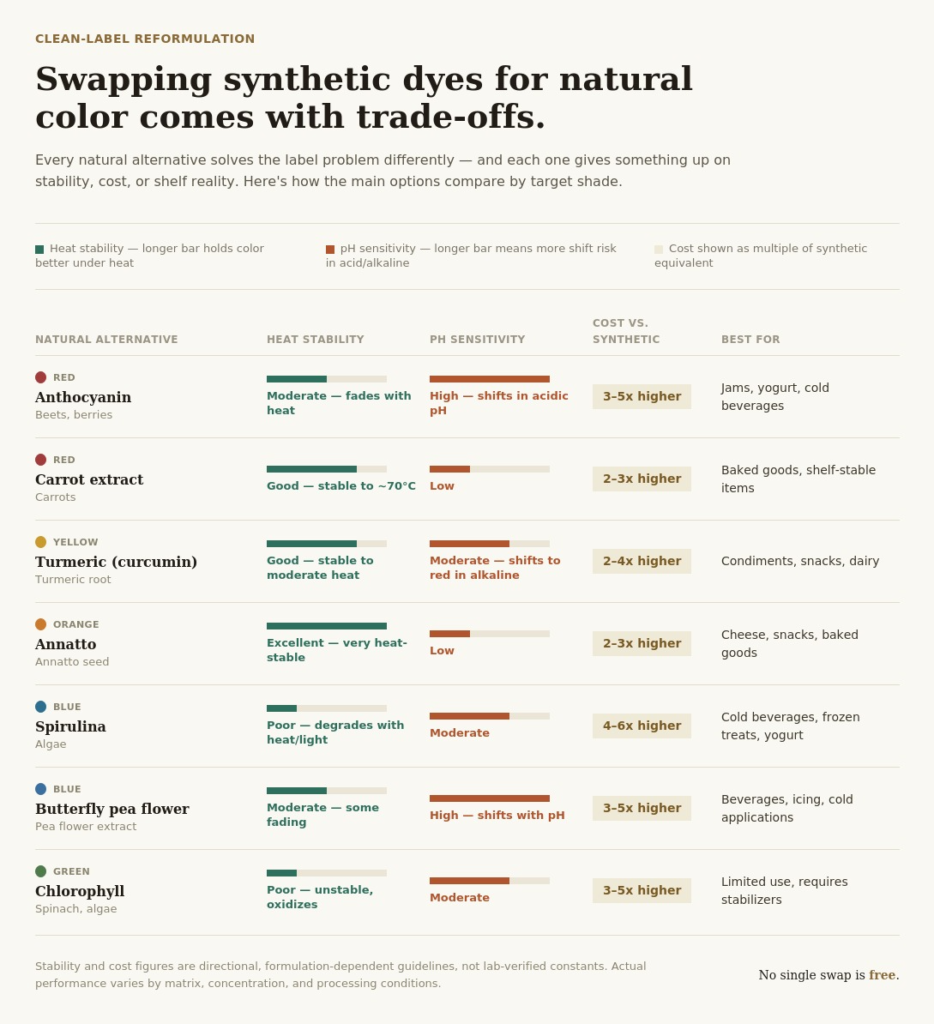
Many operators assume reformulation is simply swapping the synthetic dye for a natural alternative and updating the label. The reality is far more complex. Natural colors behave differently from synthetic dyes. They have different heat stability profiles, pH sensitivity, shelf life consistency, and cost structures. A comprehensive product reformulation strategy accounts for all these variables before moving to production scaling. A red color that works in a cold beverage may fade or shift color in a hot baked good. A blue color stable in neutral pH may turn purple in acidic juice. And nearly all natural colors cost 2–5 times more than their synthetic equivalents.
Consider this real world failure case: A flavor centric CPG reformulated its red-colored gummy line with anthocyanin beet extract without batch testing at scale. The first full production run faded 40% by month 2 of shelf life. The company scrapped 50,000 units and delayed launch by 4 months while sourcing a different red carrot based, which required formula adjustments for flavor impact. Total cost: roughly $2 million in lost inventory, extended timelines, and supply chain rebuilding.
This scenario is not rare. As suppliers scale up production to meet the surge in natural color demand, quality consistency varies. Operators who rush reformulation without rigorous batch testing are betting on consistency they don’t yet have.
Natural Color Alternatives What Works, What Doesn’t, and the Cost
The FDA has approved several natural and nature identical alternatives to synthetic dyes. Here’s a breakdown by color, performance profile, and best use case:
Natural Color Alternatives by Hue and Performance
FDA Approved Newer Options (2024–2025)
In 2024, the FDA approved four new natural colors to ease the transition toward clean label additives: galdieria extract blue algae derived, butterfly pea flower extract, calcium phosphate (white pigment), and Gardenia genipin blue fruit derived. These options offer a broader color range and improved stability profiles compared to first generation natural colors. However, sourcing clean label ingredients at scale remains a challenge, and lead times remain extended.
| Target Color | Natural Alternative | Source | Heat Stability | pH Sensitivity | Cost vs. Synthetic | Best For |
|---|---|---|---|---|---|---|
| Red | Anthocyanin | Beets, berries | Moderate (fades with heat) | High (shifts in acidic pH) | 3–5x higher | Jams, yogurt, cold beverages |
| Red | Carrot extract | Carrots | Good (stable to ~70°C) | Low | 2–3x higher | Baked goods, shelf stable items |
| Yellow | Turmeric (curcumin) | Turmeric root | Good (stable to moderate heat) | Moderate (shifts to red in alkaline) | 2–4x higher | Condiments, snacks, dairy |
| Orange | Annatto | Annatto seed | Excellent (very heat-stable) | Low | 2 – 3x higher | Cheese, snacks, baked goods |
| Blue | Spirulina | Algae | Poor (degrades with heat/light) | Moderate | 4 – 6x higher | Cold beverages, frozen treats, yogurt |
| Blue | Butterfly pea flower | Pea flower extract | Moderate (some fading) | High (shifts with pH) | 3 – 5x higher | Beverages, icing, cold applications |
| Green | Chlorophyll | Spinach, algae | Poor (unstable, oxidizes) | Moderate | 3 – 5x higher | Limited use,requires stabilizers |
Supply Chain Reality, It’s Not Just About the Ingredient
Sensient Food Colors, a division of Sensient Technologies, is scaling up natural color production to fuel the transition in the U.S. away from synthetic dyes. However, natural color suppliers are in high demand. Lead times for custom formulations have extended from 6–8 weeks to 12–16 weeks. Sourcing bottlenecks for key ingredients spirulina, butterfly pea, annatto have created spot shortages and price volatility. Operators who wait until late 2026 may find that their preferred natural color ingredient is unavailable or backordered, forcing costly substitutions or production delays.
The Compliance and Cost Question, What Will This Actually Cost?
Reformulation costs break down into three categories, each with its own timeline and resource requirements:
1. Ingredient and Formulation Adjustment (30–50% of total cost)
This includes the new color ingredient typically 1.5 — 3x the cost of the synthetic equivalent, reformulation labor chemist time, bench testing, supplier qualification, and batch consistency validation. For a straightforward color swap on a single SKU, expect $5,000–$25,000 depending on product complexity. A multi ingredient formulation requiring taste and texture adjustments can exceed $50,000.
2. Stability and Shelf Life Testing (20–35% of total cost)
Natural colors must be tested at scale accelerated shelf life studies heat, light, pH exposure, microbial stability testing, and sensory panel confirmation taste, appearance consistency over time. A standard shelf life study takes 2 – 3 months and costs $3,000–$15,000 per SKU. This cannot be skipped without risking product failures after they reach retail shelves.
3. Regulatory and Compliance (15 – 25% of total cost)
This includes FDA pre-approval or clarification if using novel ingredients, state-specific compliance verification in different states, different rules, label re-approval, and artwork changes. Budget $2,000–$10,000 per SKU. Total reformulation cost per SKU, $10,000–$50,000 depending on product complexity, volume, and testing rigor. For a brand with 50 colored SKUs across multiple states, total reformulation cost could reach $500,000–$2.5 million, excluding inventory write-offs and production delays.
Timeline Reality:
Plan for 12–18 Months, Not 6
- Months 0–3, Supplier qualification, ingredient sourcing, bench testing
- Months 3–6, Formulation finalization and first batch trials
- Months 6–9, Stability testing and regulatory confirmation
- Months 9–12, Production scaling, supply chain validation
- Months 12–15, Inventory transition and market rollout
- Months 15–18, Contingency and market feedback loop
Rushing this timeline leads to production failures, batch waste, and supply chain disruption. Operators who started reformulation in Q1 2025 are just now moving to production scaling. Those starting in Q3 2025 face compressed timelines and will likely miss the December 31, 2026 deadline if ingredient sourcing or testing encounters delays. Effective project management and timeline tracking become critical when managing multiple SKU reformulations across overlapping deadlines.
Multi Market Strategy, Managing State Fragmentation
For operators selling across California, West Virginia, Texas, Hawaii, and other restricted states, a single national formulation may not be viable. The path forward depends on your distribution model, cost structure, and brand positioning. Three strategic approaches exist:
Strategy 1:
Single Formulation Compliant with Most Restrictive State (California)
Reformulate all SKUs to comply with California’s most restrictive standards, then sell the same formulation nationally. This approach aligns with standardized food brand compliance and channel strategy.
Pros, Simplest supply chain, single SKU nationwide, easiest inventory management Cons, Higher cost upfront premium natural ingredients for all markets, slower market entry if reformulation requires extensive testing. Best for, National brands with scale and retail distribution that can absorb reformulation costs and pass increases to consumers
Strategy 2:
Dual Formulation (Restricted States Unrestricted States)
Maintain synthetic dye formulations for unrestricted states, reformulate only for California, West Virginia, Texas, and Hawaii. Pros, Cost optimization, can use traditional dyes in unrestricted states while offering clean label in restricted markets Cons, Supply chain complexity, dual inventory management, potential brand confusion if consumers compare products across states higher operational overhead Best for, Multi brand operators with regional distribution or tiered product lines with budget flexibility
Strategy 3:
Gradual Transition to All Natural Formulation (Phased by SKU)
Sequence reformulation by SKU priority over 18–24 months, spreading cost and timeline. Pros, Spreads cost and timeline; allows for learning and optimization, reduces single point of failure risk Cons, Requires tracking which SKUs are reformulated and when longer overall transition period, supply chain complexity during transition Best for, Operators with large portfolios, strong relationships with suppliers, and budget flexibility for phased spending
Decision Framework, Choosing Your Reformulation Strategy
Step 1:
Map Your Portfolio by Color Dependency. Identify which SKUs contain Red 3, Red 40, Yellow 5, Yellow 6, Blue 1, Blue 2, or Green 3. Categorize by volume, margin, and market reach. High volume, high margin SKUs should reformulate first.
Step 2:
Assess State Specific Distribution Determine what percentage of your volume ships to restricted states California, West Virginia, Texas, Hawaii versus unrestricted states. If more than 40% of volume goes to restricted states, a single formulation strategy is likely more cost effective than maintaining dual inventory.
Step 3:
Evaluate Supplier Readiness. Contact your color suppliers about natural alternatives, lead times, and cost premiums. Get quotes and availability windows for your target ingredients. If a supplier cannot meet your timeline with your target color, identify secondary sources immediately.
Step 4:
Run Pilot Batches. For your top 3–5 SKUs, run small pilot batches with natural alternatives before full-scale reformulation. Test for stability, taste impact, and visual consistency. Budget 8–12 weeks for pilot completion.
Step 5:
Establish a Phased Timeline. Map out which SKUs reformulate in Q1 2026, Q2 2026, Q3 2026, and Q4 2026 before the December 31, 2026 FDA phase out deadline. This spreads cost and risk and allows for learnings from early pilots to inform later reformulations.
Step 6:
Lock in Supply Agreements. Once you’ve identified your target natural colors, negotiate long term supply agreements with your ingredient suppliers to lock in pricing and availability through 2027. Commodity price volatility and supply constraints are real long term agreements provide cost certainty.
What Operators Are Actually Doing, Patterns from the Field
Across implementations supporting reformulation projects, three operator archetypes are emerging:
Archetype 1:
The Early Movers (Started Q1 2025). These operators completed bench testing and are in the production scaling phase. They’re managing supply chain sourcing and cost absorption proactively. Reformulated SKUs will reach shelves by Q3–Q4 2025, ahead of competitors. They’re gaining brand positioning advantage with clean label marketing and building consumer trust before state deadlines compress the market.
Archetype 2:
The Middle Followers (Starting Q3–Q4 2025). Currently in supplier qualification and pilot batch phase, facing tighter timelines and potential supply shortages if ingredient sourcing encounters delays. They may need to absorb premium pricing for expedited natural color ingredients. Expected reformulation completion, mid-2026.
Archetype 3:
The Late Stage Reformulators (Starting 2026). Waiting for more data, testing clarity, or market proof before committing. They run the risk of supply chain constraints and ingredient availability bottlenecks as the December 2026 deadline approaches. Compressed timelines and higher costs emergency sourcing, expedited testing are likely. They may miss the competitive positioning window entirely.
Pattern observation, Operators in Archetypes 1 and 2 are treating reformulation as a supply chain and go to market event, not a compliance checkbox. They’re mapping ingredient costs against price increases they can sustain without demand destruction. They’re coordinating with retailers on shelf space and marketing support during transition. They’re using reformulation as a brand positioning play now with natural colors. They’re planning inventory runway carefully to minimize write offs.
FAQS
Do I need to reformulate if I only sell to states without restrictions?
Yes. The FDA’s plan to phase out six synthetic dyes by December 31, 2026 applies nationwide. If your product contains:
Red 40
Yellow 5, Yellow 6
Blue 1, Blue 2
Green 3
you will need to reformulate by December 2026, regardless of which states you sell to. State restrictions create additional complexity only if you have a multi state distribution.
Can I just add natural color to my existing formula, or do I need to change the recipe?
Most likely, you’ll need to reformulate. Natural colors have different stability profiles, pH sensitivity, and heat resistance properties than synthetic dyes. Adding a natural color to a formula designed for synthetic dyes often results in color fading, shifts, or off flavors. Budget for bench testing and potentially ingredient adjustments (pH buffers, antioxidants) to ensure shelf life consistency.
How much will reformulation cost, and how do I know what’s reasonable?
Expect $10,000–$50,000 per SKU for full reformulation, testing, and regulatory confirmation depending on product complexity. Get quotes from at least two color suppliers and one contract lab for shelf life testing to establish reasonable benchmarks. Don’t skip stability testing to save cost; production failures in market are far more expensive.
If I reformulate now, will my new formula still be allowed in 2027?
If you reformulate with natural colors approved by the FDA spirulina, butterfly pea, annatto, turmeric, carrot extract, beet extract, and 2024–2025 approvals, your product will be compliant through 2027 and beyond. Verify with your supplier that the specific natural color ingredient is FDA compliant and approved for your application beverage versus baked good, for example.
What if my supplier can’t source the natural color I want?
Lead times for natural colors have extended due to high demand. If your supplier cannot meet your timeline, contact secondary suppliers immediately Koel Colours, Sensient Food Colors, Prinova, Gillco, or specialty ingredient distributors. Be prepared for price premiums if you need expedited sourcing. Alternatively, consider a color change e.g., switch from red to orange to use annatto, which has better supply availability.
Conclusion
The FDA’s synthetic dye phase out is not a future risk. It’s an active regulatory event reshaping the F&B supply chain right now. State level fragmentation means there’s no single one size fits all compliance strategy. The brands that preserve margin and positioning are those that treat reformulation as an integrated supply chain and go to market decision, start early, run pilot batches, lock in supply agreements, and phase the transition strategically.
For F&B eCommerce operators, reformulation is not a distraction from core operations. It’s a supply chain event that intersects with ingredient sourcing and supply chain strategy, production scheduling, inventory management, and distribution. The operators who start now will have reformulated SKUs on shelf by Q4 2025, gaining first mover brand positioning before competitors compress into the same supply chain bottlenecks. Those who wait until 2026 will face cost inflation, ingredient scarcity, and production delays as multiple brands compete for limited natural color supplies.
Your regulatory timeline is clear. Your cost framework is documented. The decision framework is actionable. The only question left is whether you’re an Early Mover, a Middle Follower, or a Late-Stage Reformulator. Each carries different competitive outcomes.
