
Your first shipment arrives thawed. Your payment processor rejects 40% of month 2 renewals due to failed retry logic. Your month 3 retention drops to 28%. By month four, you’re gone. Good Ranchers hit this wall in 2024, ButcherBox didn’t, because they had built something before the first customer ever came.
- $150–$400+ Average unit value per box magnifies the cost of every fulfillment failure
- 5–15% Refund and reship rate in peak fulfillment seasons enough to erase margin from 20–50 successful orders
- 50% Billing failure rate that forced Good Ranchers to abandon their homegrown subscription system and migrate entirely
- 44% Of subscription box customers who cancel within 90 days the industry cliff, not a growth anomaly
Key takeaways:
- Cold chain failures aren’t edge cases, they’re structural to DTC meat’s unit economics and can erase the margin from dozens of successful orders
- 50% of subscription billing failures come from payment processing, not customer choice the wrong platform can cost you 15–20% of cohort retention in month 2 alone
- The month 3 churn cliff 60–70% customer loss by order 3 is driven by infrastructure gaps, not product taste and it’s baked in before most operators realize it
Why Cold Chain Failures Erase Profitability
One compromised shipment erases the margin from 20 50 successful orders. That’s not hyperbole, it’s the math that separates surviving DTC meat operators from the ones who pivot to retail.
The vulnerability is structural. Unlike consumable subscriptions (coffee, deodorant, vitamins), meat subscriptions face three compounding constraints. First, unit value is punishing, a single box contains $150–$400+ in premium cuts. Second, frozen requirements are strict. Refrigeration isn’t enough. Even partial thawing degrades texture, safety perception, and product quality. Third, delivery is uncontrollable. Porch exposure, missed attempts on Fridays, heat waves during summer, and carrier mishandling all shift risk to the brand. This is why understanding your cold chain shipping strategy from the start is non negotiable it shapes your entire operational model.
The math on failure costs is relentless. According to operator data from companies bringing dry ice production in house, refund and reship rates of 5–15% in bad seasons can quietly devastate profitability. Most operators model averages. Few account for exception volume adequately and exception volume is where margins go to die.
Here’s what that looks like in practice:
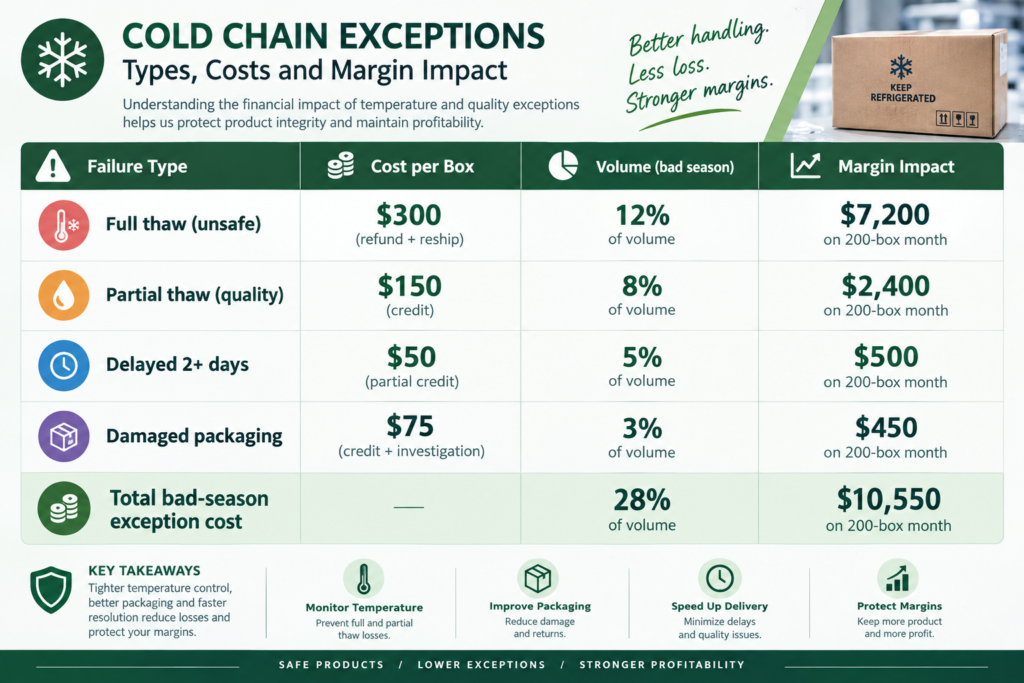
For a brand shipping 200 boxes per month with a 25% gross margin, that $10,550 in exceptions wipes out roughly two months of profit. One bad fulfillment season, a heat wave in July, a carrier service disruption in August can set growth back by months.
Most DTC meat brands under ice shipments by modeling averages, not worst case transit time, heat exposure, and exception volume. Operators who’ve audited their sublimation loss in detail find they were losing margin consistently month over month without ever isolating why.
The asymmetry is brutal, a brand carefully models carrier rates and packaging costs, then overlooks exception volume. The result is that cold chain decisions made before launch whether you own fulfillment, which carrier you choose, how you handle exceptions determine profitability more than product quality or marketing spend.
The Subscription Billing Trap, Good Ranchers’ Reckoning
Good Ranchers built a strong brand and sourcing story. They grew in a market hungry for premium American beef. Then they hit a wall that had nothing to do with meat.
In 2024, Good Ranchers was only processing 50% of their subscriptions because their homegrown billing system couldn’t handle renewal volume. That’s not a typo. Half their revenue stream was failing silently month after month. They didn’t realize it until cash flow collapsed and customer support began tracking the pattern of failed charges.
The mistake wasn’t stupidity. It was the assumption that billing was infrastructure they could iterate on. Most founders build products (sourcing, cuts, boxes) and defer platform decisions until scale forces them. By then, the damage is compound, customers churn because payments fail, the brand assumes churn is voluntary, retention efforts fail because they’re targeting the wrong problem.
The core issue is involuntary churn. Industry research shows that 30–40% of total subscription churn is just billing failure and pure infrastructure failure. Customers didn’t choose to cancel, their card declined, the platform didn’t retry intelligently, and the subscription died. A brand that catches this early can recover 40–70% of that cohort with smart retry logic. A brand that doesn’t realize it’s happening loses them forever.
Good Ranchers’ solution was to migrate to Shopify and a dedicated subscription app. That migration gave them a 10% lift in subscription adoption and 48% year over year growth. That growth didn’t come from better marketing or better meat. It came from processing 100% of their billings instead of 50%.
The lesson is different for operators building before launch: don’t deploy a homegrown subscription stack. Choose a platform (Shopify, Recharge, Bold, Subbly) that has involuntary churn recovery baked in. Test it before accepting your first payment. Measure what percentage of failed payments get recovered on retry, and target 40%+ recovery as a minimum bar.
What Good Ranchers learned, Billing infrastructure is not optional tech debt it’s product design. It shapes customer experience more than anything you control directly, and failures compound invisibly until cash flow becomes the symptom.
Month 3 Churn Cliff, What Industry Data Shows
There’s a universal pattern in subscription data. It’s not unique to meat. It shows up in meal kits, beauty boxes, pet food any category. The curve looks the same: retention plummets between order 1 and order 3, and then, if the customer survives the cliff, they stabilize.
The pattern is stark. 44% of subscription box cancellations happen in the first 90 days. Month 3 retention drops to 30–35% across most food subscription categories. Those aren’t customers changing their minds about the product. That’s infrastructure failure plus missing activation. For meat subscriptions specifically, the month 3 cliff looks like this:
- Month 1, 65–70% retention immediate post purchase buyers stay, deal seekers churn fast
- Month 2, 50–55% retention voluntary churn from deal seeking tier, first involuntary failures
- Month 3, 30–40% retention compound involuntary failures + failed reactivation attempts
The steepest drop happens between month 2 and month 3. That’s where unprepared infrastructure becomes visible. Here’s why:
Involuntary churn compounds. A failed payment in month 1 might get caught on a retry. A failed payment in month 2 might not. By month 3, the customer has received retry notices, lost patience, and either self cancels or stops trying to update their payment method. That customer is gone.
Retention mechanics activate too late. Pause before cancel isn’t deployed until month 2 or 3, after customers have already decided to leave. Skip/swap options launch in month 4, after retention cohorts are already damaged. By then, the curve is locked in.
Product quality doesn’t fix infrastructure. The month 3 cliff isn’t about taste. ButcherBox and Good Ranchers both ship premium meat. Yet Good Ranchers hit a 50% billing failure rate while ButcherBox sustained growth. The difference wasn’t product, it was infrastructure.
The operator takeaway is harsh, the month 3 cliff is baked in before your first customer ships. You don’t prevent it with better retention tactics in month 4. You prevent it with the right billing platform in month 1, dunning workflows designed before launch, and pause mechanics in the signup flow from day 1.
Three Pre-Launch Infrastructure Decisions
Before you make any of these decisions, ensure you understand the foundational requirements for selling meat online, including regulatory compliance and baseline operational needs.
Decision 1. Cold Chain Sovereignty vs Outsourcing:
Build or outsource? The trade off matrix is financial and operational. Outsource contracted logistics partner:
- Capital, $0 upfront
- Operational control, Low you negotiate SLAs, but failures still hit your brand
- Scalability, Carrier has limits, you’re subject to their pricing escalation
- Risk, Exception rates of 5–15% depend on carrier quality and accountability
Sovereign fulfillment own facility + dry ice production:
- Capital, $40–100K upfront for equipment, testing, compliance
- Operational control, High you manage exceptions, sublimation loss, inventory
- Scalability, You scale as you grow, no surprise capacity constraints
- Risk, You own the full cost of failures
Here’s the decision threshold, model your peak season volume and failure rate. If 5–15% exception volume costs you more than dedicated dry ice infrastructure, ownership pays within 18–24 months. If you ship fewer than 500 boxes per month, outsource aggressively and negotiate SLAs hard. Above 1,000 boxes per month, capital investment in ownership typically breaks even and then compounds margin recovery.
Negotiation with a carrier requires specificity. Define failure thawed, damaged, delayed >2 days. Set SLAs max 3% loss rate. Audit quarterly. If they breach SLA, charge them the refund cost. If they breach twice, change carriers.
Decision 2. Subscription Billing Platform Selection:
This decides your month 3 retention more than anything else. Non negotiable requirements:
- Involuntary churn recovery: Can the platform retry failed payments with smart timing and decline code branching?
- Account updater enrollment: Will it auto refresh expiring cards?
- Dunning workflows: Can you customize retry cadence and customer messaging?
- Reporting: Can you segment voluntary vs involuntary churn separately?
Test before launch. Run a sandbox test: simulate 1,000 renewals with 5% failure rate. Measure recovery. Target 40%+ recovery of soft declines insufficient funds, temporary issuer holds, velocity checks. This single metric predicts month 3 retention better than any marketing tactic.
Platforms worth evaluating, Shopify with Recharge or Bold, Subbly, or a standalone Recharge/Ordergroove deployment. Avoid homegrown solutions. Avoid platforms that retry once per day at the same time for all failed payments. Those leave money on the table.
Decision 3. Retention Mechanics (Designed Before Launch):
Most brands treat retention as a month 3 problem. Deploy pause-before-cancel in month 4. Run a discount recovery email in month 5. By then, the cohort is already damaged. Design retention into the signup flow:
- Pause window definition. Allow customers to pause (not cancel) for 2–8 weeks penalty free. Communicate this in a welcome email and in the cancellation flow. Data shows 25% of would be churners choose pause when it’s presented as the default option.
- Failed payment notification. When a payment fails, email the customer the same day with a one click payment method update link. No login required. This catches 50%+ of soft declines on first contact.
- Activation sequence. First 14 days, send three emails, welcome + first shipment timing, day-7 prep make sure you’re home, day 10 shipment confirmation. These drive engagement in the critical retention window.
- Customization mechanics. Offer skip/swap/customize in the first 7 days. Tell customers they can adjust, pause, or swap cuts anytime. This gives people control and reduces the impulse to cancel.
- Cohort monitoring. Track retention by signup cohort, not blended rate. Set alerts if a cohort’s month 2 or month 3 retention bends sharper than plan. Intervene with customer research don’t guess.
Building the Numbers, Unit Economics and Breakeven
A DTC meat subscription breaks at different thresholds than coffee or consumables. Unit value magnifies every failure. Understanding the full cost structure and profitability drivers of DTC beef operations is critical before you commit capital to fulfillment infrastructure.
Here’s the input stack for a 200 box per month operation:
| Line Item | Per Box | 200/month |
|---|---|---|
| COGS (meat, processing) | $65 | $13,000 |
| Packaging (insulated box, vacuum seal, labels) | $8 | $1,600 |
| Dry ice (sublimation + margin) | $12 | $2,400 |
| Cold chain logistics (carrier rate + exception reserve) | $22 | $4,400 |
| Payment processing (Shopify, app fee, payment gateway) | $6 | $1,200 |
| Subscription platform fee | $2 | $400 |
| CAC allocation (prorated annual budget) | $35 | $7,000 |
| Total cost per box | $150 | $30,000 |
| Revenue per box (average subscription price) | $180 | $36,000 |
Your pricing strategy should reflect these cost drivers. Understanding how to price beef subscriptions in the current market environment ensures your margin assumptions are realistic before launch. Gross margin per box, $30 $6,000 Gross margin% , 16.7%
Now layer in the exception rates from the failure table above. In a bad month, 28% exception volume costs, $10,550. That wipes out your entire month’s gross margin $6,000 budget + $4,550 into reserves.
This is why cold chain and billing infrastructure decisions made before launch are the make or break factor. A 5% reduction in exception volume translates to $3,000 more margin per month, $36,000 per year. That’s 25% margin improvement without changing COGS, pricing, or CAC.
Similarly, a 2% improvement in month 3 retention from 35% to 37% retention extends average customer lifetime from 2.8 months to 3.5 months, a 25% LTV lift. That’s worth 2–3 extra months of growth in year 1 without acquiring a single new customer. Infrastructure ROI compounds faster than marketing ROI. Nail the infrastructure, then market.
Pre-Launch Infrastructure Checklist
Step 1:
Cold Chain Audit and SLA Definition. Map transit time, heat exposure, sublimation loss. Decide: sovereign fulfillment or contracted partner with performance guarantees. If outsourced, set exception thresholds max 3% loss rate and audit triggers quarterly. Verify your inspection requirements state vs USDA are factored into your logistics plan inspection costs vary significantly by processing location and inspection type.
Step 2:
Subscription Platform Selection and Testing. Select billing provider (Shopify + Recharge, Bold, or Subbly). Run sandbox tests simulate 1,000 renewals with 5% failure rate. Measure recovery. Target 40%+ recovery of soft declines before launch. Confirm your interstate shipping regulatory status and USDA inspection requirements are locked in before you commit to a carrier strategy.
Step 3:
Retention Mechanics and Dunning Policy. Define pause window, retry cadence, and customer communication sequence. Template messaging for day 1, day 7, and first renewal windows. Activate skip/swap/customize options in the first 7 days if using them.
Step 4:
Payment Method Enforcement. Require account updater enrollment at signup auto refresh expiring cards. Route soft vs hard declines to different retry strategies. Set SMS notification for high risk renewals.
Step 5:
Cohort Retention Tracking and Alerts. Establish baseline targets month 1, 65%, month 3, 40%, month 6, 30% as planning ranges. Set automated alerts if cohort curves bend sharper than plan. Distinguish voluntary vs involuntary churn from day one.
Step 6:
Carrier Accountability and Exception Handling. Map refund/reship SLA and cost split with the carrier. Define failure thawed, damage, delay >2 days. Automate customer communication and credit issuance for predefined failure codes.
FAQS
How do I know if I should bring dry ice fulfillment in the house?
Model your peak-season volume and failure rate. If 5–15% exception volume costs you more than dedicated dry ice infrastructure, ownership pays within 18–24 months. If you ship fewer than 500 boxes per month, outsource and negotiate SLAs. Above 1,000 per month, capital investment typically breaks even.
What’s the difference between a good subscription billing system and a bad one?
Good systems recover 40–70% of failed payments through smart retries, account updater enrollment, and soft decline branching. Bad systems retry once per day at the same time and write off the rest. Test before launch: simulate 100 failed payments and measure recovery. This metric predicts month 3 retention better than marketing.
Why do so many meat subscriptions fail in the first 90 days?
44% cancel within 90 days across the box category. Of those, 30–40% are involuntary failed payments or missed reactivation. The rest are voluntary but often triggered by delivery friction. Pre-launch infrastructure design directly controls both.
Can I launch with a homegrown subscription system and upgrade later?
No. Good Ranchers migrated mid scale after hitting 50% billing failure. Migration is expensive development, customer communication, churn spike. Build the right infrastructure before launch. Platform migration is a tax on growth you can avoid.
What’s the minimum infrastructure spend before I accept the first order?
Subscription platform $300–2,000 per month, cold chain qualification $5–15K for compliance and testing, and contingency capital 2–3 months of expected refund volume in reserves. For a 500 box per month operation, budget $15–30K pre-launch. For 2,000+ per month, budget $40–60K.
Conclusion
The operators who scale meat subscriptions aren’t the ones with the best marketing or the most premium sourcing story. They’re the ones who made three unglamorous infrastructure decisions before accepting a single customer.
Cold chain sovereignty or a carrier SLA you’re willing to enforce. A billing platform that recovers involuntary churn. Retention mechanics designed into signup, not added in month 4. These choices cost capital and focus upfront. They also cost nothing compared to the alternative, a cohort that never reaches month 3, margins erased by exceptions, and a brand that pivots to retail because subscription profitability stays out of reach.
You can’t build your way out of bad infrastructure with better marketing. But you can build your way to profitability by choosing infrastructure carefully before launch. That’s where the operators who survive and scale diverge from the ones who don’t.
