
The Federal Milk Marketing Order Reform Just Changed How Dairy Is Priced What Small Producers Need to Build Into Their Online Pricing:
- $337 Million Lost pool value in the first three months June–August 2025 across all 11 FMMOs, with regional variation from +$1.40 to – $0.78 per hundredweight
- 17 Years Since the last comprehensive FMMO reform 2008, making this the most significant pricing overhaul in nearly two decades
- 5 Categories Of pricing formula changes affecting how minimum milk prices are calculated, make allowances, barrel cheese removal, Class I mover, location differentials, and composition factors
- 6 Months Implementation lag on skim milk composition factor updates June 1 to December 1, 2025, creating two distinct pricing periods for your COGS forecasting.
Key takeaways:
- Make allowance increases directly decrease butterfat and protein values composition factor updates partially offset this, with timing and regional location determining net impact on your COGS.
- The shift from average to higher of Class I pricing benefits fluid milk producers in high utilization regions but disadvantages others, your FMMO region determines whether you gained or lost.
- Small producers sourcing commodity milk must forecast region specific cost changes before Q4 2025 to adjust online pricing defensively and avoid margin compression
Why FMMO Reform Matters to Your Online Pricing Strategy
You don’t pool milk in a Federal Milk Marketing Order, but the prices those orders set cascade directly into your input costs. Here’s how.
The FMMO system, established in the 1930s, sets minimum prices paid to dairy farmers across 11 U.S regions. These minimum prices are calculated using formulas based on wholesale dairy product prices. When the FMMO adjusts its formulas, it ripples through commodity milk markets, affecting what processors pay for milk and what they charge you for sourced dairy ingredients. Understanding your broader dairy operational and supply chain model is essential context for understanding FMMO impact on your COGS.
If you bottle milk for online sale, your sourced milk price tracks Class I fluid milk pricing. If you make cheese, your milk input cost follows Class III pricing. If you resell packaged yogurt, your supplier’s wholesale price is embedded in their COGS, which is tied to their regional FMMO milk costs. Your product positioning whether you differentiate on pasteurization, sourcing, or processing claims shapes your pricing power and ability to absorb or pass through commodity cost changes.
The June 2025 reform changed five components of those formulas simultaneously the biggest overhaul since 2008. This matters to you because commodity milk pricing is now more volatile, regional impacts are asymmetric, and your COGS trajectory depends on which region your supplier operates in. Compliance with dairy standards of identity is a parallel operational requirement that also affects your product costs and online positioning strategy.
What is FMMO pooling and why should a DTC producer care? FMMOs create a pool where revenues from all classified milk Class I–IV are combined and redistributed as a weighted average producer price blend price. Individual producer prices vary by milk component value butterfat, protein, solids and classification. When FMMO formulas change, the pool value changes, affecting how much processors pay for milk, which cascades into your sourced ingredient costs. You don’t operate the pool, but you’re downstream of it.
The Five Pricing Changes Explained Make Allowances, The Biggest Cost Shock
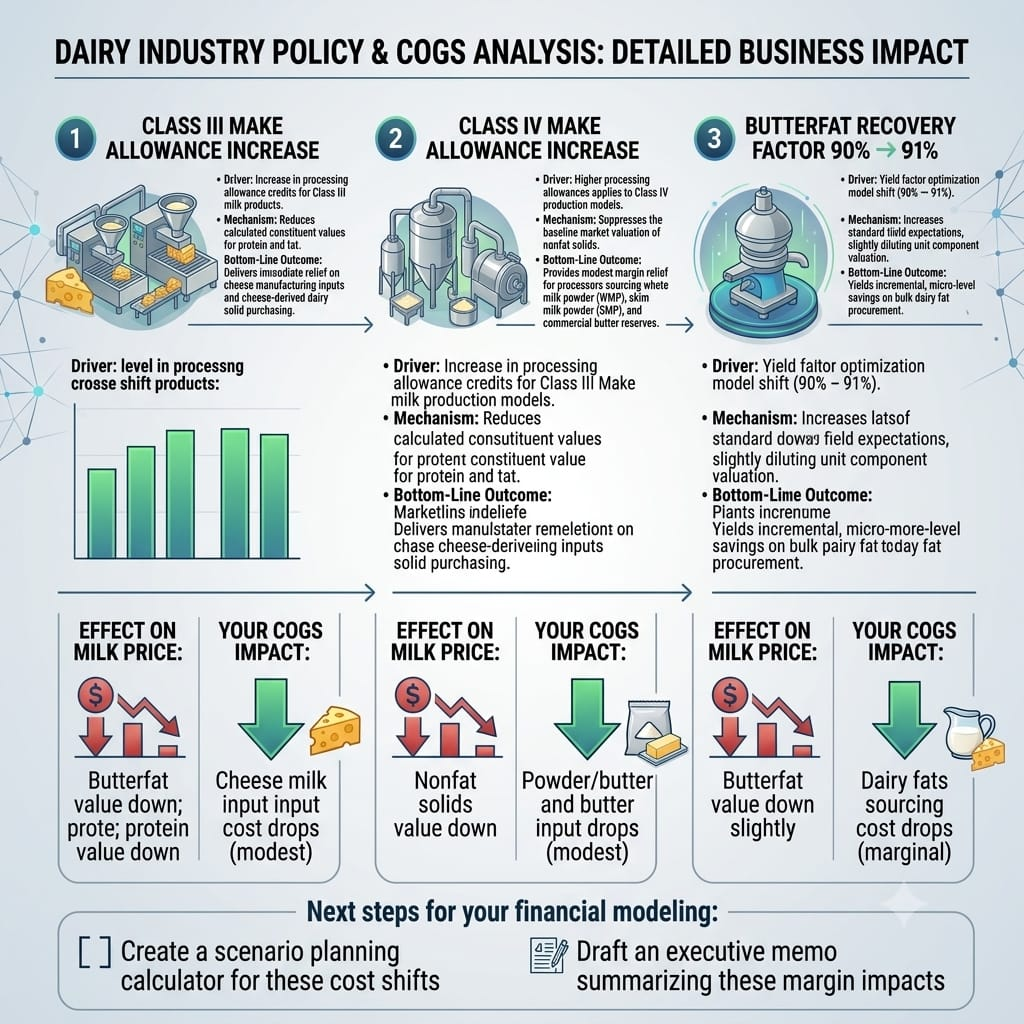
The FMMO formulas account for manufacturing costs and the expense to process milk into butter, cheese, whey, and powder. These costs are called make allowances. For the first time since 2008, the USDA updated them.
Make allowances increased. This sounds good for processors lower net cost per unit produced but creates a negative effect in the milk pricing formula. Higher make allowances reduce the calculated value of butterfat, protein, and other milk solids. Lower component values mean lower minimum milk prices.
In the first three months under the new rules June–August 2025, farmers lost more than $337 million in combined pool value, with Class price reductions ranging from 85 to 93 cents per hundredweight. That’s the make allowance shock hitting the market.
For you, if you source milk from processors, their input costs drop slightly. Some of that savings may flow to you as a lower wholesale ingredient price but only if your supplier passes through the savings. Ask directly, Did the June 2025 FMMO change affect your milk costs? Their answer determines whether your COGS improved.
Barrel Cheese Removal, The Nuance:
The USDA survey that generates Class III milk prices used to price milk for cheese production previously included prices for 500-pound barrel cheddar cheese. Barrels are commodity traded, volatile, and don’t represent how much cheese makers actually sell. The reform removed barrels from the survey. Now only block cheese prices and the standard retail format are used.
Effect, modestly increases protein values in the Class III formula. This partially offsets the make allowance decrease. For you, if you make cheese or source cheese milk, this change slightly helps but the make allowance decrease overwhelms it. The net effect is still negative for component values, with the magnitude varying by region.
Class I Mover Change, Fluid Milk Gets a Lift:
The formula for Class I fluid milk pricing changed from average of (Class III and Class IV prices to higher of Class III and Class IV) prices. Why? When commodity prices spike, one of those classes (Class III or IV) will spike higher. Using the average muted that signal. Producers missed price recoveries, and the market sent weak price signals. Returning to higher or higher captures spikes faster and more accurately. Effectively, Class I prices now benefit more in volatile commodity markets. Fluid milk producers see better pricing during upswings.
For you, if you bottle milk for online sale, this reform helped. Your sourced fluid milk is now priced more favorably during commodity commodity price spikes. However, this benefit is asymmetric by region. Regions with high Class I utilization Appalachian, Southeast, Florida, Arizona benefit more than regions focused on manufacturing milk.
Location Differentials, Regional Pricing Variation:
Class I prices vary by location and transportation cost adjustment. The reform updated these differentials nationwide. Some regions gained, others lost. Here’s the impact by region based on December 2025 actual data:
| Region | FMMO | Change per cwt | Impact |
|---|---|---|---|
| Florida | Southeast | +$1.40 | Gain |
| New York | Northeast | +$1.40 | Gain |
| Wisconsin | Upper Midwest | –$0.78 | Loss |
| California | California | –$0.60 | Loss |
| Arizona | Arizona | –$0.52 | Loss (smallest) |
Why the variation? Transportation costs, processor capacity, and Class utilization. Regions with higher Class I utilization more fluid milk production benefit from the Class I pricing improvements. Regions focused on manufacturing (cheese, powder) are hurt by make allowance increases.
For you, your region determines whether the reform helped or hurt your input costs. If you source from Wisconsin or California, expect slight COGS decreases to make allowances down outweigh location differential losses. If you source from Florida or New York, expect slight COGS increases location differential gains don’t fully offset make allowance losses.
Composition Factors,The Delayed Implementation:
Skim milk composition factors the assumed percentage of protein, other solids, and nonfat solids in skim milk weren’t updated since before 2008. The reform updated them:
- True protein: 3.1% → 3.3%
- Other solids: 5.9% → 6.0%
- Nonfat solids: 9.0% → 9.3%
Effect, increases calculated skim milk value slightly. Implementation, (December 1, 2025) six month delay from (June 1). Why? Processors need time to adjust risk management and testing protocols.
Mark your calendar. December 1, 2025 triggers the second pricing wave. The make allowance shock is June–November. The composition factor relief begins in December. Your Q4 2025 pricing strategy must account for both periods separately. Model your COGS under both scenarios June pricing and projected December pricing to set a pricing bracket for customer communication.
How Commodity Milk Pricing Cascades Into Your COGS
Understanding the cascade is critical. FMMO minimum prices are regulated floor prices, actual market prices usually exceed them. But the minimum price sets the economic baseline for processors, which flows into what they charge you. The flow, FMMO minimum prices (by class) → Commodity milk market adjusted for supply/demand → Processor cost of goods → Processor wholesale price to you → Your packaged product COGS
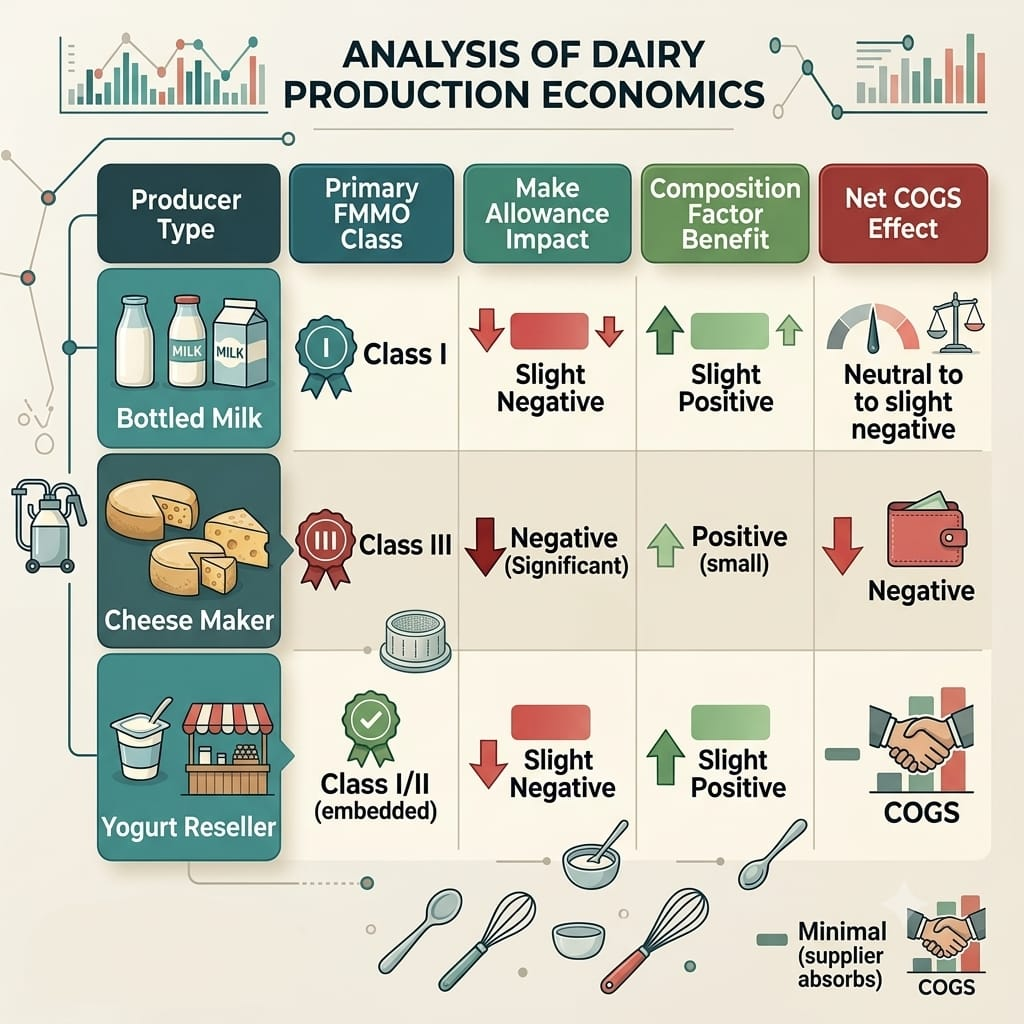
Three producer types experience this differently:
- Bottled milk producers. You source from a processor or bottler. Their cost of goods is primarily Class I milk. The shift from average to higher of Class I pricing helps you lower processor COGS. Their wholesale price to you should reflect this.
- Cheese makers. You source milk or whey. Your cost of goods is primarily Class III milk. Make allowances directly hit your input cost (negative). Composition factors help positive, but small. Net effect, slight COGS increase. Understanding regulatory requirements is equally critical, compliance affects your operational costs and must be factored into pricing alongside commodity milk changes.
- Yogurt resellers, You source packaged yogurt from manufacturers. Their COGS includes milk (Class I or II depending on yogurt type). Your wholesale price is embedded with all their cost pressures. You don’t see direct FMMO impact, but it’s hidden in your supplier’s pricing.
Most small producers don’t track FMMO formulas they track supplier prices. But supplier prices lag formula changes. You’ll see the FMMO impact in your Q3 2025 invoices June changes and again in Q4 2025 composition factors.
Regional Impact Map, Who Gained, Who Lost
The FMMO reform was national, but impacts were hyperlocal. Producers in fluid milk focused regions Southeast, Florida, Arizona, Appalachian faced a positive Class I mover change. But making allowance losses and location differential adjustments muted that gain. Net, minimal change or slight loss in many fluid milk regions.
Producers in manufacturing focused regions Upper Midwest Wisconsin, Minnesota California, faced make allowance losses without sufficient Class I gained they focus on cheese and powder, not fluid milk. Net, clear losses. In reality, Wisconsin cheese makers and California bottlers faced higher commodity input costs. Florida and New York fluid producers faced marginal changes, gains and losses offset. Arizona producers faced small losses.
Over five years, models project an average impact of $0.07/cwt lower milk prices across all orders as production adjusts to new economics. For you, audit your milk sourcing location. If you’re sourcing from Wisconsin, your COGS benefited slightly. If you’re sourcing from Florida, your COGS was pressured slightly. Mixed sourcing? Calculate the weighted impact.
Pre-Composition Factor Pricing Decisions
You have until December 1, 2025 to make five critical decisions. After composition factors are implemented, the pricing landscape shifts again.
Step 1. Audit Your Input Cost Exposure by FMMO Region:
Identify which milk marketing order affects your milk sourcing. Your processor or supplier can tell you. Map the June 1 impact on your specific ingredient costs. If you source from multiple regions e.g., Wisconsin milk for cheese, Florida milk for bottled yogurt, model the impact separately per region. Action, Call your supplier and ask, What did the June 2025 FMMO reform cost you? Their answer is your answer.
Step 2. Recalculate Your Packaged Product COGS:
Update your ingredient cost model with June 2025 data. If you source commodity milk at new prices, your cheese, yogurt, or bottled milk COGS has shifted. Calculate the net COGS change: make allowance decrease + composition factor increase coming Dec 1 + location differential impact. Action, Build a three scenario model: June pricing, December pricing with composition factors, and blended year end average. Use these to forecast margin pressure.
Step 3. Adjust Online Pricing Pre-December 1:
The composition factor implementation Dec 1, 2025 will trigger a second pricing shift. Establish your new online prices before Q4 2025 to avoid reactive margin compression. Model both scenarios current June prices and forecasted Dec prices to set a pricing bracket. Action, Communicate pricing changes to customers in November, effective December 1. Frame as supply chain cost adjustment due to federal milk pricing updates. Transparency builds trust, surprise price hikes erode it.
Step 4. Lock in Supplier Price Terms Through Q4:
If sourcing from processors, negotiate supply agreements that pass through or cap FMMO formula changes. Understand whether your supplier has already adjusted wholesale prices to you, if not, they will by November. Get ahead of it. Action, Request a FMMO pass through agreement that ties your ingredient cost to the specific formula changes. This protects you from processor margin expansion.
Step 5. Monitor Regional Depooling Trends:
Track whether higher make allowances trigger depooling in your region. Depooling occurs when commodity prices spike and producers pull milk out of the FMMO pool to sell directly to processors for higher prices. This creates commodity price volatility, which cascades into your input costs unpredictably. Action, Subscribe to your region’s FMMO reporting available from USDA AMS. Watch for depooling trends in Q3 and Q4 2025.
Step 6. Set Customer Communication Strategy on Price Increases:
If FMMO changes increase your COGS materially, decide whether to absorb, pass through, or blend. Transparency on supply chain cost drivers builds credibility with DTC customers. Premium positioning grass fed, organic, artisan, allows price increases; commodity positioning requires margin absorption. Action, Draft two customer communication templates, No price increase if you can absorb and Modest price increase due to supply chain costs if you must pass through. Test the second one if margin pressure is >5%.
FAQS
How do I know if the FMMO reform affected my COGS?
Identify which FMMO region your milk source operates in. Check whether your supplier raised prices between June and August 2025. If sourcing milk from Wisconsin is a major loss region, your input costs likely dropped slightly due to allowance decreases and high utilization of manufacturing milk classes. If sourcing from Florida or New York gain regions, your costs likely rose due to Class I pricing improvements. Ask your supplier for the specific price change it should correlate to the formula update.
When does the composition factor change take effect?
December 1, 2025. Most of the June 1 changes are already live make allowances, barrel cheese removal, Class I mover, differentials. The composition factor update is the second wave, taking effect in six months. It modestly increases skim milk values, which helps most packaged dairy producers. Plan your Q4 2025 pricing adjustments around both dates June impact and December impact are distinct.
How do I explain these pricing changes to my customers?
Most customers don’t need technical details. Frame it as: Milk prices are set by federal regulations. New regulations took effect June 2025 that modernize how those prices are calculated. We’ve adjusted our sourcing and pricing to reflect that change. Link to your supply chain transparency story if you have one this demonstrates responsiveness to market fundamentals, not margin hunting. Transparency around supply chain costs builds trust, supports premium positioning, and is increasingly central to DTC dairy market share growth.
Should I source from multiple regions to hedge FMMO risk?
It’s an option but operationally complex. If you’re bottling milk, sourcing from a lower cost region Wisconsin reduces COGS but requires logistics coordination. If you’re reselling packaged products (yogurt, cheese), your supplier’s region is already decided. Focus instead on locked in supplier price terms through 2026 and transparent FMMO pass through clauses in your contracts. Beyond COGS considerations, interstate dairy sourcing involves state specific regulatory requirements, so regional diversification adds compliance complexity alongside FMMO impact.
Make allowances go up, doesn’t that hurt me?
Not directly, and not equally across all regions. Higher make allowances decrease butterfat and protein values negative for you as an ingredient buyer, but skim milk composition factors increase December 1 positive for you. The net effect depends on your milk’s component profile and your region’s Class utilization. Florida producers bottling fluid milk gained overall from the Class I mover change; Wisconsin cheese makers faced losses. Your region and product type determine whether you gained or lost.
Conclusion
The Federal Milk Marketing Order reform didn’t change the dairy industry overnight. It changed the math that undergirds commodity milk pricing and that math now flows into your online product COGS. You have six months June through December 2025 to adapt. The make allowance shock is live, the composition factor relief is coming December 1. Between now and then, your input costs will land somewhere in a regional bracket you can forecast today.
The operators who adapt fastest will be those who understand the cascade. FMMO formula → commodity milk price → processor cost → your ingredient cost. They’ll audit their region. They’ll negotiate supplier terms. They’ll model their pricing before December 1. They’ll communicate transparently to customers.
The operators who don’t will wake up in January 2026 with margin compression they didn’t anticipate, finding themselves repricing reactively and losing customers to faster moving competitors in adjacent regions. The reform isn’t optional. Your response to it is.
